How to Purify Wealth and Cleanse Non-Shariah Compliant Money

Seeking halal wealth is obligatory for all Muslims. If you possess money that is non-shariah compliant, it is compulsory for you to purify and cleanse that wealth.
In stock investing, there are several situations that can cause your money to become 'dirty' or in other terms, become non-shariah compliant or haram.
This can occur if you:
- Earn profits from selling non-shariah compliant stocks
- Receive interest/returns that are non-shariah compliant from broker companies or banks
Therefore, you need to purify and cleanse the wealth obtained from such sources.
Non-Shariah Compliant Companies
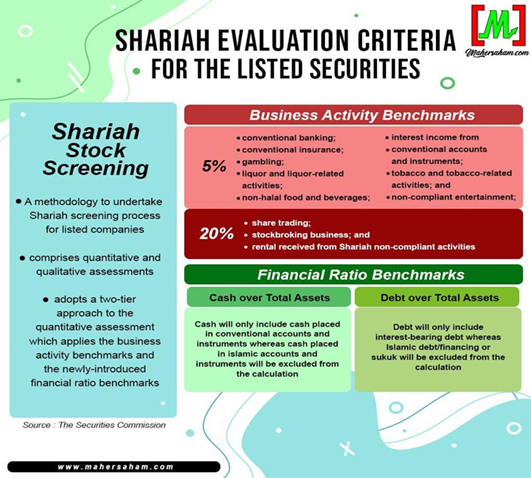
The Securities Commission (SC) Malaysia has outlined several benchmarks to determine whether a business activity qualifies as shariah-compliant. The contribution of non-shariah compliant activities to the Group's revenue and the Group's profit before tax of a company will be calculated and compared against the relevant business activity benchmarks as follows:
- Conventional insurance
- Gambling
- Alcohol and related activities
- Pork and related activities
- Non-halal food and beverages
- Non-shariah compliant entertainment
- Tobacco and related activities
- Interest income from conventional accounts and instruments
- Other activities deemed non-shariah compliant
- See more details at /blogs/saham-patuh-syariah/
Shariah Advisory Council of the Securities Commission
Baitulmal has also been listed by the Shariah Advisory Council of the Securities Commission in its resolution regarding the List of Shariah-Compliant Securities on 20th November 2008, which among other things stated:
i. "Shariah-compliant securities" that subsequently change status to "non-shariah compliant"
"... However, any excess capital gains obtained from the sale after the announcement date at a market price higher than the closing price on the announcement date, shall be channelled to charitable bodies or baitulmal".
ii. Shariah-compliant securities
"... Any gains in the form of capital gains or dividends obtained during or after the disposal of the said securities shall be channelled to charitable bodies or baitulmal. Investors are only entitled to recover the original purchase cost".
The classification of shariah-compliant investments (shariah-compliant securities) can be clearly seen through the List of Shariah-Compliant Securities issued by the Shariah Advisory Council, Securities Commission Malaysia (SC) dated 26th November 2010. Furthermore, the list also outlines how a security's level of permissibility and shariah compliance is measured. Not only that, the list also clearly states companies that have been excluded or do not comply with shariah principles.
In addition, the Shariah Advisory Council of the Securities Commission has also issued the List of Shariah-Compliant Securities on 25th November 2011 and the List of Launched Funds in Relation to Unit Trust Funds updated on 31st October 2011, which clearly state unit trust funds that are shariah-compliant and those that are not.
How to Purify Non-Shariah Compliant Money
National Fatwa Council / Federal Mufti
Through the decision of the 87th Fatwa Committee Muzakarah, the National Council for Islamic Affairs on 23-25 June 2009, it was stated that:
"After examining the evidence, arguments and views presented, the Muzakarah is of the opinion that in Islam, wealth obtained through means that do not comply with shariah such as usury (riba), uncertainty (gharar), gambling, fraud, robbery, seizure, bribery and the like, is haram and cannot be used for one's own benefit and interest, and must be purified through the following methods:
1. Handed over to baitulmal for the general welfare of Muslims such as funding the construction or maintenance of bridges, roads, toilets and the like;
2. Handed over to the poor and destitute; or
3. If the wealth is stolen property, robbed or the like, then the property must be returned to its owner. If the owner has passed away or cannot be found, then the property must be returned to the owner's heirs. If the owner or heirs cannot be identified, then the property shall be handed over to baitulmal".
Distribution of Non-Shariah Compliant Wealth to Baitulmal and Other Islamic Institutions (2009) (Number 34, pages 75, 76)
Frequently Asked Questions (FAQ)
How do you purify money that is non-shariah compliant?
Non-shariah compliant money can be purified by donating the haram profits to the poor and destitute, baitulmal, or Islamic charitable institutions. Only the portion of profit that is non-shariah compliant needs to be purified, not the entire capital.
Is it obligatory to purify dividends from non-shariah compliant stocks?
Yes, according to the majority of scholars, dividends received from non-shariah compliant stocks must be purified. Investors need to calculate the percentage of non-shariah compliant income and donate it accordingly.
How do you determine whether a stock is shariah-compliant or not?
The Securities Commission Malaysia releases a list of shariah-compliant stocks twice a year. Investors can check the latest list on the Securities Commission's website or through their stock trading platform.
Where should wealth purification funds be channelled?
According to the Muzakarah MKI, purification funds can be channelled to the poor and destitute, baitulmal, or used for public benefit such as infrastructure development. The money cannot be used for personal benefit.
Maintaining the purity of wealth is the responsibility of every Muslim investor. Ensure you always check the shariah compliance status of your investments.
Open your CDS account today through our step-by-step guide here to start investing in shariah-compliant stocks.
Download the free stock basics ebook to learn the fundamentals of stock investing from scratch.