Confirmation Bias in Stocks: Why You Only Read News That Agrees With You

You buy shares in Company A because you are convinced it will rise. So what do you do every day after that? You open the stock forums and hunt for threads praising the company. You follow the bullish social media accounts. When bad news breaks, you say "that's just noise" or "that analyst doesn't get it." When good news appears, you screenshot it and share it. Sounds like you're doing your research? You are actually trapped in confirmation bias - the tendency to only seek information that supports your existing beliefs, while rejecting any facts that contradict them.
Confirmation bias is one of the most dangerous psychological traps in investing because it disguises itself as "research." You feel like you're gathering evidence, when in reality you're only collecting the evidence that is comfortable to believe. This article explains what confirmation bias is, why the human brain so easily picks the news that agrees with it, how it shows up in stock investing on Bursa Malaysia, and most importantly, how to fight it before it wrecks your portfolio.
What Is Confirmation Bias?
Confirmation bias is the mind's tendency to search for, interpret, and remember information in a way that confirms existing beliefs or assumptions, while ignoring or downplaying contradictory evidence. According to Corporate Finance Institute, it occurs when a person becomes attached to a view and then filters all new information through the lens of that view, rather than evaluating the facts objectively.
In an investing context, this means you are not really searching for the truth about a stock. You are searching for confirmation that your decision was right. According to Investopedia, investors prone to confirmation bias tend to focus on information that supports their position and dismiss information that contradicts it - a pattern that can lead to high-risk decisions and an undiversified portfolio.
The difference from genuine research is intent. An honest researcher tries to disprove their own hypothesis. An investor under confirmation bias tries to confirm their belief. The first seeks the truth; the second seeks comfort.
Why Your Brain Only Reads News That Agrees With You
Confirmation bias is not a sign that you are lazy or unintelligent. It is a natural feature of how the human brain works to conserve energy and protect the ego. There are several reasons it is so powerful:
1. The brain hates contradiction (cognitive dissonance). When new facts conflict with our beliefs, the brain experiences mental discomfort called cognitive dissonance. The easiest way to relieve that discomfort is not to change the belief, but to reject the disruptive fact. It is easier to discard bad news than to admit our decision was wrong.
2. Ego and identity. Once you have declared on a forum or to friends that stock A "will definitely rise," the stock becomes part of your identity. Admitting it might be wrong is no longer about money - it becomes about pride. So the brain works hard to find evidence that protects your ego.
3. The brain loves shortcuts. Re-evaluating a stock objectively every time takes a lot of mental energy - reading financial reports, listening to opposing views, recalculating value. It is easier for the brain to simply accept information that aligns with what it already believes. It is a lazy but comfortable shortcut.
The combination of these three factors makes confirmation bias extremely stubborn. It is not merely a thinking error - it is an emotional defense mechanism. No wonder it is listed as one of the 7 mental biases that most often cost investors money on Bursa Malaysia.
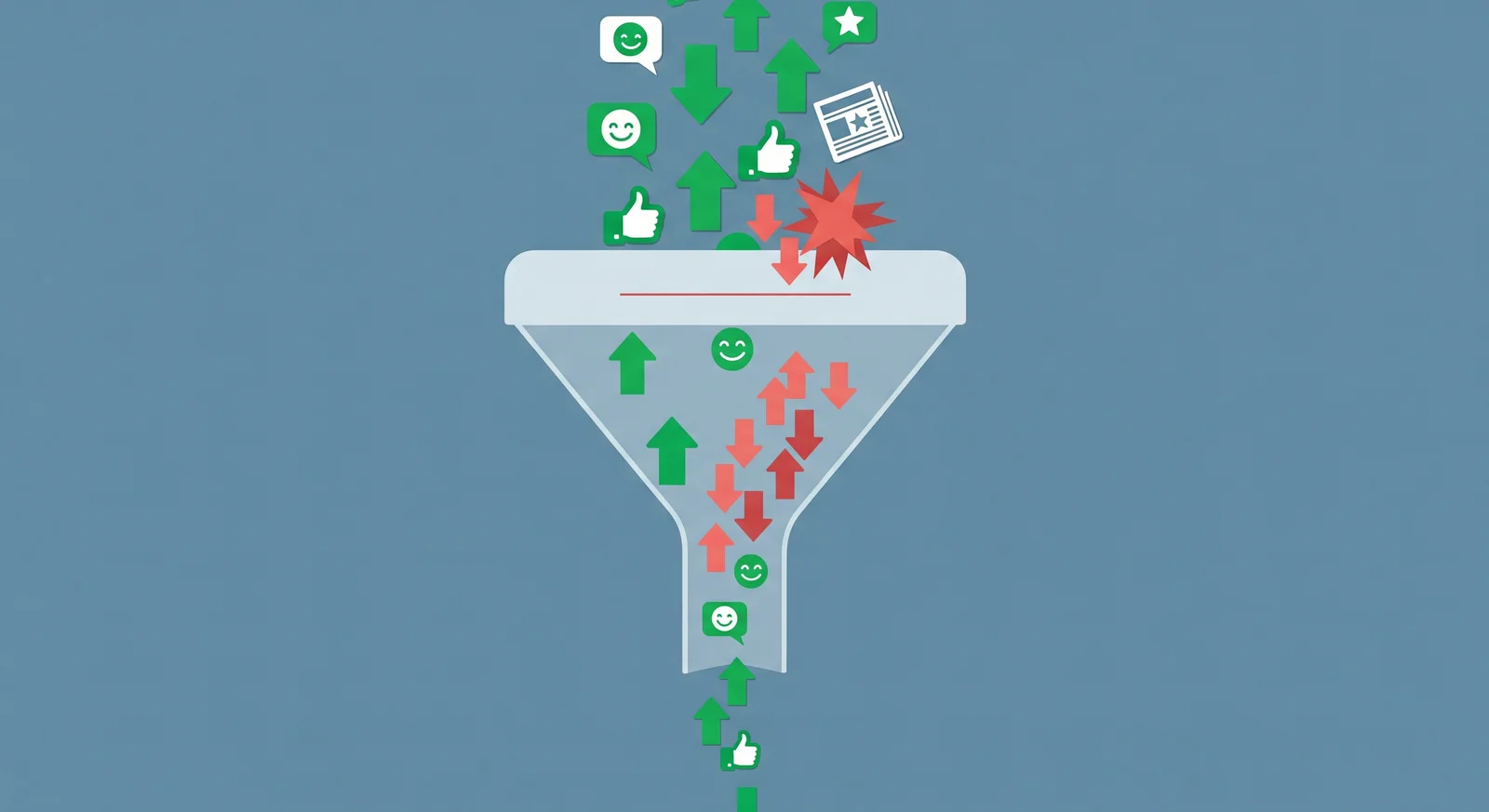
6 Forms of Confirmation Bias in Stock Investing
Confirmation bias disguises itself in many forms. Recognise these six so you can catch yourself when you fall into the trap:
1. Reading only bullish threads and comments
After buying a stock, you only open the positive forum threads about the company. You skip the bearish comments, or you reply to them angrily. You are effectively building an echo chamber where only voices that agree with you get heard.
2. Following only those who agree
You follow the stock influencers, X (Twitter) accounts, or YouTube channels that constantly promote the stock you hold. An analyst who downgrades the stock is dismissed as "clueless" or "having an agenda." The information you receive becomes automatically one-sided.
3. Interpreting news selectively
The same news can be read two ways. When a company reports lower profit, a bullish investor says "this is temporary, the fundamentals are still solid." When profit ticks up slightly, they say "this proves the company is great." The brain picks the interpretation that supports it, not the most accurate one.
4. Remembering the hits, forgetting the misses
You clearly remember the time your favourite analyst was right, but forget the dozen times they were wrong. Human memory is also biased - we recall evidence that supports our beliefs and forget what contradicts them. This reinforces a confidence that is actually baseless.
5. Looking for evidence after the decision
The most dangerous one: you buy first on a hunch, then look for research to justify it. This is the reverse of the proper process. Research should come before the decision, not become a tool to confirm a decision already made emotionally.
6. Ignoring obvious red flags
Rising company debt, insiders selling shares, a qualified audit opinion - all these warning signs get brushed aside because they do not align with your belief that the stock is good. You see the evidence, but the brain refuses to let it in.
The Echo Chamber: How Social Media Makes It Worse
Confirmation bias is nothing new, but the social media era makes it far more dangerous. Algorithms on platforms like X, Facebook, and YouTube are designed to show you what you like to see. The more you read and like bullish content about a stock, the more similar content the algorithm feeds you. The result is a digital echo chamber where everyone appears to agree - but that is just an illusion created by the algorithm.
A classic example happened during the COVID-19 pandemic. According to analysis by the CFA Institute, from April to October 2020 financial media and investment newsletters only talked about "pandemic winner" stocks like Peloton and Zoom - playing up the positives while ignoring any risks. Investors already holding these stocks were continuously surrounded by supporting stories, so many got stuck when prices eventually crashed.
In Malaysia, this phenomenon is alive in Telegram "stock tip" groups and Bursa threads on social media. When a stock goes viral, thousands of investors pile in on the same hype, each reinforcing the others' conviction. This is exactly why the skill of separating important news from noise is so critical - without a filter, confirmation bias will pick the noise that pleases you.
The Scientific Evidence: What the Research Says
Confirmation bias is not just theory - it has been documented in dozens of psychology and behavioural finance studies.
Malaysian retail investors are no exception. A study titled "Behavioural finance perspectives on Malaysian stock market efficiency" confirms that local investors display bounded rationality - their decisions are influenced by reference to past performance, attention to extreme price moves, and a tendency to pay selective attention to only certain information. This pattern is consistent with the effects of confirmation bias.
Professionals rank it highly themselves. In a CFA Institute survey, confirmation bias was listed among the most influential biases on investment decisions - not just a beginner's problem, but one that affects experienced professionals who should know better.
It hurts diversification. When investors only seek information that supports their favourite stock, they tend to over-allocate to a single idea or sector. This raises concentration risk - the portfolio looks convincing, but it is actually fragile because it is built on a single narrative that was never critically tested.
A Real Scenario on Bursa Malaysia
Imagine Mrs. Siti buys shares in a glove company at RM5.00 while the sector is hot. She is convinced it will keep rising. After buying, several things happen in her mind:
- Source selection: She joins three Telegram groups that are all bullish on gloves. Every morning she reads "target RM8.00!" messages and feels reassured.
- Selective interpretation: When news breaks that glove selling prices are falling, she says "this is temporary, demand is still high." When one quarter shows a profit bump, she says "see? I was right."
- Ignoring red flags: Reports show shrinking profit margins and overcapacity in the industry, but she skips that part because it does not align with her belief.
A year later, the price is at RM1.50. Mrs. Siti is still in the same Telegram group, still reading reasons why "the recovery is coming." Confirmation bias has blinded her to one crucial question: What evidence would convince me that I am wrong? If you cannot answer that question, you are not investing - you are defending your ego.
Confirmation Bias + Other Biases: A Dangerous Combination
Confirmation bias rarely acts alone. It amplifies other biases in a vicious cycle. It pairs with anchoring bias - after clinging to your original purchase price, you only look for news that supports the hope the stock will "get back to break-even." It also fuels the sunk cost fallacy - the more money already committed, the harder you look for justifications to keep averaging down a dead stock.
The combined result is an investor who is very confident but very wrong. Confidence built on selective evidence is more dangerous than doubt, because it stops you from acting when the facts have clearly changed. This is why so many investors "lose with full confidence" - they never lacked evidence, just the wrong kind of evidence.
How to Detect and Beat Confirmation Bias
The good news is that confirmation bias can be fought with discipline and systems. Here are seven practical strategies:
1. Deliberately seek opposing views. Before buying, force yourself to find three strong reasons the stock might FALL. If you cannot find any risk, that is a sign you have not done proper research - not a sign the stock is perfect.
2. Write down your investment thesis and its kill criteria. Note why you are buying and what specific facts would prove you wrong (e.g. "if margins fall below 10%, I sell"). When that condition is met, sell - without inventing new excuses.
3. Run a "pre-mortem." Imagine a year from now the stock has fallen 50%. Ask: what caused it? This exercise forces the brain to confront the risks it usually rejects.
4. Diversify your information sources. Do not only follow bullish accounts or groups. Follow sceptical analysts, read critical reports. Break the echo chamber before it traps you.
5. Separate your ego from the stock. Your stock is not you. Admitting you were wrong on one stock does not make you a bad investor - on the contrary, it shows maturity. The best investors are wrong often, but they admit it and correct it fast.
6. Find the facts before the decision, not after. Do full research first, then decide. If you find yourself hunting for "evidence" after you have already bought, stop - that is justification, not analysis.
7. Be aware and acknowledge the bias exists. Studies show that awareness alone already reduces a bias's effect. Understanding your own psychology is half the solution - we cover the rest in 13 emotional traps that can destroy your portfolio.
Frequently Asked Questions (FAQ)
What does confirmation bias mean in stocks?
Confirmation bias in stocks is an investor's tendency to only seek, believe, and remember information that supports their existing belief about a stock, while ignoring contradictory facts. As a result, decisions are based on selective evidence rather than the full picture.
What is the difference between real research and confirmation bias?
Real research tries to test and disprove your own assumptions - you actively seek opposing views. Confirmation bias tries to confirm an existing assumption - you only collect evidence that pleases you. The intent differs: one seeks truth, the other seeks comfort.
How do I know if I have confirmation bias?
Clear signs: you feel angry when people criticise your stock, you skip bad news about your holdings, you only follow sources that agree with you, and you cannot list what would prove you wrong. If this happens, you are filtering information, not evaluating it.
Does social media make confirmation bias worse?
Yes. Social media algorithms feed you content you like to see, so the more bullish content you read about a stock, the more is shown to you. This creates an echo chamber where everyone appears to agree, when it is just an algorithmic illusion.
Do professional investors also suffer from confirmation bias?
Yes. Surveys among finance professionals show confirmation bias is among the most influential biases, even among the experienced. Nobody is fully immune; what sets people apart is the system and discipline to fight it consciously.
How can I fight confirmation bias quickly?
The fastest way: before making any decision, force yourself to write three reasons you might be wrong. This simple exercise makes the brain confront contradicting evidence it usually rejects automatically.
Does confirmation bias only affect bullish investors?
No. It works both ways. An investor convinced a stock will fall will also only seek bad news about the company, ignoring signs of recovery. Confirmation bias supports any existing belief, whether positive or negative.
Conclusion
Confirmation bias is the sneakiest psychological trap because it disguises itself as hard work. You feel like you're doing research, when in reality you're just collecting comfortable evidence. The key to fighting it is to reverse the process: deliberately seek opposing views, write down the conditions that would prove you wrong, and separate your ego from the stocks you hold.
Understanding your own psychology is the least-taught yet most important investing skill. The next step is to practise it with the right investment account.
To start investing on Bursa Malaysia as well as overseas stocks such as the US and Hong Kong, you can open a CDS account with Mahersaham and start building a portfolio with discipline and an open mind.
If you are just starting out, download the free stock market basics ebook to understand the key concepts before investing real money.
Further Reading
- Investor Psychology: 7 Mental Biases That Make You Lose Money on Bursa Malaysia
- Anchoring Bias in Stocks: Why Your Brain Clings to the Original Buy Price
- Sunk Cost Fallacy: Why Investors Keep Averaging Down Dead Stocks
- How to Filter News vs Noise: A 3-Tier Framework for Bursa Malaysia Investors
- Investment Psychology: 13 Emotional Traps That Can Destroy Your Portfolio