Investor Psychology: 7 Mental Biases That Make You Lose Money on Bursa Malaysia

You can read 100 books on fundamental analysis, memorise every financial ratio, and understand every chart pattern - yet still lose money on Bursa Malaysia. Why? Because an investor's biggest enemy is not the market, but their own brain.
The field of behavioral finance, pioneered by psychologists Daniel Kahneman and Amos Tversky, has proven an important truth: humans are not rational investors. Our brains come equipped with cognitive biases - mental shortcuts that helped our ancestors survive in the wild, but cause major losses in modern investing.
This article differs from typical investment emotion discussions. We focus on 7 specific cognitive biases - with their technical names, scientific basis, and most importantly: how to counter each one. If you want to read about broader emotional traps, refer to Stock Investment Psychology: 13 Emotional Traps That Can Destroy Your Portfolio.
In this article, you'll learn:
- 7 mental biases that most frequently cause Bursa Malaysia investors to lose money
- The scientific basis of each bias (prospect theory, heuristics, etc.)
- Concrete examples of how each bias appears in real trading
- Practical strategies to counter each bias
- A system to protect yourself from your own brain
Bias 1: Loss Aversion
This is the most powerful bias, and the most destructive. Loss aversion is the key finding from Kahneman & Tversky's Prospect Theory (1979) - the research that won the Nobel Prize in Economics.
The finding: the pain of losing RM1,000 is felt about 2 times more strongly than the joy of gaining RM1,000. The human brain does not treat gains and losses symmetrically.
How It Makes You Lose
When your stock falls, loss aversion makes you reluctant to sell because selling means "admitting a loss." You hold the stock as it continues to plunge, hoping it will "break even" - and eventually a RM1,000 loss becomes RM5,000.
At the same time, loss aversion makes you sell winning stocks too early - you want to "lock in" small gains before they disappear, even though that stock still has plenty of upside.
How to Counter It
- Set a stop loss BEFORE buying - the exit decision is made while you're rational, not while panicking. Read Stop Loss & Position Sizing: How to Protect Your Capital Before Buying Stocks
- Think in portfolio percentages, not individual ringgit. "I lost 1% of portfolio" is easier to accept than "I lost RM2,000"
- Ask: If I didn't own this stock right now, would I buy it at this price? If not, sell
Bias 2: Anchoring Bias
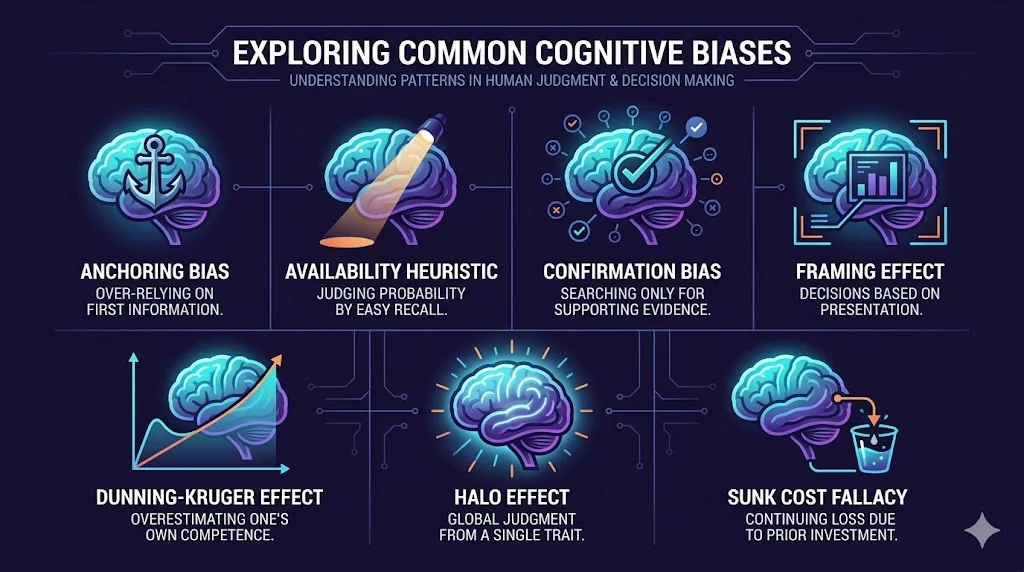
Anchoring is the tendency to rely too heavily on a single reference point - usually the first number we see - when making decisions.
How It Makes You Lose
You buy a stock at RM3.00. Now it trades at RM2.00. Your brain is "anchored" to RM3.00 as the stock's "true price." You think, "RM2.00 is cheap, since it used to be RM3.00." But RM3.00 is irrelevant - what matters is the company's fundamental value today.
Anchoring also appears when investors refuse to buy a stock that has risen high ("used to be RM1.00, now RM5.00, too expensive") even though fundamentals support an even higher price.
How to Counter It
- Your purchase price is irrelevant to the market - the market doesn't know and doesn't care what you paid
- Value stocks based on current fundamentals (PE, growth, dividend yield), not historical prices
- When evaluating a stock, hide your purchase price and ask: based on today's data alone, is this a buy or sell?
Bias 3: Confirmation Bias
Confirmation bias is the tendency to seek, interpret, and remember information that confirms our existing beliefs - and ignore contradicting evidence.
How It Makes You Lose
After buying a stock, you become its "defence lawyer." You only read positive news about it, join Telegram groups that are all bullish, and ignore red flags - weak financial reports, rising debt, or insider selling.
Confirmation bias makes investors blind to a broken investment thesis. You keep holding because you only see evidence supporting your original decision.
How to Counter It
- Actively seek the opposing thesis - before buying, ask "What could make this stock fall?"
- Follow bearish analysis of your stock, not just bullish
- Keep an investment journal - record your original thesis, then objectively review whether it still holds
- Engage in discussions with investors who disagree with you
Bias 4: Recency Bias
Recency bias is the tendency to give more weight to recent events than long-term historical data.
How It Makes You Lose
After the market rises for 6 consecutive months, recency bias makes you think "the market will keep rising" - so you enter with large capital at the peak. After the market crashes badly, you think "the market will keep falling" - so you sell everything at the lowest point.
This is why many retail investors buy high, sell low - the opposite of what they should do. They react to the recent trend, not fundamental value.
How to Counter It
- Look at long-term data (10-20 years) - markets move in cycles, not straight lines
- Understand that after a big rise there's usually a correction, and after a big crash there's usually a recovery
- Use dollar cost averaging - investing a fixed amount periodically reduces the effect of recency bias
- When everyone is euphoric, be cautious. When everyone is fearful, look for opportunities
Bias 5: Herd Mentality (FOMO)
Herd mentality is the tendency to follow the crowd's actions rather than make independent analysis. It often appears as FOMO (Fear of Missing Out).
How It Makes You Lose
A stock goes viral in WhatsApp groups and TikTok. Everyone says "up 200%, don't miss out!" FOMO takes over - you buy without due diligence, without understanding the company's fundamentals, purely out of fear of missing out.
The problem: once a stock is already viral, the price has already risen high. You are usually the last buyer before operators or early investors start selling. Herd mentality makes you exit liquidity for others.
How to Counter It
- If a stock is already the talk of the crowd, you're already late - most of the rise has occurred
- Do your own homework - don't buy a stock whose business model you can't explain in 2 sentences
- FOMO is a danger sign, not an opportunity sign
- Remember: the stock market isn't a popularity contest. Boring stocks are often more profitable than viral stocks
Bias 6: Overconfidence Bias
Overconfidence bias occurs when investors overestimate their own abilities - analytical skills, access to information, and forecasting accuracy.
How It Makes You Lose
After a few successful trades, you think you've "got it figured out." Overconfidence causes:
- Over-trading - buying/selling too frequently, transaction costs eat into profits
- Positions too large - putting 50% of portfolio in one stock because you're "so confident"
- Ignoring risk management - not setting a stop loss because "I know this stock will rise"
- Not diversifying - because you're sure your own picks are right
Behavioral finance studies show that overconfident traders trade more frequently and earn lower returns than humble passive investors.
How to Counter It
- Track ALL your trades - including the losing ones. The brain likes to remember wins, forget losses
- Acknowledge the role of luck - a few successful trades don't mean you're skilled
- Stick to position sizing rules even when you're confident (refer to position sizing)
- The most successful investors are usually the most humble about what they don't know
Bias 7: Disposition Effect
The disposition effect is a combination of several biases - the tendency to sell winning stocks too early, and hold losing stocks too long.
How It Makes You Lose
This is loss aversion playing out in a real portfolio:
- Your Stock A is up 15% - you quickly sell to "lock in profit"
- Your Stock B is down 15% - you hold, hoping it will "recover" so you don't have to admit a loss
The result: you cut the flowers, water the weeds. Your portfolio becomes a collection of plunging stocks (which you refuse to sell), while your best stocks (which you should have held) were sold early.
A classic study by Terrance Odean (1998) on real broker accounts proved this disposition effect is widespread - and the stocks sold early kept rising, while the stocks held kept falling.
How to Counter It
- Let winners run, cut losers - the opposite of your natural instinct
- Use a trailing stop on winning stocks - let it rise, but protect the gains
- Set selling rules based on thesis, not on purchase price. Sell when the thesis breaks, not when you're slightly in profit
- Review your portfolio: if you had to choose, would you add to the stock that's up or the one that's down? That answer reveals which stock you should sell
A System to Protect Yourself from Your Own Brain
Recognising these 7 biases alone is not enough - because cognitive biases operate subconsciously. You need a system that forces discipline:
1. Write an Investment Thesis Before Buying
Before pressing Buy, write 3-5 sentences: why you're buying, what you expect, and what would invalidate this thesis. This counters confirmation bias and anchoring.
2. Pre-Set Stop Loss & Take Profit
Make the exit decision while you're rational and have no money at risk. This counters loss aversion and the disposition effect.
3. Trading Journal
Record every trade - thesis, emotion at time of buying, outcome. Review monthly. This counters overconfidence (you'll see your real pattern of mistakes).
4. Pre-Buy Checklist
Build a checklist of 5-10 questions that MUST be answered before any purchase. A checklist forces a systematic process, countering herd mentality and FOMO.
5. Cooling-Off Period
When you feel "I must buy now!" - that's a sign of FOMO. Wait 24 hours. If after 24 hours it still makes sense, then buy. Most FOMO buys lose their power after a night's sleep.
Frequently Asked Questions (FAQ)
What is behavioral finance?
Behavioral finance is a field that combines psychology with economics to understand how humans make financial decisions. It proves that investors aren't fully rational - we're influenced by systematic cognitive biases. Pioneered by Daniel Kahneman and Amos Tversky.
Which cognitive bias is most dangerous for investors?
Loss aversion is usually considered the most destructive because it causes investors to hold losing stocks too long and sell winning stocks too early - a combination that destroys long-term returns. It also forms the basis of the disposition effect.
Can I eliminate cognitive biases entirely?
No. Cognitive biases are part of how the human brain works - they cannot be "deleted." What you can do is build systems and processes (stop loss, checklist, journal) that force discipline even though biases still exist subconsciously.
Are professional investors also exposed to these biases?
Yes, although less so. Professional fund managers are exposed to herd mentality, overconfidence, and confirmation bias too. What distinguishes them is they have strict systems, processes, and accountability to control bias effects - not because they're immune.
What's the difference between cognitive bias and emotion in investing?
Cognitive bias is a systematic error in the way of thinking (e.g., anchoring on an old price). Emotion is a feeling (fear, greed) that influences decisions. The two are linked - emotions often trigger biases. This article focuses on cognitive biases; for broader emotional traps, read the related article in Further Reading.
How do I know if I'm being influenced by bias?
Common signs: you refuse to sell losing stocks ("wait to break even"), you only read positive news about your stock, you feel "I must buy now" without analysis, or you trade more frequently after a few wins. A trading journal helps you detect these patterns objectively.
Do index funds or ETFs protect against bias?
Partly, yes. Investing in index ETFs via dollar cost averaging reduces the chance for individual biases (anchoring, overconfidence in stock picking) to damage your portfolio. But you can still fall for recency bias and herd mentality - e.g., selling all ETFs during a market panic.
How long does it take to overcome mental biases in investing?
There's no fixed timeline - it's a lifelong ongoing process. But building systems (checklist, journal, pre-set rules) can start today. After 6-12 months of using a trading journal, most investors begin to see their own pattern of mistakes and can start improving.
Conclusion
You cannot erase cognitive biases - they are part of the human brain's hardware. But you can build systems that force discipline: a written investment thesis, pre-set stop loss, trading journal, checklist, and cooling-off period. Successful investors aren't the smartest - they are the ones most aware of their own cognitive weaknesses and most disciplined in countering them.
The first step is awareness. The second is a system. The third is consistent execution - and that requires an investment platform that lets you set rules automatically.
To start investing with systematic discipline, you need a trading account that supports stop limit orders and broad market access.
A CDS account lets you invest in Bursa Malaysia stocks and overseas markets like US and Hong Kong, with tools that help you execute investment discipline - open your CDS account here.
For stock investing fundamentals including how to build a bias-resistant investment process, download the free Stock Market Basics Ebook.
Further Reading
- Stock Investment Psychology: 13 Emotional Traps That Can Destroy Your Portfolio
- Stop Loss & Position Sizing: How to Protect Your Capital Before Buying Stocks
- Learning From The Man Who Broke the Bank of England: Why Position Sizing Is 80% of Your Trading Strategy
- Introduction to Risk Management in Stocks
- Trader Psychology: The Secret Weapon Intraday Traders Often Overlook