The Bursa Investor's Economic Calendar: Key News Dates to Mark Every Month

Most Bursa Malaysia investors react to news reactively - they're caught off guard when the market moves sharply after an announcement, even though that announcement was actually scheduled months in advance. Bank Negara's OPR decision, inflation data, GDP, earnings season, Federal Reserve meetings - all of these happen on a fixed, predictable schedule.
Experienced investors aren't surprised. They have an economic calendar - a list of key news dates marked in advance, so they can prepare rather than panic.
This article is the complete master list for Bursa Malaysia investors: a list of recurring economic dates and events you should mark every month, complete with an explanation of what to watch for each one.
In this article, you'll get:
- Why an economic calendar matters for Bursa Malaysia investors
- OPR / Bank Negara MPC Meetings - 6 dates a year
- CPI (Inflation) - monthly DOSM release
- GDP - quarterly release
- Quarterly Results (QR) Season - submission deadlines
- FOMC - Federal Reserve meetings and why they're relevant
- Other dates to mark - National Budget, MPOB, US data
- How to build and use your own economic calendar
Why an Economic Calendar Matters
The stock market moves most strongly around scheduled events - not because the news is surprising, but because it creates a point where investors simultaneously reassess their expectations.
The advantages of having an economic calendar:
- Prepared, not surprised - you know when volatility is likely to rise
- Avoid bad timing - you won't open a large position the day before an OPR decision without realising it
- Context for price movements - when the market moves, you know whether there's a fundamental reason or it's just noise
- Emotional discipline - knowing planned events reduces panic reactions
Important to understand: having a calendar does not mean you need to trade every event. It means you're aware and can distinguish signal from noise - a concept discussed in How to Filter News vs Noise: A 3-Tier Framework for Bursa Malaysia Investors.
1. OPR / Bank Negara Malaysia MPC Meetings
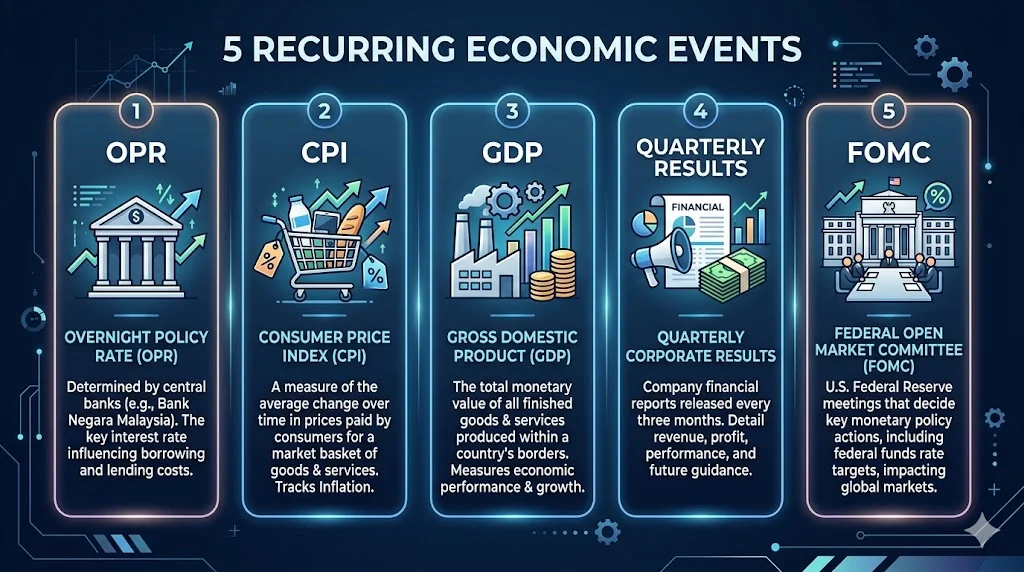
What: Bank Negara Malaysia's Monetary Policy Committee (MPC) meets to set the Overnight Policy Rate (OPR) - the benchmark interest rate that influences borrowing costs across the economy.
Frequency: 6 times a year (not every month).
2026 Schedule: According to Bank Negara Malaysia, the 2026 MPC meetings are scheduled for 22 January, 5 March, 7 May, 9 July, 3 September, and 5 November. The Monetary Policy Statement is released at 3:00 PM after each meeting.
What to watch:
- Whether the OPR is raised, cut, or held (as of May 2026, OPR is at 2.75%)
- The tone of the statement - "hawkish" (leaning toward hikes) or "dovish" (leaning toward cuts)
- Forward guidance on policy direction
Why it matters: The OPR influences bank lending costs, the profit margins of indebted companies, and the attractiveness of dividend stocks versus fixed deposits. To understand the full mechanism, read OPR Decisions: Impact on the Economy & Malaysian Stock Market.
2. CPI - Consumer Price Index (Inflation Data)
What: The Consumer Price Index (CPI) measures the inflation rate - how fast the prices of goods and services are rising.
Frequency: Monthly - released by the Department of Statistics Malaysia (DOSM).
Schedule: DOSM releases CPI data around mid-month for the previous month's data. Example: April's CPI data is released around mid-May. Data is available at OpenDOSM.
What to watch:
- The headline inflation rate vs core inflation
- Whether inflation is rising, stable, or falling versus the previous month
- Compare with the consensus expectation
Why it matters: Inflation is a key determinant of OPR decisions. High inflation tends to lead to higher interest rates. To understand the difference between headline and core, refer to Core Inflation vs Headline Inflation: Which Should Investors Follow? and the basics in What Is Inflation?.
3. GDP - Gross Domestic Product
What: GDP measures the total value of all goods and services produced in the economy - an indicator of overall economic health.
Frequency: Quarterly (4 times a year) - released by DOSM.
Schedule: DOSM usually releases an advance estimate about 6 weeks after the quarter ends, and the full figure around mid-month of the second month after the quarter ends. Example: first-quarter GDP (Jan-Mar) is released around mid-May.
What to watch:
- The year-on-year GDP growth rate (as of May 2026, Q1 2026 GDP grew 5.4%)
- Which sectors drove or dragged growth
- Compare with expectations and the previous quarter
Why it matters: GDP shapes the overall macroeconomic context. Strong growth supports market sentiment; weak growth brings concerns. For the basics, read What Is GDP?.
4. Quarterly Results (QR) Season
What: Every company listed on Bursa Malaysia must announce its quarterly financial results - this is the most important news for the individual stocks you hold.
Frequency: Quarterly for each company - but since thousands of companies are listed, QR season happens 4 times a year in waves.
Schedule / deadlines: According to Bursa Malaysia rules, companies must announce quarterly results no later than 2 months after the end of each financial quarter. This means:
- Q1 (Jan-Mar) → deadline end of May
- Q2 (Apr-Jun) → deadline end of August
- Q3 (Jul-Sep) → deadline end of November
- Q4 (Oct-Dec) → deadline end of February
So February, May, August, and November are the peak of earnings season - the most companies announcing.
What to watch:
- Revenue and profit vs the previous quarter and previous year
- Profit margins - rising or compressed
- Declared dividends
- Management's outlook statement
Why it matters: This is the real Tier 1 signal for individual stocks - quarterly results materially change a company's fundamental value. To learn to read financial reports, refer to How to Read a Bursa Malaysia Annual Report Without a Headache.
5. FOMC - Federal Reserve Meetings (United States)
What: The US Federal Reserve's Federal Open Market Committee (FOMC) sets US interest rates - a decision that moves financial markets worldwide, including Bursa Malaysia.
Frequency: 8 times a year.
2026 Schedule: According to the Federal Reserve, the 2026 FOMC meetings are on 27-28 January, 17-18 March, 28-29 April, 16-17 June, 28-29 July, 15-16 September, 27-28 October, and 8-9 December.
What to watch:
- The US interest rate decision
- The "dot plot" - FOMC members' projections of future rates
- The tone of the Fed Chair's press conference
Why it matters for Bursa Malaysia investors?: US interest rates influence global capital flows. When the Fed raises rates, foreign funds tend to flow out of emerging markets (including Malaysia) into US assets - pressuring the ringgit and the KLCI. When the Fed cuts rates, the opposite can happen. FOMC is the most powerful Tier 2 (context) event for Malaysian investors.
6. Other Dates to Mark
Beyond the five main events above, several additional dates are worth watching:
Malaysia's National Budget
Tabled around October each year. The Budget reveals the government's fiscal policy - sector incentives, taxes, development spending. Certain sectors often rally ahead of the Budget.
MPOB (Malaysian Palm Oil Board) Data
Released monthly around the 10th-12th - stock, production, and export data for palm oil. Important if you invest in plantation stocks.
US Economic Data (NFP & US CPI)
- Non-Farm Payrolls (NFP): US employment data, released the first Friday of each month
- US CPI: US inflation data, released around mid-month Both move Fed policy expectations and can affect global sentiment.
Dividend Announcements & Corporate Actions
Not on a fixed schedule, but individual companies announce dividends, bonus issues, rights issues, and corporate actions throughout the year. Follow the companies in your portfolio via official Bursa announcements.
How to Build & Use Your Economic Calendar
Step 1: Create an Annual Calendar
At the start of each year, mark the fixed dates in your digital calendar:
- 6 Bank Negara MPC dates
- 8 FOMC dates
- Estimated monthly CPI release dates and quarterly GDP
- Peak QR season periods (Feb, May, Aug, Nov)
Step 2: Review Weekly
Every weekend, look ahead: are there important events next week? If so, you can prepare - perhaps avoid opening large new positions before an OPR or FOMC decision.
Step 3: Don't Trade Every Event
This is the important part. Having a calendar is not an invitation to trade every event. For long-term investors, most of these events are just context - to be understood, not traded. The calendar helps you avoid being surprised, not to become a hyperactive trader.
Step 4: Use Official Sources
For accurate dates and data, always refer to primary sources: the Bank Negara Malaysia website for MPC, OpenDOSM for CPI/GDP, the Federal Reserve website for FOMC, and Bursa Malaysia announcements for company results. Avoid relying on secondhand interpretation.
Step 5: Focus on QR for Your Stocks
Of all the events, the quarterly results of the companies you hold are the most directly important. Mark when your companies usually announce results, and pay full attention on those dates.
Frequently Asked Questions (FAQ)
What is an economic calendar for stock investors?
An economic calendar is a list of scheduled economic event dates that can move the market - interest rate decisions, inflation data, GDP, earnings season, and foreign central bank meetings. Investors use it to prepare for volatility and avoid being surprised.
How often does Bank Negara Malaysia meet to set the OPR?
6 times a year. For 2026, MPC meetings are scheduled for 22 January, 5 March, 7 May, 9 July, 3 September, and 5 November. The Monetary Policy Statement is released at 3:00 PM after each meeting.
When is earnings (QR) season on Bursa Malaysia?
Listed companies must announce quarterly results within 2 months after the quarter ends. So peak QR season occurs in February (for Q4), May (Q1), August (Q2), and November (Q3) - these months see the most companies announcing results.
Why are US Federal Reserve meetings important for Malaysian investors?
US interest rates influence global capital flows. When the Fed raises rates, foreign funds tend to flow out of emerging markets like Malaysia into US assets, pressuring the ringgit and the KLCI. The FOMC meets 8 times a year and its decisions move markets worldwide.
When is Malaysia's inflation (CPI) data released?
DOSM releases CPI data monthly, usually around mid-month for the previous month's data. For example, April's CPI data is released around mid-May. Data can be accessed on the OpenDOSM portal.
Should I trade every time there's an economic announcement?
No. Having an economic calendar doesn't mean you need to trade every event. For long-term investors, most of these events are just context - to be understood, not traded. The calendar helps you prepare and avoid being surprised, not to become a hyperactive trader.
Which event is most important for my individual stocks?
The quarterly results (QR) of the companies you hold are the most directly important - they materially change a company's fundamental value. Macro data like OPR and GDP is the overall context, but QR is the specific signal for your stocks.
Where can I get the exact dates of these economic events?
Use official sources: the Bank Negara Malaysia website (MPC schedule), OpenDOSM (CPI and GDP), the Federal Reserve website (FOMC schedule), and official Bursa Malaysia announcements (company results). Avoid relying on secondhand interpretation for dates and data.
Conclusion
Successful investors aren't the best at predicting - they're the best prepared. An economic calendar transforms you from a reactive investor surprised every time the market moves, into a proactive investor who knows when volatility is likely to come and can distinguish signal from noise.
Mark the 6 MPC dates, 8 FOMC dates, monthly CPI releases, quarterly GDP, and the peak of QR season. But remember - the calendar is for awareness, not an invitation to over-trade. For long-term investors, the main focus remains the quarterly results of the companies you hold.
To start investing on Bursa Malaysia with a prepared and disciplined approach, you'll need a suitable trading account.
A CDS account lets you invest in Bursa Malaysia and overseas markets like US and Hong Kong, giving you access to build a solid portfolio across multiple economic cycles - open your CDS account here.
For the basics of understanding economic indicators and how they affect your stock investments, download the free Stock Market Basics Ebook.
Further Reading
- How to Filter News vs Noise: A 3-Tier Framework for Bursa Malaysia Investors
- OPR Decisions: Impact on the Economy & Malaysian Stock Market
- Core Inflation vs Headline Inflation: Which Should Investors Follow?
- What Is GDP? Calculation, Facts & Malaysia's Global Standing
- How to Read a Bursa Malaysia Annual Report Without a Headache