US Investigates Malaysia Over Excess Electronics & Steel Capacity: What It Means for Investors

The United States has officially launched a Section 301 investigation against Malaysia under the Trade Act of 1974. The allegation? Malaysia is said to have excess production capacity in electronics, machinery, and steel sectors - flooding the US market with cheap goods and hurting American domestic industries.
This move comes at an extremely sensitive time - just weeks after Malaysia cancelled its trade deal with the Trump administration, and after the US Supreme Court struck down IEEPA tariffs. What is happening, and what does it mean for investors on Bursa Malaysia?
What Is a Section 301 Investigation?
Section 301 is a US trade law that empowers the US Trade Representative (USTR) to investigate and take action against foreign trade practices deemed unfair. This includes government subsidies, excess production capacity, and practices that harm American industries.
The investigation was launched on March 11, 2026 by USTR Jamieson Greer, involving 16 countries including Malaysia, China, the European Union, Singapore, Japan, South Korea, and others.
According to the USTR statement: "Many US trading partners have abandoned market-based policies and produce more goods than they can consume domestically. The result is excess exports that displace US domestic production."
Why Is Malaysia Being Targeted?
1. Excess Steel Production
According to data cited in the USTR investigation, Malaysia's steel production capacity increased 22% between 2018 and 2022, even though domestic demand fell 25% during the same period. This means Malaysia was producing far more steel than needed, with the excess being exported.
2. Electronics & Machinery Exports
Malaysia is Southeast Asia's largest semiconductor and electronics manufacturing hub. The country has a trade surplus of USD16 billion with the US, driven primarily by electronics and machinery exports.
3. Forced Labour Concerns
Beyond excess capacity, the investigation also touches on allegations of forced labour in the manufacturing sector - an issue that has long plagued Malaysia, particularly in the glove and electronics industries.
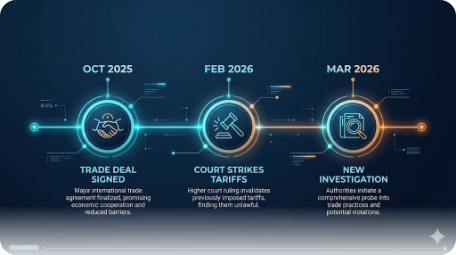
Full Timeline: From the Trump-Anwar Deal to the New Investigation
To understand the full context, we need to look at the chronology of events over the past 6 months:
October 2025: Trump Visits Malaysia, Signs Trade Deal
President Trump visited Malaysia and signed a reciprocal trade agreement with PM Anwar Ibrahim. Malaysia secured a tariff rate of 19% - lower than the original 25% rate - but with conditions:
- Purchase of US LNG worth USD3.4 billion annually through Petronas
- Purchase of US coal worth USD42.6 million annually
- Order of 30 Boeing aircraft with options for 30 more
- Purchase of US semiconductors, aerospace components, and data centre equipment worth USD150 billion
- Granting US access to critical minerals
The deal was controversial, with some arguing Malaysia gave away too many concessions, including claims that US firms were given Bumiputera status under the agreement.
February 2026: US Supreme Court Strikes Down Tariffs
On February 20, 2026, the US Supreme Court ruled that Trump's reciprocal tariffs under IEEPA were unconstitutional. This changed the entire landscape because the tariff basis that served as leverage for the bilateral deal had collapsed.
Pressure mounted on PM Anwar to cancel the deal signed with Trump, since the tariff basis that justified the agreement was no longer valid.
March 2026: Malaysia Cancels Deal + US Launches New Investigation
On March 15, 2026, International Trade Minister Johari Ghani confirmed the Malaysia-US trade deal had been cancelled. Just 4 days earlier (March 11), the US had already launched the Section 301 investigation against Malaysia.
The question is: Was this investigation retaliation for Malaysia cancelling the deal? Or was it already planned? The answer likely lies somewhere in between.
What Trade Actions Could Follow?
If the investigation finds Malaysia's practices "unreasonable or burdensome to US commerce," the USTR can take the following actions:
- New tariffs on imports from Malaysia - this is the most feared outcome
- Quotas on specific goods (e.g., limits on semiconductor exports)
- Other trade restrictions targeting specific sectors
MITI (Ministry of International Trade and Industry) has said they will provide explanations to the US on these issues. The public and stakeholders can submit comments through the USTR portal until April 15, 2026.
Impact on Bursa Malaysia Investors
As an investor, here is what you need to watch:
Most At-Risk Sectors
- Semiconductors & Electronics: Inari Amertron, Unisem, Frontken, Malaysian Pacific Industries (MPI) - these companies depend heavily on US exports
- Steel: Ann Joo Resources, Southern Steel, Malaysia Steel Works - if tariffs are imposed, export prices rise and demand falls
- Machinery & Equipment: Pentamaster, ViTrox, Greatech - automation segments exporting to the US market
Potential Positive Effects
- Ringgit Strengthening: If Malaysia shifts toward domestic markets, demand for the ringgit could stabilise
- Market Diversification: Companies already serving China, Europe, and ASEAN markets may be less affected
- FDI Investment: Some US companies may choose to invest directly in Malaysia (build local factories) rather than import
What Should Investors Do?
- Monitor developments - The next key date is April 15, 2026 (public comment deadline)
- Check export exposure in your portfolio - what percentage of your companies' revenue comes from the US market?
- Don't panic - An investigation doesn't mean tariffs will definitely be imposed. The process can take months
- Diversify - Ensure your portfolio isn't too concentrated in any single sector
16 Countries Under US Investigation
Malaysia is not the only country targeted. Here is the full list of 16 countries under investigation:
- China
- European Union (EU)
- Singapore
- Switzerland
- Norway
- Indonesia
- Malaysia
- Cambodia
- Thailand
- South Korea
- Vietnam
- Taiwan
- Bangladesh
- Mexico
- Japan
- India
The reality is that this is part of Trump's reshoring strategy aimed at bringing manufacturing back to American soil. Malaysia is just one of many targets.
KR Institute Analysis
According to analysis by KR Institute (Khazanah Research), the Malaysia-Trump tariff deal had significant implications for the country's industrial policy. The original agreement forced Malaysia to purchase US goods in large volumes, which could reduce industrial policy flexibility and hinder local industry development.
The deal's cancellation gives Malaysia more room to manoeuvre, but the Section 301 investigation opens a new risk - higher tariffs without any "protective agreement."
Frequently Asked Questions (FAQ)
Will new tariffs definitely be imposed on Malaysia?
Not necessarily. The Section 301 investigation is the first step. The process includes a public comment period (until April 15, 2026), hearings, and a final decision by the USTR. Tariffs will only be imposed if the investigation finds Malaysia's practices harmful to the US.
How long does the investigation process usually take?
A Section 301 investigation can take 6 months to over a year. However, the Trump administration is known for acting faster than usual.
Did Malaysia's cancellation of the trade deal cause this investigation?
The chronology shows the investigation was launched (March 11) before the official deal cancellation (March 15). So it may not be direct retaliation, but the connection between both events cannot be ignored.
Which sectors on Bursa Malaysia are most affected?
Semiconductors, electronics, and steel are the highest-risk sectors as they are directly involved in the investigation. Companies with high US export exposure like Inari, MPI, and Ann Joo need close monitoring.
What is MITI doing to protect Malaysia?
MITI has said they will provide explanations to the US regarding excess capacity and forced labour issues. Malaysia can also submit official comments through the USTR portal before April 15, 2026.
Is this an opportunity to buy stocks at low prices?
It depends on developments. If stocks in affected sectors drop due to fear rather than actual impact, it could be an opportunity. But make sure you understand the real risks before making decisions.
How can Malaysia avoid new tariffs?
Malaysia can negotiate bilaterally with the US, voluntarily reduce excess capacity, or redirect exports to other markets. MITI needs to act proactively during the public comment period.
Should investors sell electronics sector stocks now?
Don't make decisions based on fear. An investigation doesn't mean tariffs. Monitor developments, check each company's US exposure, and diversify your portfolio.
Conclusion
The US Section 301 investigation against Malaysia is a serious development that investors need to monitor closely. The combination of excess capacity issues, trade deal cancellation, and geopolitical uncertainty could impact key sectors on Bursa Malaysia. However, an investigation doesn't mean tariffs are certain - there is still room for negotiation and explanation.
In uncertain market conditions like these, it is important for investors to stay informed and prepared.
Open a CDS trading account through Mahersaham to start investing on Bursa Malaysia as well as international stocks such as US and Hong Kong markets.
Download the free Stock Market Basics Ebook to understand investment fundamentals and risk management.