What a Falling Ringgit Means for Bursa Malaysia Investors

You may still remember late 2022 and early 2024 - when the Malaysian Ringgit plunged to RM4.80 against the US Dollar. Every morning's news was filled with headlines about the falling Ringgit, surging import prices, and bleeding stock portfolios. Retail investors all asked the same question: What should I do now?
Today, the picture looks different. As of April 2026, the Ringgit trades around RM3.95 against USD - its strongest level since June 2018. But market history reveals one truth: currency cycles always turn. What goes up will eventually come down again.
That is why this article is not a forecast - it is a playbook. When the Ringgit falls (and it will fall again), your portfolio will be affected. The question: do you know which sectors win, which lose, and how to adapt before everyone else panics?
Let us break down the mechanics.
Current Context: Ringgit at a 13-Month High
Before discussing the "falling Ringgit" scenario, it is important to understand where we are now. According to Tradingeconomics, USD/MYR fell to 3.9525 on 17 April 2026, continuing the strengthening momentum that began in late 2025. Year-to-date (YTD) 2026, the Ringgit has appreciated 7.11% against the USD.
Bank Negara Malaysia (BNM) has held the Overnight Policy Rate (OPR) at 2.75% throughout 2026. BNM's international reserves reached USD126.6 billion at end-March 2026 - the highest level in 11 years, according to The Star. Foreign capital inflows into Malaysian bonds remained strong, with RM12.8 billion recorded in the first 10 months of 2025.
In short, the Ringgit is "strong" today. But this strength is not permanent. History records:
- 2015: USD/MYR sank to RM4.40 (1MDB crisis + falling oil prices)
- 2020: USD/MYR hit RM4.34 (COVID-19 pandemic)
- 2022-2024: USD/MYR touched RM4.80 (aggressive US Fed rate hikes)
- 2026 (now): USD/MYR at RM3.95 (cyclical strength)
Each time the Ringgit falls, unprepared investors get blindsided. Those who are prepared? They rebalance portfolios and seize sector opportunities.
Mechanics: How the Ringgit Affects Bursa Malaysia
Ringgit movements impact Bursa stocks through three main channels:
1. Earnings Translation Channel
Companies that earn in USD but bear costs in Ringgit will see margin boost when the Ringgit weakens. The clearest example: rubber glove makers - 90% of sales are in USD while production costs (wages, local raw materials) are in Ringgit. Every 5 sen Ringgit weakness against USD = ~4.2% EPS uplift for glove makers, according to Bloomberg analysis.
Conversely, companies that import raw materials in USD and sell domestically in Ringgit face margin pressure.
2. Foreign Capital Flow Channel
When the Ringgit is expected to fall, foreign investors tend to sell MYR assets - including Bursa stocks - to avoid forex losses. This outflow can drag down the FBM KLCI even if company fundamentals are unchanged. Conversely, a strong Ringgit attracts inflows.
3. Imported Inflation Channel
Malaysia is a net importer of food, medicine, and technology. When the Ringgit weakens, import prices spike, inflation rises, and consumer purchasing power suffers. Consumer-facing sectors (Padini, MyNews, Aeon) feel it directly.
Understand these three channels and you have the basic framework to read any currency movement.
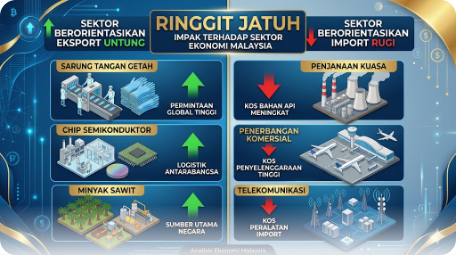
When the Ringgit Falls: Sectors That Win
When the Ringgit weakens against USD, export sectors and companies with USD revenues catch a tailwind. According to a Hong Leong Investment Bank note reported by The Edge Malaysia, the following sectors typically benefit:
1. Glove Manufacturers (Glove Sector)
Top Glove (KLSE: TOPGLOV), Hartalega (KLSE: HARTA), Kossan Rubber (KLSE: KOSSAN), and Supermax (KLSE: SUPERMX) - more than 90% of their sales are in USD. When the Ringgit weakens, every USD converts into more Ringgit. EPS rises significantly without any volume increase.
Quantitative example: If a glove maker generates USD 100 million per quarter, at RM4.00 = RM400 million. At RM4.50 = RM450 million. The additional RM50 million flows almost entirely to the bottom line because production costs remain in Ringgit.
2. Technology & EMS Sector (Electronics Manufacturing Services)
Inari Amertron (KLSE: INARI), ViTrox Corporation (KLSE: VITROX), Greatech Technology (KLSE: GREATEC), and MPI (KLSE: MPI) - the majority of their contracts with international clients are billed in USD. Bloomberg reports that Malaysian tech companies are "already reflecting the impact of US dollar depreciation and recording forex losses in their earnings" - when the trend reverses, they will record forex GAINS instead.
3. Upstream Oil & Gas Producers
Yinson Holdings (KLSE: YINSON), MISC Berhad (KLSE: MISC), and O&G service companies with FPSO or shipping contracts denominated in USD. Weak Ringgit = USD revenue translates into higher Ringgit. Petronas Chemicals (KLSE: PCHEM) is also in this category - petrochemical export earnings are in USD.
4. Plantation Sector
Sime Darby Plantation (KLSE: SDPLANT), IOI Corporation (KLSE: IOICORP), Kuala Lumpur Kepong (KLSE: KLK), and FGV Holdings (KLSE: FGV). Palm oil prices are pegged in USD on international markets. When the Ringgit falls, the same volume of CPO export revenue becomes higher in Ringgit. While there is the challenge of imported fertilizer costs (also USD), the net effect is generally positive for large producers.
5. Metals & Other Commodities
Press Metal Aluminium (KLSE: PMETAL) and Malaysia Smelting Corp (KLSE: MSC) - aluminium and tin are sold at LME (London Metal Exchange) prices in USD. Same mechanism as the sectors above.
When the Ringgit Falls: Sectors That Lose
Conversely, import-heavy sectors or those carrying USD debt come under pressure. According to The Star analysis (which describes the inverse - sectors that benefit when the Ringgit strengthens), we can flip the logic:
1. Power Utilities - TNB
Tenaga Nasional (KLSE: TENAGA) relies on imported coal and natural gas. When the Ringgit weakens, fuel costs rise. TNB has an Imbalance Cost Pass-Through (ICPT) mechanism to pass costs to consumers, but there is lag and political limits.
2. Automotive Sector
Perodua, Proton, and distributors like UMW Holdings - many parts (especially CKD - Completely Knocked Down) are imported. Weak Ringgit = expensive parts = pressured margins or higher selling prices.
3. Aviation
AirAsia X (KLSE: AAX), Capital A (KLSE: CAPITALA), and Malaysia Airports Holdings (KLSE: AIRPORT) - jet fuel is priced in USD, much of the aircraft debt is in USD. Triple whammy: fuel costs rise, USD debt becomes expensive in Ringgit, and foreign tour operators may pass on higher costs.
4. Telecommunications
CelcomDigi (KLSE: CDB), Maxis (KLSE: MAXIS), and Time dotCom (KLSE: TIMECOM) - network equipment (5G base stations, cables, switches) are mostly imported. Capex rises when the Ringgit weakens, while revenue stays in Ringgit.
5. Construction & Cement
Gamuda (KLSE: GAMUDA), IJM Corporation (KLSE: IJM), and Malayan Cement (KLSE: MCEMENT) - steel, heavy machinery, and several other inputs are imported. Project margins get squeezed when material costs rise unexpectedly.
6. F&B & Import-Based Consumer
Nestle Malaysia (KLSE: NESTLE), Padini (KLSE: PADINI), Aeon (KLSE: AEON), and MyNews (KLSE: MYNEWS) - imported products (milk, wheat, fashion) become expensive. Choice: absorb the cost (margin drops) or raise prices (volume may drop).
Additional Channel: What Happens to Foreign Capital
When the Ringgit is expected to fall, foreign institutional investors tend to reduce exposure to Malaysian assets. They sell Bursa stocks, sell Malaysian Government Securities (MGS), and repatriate USD home. This outflow can pressure the FBM KLCI even when individual companies are fundamentally sound.
Data from Bank Negara Malaysia shows international reserves are now at USD126.6 billion - a substantial cushion against volatility. This differs from the 1997 (Asian crisis) situation when Malaysia's reserves were insufficient to defend the Ringgit.
For retail investors, this means one thing: When the Ringgit falls, expect short-term selling pressure on the FBM KLCI even if fundamentals do not change. This is the opportunity to top up quality stocks whose prices fall on technical/sentiment grounds, not fundamentals.
Imported Inflation & Consumer Impact
Malaysia is a net importer of:
- Several basic food items (wheat, milk, beef)
- Almost all medicines and medical equipment
- Electronic components & machinery
- Industrial chemicals
When the Ringgit weakens, the cost of all these items rises and is eventually passed to consumers as higher inflation. This in turn:
- Reduces household disposable income
- Pressures consumer discretionary sectors (fashion, restaurants, tourism)
- May trigger a BNM response - either raising the OPR or intervening in the forex market
New Straits Times reports that BNM has consistently held the OPR at 2.75% as inflation remains contained. But if the Ringgit falls significantly, OPR expectations may shift - and bank stocks usually benefit (NIM expanding with higher rates), while property and REIT stocks suffer.
Portfolio Strategy: Adapt, Do Not Predict
Investors who try to predict the exact timing of a Ringgit fall or rise usually get it wrong. Investors who build portfolios that are resilient to both scenarios - those are the ones who win long-term.
Here is the basic framework:
1. Diversify Across Currency Exposure
Do not put all eggs in one currency basket. The portfolio should have:
- 30-40% export / USD revenue sectors (gloves, tech, plantation, upstream O&G)
- 30-40% domestic-driven sectors (telco, REITs, consumer staples, banks)
- 20-30% neutral sectors (regulated utilities, infrastructure)
With this mix, when the Ringgit falls, exporters surge. When the Ringgit rises, domestic-driven names absorb the brunt. Portfolio is more stable overall.
2. Watch the BNM Reserves & OPR Signal
Rapidly declining BNM reserves = warning signal that the Ringgit is under pressure. A rising OPR = BNM trying to defend the Ringgit (positive for banks, negative for property). Track monthly data from the BNM website.
3. Sector Rotation When Trend Confirmed
Do not rotate based on one day's Ringgit movement. Wait for confirmed trends (3-6 months of clear momentum), then tilt the portfolio:
- Ringgit weakness trend → overweight exporters, underweight importers
- Ringgit strength trend → overweight domestic, underweight exporters
4. Use Cash as Optionality
Keep 10-20% of the portfolio in cash. When a falling Ringgit triggers panic selling on Bursa, you have ammunition to enter at discount prices.
Practical Scenario: An RM10,000 Portfolio
Suppose you have an RM10,000 portfolio that is well diversified:
| Sector | Stock | Allocation | Initial Value |
|---|---|---|---|
| Gloves | Hartalega | 15% | RM1,500 |
| Tech | Inari | 15% | RM1,500 |
| Plantation | IOI Corp | 10% | RM1,000 |
| Bank | Maybank | 15% | RM1,500 |
| REIT | KLCC | 10% | RM1,000 |
| Telco | Maxis | 10% | RM1,000 |
| Utility | Tenaga | 10% | RM1,000 |
| Consumer | Nestle | 10% | RM1,000 |
| Cash | - | 5% | RM500 |
Scenario A: Ringgit Falls 5% (USD/MYR from RM4.00 → RM4.20)
Estimated impact (rule of thumb, not exact):
- Exporters (Hartalega, Inari, IOI Corp): +5-8% ⇒ +RM200 to RM320
- Importers (Tenaga, Nestle): -3-5% ⇒ -RM60 to RM100
- Bank (Maybank): neutral, slight positive if OPR rises
- Domestic (Maxis, KLCC): neutral to slightly negative
Net effect: The portfolio may gain RM150-200 (1.5-2%) even though the broader market falls, because the combination of exposures cushions the impact.
Scenario B: Ringgit Rises 5% (USD/MYR from RM4.00 → RM3.80)
Reverse: Importers get a lift, exporters come under pressure. Portfolio is once again cushioned.
Insight: The point of diversification is NOT to maximise gains in one scenario - it is to minimise losses in scenarios you cannot predict.
April 2026 Reality: The Ringgit Is Actually Strengthening
Let us address the elephant in the room. As this article is written (April 2026), the Ringgit is NOT falling - it is strengthening to a 13-month high, driven by:
- Optimism about Malaysia's role in the AI and data centre supply chain
- BNM reserves at an 11-year high
- BNM holding OPR (no need to cut, currency stable)
- Foreign capital inflows into Malaysian bonds
So why read an article about a "falling Ringgit"? Because:
- Cycles inevitably reverse - the past 30 years show the Ringgit hit RM3.40 (1997) and RM4.80 (2022). No permanent direction.
- Triggers can come suddenly - US Fed rate hikes, commodity crisis, capital flight from emerging markets, or domestic political crisis.
- Better prepared than panicked - when the Ringgit eventually weakens, you already know which sectors to overweight, which to reduce.
The investors who regret are those who only think about currency exposure AFTER the Ringgit has already fallen 10%. By then, exporter prices have already moved ahead. Those who read this article today are one step ahead.
FAQs
What does it mean for the Ringgit to fall?
The Ringgit "falling" means the Malaysian Ringgit weakens against another currency - usually measured against the US Dollar (USD). For example, if USD/MYR rises from RM4.00 to RM4.30, the Ringgit has fallen 7.5%.
What are the main reasons the Ringgit falls?
Several main factors: (1) the interest rate differential between BNM and the US Federal Reserve, (2) commodity prices especially crude oil, (3) global risk sentiment toward emerging markets, (4) domestic political conditions, and (5) Malaysia's trade balance.
Which stocks should I buy when the Ringgit falls?
Export sectors typically benefit - gloves (Hartalega, Top Glove), tech (Inari, ViTrox), plantation (IOI Corp, KLK), and upstream O&G (Yinson). But do not buy based on one day of movement - wait for a confirmed trend.
Should I convert Ringgit to USD when the Ringgit falls?
For retail investors, hedging currency directly is usually not an optimal strategy because of high transaction costs and timing risk. It is better to gain indirect exposure through Bursa exporter stocks.
How long does a falling Ringgit cycle usually last?
There is no fixed answer. A weak Ringgit cycle can last 1-3 years (example: 2022-2024 RM4.80 era), then reverse (2025-2026 strengthening momentum).
Will BNM intervene if the Ringgit falls a lot?
BNM has several tools: (1) intervene directly in the forex market using reserves, (2) raise the OPR to attract capital, (3) coordinate with exporters to repatriate USD revenue. But BNM cannot defy long-term fundamentals.
Is a falling Ringgit always negative for Bursa Malaysia?
No. A falling Ringgit is negative for the broad index (FBM KLCI) in the short term due to foreign outflows, but positive for individual export sectors. There are opportunities in volatility.
How do I track daily Ringgit movements?
Several free sources: the BNM website (official exchange rates), Bloomberg.com, Tradingeconomics.com, or your trading app (M+ Online, Bursa Anywhere).
Conclusion
Today's strong Ringgit is not permanent. Serious Bursa Malaysia investors need a playbook for when the cycle reverses - which sectors win, which lose, and how to adapt the portfolio without panicking. The bottom line: diversifying across exporters and domestic stocks, plus tracking signals from BNM (reserves + OPR), is the foundation every investor needs.
Rather than trying to predict when the Ringgit will fall, it is better to build a portfolio that is resilient in both scenarios - that is the strategy of successful long-term investors.
If you want to start building a more structured portfolio with exposure to both export and domestic sectors, the first step is to have a platform that gives you access to the best stocks on Bursa Malaysia and overseas markets.
Open a CDS trading account today to start investing in Bursa Malaysia as well as overseas markets including US and Hong Kong stocks through one platform.
Download our free stock market basics ebook to understand investment fundamentals before taking the next step.