GOOG vs GOOGL: Why One Company Has Two Stock Tickers

Have you ever opened your trading app, typed "Google", and seen TWO tickers appear: GOOG and GOOGL? Nearly identical prices, same company name, same logo. So which one is the "real Google"? This is one of the most common questions from Malaysian investors who are new to US stocks, and the answer leads us to an important stock market concept: dual-class shares.
In this article, we will break down why one company can have two (or more) tickers, the difference between Class A, Class B and Class C shares, and most importantly: which ticker you should buy as a retail investor in Malaysia.
Quick Answer
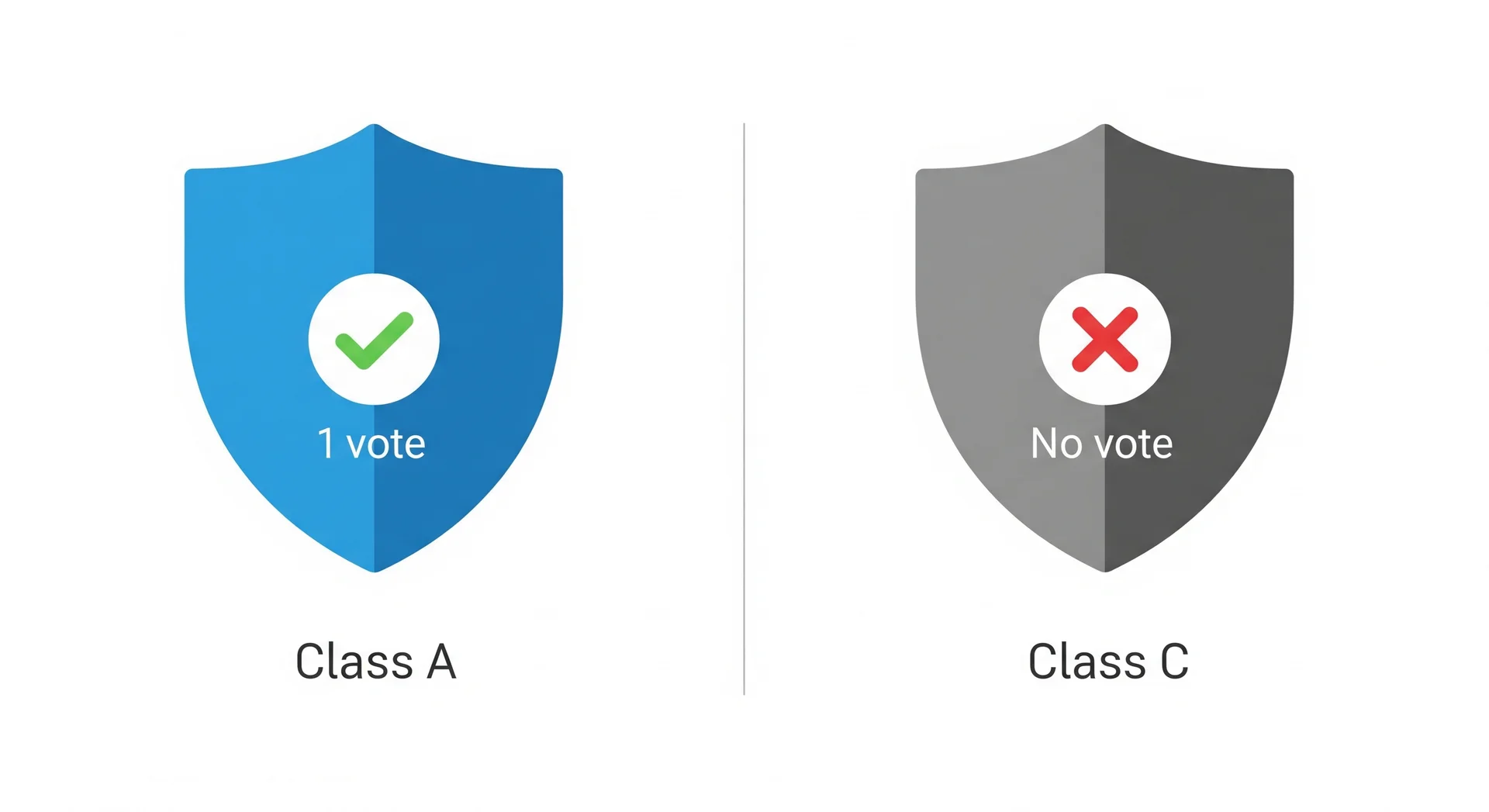
GOOG and GOOGL are the SAME company, Alphabet Inc (Google's parent company). The only difference is voting rights: GOOGL (Class A) carries 1 vote per share, while GOOG (Class C) carries no voting rights at all. In terms of business ownership, profits and dividends, both are equal. For retail investors, the practical difference is close to zero.
What Are Dual-Class Shares?
Dual-class shares means a company issues more than one class of shares, and each class carries different voting rights. The basic structure usually looks like this:
- Class A - ordinary shares for the public, usually 1 vote per share
- Class B - "super-voting" shares for founders and executives, often carrying 10 votes per share (and usually NOT listed on any exchange)
- Class C - non-voting shares sold to the public
Note one important point: the A, B and C labels are not standardised. Every company is free to decide which class carries how many votes. That is why you must check each company's structure before buying, and never assume Class A is always "better" than Class C.
According to Investopedia, the difference between GOOG and GOOGL comes down to those voting rights alone. Both classes represent the same economic interest in Alphabet: same profits, same assets, and if dividends are paid, the same dividend amount.
Why Do Companies Create Two Share Classes?
One word: control. Or in market terms, founder control.
When a company lists on an exchange, the founders have to sell part of their ownership to the public. The problem is, the more shares they sell, the more their voting power gets diluted. Over time, founders can lose control of the very company they built, whether through activist shareholder pressure or takeover attempts.
A dual-class structure solves this. Founders hold super-voting shares (for example, 10 votes per share), while the public holds ordinary or non-voting shares. As a result, founders can raise huge amounts of capital from the market without giving up strategic control.
The clearest example is Meta Platforms. Mark Zuckerberg holds Class B shares carrying 10 votes each. With an economic stake of only around 13%, he controls more than 50% of Meta's voting power. This means nobody can remove Zuckerberg from Meta, even if the majority of public shareholders disagree with his decisions.
Google (now Alphabet) pioneered this structure in the tech world. During its 2004 IPO, Larry Page and Sergey Brin issued Class A shares (1 vote) to the public and kept Class B shares (10 votes) for themselves. To this day, the two founders still control the majority of Alphabet's voting power through Class B, even though their economic stake is far smaller.
Alphabet's Structure: GOOGL vs GOOG in Detail
Alphabet actually has THREE share classes, but only two are available to buy:
| Class | Ticker | Voting Rights | Who Holds It |
|---|---|---|---|
| Class A | GOOGL | 1 vote per share | Public (listed on NASDAQ) |
| Class B | None (unlisted) | 10 votes per share | Founders & insiders only |
| Class C | GOOG | No votes | Public (listed on NASDAQ) |
Where did Class C come from? In April 2014, Alphabet (then Google) carried out a special stock split: every Class A shareholder received one Class C share for free. The purpose was strategic: the company could use non-voting Class C shares to pay employees and fund acquisitions without diluting the founders' voting power. Then in July 2022, Alphabet did a 20-for-1 split, making each share more affordable for retail investors.
How big is the price gap between the two tickers? Almost nothing. Based on Google Finance data on 31 July 2026, GOOGL closed at USD 333.66 while GOOG closed at USD 333.68. A difference of just 2 cents, or less than 0.01%. In theory, GOOGL should trade slightly higher because of its voting rights, but in practice the market prices retail voting rights at almost zero, so both move in lockstep.
Full details of the share class structure are available directly on the Alphabet Investor Relations page.
Other Companies With Two Tickers
Alphabet is not alone. Here are some other big names in the US market using the same structure:
Berkshire Hathaway: BRK.A vs BRK.B
This is the most extreme example. Berkshire's Class A shares (BRK.A) have never been split since Warren Buffett took over the company, and now trade at around USD 764,990 per share (price as at 30 July 2026). Yes, you read that right: more than RM3 million for ONE share.
In 1996, Buffett issued Class B shares (BRK.B) so that ordinary investors could own Berkshire. BRK.B now trades at around USD 509, with an economic value of 1/1,500th of a Class A share but voting rights of only 1/10,000th. The full comparison is explained by the company itself in the official Berkshire Hathaway memo. If you are interested in the investment philosophy behind this company, read our article on Warren Buffett's investment principles.
Fox Corporation & News Corp: When Class A Has No Vote
Here is proof that class labels are not standardised. At Fox Corporation, Class A shares (ticker FOXA) carry NO voting rights, while Class B shares (ticker FOX) do. The same structure applies at News Corp: NWSA (Class A) has no vote, NWS (Class B) does. The opposite of Alphabet! This structure allows the Murdoch family to retain control over both media empires. Once again: always check the actual structure, never guess from the class letter.
Meta Platforms: The Class B You Cannot Buy
Meta lists only one ticker (META, its Class A shares with 1 vote each). The Class B shares carrying 10 votes each are held almost entirely by Zuckerberg and are not listed. So even though you only see one ticker, the dual-class structure still exists behind the scenes.
Remember: Same Company, Same Business
This point must be crystal clear: when you buy GOOG or GOOGL, you own a slice of the SAME business. Same search engine, same YouTube, same Google Cloud, same profits. One GOOG share and one GOOGL share represent an equal economic interest in Alphabet.
Only three things differ:
- Voting rights - GOOGL has 1 vote, GOOG has none
- Market price - a very small gap, usually under 1%, and sometimes GOOG trades higher
- Liquidity - both are highly liquid, but daily trading volumes can differ slightly
Dividends? Since Alphabet started paying dividends in 2024, both classes receive the same dividend per share. Neither ticker has a dividend advantage.
GOOG or GOOGL: Which Should Malaysian Retail Investors Buy?
The honest answer: for most retail investors, it barely matters. Here is why:
1. Your vote has no practical impact. Say you buy 10 GOOGL shares, you get 10 votes. Alphabet's founders control the majority of voting power through Class B. Your vote is practically symbolic. Paying a premium (if any) for retail voting rights is rarely worth it.
2. The price gap is tiny. As the data above shows, the GOOG vs GOOGL price difference is usually just a few cents. On the day you buy, GOOGL might be cheaper, or GOOG might be. Simply pick whichever is cheaper at that moment if you want to count every cent.
3. Both are extremely liquid. GOOG and GOOGL are among the most actively traded stocks in the world. The bid-ask spread on both is razor thin. At retail trade sizes, you will not feel any difference.
Practical conclusion: if you want to feel like a "complete" owner, buy GOOGL (with votes). If you simply want exposure to Alphabet's business at the lowest price available, compare both tickers when placing your order and pick the cheaper one. Both choices are correct.
What This Means for Malaysian Investors Buying US Stocks
For Malaysian investors, both GOOG and GOOGL can be bought through platforms like M+ Global. The process is the same as buying any other US stock, and we have a real demo of how to buy US stocks in the M+ Global app step by step.
A few extra things Malaysian investors should keep in mind:
- Find the right ticker. In the app, type "Alphabet" and you will see both GOOG and GOOGL. Do not be confused, both are legitimate and both are Alphabet. Double-check the ticker letters before confirming your order.
- Transaction costs are identical. Brokerage charges for GOOG and GOOGL are the same. What affects your cost is the platform's fee structure, not your ticker choice. See our guide on M+ Global transaction fees for Bursa vs US.
- Dividend withholding tax. US stock dividends are subject to 30% withholding tax for Malaysian investors, whether you hold GOOG or GOOGL.
- Nominee ownership. Your US shares are held through a nominee structure, unlike Bursa shares which go directly into your CDS account. Understand the difference in our article on Direct CDS vs Nominee accounts.
Do Dual-Class Shares Exist on Bursa Malaysia?
As of now, no. Bursa Malaysia still follows the "one share, one vote" principle for listed companies: one ordinary share, one vote. That is why you will not find two tickers for the same company like GOOG and GOOGL on the local market.
However, discussions have been ongoing for a while. In the Budget 2023 speech, the government announced plans to allow dual-class share listings on Bursa Malaysia to attract high-growth technology companies to list locally instead of heading to foreign exchanges. Singapore (SGX) and Hong Kong (HKEX) have allowed this structure since 2018, with safeguards such as a maximum of 10 votes per share.
At the time of writing, no official framework has been implemented on Bursa Malaysia. The debate continues, as covered by The Edge Malaysia: supporters say it is needed to keep local tech companies listing at home, while critics worry it weakens minority shareholder protection. For now, if you want to invest in dual-class companies, your options remain in foreign markets like the US.
FAQ: Common Questions About GOOG vs GOOGL
Are GOOG and GOOGL the same company?
Yes. Both are Alphabet Inc, Google's parent company. GOOGL is the Class A share (1 vote per share) and GOOG is the Class C share (no votes). Business ownership and economic value are equal for both.
Why do GOOG and GOOGL prices differ slightly?
Because they trade as two separate securities, each with its own supply and demand. In theory GOOGL should trade slightly higher because of its voting rights, but the gap is usually under 1% and sometimes GOOG trades higher instead.
Which ticker suits Malaysian retail investors better?
Both are suitable. Retail voting rights carry almost no practical value because the founders control the majority of votes through Class B. Compare live prices of both tickers and pick the cheaper one, or choose GOOGL if you still want voting rights.
Do GOOG and GOOGL pay dividends?
Yes. Alphabet started paying dividends in 2024, and both share classes receive the same dividend per share. Remember, US stock dividends are subject to 30% withholding tax for Malaysian investors.
Can I convert GOOG shares into GOOGL?
No. There is no automatic conversion mechanism for retail investors. If you want to switch, you need to sell one and buy the other, with the usual transaction costs.
Why does Berkshire Hathaway have BRK.A and BRK.B?
BRK.A is the original share that has never been split and trades at hundreds of thousands of dollars per share. BRK.B was issued in 1996 with an economic value of 1/1,500th of BRK.A so that ordinary investors could afford to own Berkshire.
Are there any dual-class shares on Bursa Malaysia?
Not yet. Bursa Malaysia still uses the one share, one vote principle. The government announced plans to allow dual-class shares in Budget 2023, but no official framework has been implemented yet.
Conclusion
GOOG and GOOGL are not two companies, but two share classes of the same company, Alphabet. Dual-class share structures exist to preserve founder control, and for retail investors, the difference between the two tickers has almost no practical impact. What matters more is not which ticker you pick, but whether the business behind it is high quality and worth the current price.
Now that you understand the difference between Class A and Class C, the next step is to start building your own portfolio, whether in local stocks or US tech giants like Alphabet.
Open a CDS Trading Account with us today to invest in Bursa Malaysia as well as foreign stocks like the US and Hong Kong on a single platform.
You can also download our Stock Market Basics Ebook for free to master the fundamentals of stock investing before you start.