Herd Behavior in Stocks: When Following the Crowd Pays Off, and When It's a Deadly Trap

A tech counter suddenly jumps 40% in three days. Your WhatsApp groups explode, TikTok is full of people flashing their profits, and friends who never talked about stocks are suddenly "experts". You, who started out calm, begin to feel anxious - "Everyone's already in. If I don't get in now, I'll miss out." So you buy at the top. A week later the stock crashes 50%, and the once-noisy group falls dead silent. That is herd behavior - the herd mentality that is one of the most powerful forces driving the stock market, and one of the most common reasons retail investors suffer big losses.
But here's the twist: following the crowd is not always wrong. Sometimes going with the flow really does pay off. The problem is that investors rarely know how to tell when following the crowd is rational, and when it's a deadly trap that will wreck their portfolio. This article explains what herd behavior is, why the human brain so easily follows the masses, when it can be profitable, when it becomes a disaster, and how to protect yourself from getting caught.
What Is Herd Behavior?
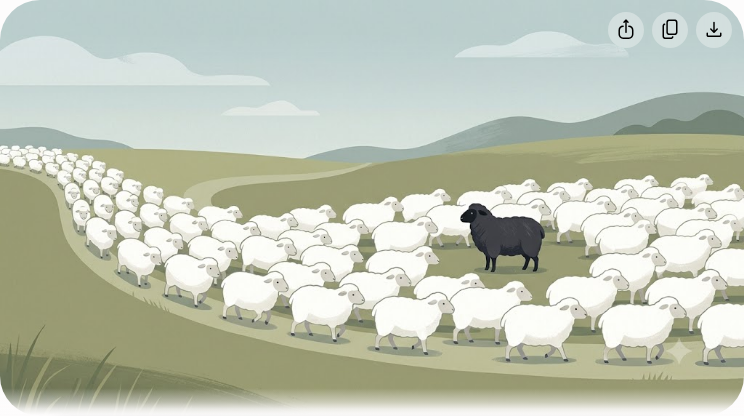
Herd behavior (or "herd mentality") is the tendency of individuals to imitate the actions of a larger group instead of making decisions based on their own analysis and information. In investing, it happens when investors buy or sell a stock simply because many other people are doing the same thing - without evaluating the company's fundamentals or the stock's real value.
The term comes from how livestock move in herds. One animal runs, so the whole herd runs, even though most of them cannot see what they are fleeing from. Humans, despite being far smarter, share a similar instinct. According to Investopedia, this herd instinct is what often triggers extreme market rallies and massive panic sell-offs - both usually without solid fundamental support.
In finance research, herding has been documented extensively. A classic working paper from the International Monetary Fund (IMF) by Bikhchandani and Sharma explains that herding in financial markets can push asset prices far from their fundamental value, increase market instability, and make the financial system more fragile. This is not just an individual habit - it is a phenomenon capable of shaking entire markets.
Why the Human Brain Loves to Follow the Crowd
Herding is not a sign that you are weak or foolish. It is an ancient instinct hard-wired into the human brain over thousands of years. There are several psychological reasons we follow the crowd so easily:
1. Social proof - "if many people do it, it must be right". The human brain treats the majority's actions as evidence that something is correct. When we're unsure, we look to what others are doing for guidance. In daily life this is often useful (a packed restaurant = good food), but in the stock market it can mislead, because the retail majority is often wrong at the most critical moments.
2. Safety in the group. Evolutionarily, being separated from the group meant danger. So our brains reward us (with a feeling of safety and relief) when we do the same as everyone else. In investing, "losing together" feels less painful than "losing alone", even though the amount of money lost is the same.
3. FOMO (fear of missing out). The fear of missing an opportunity is a primary driver of herding. When you see others profiting, your brain interprets it as a personal loss - "that should have been my money". This emotional pressure pushes investors in at high prices, often right before the market reverses.
4. Information cascade. When one investor buys, a second assumes they have good information, so they buy too. A third sees two people buying and follows suit. Over time, thousands buy not because of their own analysis, but because they assume "the people before me must know something". The Decision Lab describes this as "the sheep in the stock market" - where each person follows the one in front without really knowing where they are headed.
The combination of these four instincts makes herding one of the mental biases that most frequently cost investors on Bursa Malaysia. It works at a subconscious level, so you may be trapped without even realising you are following.
When Following the Crowd Actually Pays Off
Here is the part many people forget: not all herding is bad. In certain situations, moving with the crowd really can be profitable. Researchers call it "rational herding" - going with the flow for a sensible reason.
1. Momentum and genuine trends. When a stock rises because its fundamentals are genuinely improving (rising profits, big contracts, a growing sector), the inflow of investors can sustain the upward momentum for a long time. Traders who ride such trends can profit - as long as they know when to exit.
2. Better liquidity. A stock that many people trade is usually easier to buy and sell at a fair price, with tighter bid-ask spreads. In this sense, "following" the crowd toward popular stocks gives you a practical edge over holding thin stocks that are hard to sell.
3. Genuine collective information. Sometimes the crowd is right. If thousands of investors sell the stock of a company that has just been declared PN17 or hit by a scandal, they are acting on valid information. Following that sell-off (or avoiding the stock) is a rational decision, not blind herding.
The key: profitable herding is when the crowd's actions happen to align with fundamentals and you understand why. Destructive herding is when you follow simply because others are doing it, without knowing the reason. The difference is subtle but determines whether you profit or become a victim.
When Herding Becomes a Deadly Trap
This is the dark side of herding - and it happens far more often than the profitable kind. When the crowd acts on emotion rather than fundamentals, herding creates two major traps:
Price bubbles. When too many investors chase the same stock out of FOMO, the price soars far above its real value. The most famous example is the dot-com bubble of the late 1990s, when internet companies with no profits were valued at billions simply because "everyone was buying tech stocks". When the bubble burst, the majority who entered late suffered huge losses. The 2021 GameStop saga - where millions of retail investors chased the same stock driven by social media - is the modern version of the same phenomenon, a story we cover in our article on the lessons from Dumb Money and the GameStop saga.
Panic selling. Herding works both ways. When the market falls and everyone panics, fear becomes contagious. Investors sell good stocks at cheap prices simply because "everyone is selling". This is why market crashes often overshoot - not because every company's fundamentals collapse at once, but because collective emotion takes over. If your portfolio is in the red and you feel the urge to join the selling, first read 5 smart steps to handle a floating loss before making any rushed decision.
What hurts most is that herding always traps retail investors at the worst possible time. They buy at the peak (at maximum euphoria) and sell at the bottom (at maximum fear) - the exact opposite of the basic principle "buy low, sell high". The herd instinct systematically steers the majority toward the wrong decision at the most critical moments.
Scientific Evidence: Herding on Bursa Malaysia
Herding is not an abstract theory that only happens on Wall Street. It has been studied and proven to exist on Bursa Malaysia through several academic studies:
Herding is stronger when the market falls. A study by Universiti Sains Malaysia researchers published in a SAGE journal (Ooi Kok Loang & Zamri Ahmad, 2024) found that herd behavior exists in the Malaysian stock market, and investors tend to "herd" more strongly in bearish (down) market conditions than in rising markets. This confirms the panic-selling pattern - fear is more contagious than greed.
Analyst recommendations trigger herding. The same and related research found that when analysts issue recommendations (buy/sell), it triggers volatility that in turn pushes investors to follow the crowd. Information meant to help investors think independently instead becomes a trigger for copycat behavior.
Herding appears during crises. Local academic work such as the case study of herding on Bursa Malaysia (UTAR) found herd behavior to be more pronounced in extreme market conditions - whether sharp surges or severe crashes. A separate comparative study of the Indonesia Stock Exchange and Bursa Malaysia (2015-2021) also found herding rising during high uncertainty, including the COVID-19 pandemic that triggered panic among investors.
The conclusion of these studies is clear: Malaysian investors, like those around the world, are vulnerable to herding - and it is most dangerous exactly when you most need a calm mind.
Warning Signs You Are Caught in Herding
Herding works at a subconscious level, so the first step to fighting it is recognising the signs in yourself:
- You buy because "everyone says so". You can't explain why you bought the stock other than "lots of people are talking about it" or "it's trending on social media".
- You're afraid of missing out (FOMO). Your decision is driven by anxiety about missing an opportunity, not by value analysis.
- You sell because others are panicking. You sell not because fundamentals changed, but because the market is red and everyone is dumping shares.
- You don't do your own research. You rely entirely on group tips, influencers, or "insiders" without verifying the facts.
- You only feel comfortable when many agree. You hesitate to hold a stock nobody else is interested in, even when your analysis is solid.
If you nodded at any of the signs above, you are not unusual - almost every investor has been trapped at some point. What sets successful investors apart is that they learn to spot these signs early and stop before it's too late.
Real Example: A Bursa Malaysia Scenario
Imagine Madam Siti, who has just started dabbling in stocks. A construction-sector counter suddenly rises 60% in two weeks after going viral on TikTok and Telegram groups. Every day she sees people posting profit screenshots. At first she's doubtful, but after a week of watching the price keep climbing, FOMO takes over. She puts in RM20,000 - nearly all her savings - at RM1.80.
What Madam Siti doesn't know: the rally was not driven by fundamentals. The company's profits were actually declining, and the "big players" who sparked the rise had quietly started selling to the newly arriving retail investors. Two weeks later, a weak quarterly profit report comes out. The price crashes to RM0.95. The once-buzzing Telegram group is now full of people asking "when will it go back up?". Madam Siti, who entered simply by following the crowd, is now stuck with a 47% loss.
The lesson is not "never follow the crowd". The lesson is: don't follow the crowd without knowing why the crowd is moving. If Madam Siti had asked one simple question - "Do the company's fundamentals support this price?" - she might have been spared. The crowd can be right or wrong; your job is to verify, not to follow blindly.
How to Avoid the Herd Behavior Trap
The good news is that herding can be fought with discipline and a system. Here are seven practical strategies:
1. Do your own research before buying. Before entering any stock, understand its business, profits, debt, and prospects. If you can't explain why you're buying in one sentence based on fundamentals, don't buy. Group tips are not research.
2. Write down your investment thesis. Note why you're buying and what would make you sell. When a decision is documented in writing, it is harder to be disrupted by group noise or market panic.
3. Ask "why is the crowd moving?". Every time you see a stock surge or plunge, ask: is this driven by valid fundamentals, or just emotion and FOMO? If you can't find a fundamental reason, be careful.
4. Beat FOMO with patience. No opportunity is truly "once in a lifetime". The market always offers new ones. Missing one rally is far better than entering late and becoming someone else's "exit liquidity".
5. Set your rules before emotion kicks in. Decide your cut-loss level and profit target before you buy, and stick to them without compromise. Rules set when calm beat emotions that surface when the market is turbulent.
6. Reduce your exposure to "noise". Speculation groups, "stock tip" influencers, and minute-by-minute price charts amplify the herd instinct. Spend less time there and focus on quality information and fundamental research.
7. Be aware and acknowledge this bias exists. Awareness alone already reduces the effect of bias. Understanding your own psychology is half the solution - we cover the rest in our piece on the 13 emotional traps that can destroy your portfolio.
Frequently Asked Questions (FAQ)
What does herd behavior mean in stocks?
Herd behavior in stocks is the tendency of investors to buy or sell simply because many other people are doing so, without doing their own analysis. It is driven by the herd instinct, social proof, and the fear of missing out (FOMO).
Is following the crowd in investing always wrong?
No. Following the crowd can be profitable when their actions happen to align with valid fundamentals - for example, riding a trend backed by genuine company profit growth. It becomes dangerous when you follow simply because others are doing it, without knowing the reason.
How is herding related to FOMO?
FOMO (fear of missing out) is one of the main drivers of herding. When you see others profiting, your brain interprets it as a personal loss, pushing you to enter at high prices - often right before the market reverses downward.
Why is herding dangerous when the market falls?
When the market falls, fear becomes contagious. Investors sell good stocks at cheap prices simply because "everyone is selling". Studies on Bursa Malaysia found herding is actually stronger in falling markets than in rising ones.
How do I know if I'm caught in herd behavior?
Clear signs: you buy because "lots of people say so", you can't explain a fundamental reason, you're driven by FOMO, or you sell only because others are panicking. If your decisions are guided more by others' actions than your own analysis, you are herding.
Are professional investors also affected by herding?
Yes. Studies show that even institutional investors and fund managers can be vulnerable to herding, partly because they do not want to look "different" from their peers. No one is fully immune; what sets people apart is the system and discipline to fight it.
What's the difference between herd behavior and anchoring bias?
Herd behavior is following the crowd's actions, while anchoring bias is clinging to a single reference number (such as your original buy price). Both are psychological biases, but herding relates to social influence, while anchoring relates to an internal reference point.
Conclusion
Herd behavior is one of the most powerful forces in the stock market - it can be profitable when aligned with fundamentals, but becomes a deadly trap when driven purely by emotion and FOMO. The crowd can be right or wrong; your job is not to blindly follow or oppose, but to verify whether their movement is based on fundamentals or just the herd instinct.
The key to protecting yourself is to think independently: do your own research, write your investment thesis, beat FOMO with patience, and always ask "why is this crowd moving?". Understanding your own psychology is the least-taught but most important investing skill.
The next step is to put this discipline into practice with the right investment account.
To start investing on Bursa Malaysia as well as foreign markets such as the US and Hong Kong, you can open a CDS account with Mahersaham and begin building your portfolio with solid discipline.
If you're just starting out, download our free stock market basics ebook to understand the key concepts before investing real money.
Further Reading
- Investor Psychology: 7 Mental Biases That Make You Lose Money on Bursa Malaysia
- Anchoring Bias in Stocks: Why Your Brain Clings to the Original Buy Price
- Dumb Money & the GameStop Saga: The Dangers of FOMO and Herd Mentality
- Portfolio Deep in the Red? Don't Panic - 5 Smart Steps to Handle a Floating Loss
- Investment Psychology: 13 Emotional Traps That Can Destroy Your Portfolio