Malaysia GDP Hits 5.2% in 2025 - 2026 Forecast, Key Sectors & Investment Opportunities

Malaysia's economy ended 2025 on a strong note. The country's Gross Domestic Product (GDP) grew by 5.2 percent, surpassing the 5.1 percent achievement from the previous year. This is more than just a statistic - it reflects a strengthening domestic economy and opens new opportunities for investors.
But the key question now is: can this momentum be sustained in 2026? With global geopolitical challenges, US trade tariffs, and market uncertainty, investors need to understand where the national economy is headed.
In this article, we break down Malaysia's GDP performance comprehensively - from quarterly data in 2025, key contributing sectors, 2026 forecasts from various institutions, to the impact on the stock market and your investment strategy.
What Is GDP and Why Should Investors Care?
GDP or Gross Domestic Product (KDNK in Malay) measures the total value of all goods and services produced within a country over a specific period. It is the primary indicator of a nation's economic health.
For investors, GDP matters because it reveals:
- Economic direction - positive GDP growth typically means companies are generating more revenue
- Central bank decisions - GDP data influences Bank Negara Malaysia's Overnight Policy Rate (OPR) settings, affecting borrowing costs and investment returns
- Foreign fund flows - international investors monitor GDP trends before entering the Malaysian market
- Market sentiment - strong GDP boosts investor confidence in Bursa Malaysia
For a deeper understanding of GDP concepts including calculation methods and Malaysia's global ranking, read our article What Is GDP (KDNK)?.
Malaysia GDP Performance 2025: Full Summary
According to the Department of Statistics Malaysia (DOSM), the Malaysian economy recorded GDP growth of 5.2 percent for the full year 2025, with total GDP value reaching RM1.735 trillion.
Most notably, the fourth quarter (Q4) 2025 momentum was exceptionally strong:
| Quarter | GDP Growth | Value (RM billion) |
|---|---|---|
| Q1 2025 | 4.4% | ~RM420 |
| Q2 2025 | 4.4% | ~RM427 |
| Q3 2025 | 5.2% | ~RM430 |
| Q4 2025 | 6.3% | RM457.7 |
| Full Year 2025 | 5.2% | RM1,735 |
The 6.3 percent growth in Q4 2025 was the highest since Q4 2022 - a clear signal that the Malaysian economy was gaining strong momentum towards year-end.
Key Contributing Sectors to GDP 2025
Not all sectors contributed equally to economic growth. Here is the performance of each major sector as reported by the Ministry of Economy:
Services Sector - The Economic Backbone
The services sector remains the largest contributor to Malaysia's GDP, recording growth of 5.5 percent for the full year 2025 and 6.3 percent in Q4 2025. Sub-sectors driving growth include wholesale and retail trade, information and communication, and financial services.
For investors, this means stocks related to financial services, telecommunications, and retail on Bursa Malaysia continue to be in a strong position.
Construction Sector - Double-Digit Growth
The construction sector recorded the most impressive growth at double-digit rates, driven by mega infrastructure projects like MRT3, ECRL, and the rapidly expanding data centre developments.
The data centre construction boom in Malaysia - with investments from global tech giants - has become the primary catalyst for this sector.
Agriculture Sector - Palm Oil Drives Surge
The agriculture sector also showed strong performance with 5.4 percent growth in Q4 2025. The palm oil sub-sector surged by 16.2 percent - a very significant increase driven by strong crude palm oil (CPO) prices and increased production.
Manufacturing Sector - Stable but Moderate
The manufacturing sector grew at a more moderate rate of about 3.7 percent in mid-2025. While not as impressive as other sectors, it remains important as it supports Malaysia's electronics and electrical product exports.
Mining Sector - Volatile Performance
The mining and quarrying sector experienced contraction in mid-2025 due to scheduled gas plant maintenance. However, it bounced back in Q3 2025 with 10.9 percent growth - demonstrating high volatility in this sector.
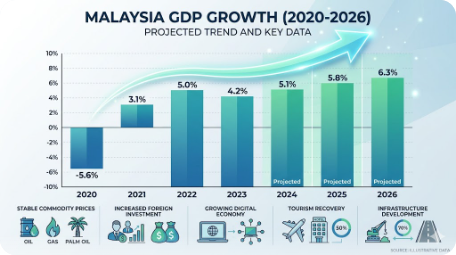
Malaysia GDP Forecast 2026: What Do Experts Say?
Several major financial institutions have released their GDP growth forecasts for Malaysia in 2026. Overall, forecasts indicate slightly slower growth compared to 2025 but still healthy:
| Institution | GDP Forecast 2026 | Notes |
|---|---|---|
| Malaysian Government | 4.0% - 4.5% | Official range in Budget 2026 |
| IMF | 4.3% | Raised by 0.3 percentage points (Jan 2026) |
| Public Investment Bank | 4.6% | Supported by domestic demand |
| CGS International (CGSI) | 4.8% | Upgraded from previous 4.6% |
| World Bank | ~4.1% | Cautious on external risks |
According to the IMF Article IV Consultation report (Feb 2026), growth is expected to slow slightly from 4.6 percent in 2025 to 4.3 percent, mainly due to the impact of higher US tariffs on Malaysia.
Meanwhile, The Edge Malaysia reported that the IMF raised its forecast by 0.3 percentage points from previous estimates - a sign of confidence in the resilience of Malaysia's economy.
Growth Drivers for 2026
What will fuel Malaysia's economy this year? Several key factors:
1. Technology & AI Investment
Malaysia has emerged as a premier destination for data centre investment in Southeast Asia. Global tech giants like Microsoft, Google, and Amazon Web Services have announced multi-billion ringgit investments to build data centres in Malaysia. This not only contributes to the construction sector but also creates a technology ecosystem generating high-skilled employment.
2. Strong Domestic Demand
Private consumption is expected to remain resilient, supported by stable labor market conditions, targeted fiscal support from the government (including targeted subsidies), and gradual recovery in services activities.
3. Infrastructure Investment
Mega projects like MRT3, ECRL, Pan Borneo Highway, and various data centre developments will continue to be growth engines throughout 2026.
4. Narrowing Fiscal Deficit
According to the IMF, Malaysia's fiscal deficit is expected to narrow to 3.5 percent of GDP in 2026, down from 3.8 percent in 2025. This reflects improving government financial management.
Risks and Challenges in 2026
Despite the positive outlook, investors need to be aware of several risks:
US Trade Tariffs
The biggest risk comes from US trade policy under the Trump administration. Higher tariffs on Malaysian goods could impact the export sector, particularly electronics and manufactured products. According to Utusan Malaysia, some analysts are more cautious with forecasts as low as 3.8 percent if tariffs are implemented aggressively.
Global Economic Slowdown
A slowing Chinese economy and uncertainty in Europe could affect demand for Malaysian exports.
Inflation and Cost of Living
While inflation is expected to remain moderate at 1.0 to 2.0 percent, the implementation of targeted subsidies and potential energy price increases could put pressure on consumer spending.
Geopolitical Uncertainty
Conflicts across various regions and US-China competition continue to create uncertainty that could affect foreign investment flows.
Impact of GDP on Malaysia's Stock Market
How does this GDP data affect Bursa Malaysia? Some important observations:
Sectors expected to benefit:
- Construction - with a large infrastructure project pipeline including data centres
- Technology - wave of AI investment and digitalisation
- Property - increasing demand alongside economic growth
- Banking - healthy loan growth in an expanding economy
- Palm oil - strong CPO prices supporting plantation companies
Sectors to watch carefully:
- Electronic exports - dependent on US tariff developments
- Mining - high volatility, dependent on global oil prices
Investors who understand these macroeconomic trends can make smarter investment decisions on Bursa Malaysia. For example, rising growth in construction and technology sectors provides clues about stocks that may outperform in 2026.
Comparing Malaysia's GDP with ASEAN Nations
For broader context, how does Malaysia's performance compare with its ASEAN neighbours?
| Country | GDP 2025 | Forecast 2026 |
|---|---|---|
| Vietnam | ~6.5% | ~6.0% |
| Philippines | ~5.8% | ~5.5% |
| Indonesia | ~5.0% | ~4.8% |
| Malaysia | 5.2% | 4.0 - 4.8% |
| Thailand | ~2.8% | ~3.0% |
| Singapore | ~4.0% | ~2.5% |
Malaysia is in a competitive position - growth higher than Thailand and Singapore, and comparable to Indonesia. The moderate but stable 2026 forecast demonstrates that Malaysia's economy has strong fundamentals.
What Should Investors Do Now?
Based on GDP data and the 2026 outlook, here are some considerations for investors:
- Focus on growth sectors - construction, technology, and banking are expected to benefit directly from economic growth
- Diversify your portfolio - don't rely on a single sector. Combine defensive stocks (utilities, telecommunications) with growth stocks
- Monitor US trade policy - tariff developments could drastically change the economic picture
- Watch quarterly data - DOSM releases GDP data every quarter. Use this data as a benchmark to evaluate your portfolio performance
- Leverage long-term opportunities - data centre and infrastructure investments are not temporary trends; they will drive growth for years to come
Frequently Asked Questions (FAQ)
What was Malaysia's GDP in 2025?
Malaysia's GDP for the full year 2025 recorded growth of 5.2 percent with a total value of RM1.735 trillion. The fourth quarter (Q4) 2025 recorded the highest growth at 6.3 percent.
What is the GDP forecast for Malaysia in 2026?
Forecasts vary by institution - the government set a range of 4.0 to 4.5 percent, the IMF projects 4.3 percent, while CGSI is more optimistic at 4.8 percent.
Will Malaysia's economy enter a recession in 2026?
There are no signs of recession. All forecasts indicate positive growth, albeit at a slower rate compared to 2025. The main risks come from US trade tariffs and global economic slowdown.
Which sector contributes most to Malaysia's GDP?
The services sector is the largest contributor, accounting for more than 55 percent of GDP. Followed by manufacturing, construction, mining, and agriculture.
How does GDP affect OPR and interest rates?
Bank Negara Malaysia uses GDP data as one of the inputs to determine the OPR. Strong GDP typically gives the central bank room to maintain or raise interest rates, while weak GDP could push for OPR cuts.
Does GDP growth mean the cost of living will increase?
Not necessarily. GDP growth and inflation are two different things. GDP can increase without high inflation. Malaysia's inflation is expected to remain moderate at 1.0 to 2.0 percent in 2026.
How can investors benefit from GDP data?
Investors can use GDP data to identify growing sectors, make asset allocation decisions, and assess the right timing to increase or reduce market exposure.
Where can I find the latest Malaysia GDP data?
Official GDP data is released by the Department of Statistics Malaysia (DOSM) through the OpenDOSM portal. Data is updated quarterly.
Conclusion
Malaysia's economy demonstrated strong performance in 2025 with GDP growth of 5.2 percent, and the 2026 outlook remains positive despite a slightly slower pace. For investors, this data points to good opportunities especially in the construction, technology, and financial services sectors.
If you are interested in starting your investment journey, the first step is to open a CDS account which allows you to invest in Bursa Malaysia as well as international stocks including the US and Hong Kong markets. Open a CDS account here.
For a foundational understanding of stock market investing, download our free ebook covering a step-by-step guide for new investors. Get the Free Stock Market Basics Ebook here.
Further Reading
- What Is GDP (KDNK)? Calculation, Facts & Malaysia's Global Ranking
- Bursa Malaysia Targets Quality Over Quantity: IPO Focus RM28 Billion for 2026
- MSCI Indonesia Issue: Bursa Malaysia Now on Radar for Foreign Fund Inflows
- Strategy 2026: Why Small-Cap Stocks May Lead the Market
- US National Debt Hits $36.5 Trillion: What Does It Mean for the Global Economy?