Michael Burry's Scion Asset: How He Screens Stocks Beyond The Big Short

Most investors know Michael Burry as "The Big Short guy" - the investor who bet hundreds of millions of dollars against the US housing market before the 2008 financial crisis. But in truth, Burry's brilliance goes far beyond that single massive trade.
Burry is a systematic value investor who has generated extraordinary returns through a unique, measurable, and learnable stock screening methodology. Behind the sensational headlines, he has a structured process for filtering through thousands of stocks and finding hidden gems that the market overlooks.
In this article, we break down how Michael Burry actually screens and selects stocks at Scion Asset Management - from the metrics he uses, his controversial investment philosophy, to his latest portfolio positions and what comes next after Scion.
Who Is Michael Burry Really?
Dr. Michael James Burry is no ordinary investor. He is a former neurologist who left medicine to pursue investing full-time. Diagnosed with Asperger's syndrome, this trait actually helps him spot patterns in data that others miss.
In 2000, Burry founded Scion Capital with just USD 600,000 and borrowed money from family. In the first two years (2001-2003), while the S&P 500 fell nearly 40%, Scion Capital posted a positive return of 16% per year - far outperforming the market.
However, Burry's name truly skyrocketed when he became one of the earliest investors to identify weaknesses in the US subprime mortgage market. Between 2005 and 2008, he purchased credit default swaps (CDS) against mortgage-backed securities. The result? Personal profits exceeding USD 100 million, and USD 700 million for his investors.
After closing Scion Capital in 2008, Burry reopened his investment fund as Scion Asset Management in 2013 - this time with a more focused approach and a more concentrated portfolio.
Step 1: EV/EBITDA as the First Filter
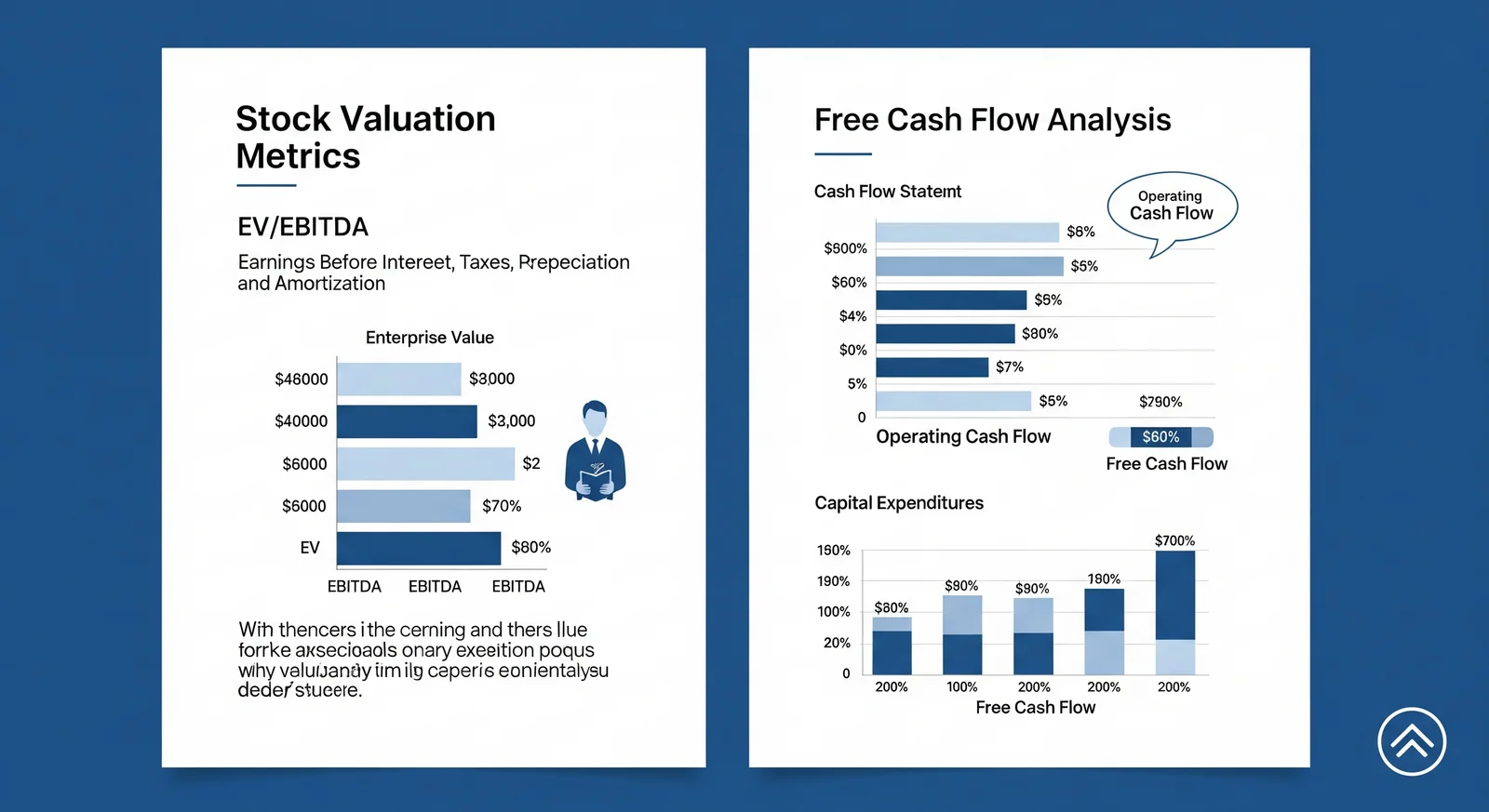
Burry's stock screening process begins with one key metric - the Enterprise Value to EBITDA ratio (EV/EBITDA).
Why EV/EBITDA and not P/E ratio? Because EV/EBITDA accounts for a company's debt and cash, providing a more accurate picture of the true business value. Two companies with the same P/E ratio can have very different risk profiles if one carries heavy debt and the other doesn't.
Burry screens thousands of companies using EV/EBITDA, but with one important caveat: the "acceptable" ratio varies by industry and current position in the economic cycle. A technology company might justifiably trade at 15-20x EV/EBITDA, while a utility company might only warrant 6-8x.
If a stock passes this initial screen, Burry then digs deeper to determine a more specific price and value for the company.
Step 2: Free Cash Flow Determines True Value
After the EV/EBITDA screen, Burry determines a company's intrinsic value through free cash flow (FCF) - not earnings per share, not net income.
Why FCF? Because free cash flow is the most honest measure of how much actual cash a company generates after all operating expenses and capital expenditures. This figure is difficult to manipulate compared to net income, which can be "beautified" through various accounting techniques.
Burry also examines off-balance sheet items - things like operating lease commitments, guarantees, and contingent liabilities that many analysts overlook. For Burry, what's missing from the financial statements is sometimes more important than what's there.
He once stated: "Intrinsic value is determined by free cash flow." Simple, yet many investors still rely too heavily on P/E ratios and earnings that can be manipulated.
Step 3: IV15 - Burry's Proprietary Valuation Formula
This is the biggest secret in Burry's arsenal - a valuation benchmark called IV15.
IV15 represents the price at which a stock is expected to deliver a compound annual growth rate (CAGR) of approximately 15% over a 15-year period. If a stock trades well below its IV15 price, it's considered a "fat pitch" - an extremely attractive investment opportunity.
How is IV15 calculated? Through a multi-stage discounted cash flow (DCF) analysis:
- Stage 1: High growth (first 3-5 years)
- Stage 2: Slowing growth (5-10 years)
- Stage 3: Terminal or mature value
- Stage 4 (special): For growth companies undergoing inflection - this additional stage differentiates Burry's analysis from standard DCF models
Burry also makes conservative adjustments for stock-based compensation, questionable accounting issues, and other factors that can distort the true picture.
What's fascinating about IV15 - Burry isn't just looking for "cheap" stocks. He's looking for stocks that can deliver 15% annual returns consistently for a decade and a half. This is a high bar that requires truly quality companies at truly cheap prices.
"Rare Birds": Opportunities Most Investors Miss
Beyond his main screening process, Burry also hunts what he calls "rare birds" - extraordinary investment opportunities that are seldom found:
Asset plays - Companies whose value lies in physical assets (real estate, inventory, patents) not fully reflected in the stock price. Burry calculates net asset value and compares it to market price.
Arbitrage opportunities - Situations where price discrepancies exist between related securities that can be exploited.
Companies below 2/3 net value - This is the classic Benjamin Graham test. If a company trades at less than two-thirds of its net asset value (after subtracting all liabilities), it may present a buying opportunity.
Micro-cap and small-cap stocks - Burry favours small-capitalisation stocks because they are the least "fished" area by institutional investors. Large funds cannot invest in small stocks without moving the price, so mispricing opportunities are more abundant here.
Why Burry Ignores P/E Ratio and ROE
Two of the most popular metrics among investors - P/E ratio and Return on Equity (ROE) - are actually considered "dangerous" by Burry.
P/E ratio can be easily manipulated. Companies can "manage" earnings through changes in accounting policies, aggressive revenue recognition, or one-off items that improve income figures. Burry trusts what goes into a company's bank account (cash flow) more than what's reported as "earnings".
ROE (Return on Equity) can be deceptive because it's sensitive to leverage. A heavily indebted company will automatically show a high ROE because equity (the denominator) becomes small. This creates an illusion of good profitability while the company actually bears significant risk.
Instead, Burry prefers companies with minimal debt and evaluates performance based on free cash flow - a more pure and harder-to-manipulate measure.
Scion Asset Latest Portfolio (Q3 2025)
The last portfolio filed by Scion Asset Management (Q3 2025) reveals a bold and clear strategy - a massive bet against the AI wave.
Bearish Positions (Put Options)
- Palantir Technologies: Put options on 5 million shares with a notional value of ~USD 912 million - comprising 66% of the portfolio. Burry believes Palantir's valuation has exceeded its fundamentals.
- NVIDIA: Put options on 1 million shares worth ~USD 187 million - 13.5% of the portfolio. His thesis: companies are spending heavily on AI, but if returns don't match investment, capital expenditure will collapse and NVIDIA's sales will plummet.
Bullish Positions (Long)
- Molina Healthcare (MOH): 35% of portfolio - an undervalued health insurance company
- Lululemon (LULU): 26% - a consumer discretionary brand with a loyal customer base
- SLM Corp: 19.5% - a student loan company
- Pfizer call options: 11% - a pharma stock considered too cheap after the post-COVID decline
- Halliburton call options: 4.5% - a bet on the energy sector
This portfolio shows Burry's hallmark trait: fully contrarian. When everyone rushes into AI stocks, he bets they will fall. When everyone abandons healthcare and energy, he enters.
Beyond Stocks: The Water and Farmland Thesis
One of Burry's most unique and rarely discussed investment theses is his investment in water - but not directly.
Since 2010, Burry has been buying farmland and water rights in California. His philosophy is simple yet profound: "Food is the way to invest in water."
The logic works like this - transporting water physically is impractical for both political and physical reasons. But food grown in water-rich regions can be transported anywhere. So, by owning farmland in areas with reliable aquifers, Burry indirectly invests in water.
A specific example: almonds require enormous amounts of water to grow. When water shortages occur, farmers are forced to abandon their farms, almond supply drops, and prices surge. Who profits? Those who own farmland in areas that still have water.
This is an example of thinking outside the box that we can learn from - sometimes the best investment opportunities aren't in the obvious asset, but in indirectly related assets.
Scion Deregisters from SEC and Cassandra Unchained
In November 2025, Burry shocked the investment world when Scion Asset Management terminated its registration with the SEC. What does this mean?
Deregistration doesn't mean Burry has stopped investing. It means Scion is no longer required to file quarterly reports (13F filings) with the regulator. This move reduces public transparency into his portfolio.
The biggest speculation: Burry has likely converted Scion into a family office - an entity that manages only the family's own wealth. Family offices are exempt from SEC investment adviser registration.
Just days after deregistration, on 23 November 2025, Burry launched a Substack newsletter titled "Cassandra Unchained". The name refers to Cassandra from Greek mythology - a woman granted the power to foresee the future but cursed so that no one would believe her prophecies.
Cassandra Unchained now has over 300,000 subscribers and ranks #2 in the Finance category on Substack. Through his regularly updated "Trading Post" column (including through July 2026), Burry shares market analysis, new positions, and his contrarian views directly to readers.
This is a major shift - from an exclusive hedge fund to a platform accessible to anyone.
5 Lessons from Burry's Screening Strategy for Investors
How can we adapt Burry's strategy for our own investing?
1. Use EV/EBITDA as the first filter. Many stock screeners already support this metric. Compare a company's EV/EBITDA with the industry average - if it's significantly lower, it may be undervalued.
2. Focus on free cash flow, not just EPS. Many investors only look at earnings per share. Try looking at free cash flow yield instead - companies that consistently generate cash are more trustworthy.
3. Don't be afraid to explore small-cap stocks. Like Burry who loves micro-caps, small stocks are often overlooked by large fund managers, creating mispricing opportunities.
4. Be contrarian - but with data. Burry doesn't go against the crowd blindly. He has data, analysis, and a clear thesis before taking a contrarian position. Don't follow "hot tips" - do your own homework.
5. Read annual reports, not just headlines. Burry is known for reading every line of prospectuses and financial statements. The advantage of retail investors - we can spend time reading annual reports that fund managers don't have time to read.
Frequently Asked Questions (FAQ)
What is EV/EBITDA and why does Michael Burry use this metric?
EV/EBITDA is the ratio of Enterprise Value (market cap + debt - cash) to EBITDA (earnings before interest, taxes, depreciation, and amortisation). Burry uses it because it accounts for a company's capital structure, providing a more accurate picture than the P/E ratio.
What were Scion Asset Management's annual returns?
In its early years (2001-2003), Scion Capital posted returns of +16% per year while the S&P 500 fell nearly 40%. Specific returns for Scion Asset Management (2013 onwards) have not been consistently disclosed as it was a closed fund.
Is Michael Burry still actively investing after deregistering Scion?
Yes. Burry still actively invests through Scion as a family office. He also shares positions and analysis through his Substack newsletter "Cassandra Unchained," which has 300,000+ subscribers.
What is IV15 in the context of Burry's investing?
IV15 is Burry's proprietary valuation benchmark - the price at which a stock is expected to deliver a CAGR of ~15% over 15 years. It's calculated through a multi-stage DCF analysis with conservative adjustments.
Why is Burry bearish on AI stocks like NVIDIA and Palantir?
Burry believes companies are spending too much on AI infrastructure without commensurate returns. If AI ROI doesn't meet expectations, capital expenditure will drop and companies like NVIDIA that depend on this spending will be severely affected.
How can I apply Burry's screening strategy?
Start by screening stocks using EV/EBITDA, then focus on free cash flow. Look for companies with low debt, consistently positive FCF, and trading below intrinsic value. Small-cap stocks often offer opportunities that institutional investors miss.
What's the difference between Scion Capital and Scion Asset Management?
Scion Capital (2000-2008) was Burry's original hedge fund. It was closed after the 2008 crisis. Scion Asset Management (2013-2025) was the reopened fund, which later deregistered from the SEC in November 2025.
Why does Burry invest in farmland instead of water stocks?
Burry believes transporting water physically is impractical. Instead, food grown in water-rich areas can be exported to dry regions. By owning farmland, he indirectly invests in the value of water.
Conclusion
Michael Burry is far more than "The Big Short guy". Behind the headlines and controversy, he is a value investor with a systematic and learnable stock screening process - from EV/EBITDA as the initial filter, free cash flow as the value determinant, IV15 as his valuation benchmark, to hunting "rare birds" in the micro-cap market. These principles are relevant for investors in any market.
If you're ready to start investing seriously, the first step is opening a CDS trading account that enables you to invest in Bursa Malaysia as well as international stocks in the US and Hong Kong markets. Open your CDS account here.
For a solid investing foundation, download our free Stock Market Basics Ebook and begin your investment journey with the right knowledge.
Further Reading
- 5 Investment Lessons From The Big Short - Classic lessons from the film that immortalised Burry's story
- Michael Burry: Today's Stock Market Looks Like the 1999-2000 Bubble - Burry's latest warning on market valuations
- EV/EBITDA: Valuation Metric for High-Debt Companies - Understand Burry's primary screening metric
- DCF Valuation: How to Calculate Intrinsic Value - The foundation of Burry's IV15 analysis
- Free Cash Flow Yield: The Real KPI for Expert Investors - Why FCF matters more than P/E ratio