Negeri Sembilan Political Crisis: What Bursa Malaysia Investors Need to Know

Negeri Sembilan is going through a political crisis that has not been witnessed since independence. What began as an internal institutional dispute between the Yang di-Pertuan Besar and the Undang Yang Empat has expanded into a constitutional crisis and eventually shaken the state government led by Pakatan Harapan. For Bursa Malaysia investors, the question is no longer simply who is right or wrong - it is how much political instability in a state that hosts the Malaysia Vision Valley 2.0 mega project will affect market sentiment, foreign fund flows, and long-term investment planning.
This article maps out the chronology of the crisis, explains the unique Adat Perpatih structure at the root of the dispute, and offers a policy assessment of its implications for investor portfolios.
What Is Actually Happening in Negeri Sembilan?
On 19 April 2026, four individuals holding the title of Undang Luak, led by the Undang Luak Sungai Ujong, Datuk Mubarak Dohak, declared the deposition of Tuanku Muhriz ibni Almarhum Tuanku Munawir as the Yang di-Pertuan Besar of Negeri Sembilan. They also named Tunku Nadzaruddin ibni Almarhum Tuanku Ja'afar as the successor. According to Wikipedia, the declaration was based on powers granted to the Undang Yang Empat under the Constitution of Negeri Sembilan.
However, the state government led by Menteri Besar, Datuk Seri Aminuddin Harun, rejected the declaration. The main argument: Datuk Mubarak Dohak himself had been removed as Undang Luak Sungai Ujong by the Dewan Keadilan dan Undang (DKU) on 17 April 2026, two days before the deposition announcement. Therefore, one of the four Undang making the decision was, in fact, no longer validly holding the office, making the collective decision procedurally void.
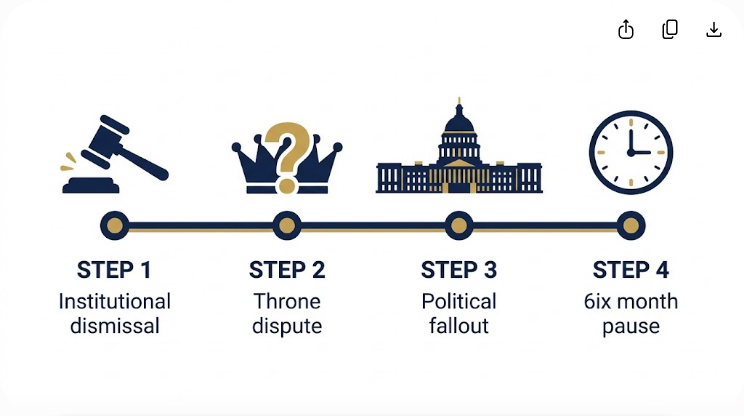
The royal conflict then spilled over into the civil political arena. On 27 April 2026, all 14 Barisan Nasional state assemblymen (ADUN), mostly from Umno, announced the withdrawal of support from the Menteri Besar. Malay Mail reported that the move left the PH bloc with only 17 seats in the 36-seat assembly, two seats short of holding a simple majority.
Quick Chronology of the Crisis
| Date | Event |
|---|---|
| 17 April 2026 | DKU accepts the removal of Datuk Mubarak Dohak as Undang Luak Sungai Ujong over 33 grounds of adat violations |
| 19 April 2026 | Four Undang declare the deposition of Tuanku Muhriz and name Tunku Nadzaruddin as successor |
| 20 April 2026 | State government formally rejects the declaration |
| 27 April 2026 | 14 BN assemblymen withdraw support from MB Aminuddin Harun |
| 5 May 2026 | Four Undang take the adat crisis to court |
| 6 May 2026 | PH and BN reach an agreement to defer the state assembly sitting for 6 months |
| 7 May 2026 | Political crisis "deferred" - MB Aminuddin temporarily safe |
The Root Cause: Adat Perpatih and the Role of the Undang Yang Empat
To understand this crisis, investors need to grasp one critical fact: Negeri Sembilan is the only monarchy in Malaysia that uses an elective ruler system rather than direct hereditary succession. The Yang di-Pertuan Besar is selected by the Undang Yang Empat from among the descendants of Raja Radin and Raja Lenggan. The system is rooted in the Adat Perpatih custom brought in from Minangkabau, West Sumatra.
The four luaks represented are Sungai Ujong, Jelebu, Johol, and Rembau. Each luak is headed by an Undang chosen by the Dato' Lembaga within the respective luak with the consent of the Ibu Soko (female adat heritage leaders). According to a Malay Mail explainer, not only do the Undang Yang Empat have the power to elect the Yang di-Pertuan Besar, they also have the constitutional power to force the ruler to abdicate.
The seeds of this tension actually go back to 2024, following the delay of the Istiadat Menyalang for the 22nd Undang Luak Rembau. Malaysiakini explains that the delay created the perception that Istana Seri Menanti was slow to recognise adat luak leaders, which undermined the balance of power between the two institutions - the throne and the adat.
The Constitutional Question: Is the Ruler or the Undang Yang Empat More Powerful?
The fundamental question now troubling constitutional law experts is: who holds greater authority between the Yang di-Pertuan Besar and the Undang Yang Empat under the Constitution of Negeri Sembilan? The National Security Council portal notes that both institutions have overlapping jurisdictions, and the current situation is the first time in modern history that this overlap has been tested openly.
The four Undang argue that the Constitution gives them explicit authority to elect and depose the Yang di-Pertuan Besar. But the state government and the palace argue that the deposition process must follow strict procedures and cannot be carried out by an Undang who has himself lost eligibility. The dispute has now been taken to court, and FMT reports that the four Undang filed legal action on 5 May 2026.
From a policy analyst's perspective, this is not merely a personal dispute. It exposes structural weaknesses in the Constitution of Negeri Sembilan, which does not provide a clear dispute resolution mechanism between the adat institution and the palace. This is unlike other Malaysian states where the ruler holds more direct and clearly defined executive authority.
The Civil Political Fallout: Minority Government and the PH-BN Test
The withdrawal of support by 14 BN assemblymen technically left the PH state government as a minority government. In the 36-seat assembly, PH holds only 17 while 19 are needed for a simple majority. Perikatan Nasional (PN) with 5 seats had in fact offered an alternative "Unity Government" deal to Umno to topple Aminuddin Harun.
However, on 6 May 2026, the top leadership of PH and BN met and reached a compromise: the state assembly sitting would be deferred for six months. Sinar Harian and FMT reported that the agreement means no motion of no confidence can be tabled against Aminuddin until the assembly reconvenes in October 2026. This agreement, however, is only a deferral - not a resolution.
From a political analysis standpoint, the Negeri Sembilan crisis is a genuine stress test of the compatibility of the PH-BN alliance at the federal level. If Umno can withdraw support from the PH state government in Negeri Sembilan, what guarantee is there that similar moves will not be replicated in other states down the line? This is why political analysts view this episode as a "litmus test" of the resilience of the Madani government.
Implications for the Economy and Bursa Malaysia Investors
So far, Communications Minister Datuk Fahmi Fadzil has stated that the Negeri Sembilan crisis has not affected relations among parties in the federal government. The Bursa Malaysia stock market has also not shown any significant panic reaction. This indicates that institutional investors are already differentiating between state-level political instability and federal-level stability.
However, medium-term effects should not be dismissed. Here are four transmission channels that investors should monitor:
First: Risk to State Investment Projects. Negeri Sembilan hosts the Malaysia Vision Valley 2.0 (MVV2.0) mega project worth approximately RM294 billion. Any instability in state administration could delay permit approvals, land allocations, and investor incentive frameworks. Listed companies with exposure to this project, such as property developers and infrastructure contractors, may face short-term share price pressure.
Second: Foreign Fund Flow Sentiment. Foreign investors are extremely sensitive to political risk. Although this crisis is state-level, the perception of instability can reduce risk appetite for Malaysian assets as a whole. Investors can monitor weekly foreign fund flow data published by MIDF Research to detect any anomalous outflows.
Third: Early PRN Speculation. If Aminuddin Harun chooses to dissolve the assembly after the six-month period to avoid a no-confidence vote, Negeri Sembilan could hold a state election as early as early 2027. State elections typically create short-term volatility in shares with state-level exposure. Historical data shows the pattern of KLCI performance before and after general elections has a cycle that disciplined investors can anticipate.
Fourth: Short-Term Ringgit Risk. Political uncertainty usually adds selling pressure on the currency. While the ringgit has remained stable so far, investors should be aware that ringgit movements have direct effects on Bursa portfolios, especially for export-oriented stocks such as rubber, gloves, and technology.
A Policy Analyst's View: Three Scenarios to Consider
In uncertainty, policy discipline teaches us to think in terms of scenarios, not single forecasts. Here are three plausible scenarios for how this crisis could unfold:
Scenario A (high probability): Political Resolution Through a New MB. The Yang di-Pertuan Besar could revisit the issue after the court decision, and if BN-Umno remains unconvinced, a new MB could be appointed from among the assemblymen with majority support. This scenario ends the crisis without a state election.
Scenario B (moderate probability): Early Negeri Sembilan State Election in 2027. Aminuddin Harun dissolves the assembly before a no-confidence motion can be tabled, triggering a state election. This scenario is the best for markets because it offers a definitive resolution and a fresh mandate.
Scenario C (low but not impossible probability): A Drawn-Out Crisis. The government remains in power with a thin majority while the courts process the adat dispute. This is the worst scenario for investors because it prolongs uncertainty and could undermine long-term investor confidence in the state economy.
What is interesting from a policy standpoint is that this crisis exposes the need to modernise the Constitution of Negeri Sembilan so that there is a clearer dispute resolution mechanism between the royal and adat institutions. Without such reform, the risk of similar episodes repeating remains high.
What Investors Can Do Right Now
The first discipline in managing political risk is avoiding emotional decisions. Here are three practical steps:
-
Filter news with a 3-tier framework. Not every political headline deserves to influence your investment decision. Use the news vs noise framework to filter which information truly has material impact on your portfolio.
-
Review your portfolio's exposure to Negeri Sembilan-linked stocks. If you hold property developers, construction companies, or infrastructure plays with major projects in Negeri Sembilan, run a fresh risk assessment specific to those companies. Not to panic-sell, but to understand how concentrated your risk is.
-
Avoid common mental biases. Political crises trigger the seven main mental biases of investors - including loss aversion, recency bias, and herd behaviour. Long-term winners are those who act on investment theses, not headlines.
FAQ - Frequently Asked Questions About the Negeri Sembilan Political Crisis
1. What is the main cause of the political crisis in Negeri Sembilan?
The crisis began when the Undang Luak Sungai Ujong, Datuk Mubarak Dohak, was removed from office on 17 April 2026, followed by the four Undang declaring the deposition of the Yang di-Pertuan Besar on 19 April. The state government did not recognise the action, and ultimately 14 BN assemblymen withdrew support from MB Aminuddin Harun.
2. Who is the Yang di-Pertuan Besar of Negeri Sembilan now?
Tuanku Muhriz ibni Almarhum Tuanku Munawir remains the Yang di-Pertuan Besar recognised by the federal government and the state government. The deposition declared by the four Undang is not officially recognised.
3. Will Negeri Sembilan hold a state election soon?
For now, the state assembly sitting has been deferred for six months until October 2026 following the PH-BN agreement. A state election has not been called, but there is a possibility it could happen in early 2027 if the crisis drags on.
4. What is Adat Perpatih and why does it matter in this crisis?
Adat Perpatih is the traditional customary system of Negeri Sembilan, brought in from Minangkabau. It grants the Undang Yang Empat the power to elect and depose the Yang di-Pertuan Besar. The current crisis is a dispute about the boundaries of authority between the adat institution and the palace under the state Constitution.
5. Is this crisis affecting the Malaysian economy overall?
So far, the impact on the federal economy is minimal. Bursa Malaysia has not shown panic reactions and the ringgit remains stable. However, the Malaysia Vision Valley 2.0 mega project in Negeri Sembilan may face delay risks if instability persists.
6. I hold property developer stocks with Negeri Sembilan exposure - what should I do?
Do not act emotionally. Reassess your original investment thesis: are the fundamental catalysts still intact? Do the projects you are interested in still have financial justification even with possible delays? If yes, hold. If not, consider rebalancing but avoid panic selling.
7. What is the power of the Undang Yang Empat under the state Constitution?
The Undang Yang Empat have the power to elect the Yang di-Pertuan Besar from among the descendants of Raja Radin and Raja Lenggan, and they are also granted the authority to force the ruler to abdicate in certain conditions under the Constitution of Negeri Sembilan. However, the procedures and conditions for deposition remain a legal dispute currently being brought to court.
8. Why is this crisis erupting now and not earlier?
Although the seeds of tension between the palace and adat institutions had existed since 2024 following the Istiadat Menyalang delay for the Undang Luak Rembau, the crisis became open when the removal of Datuk Mubarak Dohak was announced on 17 April 2026, triggering a chain reaction that ultimately led to the political battle at the state assembly level.
Conclusion
The Negeri Sembilan political crisis is a unique event combining adat, constitutional, and party-political questions. For investors, it serves as a reminder of the importance of not acting on hot headlines but instead analysing real, material risks. So far the impact on Bursa Malaysia is minimal, but investors with exposure to state-level projects like MVV2.0 should monitor developments closely over the next six months.
The next step for those who want to be better prepared to face political volatility in investing is to strengthen their fundamentals and access wider markets.
Open a CDS trading account today for full access to Bursa Malaysia stocks as well as international stocks such as the United States and Hong Kong markets, so that your portfolio is more diversified across geographies and not fully exposed to local political risk.
Download the Stock Market Basics Ebook for free to understand the fundamental analysis framework and risk management approach that helps you make calm decisions in moments of political uncertainty like this.
Further Reading
- Malaysia Vision Valley 2.0: The RM294 Billion Mega Project in Negeri Sembilan Investors Need to Know
- General Elections & Bursa Shares: The Real KLCI Performance Pattern Before/After Malaysian Elections
- Foreign Fund Flow: How to Read Foreign Capital Data to Predict Bursa Direction
- How to Filter News vs Noise: A 3-Tier Framework for Bursa Malaysia Investors
- Investor Psychology: 7 Mental Biases That Make You Lose Money on Bursa Malaysia