Oppstar Shares Surge 79%: ARM Design Token Access & What It Means for Malaysia's Chip Industry

On May 11, 2026, Oppstar Berhad (0275) shares surged nearly 79% in a single trading session after the company was confirmed as one of three local firms to receive access to ARM Limited's chip design technology through a Malaysian government initiative. For retail investors hearing this news for the first time, the key question isn't about today's share price - it's about what ARM design token access actually means, why it's significant, and how it reshapes the local semiconductor landscape.
This is not an empty pump. According to The Edge Malaysia (May 11, 2026), Oppstar - alongside SkyeChip Bhd and Great Asic Technology Sdn Bhd - received formal offer letters for access to Arm Flexible Access (AFA) and Neoverse Compute Subsystems (CSS) technologies. The ceremony was officiated by Economy Minister Datuk Seri Mohd Akmal Nasrullah Mohd Nasir in Putrajaya.
In this article, we unpack: - What are ARM design tokens (AFA & CSS) and why they're costly in the open market - Background of the Malaysia-ARM US$250 million (RM1.1 billion) 10-year deal - Why Oppstar was selected and its competitive advantages - Government target: 10 local chip companies generating US$20 billion annually within 5-7 years - Implications for Bursa Malaysia investors (Oppstar, OSAT, semiconductor ecosystem) - Risks investors must understand before chasing momentum
What Was Announced on May 11, 2026?
On Monday, May 11, 2026, the Malaysian government formally handed offer letters to three local chip design firms for ARM technology access. The exact breakdown:
| Company | Listed Status | ARM Tokens Received |
|---|---|---|
| Oppstar Technology Sdn Bhd (parent: Oppstar Berhad, code 0275) | Listed Bursa Malaysia (ACE Market) | AFA |
| SkyeChip Bhd | Not listed (private) | AFA |
| Great Asic Technology Sdn Bhd | Not listed (private) | AFA + CSS |
Quick interpretation: - AFA = Arm Flexible Access: a flexible access package for startups & SMEs. Provides early access to ARM's chip design library without prohibitive upfront licensing fees. - CSS = Arm Compute Subsystems (Neoverse series): pre-built chip components for larger enterprises wanting to speed up processor design without starting from scratch.
According to Business Today Malaysia, the initiative allocates 25 AFA tokens and 7 CSS tokens to be loaned to local firms over the deal period.
Drastic Market Reaction
Oppstar shares, which opened around RM0.43 (43 sen) before the announcement, peaked at 76 sen - a near 79% gain in a single day (source: theedgemalaysia.com/node/803121). This is the most significant surge for Oppstar since their ACE Market debut in 2023 (which also pumped 286% on day one - see our prior article).
What Is ARM Limited and Why Is This Access Valuable?
To understand investor excitement, you need to understand who ARM is:
ARM Limited - "Switzerland of Semiconductors"
ARM Limited is a CPU architecture design firm based in Cambridge, UK. Owned by Japan's SoftBank Group Corp. ARM doesn't produce chips themselves - they license designs to other companies who then fabricate their own chips.
ARM's scale of impact: - >99% of smartphones worldwide use ARM designs (including Apple A-series, Qualcomm Snapdragon, Samsung Exynos, MediaTek Dimensity) - AWS Graviton, Microsoft Cobalt, Apple M-series for data center servers - NVIDIA Grace (CPU for AI superchips) is ARM-based - Tesla, Mercedes, BMW and most automakers use ARM for vehicle SoCs
ARM is the "Switzerland of Semiconductors" - most of the global chip industry depends on ARM-owned IP (intellectual property).
ARM Licensing Costs on the Open Market
Access to ARM design technology is not cheap: - Full architecture license (Custom CPU): USD millions in upfront fees + per-chip royalty - Standard core IP license: hundreds of thousands USD annually - Arm Flexible Access (AFA) commercial: ~USD 75,000-150,000 annually for startup access - Compute Subsystems (CSS): project-based licensing, can reach USD millions
For Malaysian chip startups with limited capital, these costs were previously prohibitive. This is why investors view this government-subsidized access as a "game-changer".
Malaysia-ARM Deal: Background
The token offering to these 3 firms is the outcome of a 10-year framework agreement signed between the Malaysian government and ARM in March 2025. Deal value: US$250 million (RM1.1 billion).
Key Deal Components:
- Technology access: 25 AFA tokens + 7 CSS tokens for loan to local firms
- Expertise training: training programs for Malaysian engineers
- Commercial target: seed 10 local chip companies generating collectively US$20 billion annually within 5-7 years
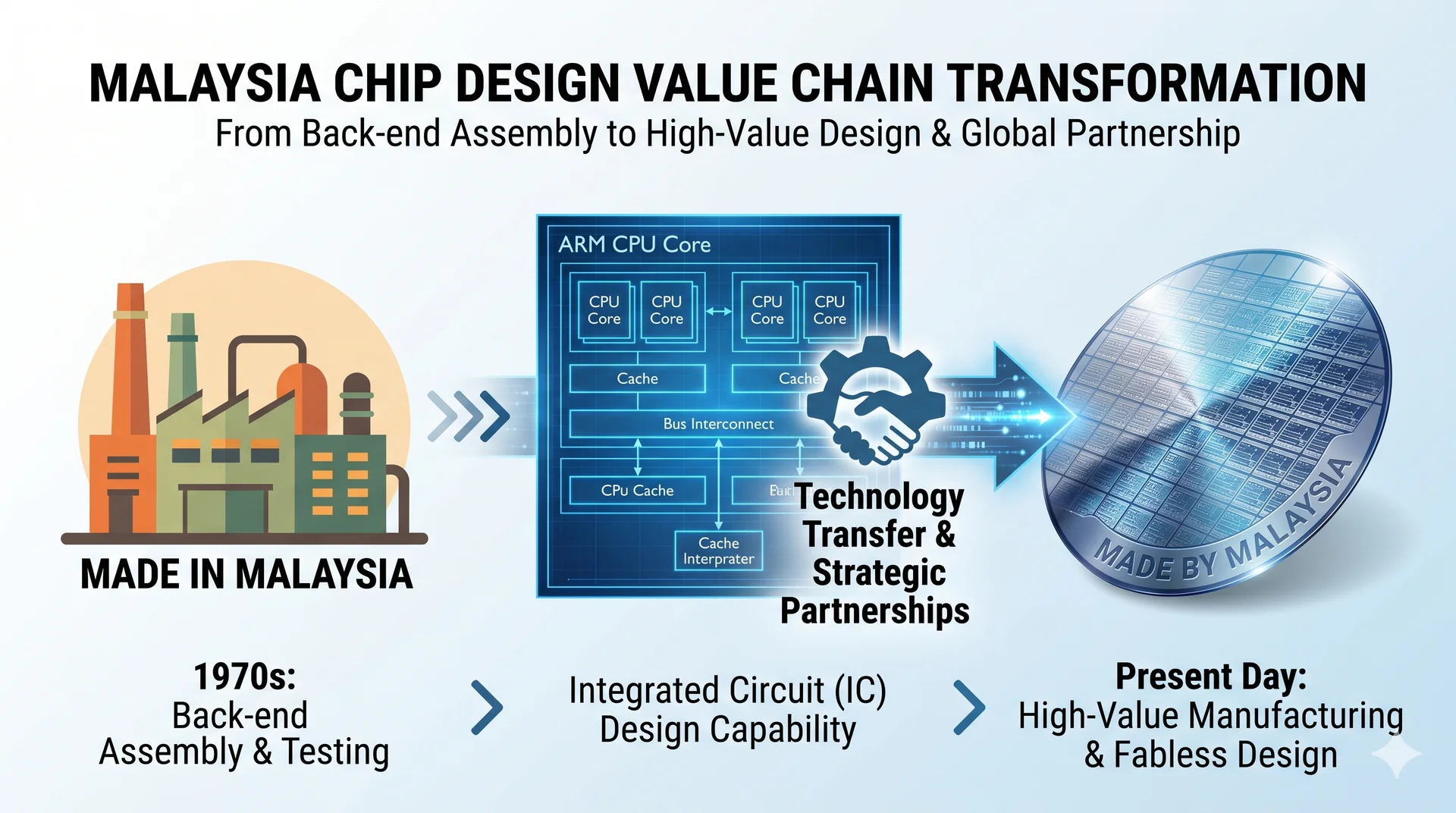
- "Made by Malaysia" vision: shift from "Made in Malaysia" (assembly) to "Made by Malaysia" (original design)
According to FMT (May 11, 2026), Economy Minister Akmal Nasrullah stated the initiative "will accelerate growth of local technology champions and elevate Malaysia as a meaningful global semiconductor player".
Steering Committee
The cooperation steering committee involves: - Ministry of Economy (lead) - MOSTI (Ministry of Science, Technology & Innovation) - MIDA (Malaysian Investment Development Authority) - MDEC (Malaysia Digital Economy Corporation) - Industry representatives
Oppstar Berhad (0275) Profile
For investors new to Oppstar, a quick profile:
Corporate Background
- Listing: ACE Market Bursa Malaysia in March 2023
- IPO debut: surged 286% on first day (RM0.63 → RM1.83)
- Founder: Datuk Ng Meng Thai and local engineering team
- Main offices: Penang & Selangor
- Target market: turnkey IC design services - front-end, back-end, and integrated solutions
Business Model
Oppstar isn't a chip fabricator - they are an IC Design Services Provider. Meaning: - Clients (typically international semiconductor companies or hyperscalers) bring chip specifications - Oppstar designs the chip (architecture, layout, verification) - Chips are then fabricated at foundries like TSMC or Samsung
This is an asset-light model - no requirement for billion-dollar capex for fabs. Margins depend on engineering talent and proprietary IP.
Existing Customers
According to Oppstar's corporate profile on i3investor, main clients include semiconductor companies in China, Taiwan, and South Korea. Current strategy is expansion into US and EU clients.
What Changes with ARM AFA Access?
Before ARM access, Oppstar could design chips - but was limited to: - IP licensed by clients themselves (Oppstar designs per client specs) - Open-source IP (e.g., RISC-V) - Custom designs more primitive without modern CPU cores
With AFA access, Oppstar can now:
- Build chips with modern ARM cores (Cortex-A, Cortex-M, Cortex-R) as building blocks
- Offer to new clients wanting ARM-based chips - especially for IoT, automotive, edge AI
- Develop own IP using ARM as foundation - then sub-license to clients
- Lower time-to-market - designs previously taking 12-18 months can be shortened to 6-9 months
- Attract tier-1 clients that previously couldn't work with Oppstar due to lack of ARM access
"Made by Malaysia" Target - What Does It Mean?
The government initiative is part of the National Semiconductor Strategy (NSS) launched in May 2024. NSS targets:
Quantitative Targets (2030)
- 10 local chip companies generating US$20 billion+ annually (collective)
- 2 "tier-1 fabless" companies with US$1 billion market cap each
- Production of Malaysian-designed chips sold to the global market
What Does "Made by Malaysia" Mean?
| Era | Model | Main Malaysian Activity |
|---|---|---|
| 1970-2010 | Made in Malaysia | Chip assembly & test (back-end) - INARI, MPI, UNISEM |
| 2010-2024 | Designed with Malaysia | Partial design (front-end OSAT services) - early Oppstar |
| 2024-2030 | Made by Malaysia | Complete chips designed, owned & marketed by Malaysia |
This is a strategic leap - from low value chain (assembly) to highest (design + IP ownership).
Implications for Bursa Malaysia Investors
How does this news affect your portfolio? Several angles:
1. Direct Beneficiary: Oppstar (0275)
Oppstar is the only one of the 3 firms listed on Bursa. Implications: - Revenue visibility: new contracts likely within 12-24 months - Margin expansion: if they successfully develop proprietary IP, design margins could rise from 15-25% to 30-40% - Valuation re-rating: from "IC design service provider" to "fabless IP company"
However - the 79% single-day surge has already priced in some of this potential. Investors must consider post-rally valuation.
2. Indirect Beneficiary: OSAT Ecosystem
Bursa Malaysia OSAT (Outsourced Semiconductor Assembly & Test) stocks will gain spillover effect if the local chip industry grows: - INARI (0166) - RF assembly & advanced packaging - VITROX (0097) - automated optical inspection equipment - PENTA (7160) - automated test equipment - FRONTKN (0128) - precision cleaning for semiconductor - UNISEM (5005) - assembly & test services - MPI (3867) - packaging for automotive & industrial
If 10 local chip firms truly emerge within 5-7 years, demand for local assembly, testing, and equipment will rise.
3. Long Tail Beneficiary: Tech Service Providers
- GHL (0021) - payments tech (for payment chips)
- MYEG (0138) - eGovernment services (government tenders)
- DSONIC (5216) - biometric tech
Less direct but the "Made by Malaysia" theme can lift sector-wide sentiment.
Risks Investors Must Understand
Before making impulsive decisions based on headlines, understand the risks:
1. High Execution Risk
The "10 firms with US$20 billion revenue" target is extremely ambitious. For context: - 2025: Oppstar's annual revenue ~RM100 million (~US$22 million) - 2030 target: US$20 billion collective from 10 firms = average US$2 billion each - Means Oppstar needs to scale ~100x in 5 years
Malaysia's tech industry history shows scale-up execution is a major challenge. Many government initiatives (mySalam, MyKad chip, BIONEXUS) didn't reach original targets.
2. Slow Time-to-Revenue
Chip design cycle: - AFA access: day 1 - Develop first product: 12-18 months - First customer engagement: 18-24 months - Mass production revenue: 24-36 months
Means impact on Oppstar's P&L may only materialize in FY2027-2028, not FY2026. Investors entering on current sentiment may need to wait 2-3 years.
3. Geopolitical Risk
Semiconductor industry is a US-China tech war battlefield. Risks: - US sanctions on ARM ecosystem to certain countries could affect Oppstar's clients - China pressure on Malaysian companies seen as too cozy with the West - Tariffs & export controls can disrupt supply chains
4. Government Concentration Risk
This initiative depends on policy consistency for 10 years. Government changes, budget priority shifts, or political scandals can delay implementation.
5. Valuation Risk After Pump
After a 79% single-day surge, Oppstar's valuation is likely stretched. P/E at peak may exceed 80-100x - a level hard to sustain unless growth truly materializes.
What Should Investors Do? (Not a Buy/Sell Call)
I'm not in a position to give buy or sell recommendations. But as an investor thinking through risk frameworks, here are considerations:
1. Distinguish Between "Newsflow Trade" vs "Fundamental Investment"
- Newsflow trade: betting on share momentum over days-weeks. High risk, requires disciplined stop-loss.
- Fundamental investment: hold 2-3 years to see "Made by Malaysia" theme mature. Lower concentration, ride structural growth.
Pick the approach that suits your profile - don't mix.
2. Don't Chase at the Top
Oppstar IPO 2023 history: - Day 1: +286% (RM0.63 → RM1.83) - Month 3: fell to RM0.55 (-70% from peak)
The current 79% pump may experience significant pull-back in coming weeks-months. Investors entering at RM0.76 face drawdown risk of 30-50%.
3. Seek More Diversified Exposure
Instead of all-in on Oppstar, consider the ecosystem: - OSAT names (INARI, VITROX, PENTA) that benefit from volume increases - Bursa tech ETFs if available - Watchlist private firms (SkyeChip, GreatAsic) if they IPO in the future
4. Monitor Important Milestones
Note dates that signal real achievement: - Q3 2026: Oppstar's first design win using ARM AFA - Q4 2026 - Q1 2027: First chip tape-out (ready for production) - H2 2027: First mass production revenue - 2028: NSS interim target achievement
If milestones slip, downgrade expectations.
5. Consider Shariah Compliance Status
Oppstar Berhad - check current Shariah compliance status. For strict Muslim investors, refer to the latest SC Shariah-Compliant Securities List before investing.
FAQ: Common Questions
1. Will Oppstar shares definitely rise after this news?
No guarantee. While the fundamental story is compelling, a 79% single-day surge is typically followed by profit-taking. Oppstar's 2023 IPO history (peak +286%, then -70%) shows rapid momentum can reverse.
2. What's the difference between Oppstar and INARI or VITROX?
- Oppstar: IC Design Services - chip design
- INARI: OSAT - assembly, test, advanced packaging for RF
- VITROX: Equipment maker for AOI inspection
They are complementary, not competitors. The chip industry needs all these segments.
3. How much in ARM licensing costs does Oppstar get free via the government?
Not publicly confirmed yet. But estimated: - Standalone AFA value: USD 75,000 - 150,000 annually - Each token may cover 1-3 years of access - Savings to Oppstar: at least USD 200,000 - 450,000
But strategic value is greater than nominal cost - access to ARM IP opens customer markets previously closed.
4. When will Oppstar show revenue from this deal?
Realistic timeline: FY2027-2028 for significant P&L impact. ARM-based chip design needs 12-18 months, customer engagement another 6-12 months, before mass production revenue.
5. Will SkyeChip or GreatAsic IPO after this?
No announcements yet. SkyeChip received investment from Khazanah Nasional in 2024 - potential 2027-2028 IPO possible. GreatAsic is private with MOSTI tech background.
6. What's the difference between AFA and CSS in ARM access?
AFA (Arm Flexible Access): - Early access to ARM standard design library - Suitable for startups and SMEs - Lower royalty rate - Can experiment before committing to full license
CSS (Compute Subsystems): - Pre-built chip components (Neoverse for servers) - Suitable for large companies with specific projects - Dramatically speeds up time-to-market - Higher cost but more powerful
Oppstar received AFA - suitable for their current stage. GreatAsic received both - meaning their projects are more ambitious.
7. Can Malaysia compete with TSMC or Samsung?
Not in leading-edge chip foundry (3nm, 5nm) - that requires USD 20-40 billion capex. But Malaysia can compete in: - Specialty chips: automotive, IoT, edge AI - Mature nodes: 28nm, 14nm still have strong demand - IC design services: leverage low-cost talent vs US/EU
Niche play, not head-to-head with giants.
8. What's the biggest risk for Oppstar investors?
Three main risks: 1. Execution gap: from promise to delivery always has a gap in government projects 2. Stretched valuation: 79% pump has priced in growth optimism 3. Geopolitical: US-China tech war can disrupt customer base
Conclusion
The 79% surge in Oppstar shares on May 11, 2026 isn't an empty pump - it's driven by significant news, namely access to ARM design tokens via a Malaysian government initiative worth US$250 million. This is a strategic breakthrough opening Oppstar's transition from IC design services provider to fabless IP company with higher margins and a larger addressable market.
However, investors must understand that time-to-revenue is slow (FY2027-2028 for significant impact), execution risk is high, and post-pump valuation is already stretched. For those newly exposed to Oppstar after the news, carefully consider whether you want to make a short-term "newsflow trade" or a 3-5 year "structural investment".
Before making any investment decisions, ensure you have an active trading account to enable access to Bursa Malaysia.
To start investing in Bursa Malaysia (including Oppstar and other semiconductor stocks) and overseas markets like the US and Hong Kong, register your CDS account with Mahersaham here.
For stock investing fundamentals including how to read financial statements, valuing semiconductor companies, and portfolio risk management strategies, get our free stock investing fundamentals ebook.
Further Reading
- Oppstar Surged 286% on ACE Market Debut - Historical context for Oppstar's IPO 2023 pump
- Beyond NVIDIA: 8 Companies Profiting from the AI Boom - Diversifying across the semiconductor value chain
- AI Memory Chips: Samsung Joins the Trillion Dollar Club - Global semiconductor cycle context
- Michael Burry: Today's Market Feels Like 1999-2000 Bubble - Risk management in the AI/semiconductor theme
- Construction Stocks: MRT3 & When the Cycle Recovers - Bursa Malaysia sector cycle theme