OPR Decisions: Impact on the Economy & Malaysian Stock Market

OPR Decisions by Bank Negara Malaysia play a crucial role in determining the direction of the national economy and stock market movements. Investors need to understand how OPR decisions affect loans, consumer spending, and investment opportunities on Bursa Malaysia.
Overnight Policy Rate (OPR) Decisions refer to the benchmark interest rate set by Bank Negara Malaysia (BNM). This rate is important because it determines the cost of borrowing between banks and serves as the basis for lending rates charged to consumers and companies in Malaysia.
Every time BNM announces a change in the OPR, the stock market tends to move actively as investors assess the impact on corporate earnings and economic growth.
Watch the OPR explainer video here.
What is OPR?
The OPR is the interest rate used by banks to lend or borrow funds among themselves overnight. Changes to the OPR cause banks to adjust the lending and savings rates charged to their customers.
When the OPR changes, it affects:
Home and car financing
Credit card interest rates and personal loans
Corporate financing costs
Consumer spending in the economy
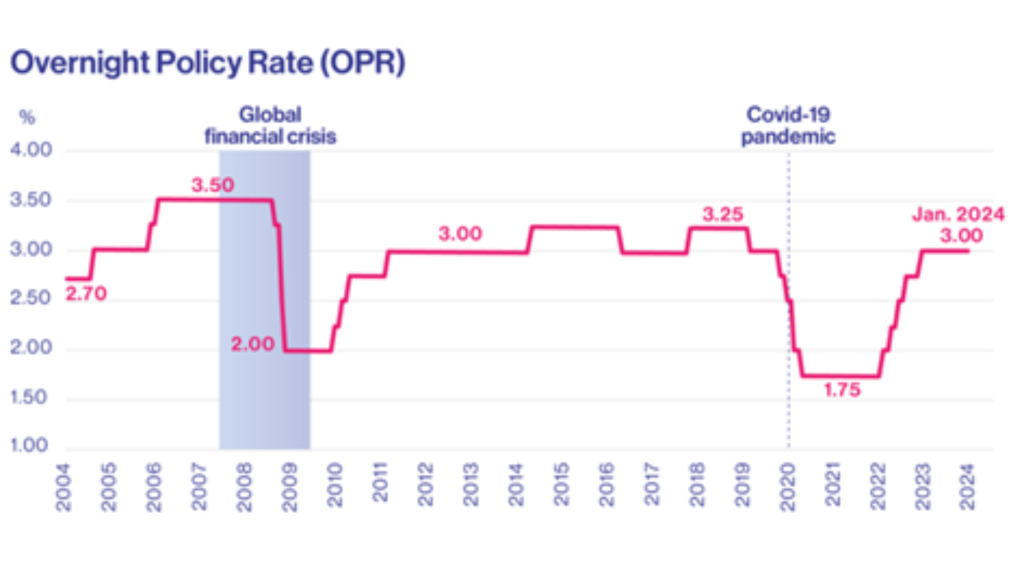
Source: Bank Negara Malaysia
How OPR Decisions Affect the Malaysian Economy
OPR Hike: Cooling the Economy (Tightening)
When OPR Decisions result in a rate hike, borrowing becomes more expensive. Individuals with home or car financing will see an increase in monthly repayments, reducing their ability to spend on other things. Reduced consumer spending affects retail sales, the consumer sector, and corporate investment.
Companies are also forced to postpone new projects or investments as the cost of capital increases. Therefore, an OPR hike is typically used to reduce inflation and prevent the economy from overheating.
In summary, an OPR hike slows down the economy, reduces purchasing power, and makes businesses more cautious.
OPR Cut: Stimulating the Economy
When BNM lowers the OPR, borrowing becomes cheaper. Individuals are more inclined to buy homes or cars as instalments become lower. Companies are also more motivated to borrow capital to expand their businesses.
This increases spending and economic activity. When spending rises, company revenues increase, and the economy moves faster.
In summary, an OPR cut stimulates economic growth and boosts market confidence.
How BNM Determines OPR Decisions
OPR Decisions are not made randomly -- they go through a thorough assessment by the Monetary Policy Committee (MPC), which typically meets 8 times a year.
Key Factors Considered by BNM
BNM collects data, analyses economic trends, and evaluates current risks before deciding whether to raise, lower, or maintain the OPR.
1. Inflation (Rising Prices)
Inflation is the most critical factor.
If inflation rises too high, BNM will consider raising the OPR to reduce borrowing and spending activity.
Conversely, if inflation is low or the economy is weak, BNM may lower the OPR to encourage consumers to spend more.
2. Economic Growth (GDP)
BNM examines Gross Domestic Product (GDP) data to assess the health of the economy.
- If GDP slows down, the OPR may be lowered.
- If GDP is overheating, the OPR may be raised.
This ensures the economy remains at a level of stable growth.
3. Job Market Conditions
The unemployment rate is also taken into account.
A strong job market usually indicates a healthy economy and reduces the need for an OPR cut.
4. Financial Stability & Credit Flow
BNM also monitors the risk of excessive household debt.
If the public is heavily indebted, BNM may raise the OPR to control borrowing.
5. Global Economic Conditions
Any global uncertainty such as:
Changes in Fed (Federal Reserve -- the US central bank) policy,
Trade wars,
Oil and commodity prices.
If the global economy slows, Malaysia may need to ease monetary policy (lower OPR) to support the domestic economy.
Summary of BNM OPR Decision Logic
| Economic Situation | OPR Action | Purpose |
|---|---|---|
| High inflation, overly aggressive lending | Raise OPR | Prevent debt bubble, stabilise prices |
| Slow economy, consumers spending less | Lower OPR | Encourage borrowing, spending & investment |
Impact of OPR on the Bursa Malaysia Stock Market
OPR changes affect the stock market because they influence borrowing costs, consumer spending, and corporate profits.
When the OPR is raised, stocks tend to weaken. Corporate borrowing costs increase, and investors are more inclined to park their money in safer instruments such as fixed deposits or bonds. Sectors such as property, construction, and consumer are usually most affected as they are dependent on financing.
When the OPR is lowered, the stock market has the potential to rise. Corporate financing costs become lower and consumers have greater purchasing power. Sectors such as property, consumer, and REITs typically benefit. Investors also tend to seek higher-return investments such as equities.
How OPR Affects the Banking Sector
The banking sector is the most sensitive to OPR changes. If the OPR rises, banks' interest income may increase, but loan applications may decline due to higher costs. If the OPR falls, loan demand will rise, but banks' profit margins may narrow slightly.
Therefore, banking stock performance depends on the balance between profit margins and loan demand in the economy.

Credit Image: Invest Asian
What Should Investors Do?
If the OPR is raised, investors can focus on defensive sectors such as telco, utilities, and healthcare, as these sectors are not heavily reliant on borrowing. If the OPR is lowered, investors can pay attention to the property, consumer, REIT sectors, and certain growth stocks that depend on capital financing.
The OPR is an important tool used by BNM to maintain national economic stability. An OPR hike typically slows the economy and negatively impacts certain stocks, while an OPR cut stimulates economic activity and can support a rise in the stock market.
Understanding the OPR gives investors an edge in reading market direction and planning their investment strategy more wisely.
Frequently Asked Questions (FAQ) on OPR & BNM Decisions
1. What is OPR?
OPR, or Overnight Policy Rate, is the benchmark rate set by Bank Negara Malaysia to determine the interest rate on interbank lending. Changes in the OPR will affect lending rates to consumers and companies.
2. Why does BNM raise the OPR?
BNM raises the OPR to control inflation and stabilise the economy when the prices of goods are rising too quickly.
3. Why does BNM lower the OPR?
The OPR is lowered to stimulate the economy. When the OPR drops, borrowing becomes cheaper, spending increases, and economic activity picks up.
4. How does the OPR affect the Malaysian stock market?
An OPR hike can weaken the stock market as corporate borrowing costs increase. An OPR cut, on the other hand, has the potential to strengthen the stock market as borrowing becomes cheaper and consumers spend more.
5. Which sectors are most affected when the OPR changes?
OPR-sensitive sectors include property, consumer, and banking. Defensive sectors such as utilities, telco, and healthcare are less affected.
6. How does the OPR affect home and car loans?
When the OPR rises, monthly loan instalments increase. When the OPR falls, loan instalments become lower.
Capitalise on Market Momentum
Understanding economic trends helps you make better investment decisions.
Investment Basics:
Learn how to analyse the market. Download our free ebook for a complete guide.
Open a CDS Account:
Don't have an account yet? Open a CDS account now to start investing.
Also Read: