Smart Financial Planning

SMART FINANCIAL PLANNING
Awareness about smart financial planning among young people today is severely lacking.
Especially fresh graduates who are busy seeking enjoyment as a 'self reward'.
There is nothing wrong with having fun, but do so in moderation.
At the very least, be aware of your responsibilities after completing your studies and have a clear plan for the future.
We are currently living in a VUCA era.
If you want to succeed in this era, 'tackle' these 4 key areas.
1 - PROTECTION
Protection is a crucial element for ensuring sound financial management, which is achieved by taking up Takaful (Islamic insurance).
Takaful protects your income, preserves your assets, and settles your debts through compensation that assists your finances.
For example, surviving family members will not lose their source of income should a major calamity occur, such as death, permanent or temporary disability from accidents like paralysis, or critical illness.
Taking up Takaful at a young age is highly encouraged because the premium payments are much cheaper at this stage.
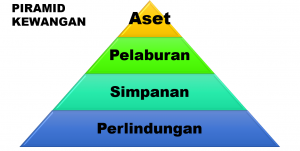
Based on the financial pyramid above, 'protection' is placed at the very bottom.
This means it should be prioritised and given the most attention, followed by financial accumulation (Savings, Investments, and Assets) as a plan to grow your capital.
2 - SAVINGS

Savings are funds set aside for emergencies.
They need to be prepared as a 'backup' in case something unexpected happens.
For example, your car breaks down, your motorcycle breaks down, or you unexpectedly lose your source of income.
Therefore, allocate at least 10% of your monthly salary.
Typically, the minimum emergency fund should equal 6 months of your salary.
'Let's say' your salary is RM1,500 and 10% of RM1,500 is RM150. If you are consistent for 6 months, it will become RM900.
Instruments that can be used for savings include Savings Accounts, Tabung Haji, or ASB.
3 - INVESTMENT
Investment aims to grow your money over the long term for goals such as retirement, performing the Hajj pilgrimage, or building an education fund.
Why is investment so important? And how is it different from savings?
The value of money today will not be the same in 5 or 10 years due to the 'Time Value of Money'.
For example, RM50 used to fill an entire trolley, but today its value only covers buying rice and milk.
This is due to the depreciation of money caused by inflation.
Therefore, investment plays a vital role in planning for your future.
Where to Invest?
Investment instruments available in Malaysia include Unit Trusts, the Stock Market, Property, and Gold. You can allocate 20% to 30% for your investment plan.
Then diversify your funds across instruments that match your risk tolerance as an investor.
4 - EXPENSES
We cannot cut all expenses because spending is also a basic necessity of life. Basic needs such as food, drink, shelter, and clothing all require costs.
At the same time, we should be able to differentiate between needs and wants.
Postpone your wants first and learn to endure hardship now rather than suffering later.
How to Manage Your Expenses?
This method is not rigid but can serve as a guide for managing your expenses as a step towards being frugal.
Monthly expenses to take into account include:
- Petrol
- Food & Drinks
- Rent
- Utility Bills
- Mobile Phone Bills (Data/Top-up)
- PTPTN Loan Repayment
- Parents
- Daily Necessities
Then, allocate an estimated monthly cost for each expense category.
Control your spending so that it does not exceed the budget you have set. This method will indirectly train you to be disciplined and frugal in your spending.
Everyone will have different cost estimates depending on their individual needs.
Different people have different lifestyles. Even though they differ, as long as you can stay disciplined and control your wants, that is sufficient and much better than having no financial plan at all.
Enhance Your Investment Knowledge
Successful investing starts with solid knowledge.
Investment Basics:
Download our free ebook for a complete guide.
Open a CDS Account:
Ready to start? Open a CDS account today.
Frequently Asked Questions (FAQ)
How should a fresh graduate start financial planning?
Begin by listing all your monthly income and expenses. Set a budget for each spending category, prioritise paying off your PTPTN loan, and save at least 10-20% of your salary. Discipline in differentiating between needs and wants is the key.
What percentage of salary should be saved each month?
Financial experts recommend a minimum of 20% of net income for savings and investments. If you cannot manage 20% yet, start with 10% and gradually increase it. The important thing is consistency — save first before spending, not save whatever is left.
What is the difference between savings and investments?
Savings are typically kept in bank accounts with low returns (2-3%) but near-zero risk — suitable for emergency funds. Investments involve instruments like shares, unit trusts, or property that offer higher returns but come with risk. Both are essential in financial planning.
When is the right time to start investing?
As soon as you have an emergency fund (3-6 months of expenses) and high-interest debts are managed. The earlier you start investing, the greater the benefit of compound interest. You do not need a large capital — on Bursa Malaysia, you can start with as little as RM100.
Smart financial planning is not just about saving — it is also about growing your money through the right investments so that your money works for you, not the other way around.
Open a CDS account to start investing in shares on Bursa Malaysia as your first step towards building wealth.
Download the free stock basics ebook to learn the fundamentals of stock investing from scratch.
Further Reading: