Stocks vs Unit Trust: Which Is More Profitable in Malaysia?

In this article, I will discuss stock and unit trust investments.
Stock and unit trust investments fall under the financial instruments available within the investment landscape.
Why Stocks And Unit Trust?
Before I delve deeper into this topic, I felt compelled to write this article because many Malaysians lack financial literacy, causing a significant number to fall victim to scam schemes such as get-rich-quick schemes and dubious investments with no clear fundamentals.
This can be evidenced from the following excerpt from Malaysia Kini:

Figure 1: Statement by Datuk Seri Johari Abdul Ghani
Malaysia's Finance Minister on 30 Dec 2017
Source: Malaysia Kini
Fraud cases carried out by irresponsible parties also occur because many Malaysians are easily trusting without conducting proper due diligence.
Such situations arise because people want to earn money easily and quickly.
I invite readers to study the histories of successful individuals like Jack Ma, Robert Kuok, and others — they all made full use of every one of their 24 hours each day.
On top of that, they sacrificed their time and energy wholeheartedly in pursuit of financial freedom.
There is no easy or quick path, nor any magic formula that can make someone achieve financial and time freedom.
As the Malay proverb says:
Paddle upstream with a raft,
Swim your way to the shore,
Endure hardship first,
Enjoy comfort later.

Stock Investment In Brief
Returning to the topic of stock investment vs unit trust, stock investment is a form of investment where you own a portion of a company or hold equity in that company.
When you purchase shares in a company, you are also known as a shareholder — owning shares in a company listed on Bursa Malaysia. Among the companies listed on Bursa Malaysia are Aeon, Petron, Nestle, Xox, Ajinomoto, and many more.

In stock investing, it is the investor who determines the profit or returns they wish to achieve.
For example, buy today and sell today, or buy today and sell within a specific time frame.
When discussing investment or business, we cannot escape the topic of losses or risks that we will face.
The probability of incurring a loss is always present.
We can minimise the losses we face by referring to our trading plan and chart analysis.
As the English saying goes, trust your chart. Stock investing is a form of investment with high liquidity.
Unit Trust Is A Long-Term Investment
Meanwhile, unit trust is a long-term investment where investors entrust their money to a registered body or financial consultant to manage their pension or retirement funds.
The money is pooled into a fund known as an amanah (trust) fund.
Typically, the returns provided are around 10%-15% per year. To enjoy substantial returns, one should wait at least 5 years to reap the rewards of what has been invested in the unit trust.
Investor returns come through dividends and gains based on the increase in each unit's value.
This differs from the stock market, where you can enjoy profits within a day or a week depending on the market price at that time. With stocks, short-term traders can potentially make 15%-30% profit in a single day.
The figure below shows the types of investments available within financial instruments:
- Commodities/Futures
- Stocks/Equities
- Unit Trust
- Sukuk/Bonds
- ASB or Tabung Haji
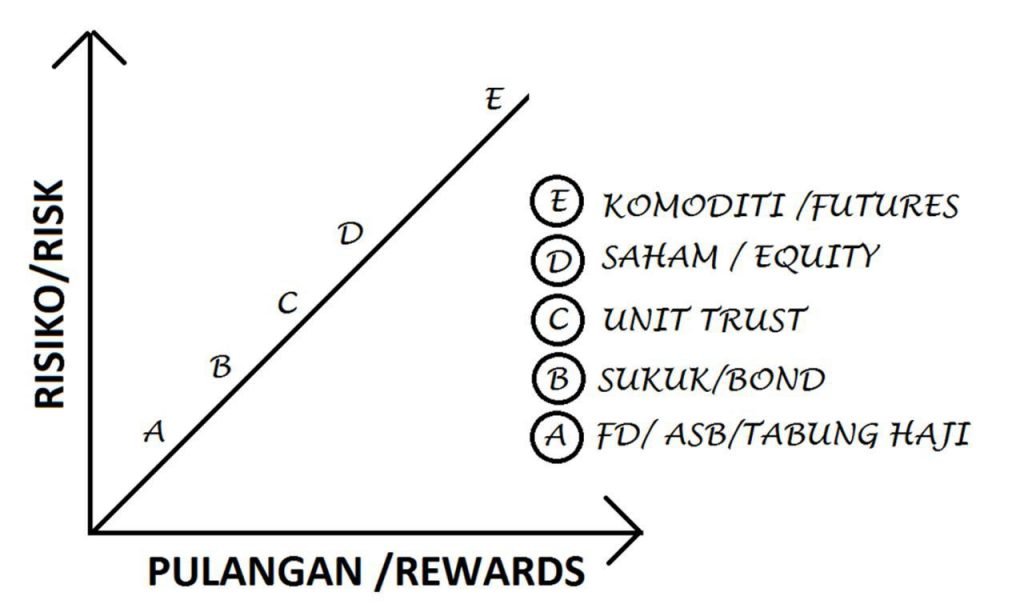
Figure 2: Types of investments
Similarities Between Stocks And Unit Trust
- Your money may also be invested in the stock market, if the unit trust you choose is an equity type.
- Your money can be invested in Shariah-compliant investments, depending on your choice.
- Both have fees or costs for investing. For stocks, the costs include brokerage fees, clearing fees, stamp duty, and these are explained in detail in Stock Trading Costs.
For unit trusts, the costs involved include upfront fees, annual management fees, and some unit trusts may also charge exit fees. - Both instruments are relatively easy to buy and sell — in other words, they are liquid — compared to property investments.
Differences Between Stock And Unit Trust Investment
| Aspect | Stock Investment | Unit Trust |
| Account | Managed by the investor themselves or a dealer. | Managed by a fund manager. |
| Capital | Surplus money from the investor — ideally not using essential funds. Capital value depends on the stock price, starting from RM50 up to the investor's affordability. | Pension money, EPF, or cash. Starting from RM50 depending on the investor's financial capability. |
| Profit | Intraday, medium-term, or long-term. You can potentially make up to 16% profit in a single day. | Dividends or increase in unit value. Approximately 10%-15% per year. |
| Loss | Investors can minimise losses based on technical analysis (TA) and fundamental analysis (FA) indicators. | Investors entrust all profit and loss decisions entirely to the fund manager. |
| Position | Company owner/shareholder. | No position in the company. |
| Broker Cost | From RM8-RM40 based on the broker per transaction. | Fund manager charge is 5.5%. For example, if the fund is RM1,000 x 5.5% = RM55. |
Conclusion
You do not necessarily have to choose only one between the two.
You may allocate a portion of your funds into stocks and another portion into unit trusts, depending on your risk appetite and risk profile.
As for me, I am aggressive. I prefer to profit in a shorter time frame and am willing to bear the risks, so the likelihood is that my capital allocated for stock investment is also larger.
How about you?
FAQ: Stocks vs Unit Trust in Malaysia
What is the difference between stocks and unit trust?
Stocks give you direct ownership (equity) in a listed company on Bursa Malaysia, whereas unit trust pools your money with other investors into a managed fund. With stocks, you make your own buy and sell decisions; with unit trusts, a professional fund manager handles the investment on your behalf.
Which is better for beginners — stocks or unit trust?
Unit trusts are generally more suitable for beginners or those who prefer a hands-off approach, as a professional fund manager handles the portfolio. However, stocks offer more control and potentially higher short-term returns for those willing to learn technical and fundamental analysis.
Can I invest in both stocks and unit trust at the same time?
Absolutely. Many Malaysian investors diversify their portfolio by allocating funds to both stocks and unit trusts. This allows you to benefit from the liquidity and higher potential returns of stocks while enjoying the stability and professional management of unit trusts.
What are the costs involved in stock trading vs unit trust?
For stocks, costs include brokerage fees (RM8-RM40 per transaction), clearing fees, and stamp duty. For unit trusts, costs include upfront fees (sales charge), annual management fees, and potentially exit fees depending on the fund.
Improve Your Investment Knowledge
Successful investing starts with solid knowledge.
Investment Basics:
Download our free ebook for a complete guide.
Open a CDS Account:
Ready to start? Open a CDS account now.