Sukuk Can Default Too: What Happens to the Money in Your Unit Trust Fund?

Many investors treat sukuk as a "safe" investment. They are Shariah-compliant, pay a fixed return and usually move less than shares. That assumption was tested this week.
On 6 November 2026, Zetrix AI Bhd failed to pay RM25.68 million due under Series 6 of its RM2 billion sukuk wakalah programme. According to The Edge, AmanahRaya Investment Management (ARIM) then valued the sukuk at zero in four of its unit trust funds. The net asset value (NAV) per unit of the AmanahRaya Unit Trust Fund fell to 66.86 sen, and dealings in all four funds were suspended until 23 November.
This article is not about one company. It is about a risk that retail investors rarely discuss: credit risk. By the end, you will understand what actually happens when a sukuk defaults, why a fund holding it can drop overnight, and what you should check in your own funds.
What Is a Sukuk, in Short?
A sukuk is an Islamic investment certificate. Sukuk holders own a share of the underlying asset, benefit or business activity, and receive a profit distribution from it. This differs from a conventional bond, which is essentially an interest-bearing loan.
But from a cash-flow point of view, the two look almost the same to an investor:
- The issuer receives the investors' money today.
- The issuer pays a periodic profit (for example every six months).
- The issuer returns the principal at maturity.
A wakalah structure, as used by Zetrix, means the issuer acts as an agent that invests the sukuk holders' funds in agreed assets or businesses. The contract is different, but the ability to pay still depends on one thing: the issuer's financial health.
Malaysia is the world's largest sukuk market. According to The Edge, Malaysia accounted for about 33% of global sukuk outstanding at the end of the third quarter of 2026. A market this large means most unit trust, fixed income and mixed-asset funds in Malaysia hold sukuk in one form or another.
For the basics of how bonds and sukuk differ, read Bonds and Sukuk.
Shariah-Compliant Is Not the Same as Guaranteed
This is the most common misconception. The "Shariah-compliant" label describes how an investment is structured: no riba, asset backing, a valid contract. It does not describe how likely the issuer is to fail to pay.
Malaysian government sukuk and sukuk from a weak company can both be Shariah-compliant. The difference is who promises to pay:
| Type | Who pays | Credit risk |
|---|---|---|
| Government sukuk (e.g. GII, Sukuk Prihatin, Retail Sukuk) | Government of Malaysia | Lowest in the local market |
| Highly rated corporate sukuk (AAA, AA) | Large companies with stable cash flow | Low to moderate |
| Low-rated or unrated corporate sukuk | Companies with more fragile finances | High |
So when you see a fund called "Syariah Income Fund", the question is not only "is it halal?" but also "whose sukuk does it hold?".
Credit Ratings: The Early Warning Many Investors Miss
In Malaysia, two main agencies assess an issuer's ability to pay: RAM Rating Services and MARC Ratings. Sukuk rated by MARC carry an "IS" suffix, for example AAA IS.
In general, the rating scale runs like this:
- AAA and AA: very strong ability to pay.
- A and BBB: adequate, but more sensitive to economic conditions. BBB is the lowest investment grade.
- BB to C: speculative. Default risk is real.
- D: already in default.
Note that ratings rarely fall from AA to D in a single day. There is usually a ladder of downgrades. In Zetrix's case, MARC had already cut the programme to C IS on 30 October, then to D IS after the 6 November payment was missed, and ended its coverage.
For fund investors, every downgrade of a sukuk held by your fund is a signal to ask the fund manager about its exposure.
What Actually Happens When a Sukuk Defaults?
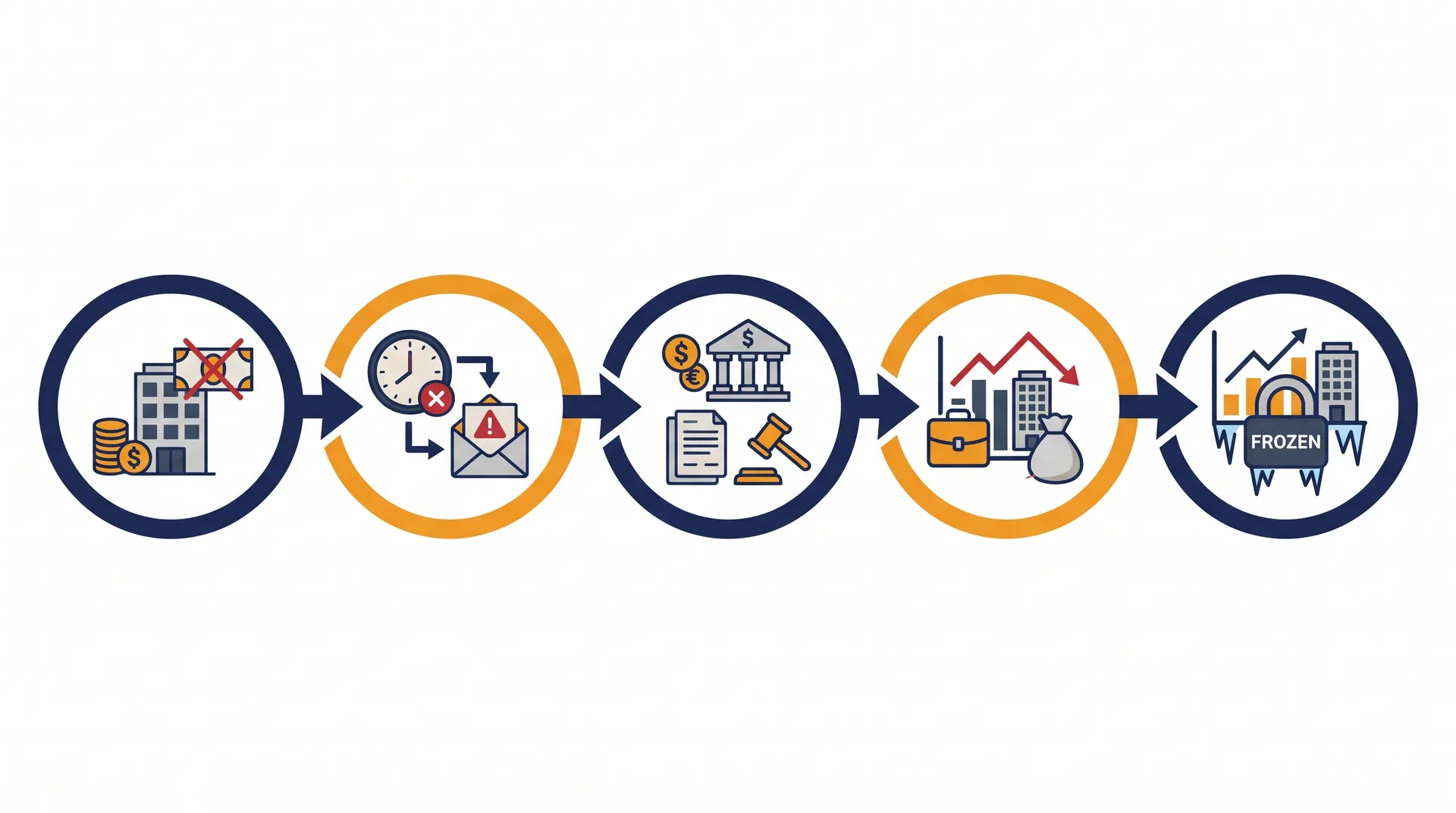
Many assume a RM25 million default means a RM25 million loss. The reality is much larger, because sukuk documents contain clauses that change the whole programme.
1. "Dissolution event" and the full claim
Every sukuk programme has a trustee who protects the interests of all sukuk holders. In this case, the trustee confirmed that failure to pay when due is an immediate dissolution event under the trust deed.
The effect, as ARIM explained to its investors, is that sukuk holders may demand all amounts due under the entire programme immediately, not just the series that was missed. One overdue series can turn the whole RM2 billion programme into a claim.
In finance this is called acceleration. It exists to protect investors, so they do not have to wait years while the issuer's assets shrink.
2. The company may argue otherwise
The issuer does not always agree. The Star reported that Zetrix confirmed the overdue payment and pledged to settle it quickly. The company had earlier said it was not required to repay the entire balance immediately, and that its next scheduled payment was only due in March 2027.
Disputes like this are common after a default. They can end in a restructuring (longer tenure, revised profit rate), asset sales, or legal action. The process takes time, and the outcome is uncertain.
3. The market price disappears
Sukuk trade between institutions in the secondary market, and Bond Pricing Agency Malaysia (BPAM) publishes the daily valuation prices fund managers use. After the default, BPAM stopped providing prices for the Zetrix sukuk.
Without a reference price, the fund manager has to decide the value itself. This is where the "zero value" decision comes from.
Why Did ARIM Value the Sukuk at Zero?
Unit trust funds are valued daily based on the market value of all their holdings. This is called mark-to-market. NAV per unit = (total asset value minus liabilities) divided by the number of units.
ARIM explained that it could not establish a reasonable basis for recognising any recoverable amount. There was no confirmed settlement date, the issuer's financial position was uncertain, and according to ARIM, Zetrix has no external auditor to confirm its position.
Two points are important:
- A zero value is an accounting decision, not a waiver of rights. ARIM stressed that the funds will still pursue the principal and profit. If money is recovered later, it will be added back to the NAV for unitholders at that time. ARIM also cautioned that recovery is not assured.
- Unitholders on the valuation date bear the fall. This is why dealings were suspended. If the fund stayed open while the true value was unclear, investors who redeemed early might exit at too high a price, shifting the loss to those who remained.
Why was the fall so large?
The NAV of ARUTF fell to 66.86 sen and ARSTF to 66.11 sen, while the conservative mixed-asset fund ARMASCIF only fell to 94.08 sen. That difference is a lesson in itself: the size of the holding in one issuer determines the size of the damage.
According to DagangNews, citing RAM Ratings, funds and mandates managed by ARIM held RM527.25 million of Zetrix sukuk as at 30 September, equal to 10.48% of ARIM's RM5.03 billion in assets under management. That figure is a company-wide average. In particular funds, the concentration was clearly much higher.
Fund Suspension: When You Cannot Take Your Money Out
Many unit trust investors assume they can redeem units at any time. Usually that is true. But a fund's deed allows the manager to suspend dealings in exceptional circumstances, with the agreement of the fund's trustee.
In ARIM's case, this was not the first time. The Star reported in mid-October that ARIM suspended dealings in three of its funds to manage liquidity constraints, amid rising redemption requests and heightened credit risk on certain investments.
This sequence shows a pattern common in credit crises:
- Negative news about the issuer spreads.
- Fund investors start redeeming en masse.
- The fund has to sell its most liquid assets, leaving the problem assets as a larger share.
- The fund is suspended to stop a "run for the exit".
- The problem assets are revalued, and the NAV falls.
Investors who redeemed early at stage 2 avoided part of the loss. Not because they were smarter, but because the fund mechanism favours those who leave first. That is why suspensions exist.
Not the First Time in Malaysia
Corporate sukuk and bond defaults in Malaysia are rare, but they do happen. In 2021, Utusan Malaysia reported that Serba Dinamik missed a payment on its US$300 million sukuk, months after a dispute with its auditor made headlines.
The similarities with the latest case are worth noting:
- Governance and audit issues surfaced before the default.
- The share price collapsed earlier. Zetrix shares had fallen more than 90% since the start of the year.
- The rating fell in steps before reaching D.
The stock market often warns earlier than the sukuk market, because shareholders are last in line for claims and act faster. If you hold a fund that owns sukuk from a listed company, watching that company's share price is a simple but useful step. For other governance warning signs, see CEO & Director Resignations.
What You Should Check in Your Own Funds
You do not need to be a credit analyst to protect yourself. These five steps are enough for most retail investors.
1. Read the fund fact sheet
Every fund manager publishes a monthly fact sheet. Look for the top 10 holdings. If one corporate issuer makes up more than 10% of your fixed income fund, that is a high concentration.
2. Check the rating breakdown
Bond and sukuk funds usually show a chart of holdings by rating (AAA, AA, A, unrated). A large "unrated" share means risk that is hard to assess from the outside.
3. Tell fund types apart
Money market funds, government sukuk funds and corporate income funds may all be labelled "low risk", but their risks differ. Money market funds hold short-term instruments. Corporate sukuk funds may hold much weaker issuers in exchange for higher returns.
4. Be suspicious of returns that look too good
If a fixed income fund returns far more than similar funds, ask where the extra return comes from. Extra return in sukuk almost always means extra credit risk.
5. Diversify across managers and asset types
Putting all your savings in one fund, or in funds from a single manager, adds another layer of risk. Different managers have different credit discipline.
If Your Fund Is Already Affected
If you hold units in a suspended fund, the practical steps are:
- Keep records. Unit statements, purchase dates and the last unit value before the suspension.
- Follow official notices only. The fund manager must inform unitholders about the redemption arrangement and when dealings resume. Ignore social media rumours.
- Know your rights. Unitholders are represented by the fund's trustee. Complaints can be made to the fund manager and, if unresolved, to regulators such as the Securities Commission.
- Do not decide out of panic. When dealings resume, the NAV will already reflect the latest valuation. What you do next depends on your own goals and cash needs, not on what others do.
FAQ
Are sukuk safer than shares?
In general, sukuk prices move less and sukuk holders are paid before shareholders if a company runs into trouble. But corporate sukuk can still default. Their safety depends on who the issuer is, not on the sukuk label itself.
Does a defaulted sukuk become non-Shariah-compliant?
No. Shariah status depends on the structure and contract of the sukuk. A default is a credit issue, meaning the issuer's ability to keep its promise, not a Shariah issue.
Does a zero value mean my money is gone for good?
Not necessarily. A zero value is an accounting valuation due to uncertainty. The fund can still claim and recover part of the amount through a restructuring or legal process. But recovery is not guaranteed and can take years.
How do I know if my fund holds a particular company's sukuk?
Check the monthly fact sheet and the fund's annual or semi-annual report. The annual report usually lists all holdings. You can also ask your fund manager or unit trust agent directly.
Are Retail Sukuk or government sukuk exposed to the same risk?
Government sukuk are paid by the Government of Malaysia, so their credit risk is much lower than corporate sukuk. They are still exposed to other risks such as changes in market profit rates. Read more in Retail Sukuk Malaysia.
Why suspend a fund at all, isn't that unfair to investors?
A suspension aims to protect all unitholders equally. Without it, investors who redeem early might exit at a NAV that does not yet reflect the loss, shifting that burden to the investors who stay.
Conclusion
The Zetrix sukuk default and ARIM's zero valuation are a reminder that fixed income investments carry risk too. The Shariah-compliant label describes the structure, not a capital guarantee. The real risk lies in the issuer's health, the concentration within a fund, and how the fund mechanism works in a crisis.
Investors who understand credit ratings, read fund fact sheets and diversify their holdings are far better placed to spot problems before they turn into losses.
Understanding the risk behind every instrument is the first step before you invest on your own, whether through funds or directly in shares.
Open a CDS trading account to invest directly on Bursa Malaysia as well as in overseas stock markets such as the US and Hong Kong.
Download the free Stock Market Basics Ebook to learn the fundamentals of share investing before you start.
Further Reading
- Bonds and Sukuk: Differences and How to Invest in Malaysia
- Retail Sukuk Malaysia: How to Buy Government Bonds with Small Capital
- Stocks vs Unit Trust: Which Is More Profitable in Malaysia?
- What Is a Fund Manager? Meet the 'Captain' Behind Your EPF & ASB Investments
- CEO & Director Resignations: When This News Is a Red Flag for Investors