Swing Trading for Beginners: Tips, Indicators & Practical Strategies

Mastering Swing Trading: From Beginner to Expert
Imagine you are an investor who wants to capitalise on market opportunities without being glued to the screen all day, yet still wants to see results faster than long-term investing. This is where swing trading emerges as the ideal strategy.
Swing trading involves holding positions for a few days to several weeks, offering a balance between daily trading activity and long-term investing. It allows traders to analyse the market thoroughly, plan entry and exit points, and make decisions based on facts and patterns rather than mere guesswork.
Why Swing Trading Is Growing in Popularity
Swing trading provides the opportunity to profit from short-to-medium-term price movements. Compared to day trading, you do not need to watch charts every moment. Compared to long-term investing, you receive feedback on your trading decisions much faster.
Swing trading is suitable for various markets:
Commodities: Influenced by economic factors and seasonal trends.
Stocks: Stable, suitable for beginners.
Forex: 24/5 access, with high leverage.
Crypto: Volatile and active 24/7, high risk but quick opportunities.
Understanding Market Structure
To succeed in swing trading, focusing on price patterns is more important than relying entirely on indicators. Two key concepts you need to understand are:
- Break of Structure (BoS): Indicates a continuing trend when price creates new highs in an uptrend or new lows in a downtrend.
- Change of Character (CHoCH): Signals a potential trend reversal when the "strong low" breaks in an uptrend or the "strong high" breaks in a downtrend.
By understanding these concepts, traders can forecast market movements and make wiser decisions.
Tools and Indicators That Help
Although price action is the foundation, several indicators can provide additional guidance:
- MACD (3/10/16): Helps detect changes in momentum.
- Pivot Points: Determines key support and resistance zones.
- Volume: Confirms the strength of breakouts or price movements.
However, remember that no single indicator is perfect. Combine all tools wisely, and never neglect risk management.
Tips for Beginners
Adapt your strategy to your lifestyle and timeframe, so that trading remains controlled and effective.
Start with a demo account to test indicator settings.
Learn about trends and market structure (BoS/CHoCH) first.
Swing trading is not merely a technique; it is the art of balancing opportunity and risk. By understanding market structure, using indicators wisely, and practising risk management, an investor can develop a consistent and flexible strategy suited to various trading styles.
FAQ – Swing Trading Basics
Swing trading is a strategy of buying and selling assets over a period of a few days to several weeks to profit from short-to-medium-term price movements. It differs from day trading (intraday) and long-term investing, as swing trading focuses on short-term trends and market momentum.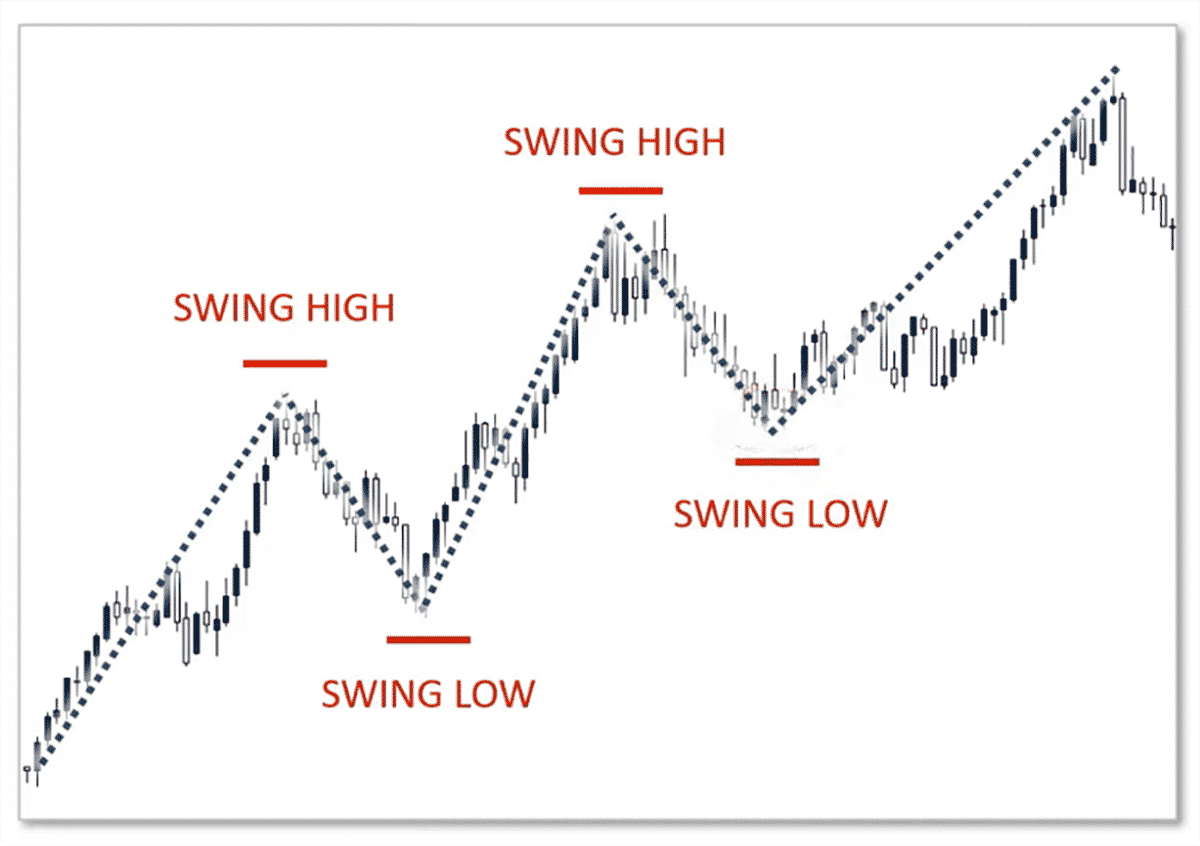
Traders who cannot monitor the market throughout the day but want to see results faster than long-term investing. Swing trading allows traders to analyse the market, plan entry/exit points, and avoid spending hours in front of the screen.
Day trading: positions are closed within a single day.
Swing trading: positions are held for several days to weeks.
Long-term investing: positions are held for months to years.
Swing trading sits between these two extremes, offering a balance between risk and time commitment.
MACD (Moving Average Convergence Divergence) helps identify momentum and trend changes. Settings such as 3/10/16 can be used for short-term/swing trading, helping traders spot momentum earlier compared to the standard 12/26/9 settings.
BoS: Price makes new highs/lows within a trend, signalling a continuing trend.
CHoCH: Price breaks the "strong low" or "strong high" level, signalling a potential trend reversal.
These concepts help traders forecast price movements and make trading decisions based on current trends.
Pivot points help identify key support and resistance zones, which are used for entry or exit strategies. Traders can use pivot points alongside other indicators to confirm trading opportunities and reduce risk.
Market volatility, false signals from indicators, and unexpected news or events. Risk management measures such as stop-loss orders and appropriate position sizing are essential to protect your capital.
Usually 2 days to several weeks, depending on the strategy and market trend. Shorter holding periods suit quick momentum plays; longer holding periods suit clear, established trends.
Yes, including stocks, forex, crypto, and commodities, but each market has its own risks and characteristics. For example, crypto trades 24/7 and is highly volatile, forex is available 24/5, stocks are more stable, and commodities depend on economic/seasonal factors.
Start with a demo account, learn to identify trends (BoS/CHoCH), and understand basic indicators like MACD and pivot points. A demo account allows you to test strategies without real risk, building confidence before trading with real capital.
Transform From Beginner to Professional Swing Trader!
Are you just starting to learn trading but feel left behind in the stock market?
Maher Saham brings you an exclusive Gold package, specially designed for beginners who want to master swing trading from the basics to an advanced level.
What You Will Get
✓ Step-by-Step Swing Trading Course -- from trend identification, Break of Structure (BoS), Change of Character (CHoCH), to MACD and Pivot Point indicators.
✓ Practical & Easy-to-Understand Strategies -- suitable for traders who are just starting out, no prior experience needed.
✓ Live Sessions & Case Studies -- learn from real market cases and see how strategies are applied.
✓ Maher Saham Trader Community -- get support, tips, and daily market updates.
Your Transformation After This Course
From confused and stuck to confidently reading charts & identifying trends.
From trading on gut feeling to trading based on strategy and real analysis.
From worrying about losing capital to skilfully managing risk & making wise decisions.
Why the Maher Saham Gold Package?
- Created specifically for beginners who want to start from the basics.
- Focuses on swing trading -- a strategy suited for those who do not have time to monitor the market 24/7.
- Equipped with tools, indicators, and practical guides that are easy to follow.
FAQ – Swing Trading in Malaysia
What is swing trading?
Swing trading is a strategy of buying and selling assets over a period of a few days to several weeks to profit from short-to-medium-term price movements. It differs from day trading and long-term investing.
Which indicators are suitable for swing trading?
Popular indicators for swing trading include MACD, RSI, Pivot Points, and trend analysis tools such as Break of Structure (BoS) and Change of Character (CHoCH).
Is swing trading suitable for beginners?
Yes, swing trading is suitable for beginners as it does not require 24/7 market monitoring like day trading. However, beginners should first understand the basics of technical analysis and risk management.
How long is the typical holding period in swing trading?
The typical holding period in swing trading ranges from a few days to several weeks, depending on the momentum and current market trend.
Mastering swing trading requires solid technical knowledge and the right trading account.
Open your CDS account through Register CDS Account with Mplus to start trading shares on Bursa Malaysia.
New to the stock market? Download the Free Stock Market Basics Ebook to understand the fundamentals of stock investing before you begin.
Further reading: