The Wyckoff Method: How the Composite Man Controls the Stock Market (Beginner Guide)

What is the Composite Man? Have you ever bought a stock, only for the price to suddenly plummet as if the market knew you had just entered? Or when you cut your losses, the price suddenly rockets back up?
Do not worry, you are not unlucky. You are simply up against an entity known as the Composite Man.
In the world of trading, if you do not understand who your opponent is, you will be eaten alive.
Today, we will uncover a legendary concept from Richard D. Wyckoff that will change the way you look at charts forever. We will learn how to swim alongside the 'sharks', not become their prey.
Do not have a CDS Direct Account yet? You need one to trade stocks. Open a CDS Trading Account with Mahersaham today.
What Is the Composite Man?
In the Wyckoff Method, the Composite Man is a fictional character or metaphor created to represent a group of market sharks.
In the Malaysian market context, they are better known as the "syndicate".
Think of the Composite Man as:
- Financial institutions (Banks)
- Hedge funds
- Professional traders with large capital
- "Smart Money"
Individually, they may compete against each other. But collectively, their actions form a powerful force that manipulates and moves stock prices.
Wyckoff's Philosophy: "Treat all market movements as the result of one man's manipulation (the Composite Man). If you understand his game, you profit. If not, he will take your money."
As small (retail) traders, we cannot fight the Composite Man. But we can be like the "remora fish" that attaches itself to a shark — we follow wherever he goes.
Why Wyckoff Created This Concept
Wyckoff wanted retail traders to learn to think like the big players because:
- Price movements do not care whether they are "genuine or manufactured"
- Whether transactions are made by real investors or big operators deliberately creating demand
- What matters is the effect of the movement on the chart, not who is behind it
In simple terms:
Retail traders do not need to know who the Composite Man actually is — it is enough to understand how he "plays" the market.
What Does the Composite Man Do? (According to Wyckoff)
After decades of studying markets, Wyckoff drew several conclusions:
The Composite Man plans, executes, and concludes campaigns in a highly organised manner.
- Every mark-up, mark-down, accumulation and distribution — all happen with purpose and planning, not randomly.
The Composite Man will "advertise" the stocks he wants to sell.
How:
- Making large and frequent transactions
- Creating the appearance of strong interest (broad market activity)
- Purpose: attract retail investors to buy while he has already accumulated shares early on
This is what we in Wyckoff circles call "distribution disguised as strength".
Traders must learn to read charts to assess the intentions of the big players.
Charts are not just about going up and down — they are a "language" that reveals:
- who is accumulating
- who is distributing
- when prices are deliberately pushed down
- when the market is ready for a mark-up
With practice, we can understand the Composite Man's actions early.
According to Wyckoff, anyone who can interpret the Composite Man's movements on the chart will be able to:
- enter during accumulation
- exit during distribution
- avoid false breakout traps
- enter early before a major rally begins
This is the foundation of why Wyckoff is considered one of the most relevant market-reading techniques to this day.
4 Market Cycle Phases: How the Composite Man Controls the Game
The Composite Man does not buy and sell randomly. He has a highly organised game plan. He needs to accumulate holdings (shares) quietly, push the price up, and sell them back to you when the price is expensive.
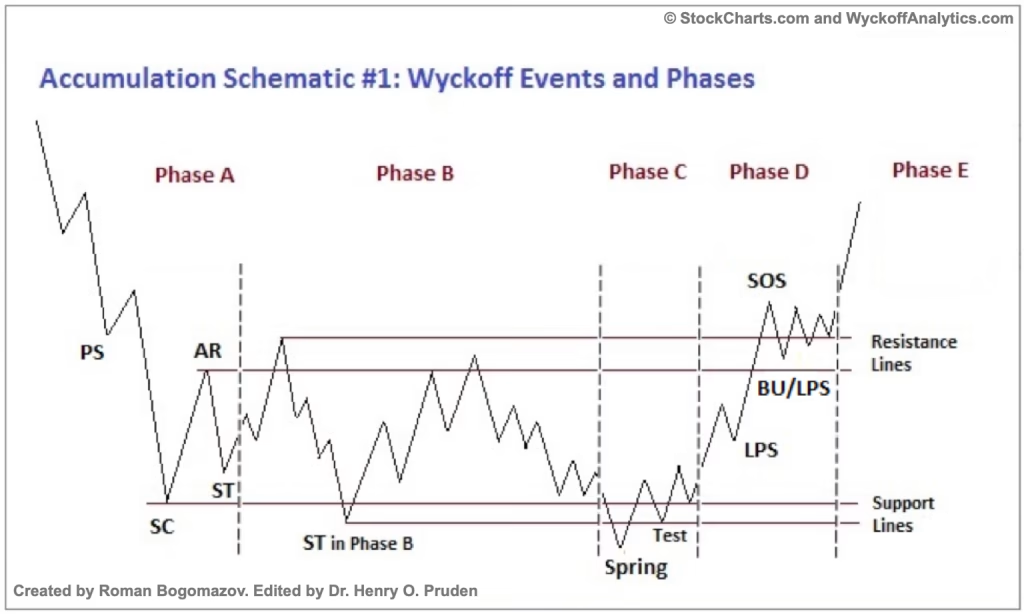
These are the 4 essential phases he identified:
Accumulation Phase
This is the phase where the price moves sideways after a sharp decline.
- Composite Man's Action: Buying shares from panicking and desperate traders at wholesale (cheap) prices.
- Market Conditions: Bad news is everywhere, nobody is interested in this stock. Volume starts coming in but the price does not rise much because the Composite Man is suppressing it so he can buy even more.
Markup Phase
After the Composite Man's pockets are full of cheap shares, he starts the engine.
- Composite Man's Action: Allowing the price to rise past resistance (breakout).
- Market Conditions: Buying interest starts to arrive. Smart Money begins attracting public attention. An uptrend begins.
Distribution Phase
This is the most dangerous phase for beginners. The price has risen high and starts to flatten out at the top.
- Composite Man's Action: Begins selling shares that were bought at the bottom to retail traders who are experiencing FOMO (fear of missing out).
- Market Conditions: News is extremely positive. Everyone says this stock is going to the moon. Beginners are buying aggressively, whilst the Composite Man is quietly exiting (selling).
Markdown Phase
The Composite Man's inventory has been completely sold off. Nobody is left to support the price.
- Composite Man's Action: Allowing the market to fall or initiating panic selling (shorting).
- Market Conditions: The price plummets. Beginners are trapped at the top (stuck). They refuse to sell hoping the price will recover, but eventually are forced to cut losses at the bottom... where the Accumulation cycle begins anew.
How to Read the Composite Man's Moves (Price Action & Volume)
The Composite Man can manipulate news, he can manipulate earnings reports, but he cannot fake Volume.
The Composite Man's footprints are massive. Here is how to detect him:
Volume Analysis
Volume is the "fuel".
- At Support: If the price drops but volume suddenly dries up, it means selling pressure has been exhausted. But if the price is moving sideways and volume suddenly surges, that is a sign the Composite Man is absorbing shares (Accumulation).
- At Resistance: If the price rises but volume is decreasing, it means Smart Money is no longer interested (Lack of Demand). Or, if volume is extremely high but the price is not moving up (Churning), that is a sign they are distributing shares (Distribution).
Spread & Price Bar
Look at the size of the candlestick.
- Effort vs Result: If you see a very long green candle (large Effort/high Volume) but the closing price is not far from the opening price, something is not right. The Composite Man may be quietly selling.
Real Market Example: Imagine Stock XYZ announces news of securing a RM1 Billion project. The price opens with a high Gap Up.
Beginners scramble to buy. But on the chart, you see extremely high volume, yet the candlestick forms a "Shooting Star" or has a long upper wick.
- What it means: The Composite Man used the good news to sell their holdings to you. This is Distribution.
Beginner Mistakes vs Pro Strategies
Many new traders fail because they try to fight the current or act too slowly.
| Beginner Mistake (The Victim) | Pro Strategy (Follow the Composite Man) |
| Buy when good news appears on TV/Social Media. | Buy during the Accumulation phase or early Markup. |
| Afraid to buy when the chart looks boring (sideways). | Know that sideways is where Smart Money accumulates stock. |
| Hold stocks when the price breaks Support because they cannot bear to sell. | Exit early when signs of Distribution appear. |
| Ignore Volume, only watch price. | Use Volume to confirm price movements. |
Applying the Wyckoff Method in Modern Trading
How do you use this knowledge tomorrow morning when the market opens? Follow these steps:
- Zoom Out: Do not just look at the 5-minute chart. Look at the Daily or Weekly chart. Which phase is the stock in? (Accumulation, Markup, Distribution, or Markdown?)
- Look for the 'Spring': During the Accumulation phase, there is usually a 'Spring' — a false drop below support to trigger stop losses of small traders before the price flies upward. This is the sharks' favourite entry point.
- Wait for Volume Confirmation: Do not guess. Let volume show the way. If there is a breakout without volume, it may be a trap (Fakeout).
Summary: What Are Your Next Steps?
Understanding the Wyckoff Composite Man concept does not mean we can predict the future with 100% accuracy, but it gives us a map so we do not get lost.
Actionable Steps for New Traders:
- Step 1: Open the chart of your favourite stock.
- Step 2: Try labelling the 4 market phases that have occurred previously.
- Step 3: Train your eyes to find sideways zones (Accumulation/Distribution) and observe what happens with Volume in those areas.
Remember, do not be a market victim. Be a Composite Man tracker. Learn to swim in the same direction as the flow of big money!
Did this article help you understand who the 'Big Boss' of the market is? If so, share this article with your fellow traders so they do not fall into the trap either!
FAQ: Wyckoff Method & Composite Man
Who is the Composite Man in Wyckoff theory?
The Composite Man is a concept representing a group of big players (smart money) such as financial institutions and syndicates who move stock prices. They accumulate shares quietly before pushing prices up, then distribute (sell) to retail investors at the top.
What are the 4 market phases in Wyckoff?
The four main phases are Accumulation (quiet buying at the bottom), Markup (price increase), Distribution (quiet selling at the top), and Markdown (price decline). Understanding these phases helps traders identify the best times to enter and exit the market.
How can I detect the Composite Man's movements?
Watch for sideways zones on the chart and analyse trading volume in those areas. Unusually high volume during sideways price action typically indicates smart money is either accumulating or distributing shares. Also look for effort vs result discrepancies in candlestick patterns.
Is the Wyckoff Method suitable for beginners?
Yes, the Wyckoff Method is suitable for beginners because it teaches how to read price structure and market intent, rather than merely relying on technical indicators alone. It provides a logical framework for understanding why prices move the way they do.
Can the Wyckoff Method be applied to Bursa Malaysia?
Absolutely. The Wyckoff Method is universal and works on any market where supply and demand dynamics exist. On Bursa Malaysia, the concept of syndicates (the local equivalent of the Composite Man) makes Wyckoff analysis particularly relevant for Malaysian retail traders.
Level Up Your Investment Knowledge
Successful investing starts with solid knowledge.
Investment Basics:
Download our free Stock Market Basics Ebook for a complete guide.
Open a CDS Account:
Ready to get started? Open a CDS Trading Account today.
Read Also: