Big Caring Group IPO (BCG 5358): Malaysia's Largest Pharmacy Chain Opens Applications at RM1.08

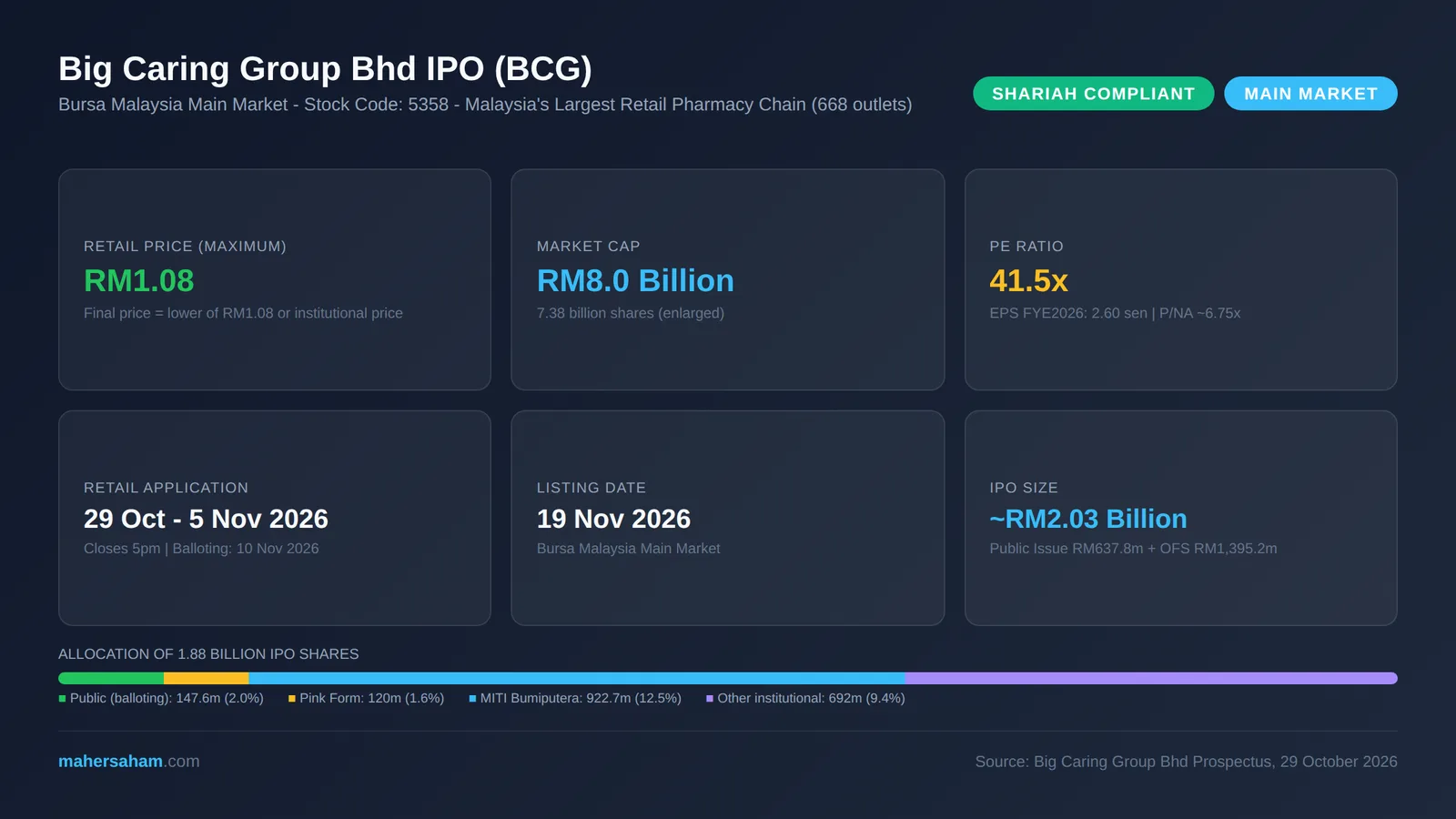
Big Caring Group Bhd, the operator of Malaysia's largest retail pharmacy chain, officially opened its IPO for applications on 29 October 2026 at a maximum retail price of RM1.08 per share. The company is scheduled to list on the Main Market of Bursa Malaysia on 19 November 2026 under the stock name BCG (code 5358). At RM1.08, its market capitalisation is about RM8.0 billion, making it one of the largest IPOs of the year.
If you have ever bought medicine at BIG Pharmacy or Caring Pharmacy, you already know this company's business. The real question is whether the shares are worth it at a PE of 41.5 times. This article summarises the key facts from the official prospectus dated 29 October 2026: offer details, share allocation, use of proceeds, four years of financials, a comparison with other listed retailers, and the strengths and risks you should understand before applying.
Quick summary: Maximum retail price RM1.08 | Market cap RM8.0 billion | PE 41.5x | Shariah compliant | Applications close 5pm, 5 November 2026 | Balloting 10 November | Listing 19 November 2026. View IPO data →
Note: In May 2026, we published our early coverage of Big Caring based on media reports estimating a RM3 billion IPO. The actual figures in the prospectus are different: total proceeds are about RM2.03 billion. This article uses the prospectus figures.
Who Is Big Caring Group Bhd?
Big Caring Group was incorporated on 2 May 2013 and operates entirely in Malaysia. The group runs 668 pharmacy outlets as at the latest practicable date (LPD) under six brands: BIG Pharmacy, CARiNG Pharmacy, Georgetown Pharmacy, Wellings Pharmacy, Ting Pharmacy and iCare Pharmacy. It is the only pharmacy chain present in all 13 states and 3 Federal Territories.
According to the independent market research (IMR) report by Frost & Sullivan in the prospectus, Big Caring holds 24.2% of Malaysia's retail pharmacy market by 2025 revenue, and 43.8% among organised pharmacy chains. By comparison, the nearest competitors such as Alpro (5.4%), Health Lane (4.1%) and Watsons Pharmacy (4.0%) are far behind. The remaining 55.5% is held by independent pharmacies and small players, so there is still room for large chains to keep gaining share.
Vertical integration: more than just pharmacy stores
What sets Big Caring apart from an ordinary retail chain is vertical integration. The group owns:
- Yanling - manufacturing of its own health products
- Medispec - drug import and distribution (acquired in 2025), targeting more than 600 registered products
- Your Physio - physiotherapy services
- Tele-consultation and the MyHA platform - digital health services
Its membership programme has about 7.9 million registered members, a large customer data asset by Malaysian standards. In FYE 2026, the retail segment contributed 92.9% of revenue, while Medispec, Yanling and others contributed 7.1%. By product, healthcare goods (42.9%) and pharmaceuticals (36.3%) dominate, followed by beauty products (12.3%).
Founders, chairman and private equity backer
The group was co-founded by Lee Meng Chuan (Group Managing Director/CEO) and Lim Sin Yin (Executive Director). Its chairman is Tan Sri Dato' Seri Dr. Noor Hisham Abdullah, the former Director-General of Health. The key backer behind the scenes is the private equity fund Creador V via IPSB, which held 33.7% before the IPO. Much of the group's growth over the past three years came from acquiring Caring Pharmacy, which was itself previously listed on Bursa before being taken private.
Big Caring Group IPO Details
| Item | Details |
|---|---|
| Company Name | Big Caring Group Bhd |
| Stock Name / Code | BCG / 5358 |
| Market | Main Market, Bursa Malaysia |
| Retail Price (maximum) | RM1.08 per share |
| Final price mechanism | Final Retail Price = lower of RM1.08 or the Institutional Price (bookbuilding). If lower, the difference is refunded to successful applicants |
| Shariah Status | Shariah compliant (SC Shariah Advisory Council) |
| Enlarged Share Capital | 7,381,835,680 shares |
| Market Cap at RM1.08 | About RM8.0 billion |
| Public Issue (new shares) | 590.5 million shares (8.0%) - RM637.8 million to the company |
| Offer for Sale (OFS) | 1,291.8 million shares (17.5%) - RM1,395.2 million to selling shareholders |
| Total IPO Size | Up to 1,882.4 million shares (25.5%) - about RM2.03 billion |
| EPS FYE 2026 (enlarged capital) | 2.60 sen |
| PE at RM1.08 | 41.5 times |
| Pro Forma NA per Share | RM0.16 (P/NA about 6.75 times) |
| Dividend Policy | Up to 50% of PATAMI |
| Joint Principal Advisers & Underwriters | Maybank IB, RHB Investment Bank, AmInvestment Bank |
| Issuing House | Malaysian Issuing House Sdn Bhd |
The retail pricing mechanism matters. You apply and pay at RM1.08, but the final price is only fixed on 10 November after the institutional bookbuilding. If institutions settle on a lower price, for example RM1.02, you pay RM1.02 and the balance is refunded. The final price will not exceed RM1.08. The launch was also reported by The Edge Malaysia, and the prospectus exposure draft is available on the Securities Commission website.
BCG's Shariah-compliant status remains valid until the next review by the Shariah Advisory Council, which updates its list on the last Friday of May and November. The official list is on the Securities Commission Malaysia website.
Key Application Dates
| Event | Date |
|---|---|
| Retail applications open | Thursday, 29 October 2026, 10.00am |
| Retail applications close | Thursday, 5 November 2026, 5.00pm |
| Institutional offering closes | 6 November 2026 |
| Final price determination and balloting | 10 November 2026 |
| Share allotment | 18 November 2026 |
| Listing date | Thursday, 19 November 2026 |
The retail application window is only one week, shorter than most ACE Market IPOs. If this is your first IPO application, read how to apply for a Bursa IPO using MPlus Global (in Malay). The list of active IPOs is also on the Bursa Malaysia IPO page.
Share Allocation: Why Your Balloting Odds Are Slim
Even though this is a RM2.03 billion IPO, the portion for the public is very small:
- Malaysian public (balloting): 147.6 million shares (2.0%), split equally with 73.8 million for Bumiputera and 73.8 million for non-Bumiputera investors
- Eligible Persons (Pink Form): 120 million shares (1.6%) for directors, employees and persons who contributed to the group
- MITI-approved Bumiputera investors: 922.7 million shares (12.5%)
- Other institutional investors: 692 million shares (9.4%)
At RM1.08, the public balloting tranche is worth only about RM159 million, less than 8% of the total IPO. For a household brand and the second-largest IPO of the year, we expect this tranche to be heavily oversubscribed. So do not be surprised if you are unsuccessful in the ballot or receive only a small lot. Eligible Bumiputera investors can also check the MITI quota route; read how to check your MITI IPO application status to understand the process.
The institutional tranche is anchored by 15 cornerstone investors who have committed to take 665.5 million shares (9.0%) at the institutional price. They include big names such as abrdn, AHAM, AIIMAN, Eastspring, FIL (Fidelity), First Sentier, IFC (World Bank Group), JPMorgan Asset Management, Kenanga, Principal and others. There is also an over-allotment (greenshoe) option of up to 225.1 million shares from IPSB, with a price stabilisation period of up to 30 days after listing.
Use of Proceeds: 89.5% Goes to Repaying Debt
This is the part many investors overlook. Of the RM2.03 billion raised, only RM637.8 million (the Public Issue) goes to the company. The remaining RM1,395.2 million from the Offer for Sale goes straight to the selling shareholders, namely UPSB (the founders' holding company) and IPSB (Creador). If the difference is unclear, read the difference between Public Issue, Offer for Sale and Private Placement.
| Use (Public Issue) | Amount | % | Timeframe |
|---|---|---|---|
| Repayment of bank borrowings | RM570.7 million | 89.5% | 3 months |
| New distribution centre | RM30.0 million | 4.7% | 36 months |
| Listing expenses | RM37.1 million | 5.8% | Immediate |
Repaying debt is not a bad thing. Group borrowings reached RM1.36 billion in FYE 2026, with finance costs of RM88.5 million a year. After the IPO and debt repayment, pro forma gearing (including lease liabilities) is expected to fall from 2.8 times to 0.9 times. Interest savings will flow straight into net profit. But it also means the IPO money is not funding new growth; it is cleaning up the balance sheet after debt-funded acquisitions.
Four-Year Financial Performance
Summary from the prospectus (RM million, financial year ended 30 June):
| Item | FYE 2023 | FYE 2024 | FYE 2025 | FYE 2026 |
|---|---|---|---|---|
| Revenue | 1,110.7 | 2,171.4 | 3,412.0 | 4,024.0 |
| Gross Profit | 232.4 | 465.1 | 845.8 | 1,212.4 |
| EBITDA | 106.5 | 194.6 | 380.7 | 552.4 |
| PATAMI | 37.0 | 37.2 | 122.3 | 191.6 |
| Gross Margin | 20.9% | 21.4% | 24.8% | 30.1% |
| PATAMI Margin | 3.3% | 1.7% | 3.6% | 4.8% |
| Total Borrowings | 155.0 | 959.2 | 1,331.2 | 1,360.2 |
| Current Ratio | 1.00x | 1.07x | 1.00x | 0.77x |
| SSSG | - | 7.3% | 9.6% | 7.3% |
The numbers look impressive: revenue grew at a 53.6% CAGR from FYE 2023 to FYE 2026, and EBITDA at a 73.1% CAGR. But you need to understand where it came from. The big jumps in FYE 2024 and FYE 2025 came mainly from the acquisition of Caring Pharmacy, which contributed revenue of RM727.7 million in FYE 2024 and RM1.62 billion in FYE 2025. Borrowings jumped from RM155 million to RM959 million over the same period. Much of this growth was bought, not organic.
FYE 2026 growth better reflects the underlying business: revenue rose 17.9%, EBITDA 45.1% and PATAMI 56.7%. Gross margin improved from 24.8% to 30.1%, helped by larger purchasing scale and in-house products (Yanling, Medispec). Same-store sales growth (SSSG) has also been consistent at 7.3% to 9.6% a year, a sign of healthy demand.
Operating cash flow in FYE 2026 was RM338.4 million, well above PATAMI. This is common for retailers given high depreciation and store lease costs. For industry context, the IMR estimates Malaysia's retail pharmacy market at RM15.4 billion in 2025, growing to RM23.3 billion by 2030, an 8.7% CAGR.
Valuation: 41.5x PE Versus Other Retailers
The prospectus itself compares Big Caring with four listed retailers (based on trailing 12-month data):
| Company | Market Cap (RM bil) | PE | EBITDA Margin | PATAMI Margin | Revenue Growth |
|---|---|---|---|---|---|
| 99 Speed Mart | 26.5 | 39.5x | 10.0% | 5.5% | 17.2% |
| Mr D.I.Y. | 12.1 | 19.4x | 25.5% | 12.2% | 6.9% |
| Eco-Shop | 8.5 | 32.0x | 18.1% | 9.1% | 4.6% |
| 7-Eleven Malaysia | 2.2 | 166.8x | 10.3% | 0.4% | 9.4% |
| Median | - | 35.7x | 14.2% | 7.3% | 8.1% |
| Big Caring (BCG) | 8.0 | 41.5x | 13.7% | 4.8% | 17.9% |
At RM1.08, BCG is priced at roughly a 16% premium to the peer median PE, and above 99 Speed Mart, which has a higher net margin. The case for the premium is growth: BCG's revenue grew 17.9% and PATAMI 56.7% in FYE 2026, much faster than Mr D.I.Y. or Eco-Shop. 7-Eleven Malaysia is an outlier because its profit fell, so its 166.8x PE is not representative.
Another measure: P/NA of about 6.75 times. Investors are paying nearly seven times book value, mostly for the brand, the store network and goodwill from acquisitions. If you are new to valuation, our guide to PE ratios by sector in Malaysia (in Malay) explains typical PE ranges by industry.
Strengths of the Big Caring IPO
- Clear market leader - 24.2% of the retail pharmacy market, about 4.5 times the second player (Alpro, 5.4%). This scale gives it pricing power with suppliers.
- Defensive demand - medicine and health products are bought regardless of the economy. Malaysia's ageing population supports long-term demand.
- Strong SSSG - existing stores grew sales 7.3% to 9.6% a year, showing older stores are still growing, not just relying on new openings.
- Clear expansion plan - 40 to 50 new outlets a year for 3 to 5 years, with an SSSG target of 7% to 9%.
- Backing from major institutions - 15 cornerstone investors including global funds such as FIL, JPMorgan AM and IFC have committed to 9.0% of the shares.
- Cleaner balance sheet after the IPO - gearing falls from 2.8 times to 0.9 times, and interest costs will drop significantly.
- Shariah compliant, with a dividend policy of up to 50% of PATAMI.
Risks and Weaknesses to Consider
1. Debt-funded growth through acquisitions
The jump in revenue from RM1.1 billion to RM4.0 billion in three years came largely from acquiring Caring Pharmacy and Medispec, funded by borrowings. Integrating acquisitions carries its own risks, and future organic growth will not match the historical numbers.
2. Current ratio of 0.77 times
As at 30 June 2026, current liabilities exceeded current assets. A ratio of 0.77 times means the group relies on daily cash flow and credit facilities to meet short-term obligations. This is the main reason 89.5% of the IPO proceeds go to repaying debt.
3. Thin net margin of 4.8%
Despite a 30.1% gross margin, only 4.8 sen of every RM1 of revenue ends up as PATAMI after rent, pharmacist salaries, interest and minority interests. A thin margin means small increases in costs, price competition or drug price control policies can hit profit hard.
4. Premium valuation
A PE of 41.5x versus a peer median of 35.7x, and a P/NA of 6.75x. The price already bakes in strong growth. If growth slows, there is plenty of room for the share price to fall.
5. Existing shareholders are partially cashing out
About 69% of the IPO shares are from the Offer for Sale. IPSB's (Creador's) stake falls from 33.7% to 19.3% (16.3% if the greenshoe is fully exercised). A partial exit is normal for a private equity fund, but investors should be aware that most of the IPO money goes to sellers, not the company. A 6-month moratorium applies to the promoters and IPSB; read why IPO stocks can crash after the lock-up period to understand the risk when moratoriums expire.
Other risks
- Competition - Watsons, Guardian, Alpro, plus online and cross-border platforms.
- Regulation - pharmacy licensing and drug price transparency or price control policies.
- Talent - a shortage of registered pharmacists could slow new outlet openings.
- Product liability - prescription errors, product recalls and reputational risk.
Who Are the Major Shareholders After the IPO?
After the IPO (without the greenshoe), UPSB holds 34.4%, IPSB (Creador V) 19.3%, Lee Meng Chuan 7.3% directly and Lim Sin Yin 3.7% directly. In total, the two founders' direct and indirect interests remain at about 45.4%, so they still have a large stake in the company's performance after listing.
Full details, including segment analysis, debt structure, industry research and our valuation view, are in the Gold report. Read the full prospectus analysis →
IPO Review and IPO Financing
Still deciding whether to apply? We are holding a free online Big Caring IPO review session on Wednesday, 4 November 2026, at 3:30pm, the day before retail applications close. A remisier will walk through the prospectus, valuation and application strategy. Join the IPO Review with a Remisier →
For those who want to apply for a larger quantity, IPO financing is available. Apply for IPO Financing 5x/10x → Remember that with a public tranche of only 2.0%, the chance of a large allotment is low, and financing magnifies both potential gains and losses. Understand the risks first in our article on share margin and IPO financing.
Frequently Asked Questions (FAQ)
What is the Big Caring Group IPO price?
The maximum retail price is RM1.08 per share. The final price is the lower of RM1.08 or the institutional price set on 10 November 2026, and the difference is refunded if the final price is lower.
When does the Big Caring IPO application close?
Retail applications open at 10.00am on 29 October 2026 and close at 5.00pm on 5 November 2026. Balloting takes place on 10 November and the shares list on 19 November 2026.
Is BCG Shariah compliant?
Yes. Big Caring Group shares are classified as Shariah compliant by the Securities Commission's Shariah Advisory Council, valid until the next review.
What is the PE of the Big Caring Group IPO?
Based on FYE 2026 PATAMI of RM191.6 million and 7.38 billion shares after the IPO, EPS is 2.60 sen and the PE at RM1.08 is 41.5 times, versus a median of 35.7 times for comparable retailers.
Why are the balloting odds for the Big Caring IPO low?
The public balloting tranche is only 147.6 million shares, or 2.0% of the enlarged capital, worth about RM159 million against a total IPO of RM2.03 billion. Half of it is reserved for Bumiputera investors. Demand is expected to far exceed supply.
Conclusion
The Big Caring Group IPO offers a Shariah-compliant leader in Malaysian retail pharmacy, with defensive demand, solid SSSG and backing from major institutional investors. However, RM1.08 already implies a PE of 41.5 times, its historical growth came largely from debt-funded acquisitions, and its net margin is still thin. The stock market is always uncertain, including how IPO shares perform after listing, so make your decision based on your own research and risk tolerance.
Before applying for this or any upcoming IPO, make sure you already have an active CDS account.
Open a CDS trading account to invest on Bursa Malaysia as well as foreign markets such as US and Hong Kong stocks.
Download our free Stock Market Basics Ebook to understand the fundamentals before making any decision.
Disclaimer: This article is for educational purposes only and is not a recommendation to buy or sell any shares. Investing in shares involves risk, and past performance does not guarantee future returns.
Further Reading
- What Is an IPO? How Initial Public Offerings Work in Malaysia
- Difference Between Public Issue, Offer For Sale and Private Placement in IPO
- Why IPO Stocks Can Crash 6 Months After Listing: Lock-Up Period & Cornerstone Investors Explained
- Check Your MITI IPO Application Status: MySaham, Payment Instruction & the Moratorium
- Share Margin Financing & IPO Financing: What Malaysian Investors Must Know