CANSLIM Technique: How to Find Winning Stocks

You often hear people say, "find stocks with good fundamentals, find profitable companies." But not many actually share how to do that research, right?
In this article I will show you a technique used by top investors around the world to find profitable companies with the potential to rise big - the CANSLIM technique. Read to the end, because there is a checklist and a worked example on Bursa Malaysia stocks waiting for you.
What Is the CANSLIM Technique?
CANSLIM is a stock selection strategy that combines fundamental and technical analysis to identify high-quality stocks before they make a big move. It was founded by William J. O'Neil, founder of the financial newspaper Investor's Business Daily, based on a study of hundreds of the market's best-performing stocks since the 1950s. Each letter in CANSLIM represents one key criterion that must be met.
O'Neil found that stocks which multiplied in value usually shared the same seven traits. Instead of guessing, CANSLIM gives you a clear, testable framework. To go deeper, read O'Neil's own book 'How To Make Money In Stocks', available on Amazon and in local bookstores - see our list of must-read books for investors.
CANSLIM is an acronym, so let us break down each letter one by one so you understand its meaning and how to apply it on Bursa Malaysia.
Meaning of CANSLIM
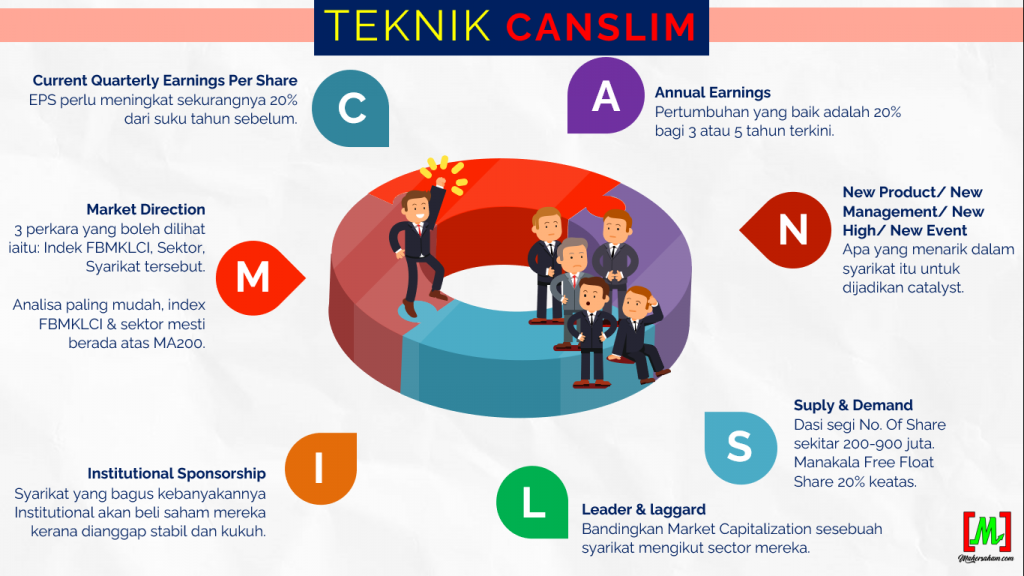
C - Current Quarter Earning Per Share
Earnings Per Share (EPS) is the company's net profit divided by its total shares. For criterion C, look at the most recent quarter's EPS compared to the same quarter a year earlier (year-on-year), not the previous quarter, to avoid being misled by seasonal factors.
O'Neil requires quarterly EPS growth of at least 20% to 25%. The higher the better. Ideal candidates show accelerating growth - for example, up 20% last quarter, then up 35% this quarter. This acceleration in earnings is often what triggers a stock's price rise.
On Bursa Malaysia, you can check quarterly EPS through company quarterly reports on the Bursa Malaysia website, KLSE Screener, or Malaysiastock.biz.
A - Annual Earning
Annual Earning refers to the company's yearly profit. This criterion ensures the quarterly growth above is not a fluke but a consistent long-term trend.
O'Neil wants annual earnings growth of at least 25% per year for 3 to 5 consecutive years. As supporting evidence, a healthy Return on Equity (ROE) is 17% or more - this shows the company generates profit efficiently from shareholders' capital.
Simple example: if last year's profit was RM1 million and this year's is RM1.25 million, that is 25% growth. Make sure this trend repeats rather than spiking once and then falling.
N - New Product / New Management / New High / New Event
The letter N is about a catalyst - something "new" that can push the share price to a higher level. You need to find what is interesting and new about the company.
- New Product/Service: A new product or service with a "wow" factor that can significantly add to revenue. Not just any ordinary new product.
- New Management: Experienced, visionary new leadership often turns around a weak company.
- New Event: A major contract, expansion into new markets, or a shift in industry policy.
- New High: Technically, a stock hitting a new high after breaking out of a consolidation area (breakout) shows strong demand. Many investors fear buying at a high price, but O'Neil believed strong stocks tend to get stronger.
S - Supply & Demand
Supply and demand is the balance of supply and demand for a company's shares. When demand exceeds supply, the price rises. A few things to watch:
- Shares outstanding: Stocks with a small to medium share count (for example, 200 million to 800 million) move up more easily than giants with billions of shares.
- Free float: Take a free float of around 20% and above so the stock is liquid enough to trade.
- Volume surge: During a breakout, trading volume should spike well above average. This signals institutions are accumulating the stock.
Learn more in our guide on the supply and demand concept in stocks.
L - Leader & Laggard
Here you determine whether the stock is a leader or a laggard within its sector. Choose the leader, because leaders move first and their gains are usually larger.
O'Neil uses Relative Strength (RS) - comparing a stock's price performance against the overall market. Pick stocks with a high RS (outperforming 80% of all other stocks). Another simple way is to compare the performance and market capitalization of companies within the same sector.
Remember, compare within the same sector only. For example, do not compare Greatech (Technology sector) with Lion Industries (Industrial Products sector) because they are in different sectors. That is an incorrect comparison.
I - Institutional Sponsorship
Quality companies usually attract institutional investors. Institutional support gives a stock stability and momentum because they invest in large amounts and for the long term.
Examples of institutions in Malaysia are EPF (KWSP), KWAP, LTAT, Tabung Haji, PNB and unit trust funds. Their fund managers only buy financially strong companies with good prospects. What matters is not merely having institutions, but that the number of institutions owning the stock is increasing quarter over quarter.
To check institutional holdings, use Bursa Marketplace, the annual report (the list of 30 largest shareholders), or the M+ Online platform. If you do not yet have a CDS account, you can open an Mplus CDS account with me to start investing.
M - Market Direction
This is the most important criterion but the one most often ignored. O'Neil found that 3 out of 4 stocks move in the direction of the overall market. This means even if you find the best stock, if the market is falling, the stock will likely fall too.
To assess market direction, look at 3 things:
- The FBMKLCI index - the overall direction of the Malaysian market.
- The sector the company belongs to - is its sector rising?
- The stock itself - its trend, support and resistance.
The simplest signal: make sure the FBMKLCI index and the relevant sector are above the 200-day moving average. You can learn more in our guide on using moving averages in TradingView.
CANSLIM Checklist
Here is a summary of the seven CANSLIM criteria along with targets and where to check the data on Bursa Malaysia:
| Letter | Criterion | Target | Where to check |
|---|---|---|---|
| C | Current Quarter EPS | Up 20-25%+ (YoY), ideally accelerating | Quarterly report, KLSE Screener |
| A | Annual Earning | Up 25%+ a year for 3-5 years; ROE 17%+ | Annual report, Malaysiastock.biz |
| N | New (product/management/high) | A catalyst + breakout to new high | Company news, price chart |
| S | Supply & Demand | 200-800m shares, volume spike | Bursa Marketplace, volume chart |
| L | Leader & Laggard | Sector leader, high RS | Sector comparison, RS rating |
| I | Institutional Sponsorship | Number of institutions increasing | Annual report, Bursa Marketplace |
| M | Market Direction | FBMKLCI & sector above MA200 | FBMKLCI index chart |
Applying CANSLIM to Bursa Malaysia Stocks
Let us look at how to use CANSLIM step by step:
- Screen with C and A: Use KLSE Screener to filter companies with quarterly and annual EPS growth of 20-25% and above. This shortens the list from hundreds of stocks to just a few dozen.
- Find the catalyst (N): From that shortlist, check news and annual reports - is there a new product, a major contract, or new management? Also check the chart to see whether the stock is near a breakout to a new high.
- Inspect S, L, I: Make sure the share count is reasonable, the stock is a sector leader, and institutional holdings such as EPF or PNB are increasing.
- Confirm M: Finally, make sure the FBMKLCI and the sector are in an uptrend above the MA200 before you enter. If the market is weak, it is better to wait.
With the discipline of these four steps, you screen stocks objectively rather than chasing emotion or "hot tips".
Advantages and Limitations of CANSLIM
Advantages: CANSLIM combines fundamentals (company profit) and technicals (price momentum), so you do not rely on a single angle. It is also disciplined and testable, reducing emotion-driven buy decisions.
Limitations: CANSLIM was created for large markets like the United States with thousands of stocks and high liquidity. In the smaller Bursa Malaysia, it can be hard to find a stock meeting all seven criteria at once. CANSLIM also suits growth and momentum strategies rather than value investing or very long-term holding. It requires periodic monitoring because it factors in momentum.
Common Mistakes Investors Make With CANSLIM
- Ignoring the letter M: Buying a good stock while the market is falling. Market direction is the main determinant.
- Comparing different sectors: Comparing leader and laggard across sectors that are not comparable.
- Compromising the criteria: "Almost enough" is not enough. CANSLIM works because its standards are strict.
- Forgetting to set a stop loss: O'Neil himself advised selling if a stock drops 7-8% below the buy price to cap losses.
Is CANSLIM Shariah-Compliant?
CANSLIM is merely a stock-selection method, so it is neutral from a Shariah perspective. What determines Shariah compliance is the stock you pick, not the analysis technique. For Muslim investors, combine CANSLIM with the list of Shariah-compliant stocks issued by the Securities Commission (SC) Malaysia. In other words, use CANSLIM to screen only from the Shariah-compliant list, so your investments remain sound in both principle and quality.
Conclusion
The CANSLIM technique is a proven method for finding quality stocks. By evaluating seven criteria - Current Earnings, Annual Earnings, New Products, Supply and Demand, Leader or Laggard, Institutional Sponsorship, and Market Direction - you can make more objective and disciplined investment decisions. Start by screening with C and A, find the catalyst, confirm institutional support and market direction, and always manage your risk.
FAQ - CANSLIM Technique
1. What is the CANSLIM technique in stock investing?
CANSLIM is a stock selection technique introduced by William J. O'Neil. It combines seven criteria - Current Earnings, Annual Earnings, New Products, Supply & Demand, Leader or Laggard, Institutional Sponsorship, and Market Direction - to identify stocks with the potential to rise big.
2. Is the CANSLIM technique suitable for the Malaysian stock market?
Yes, CANSLIM can be applied on Bursa Malaysia. You can use platforms like KLSE Screener, Malaysiastock.biz and Bursa Marketplace to obtain fundamental data. Just note that because the Malaysian market is smaller, you may need more flexibility since it is harder to find a stock meeting all seven criteria at once.
3. What does each letter in CANSLIM mean?
C = Current quarterly earnings, A = Annual earnings, N = New product/management/high, S = Supply and demand, L = Leader or laggard, I = Institutional sponsorship, and M = Market direction. Each letter represents one criterion that must be met.
4. What EPS growth percentage does CANSLIM require?
For current quarterly earnings (C), O'Neil requires growth of at least 20-25% compared to the same quarter last year. For annual earnings (A), the target is 25% and above for 3 to 5 consecutive years, with an ROE of 17% or more.
5. How long does it take to analyze a stock using CANSLIM?
It depends on your experience. For beginners it may take a few hours per stock. With practice and the help of a stock screener, the process can be shortened to 30 minutes to 1 hour.
6. What is the difference between CANSLIM and ordinary fundamental analysis?
CANSLIM combines fundamental analysis with technical analysis (especially Market Direction and breakouts). It is not just about looking at company financials, but also price momentum and institutional ownership, making it more comprehensive.
7. Is the CANSLIM technique Shariah-compliant?
CANSLIM is only an analysis method, so it is Shariah-neutral. What matters is that the stock you pick is Shariah-compliant. Combine CANSLIM with the Securities Commission (SC) Malaysia Shariah-compliant stock list for Shariah-compliant investing.
8. Can CANSLIM be used by new investors?
Yes. Although there are seven criteria, beginners can start by screening C and A using KLSE Screener, then learn the other criteria gradually. The key is discipline in following the criteria and managing risk.
Start Your Investment Journey
Now you understand the CANSLIM technique and how to apply it on Bursa Malaysia. The next step is to start practicing it.
Open a CDS Account: Open an Mplus CDS account with me and start screening stocks using the CANSLIM technique on Bursa Malaysia.
Download a Free Ebook: Get the free stock basics ebook from Mahersaham to strengthen your investing foundation.