Scientific Studies Prove Charitable People Become Wealthier and More Productive

Many people believe charity reduces their wealth. But research from Harvard Business School, the American Enterprise Institute, and several leading universities proves otherwise - people who give regularly actually become wealthier, happier, and more productive in their careers.
This article uncovers real scientific studies proving that giving is not only spiritually rewarding but also backed by economics, neuroscience, and modern psychology.
Arthur Brooks Study: Every $1 Given Returns $3.75 in Income
One of the most influential studies in this field comes from Arthur C. Brooks, former president of the American Enterprise Institute and now a professor at Harvard Kennedy School. He analysed data from the Social Capital Community Benchmark Survey (SCCBS) - a survey of over 30,000 respondents across the United States.
The results were striking. If two families identical in size, age, race, education, religion, and politics differed only in that one donated an extra USD100, the giving family would, on average, earn USD375 more.
In the Malaysian context, imagine donating an extra RM100 per month to charity. Based on Brooks' ratio, you could potentially see an income increase of up to RM375 indirectly - through better career opportunities, wider social networks, and improved productivity.
Brooks also found that in 2004, every USD100 in charitable giving stimulated GDP growth exceeding USD1,800. This means charity benefits not just individuals but drives the economy as a whole.
Harvard Business School: Spending on Others Makes You Happier
Professor Michael Norton from Harvard Business School, together with Elizabeth Dunn and Lara Aknin from the University of British Columbia, conducted a series of studies published in the prestigious journal Science.
They found that people who spent money on others - what they called "prosocial spending" - reported significantly higher levels of happiness compared to those who spent on themselves.
In one experiment, they gave bonuses to 16 employees at a Boston company and tracked how the money was spent. Workers who used more of their bonus for others recorded higher happiness levels - and this depended not on the absolute amount, but the percentage spent on others.
Even more remarkably, their research showed that spending as little as USD5 (about RM22) per day on others was enough to significantly boost happiness.
Why Does Happiness Matter for Wealth?
You might wonder - what does happiness have to do with wealth? Research from Warwick University shows that happy workers are 13% more productive. When you are more productive, you create more value, which leads to salary increases, promotions, or business success.
This creates a virtuous cycle: charity increases happiness, happiness increases productivity, and productivity increases income - which in turn enables you to give even more.
Your Brain Changes When You Give
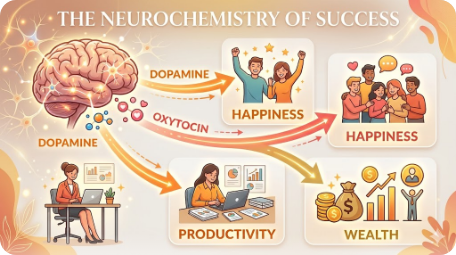
From a neurological perspective, giving literally changes how your brain functions. According to research published in Psychology Today, when someone gives or donates, several things happen in the brain:
Dopamine is released - The same chemical produced when you eat good food or achieve an important goal. This creates what scientists call the "helper's high" - a feeling of joy and satisfaction that motivates continued giving.
Oxytocin increases - The hormone associated with trust and social bonding. When oxytocin levels are high, you find it easier to build meaningful relationships - and in the business world, relationships are everything.
Cortisol decreases - The stress hormone that can impair decision-making and problem-solving ability. With lower cortisol levels, you think more clearly and make better financial decisions.
The combination of these three effects makes frequent givers calmer, more focused, and better equipped to solve complex problems.
Charity Makes You a Better Problem Solver
This is perhaps the most fascinating part. Studies show that giving enhances what psychologists call self-efficacy - the belief that you are capable of handling situations and producing desired outcomes.
When you give your time, energy, or money to something you believe in, you automatically become a problem solver. You are no longer a passive observer or victim of circumstance - you are an agent of change.
Research from Notre Dame University found that generous people demonstrate significantly higher levels of self-efficacy. They are more confident in taking calculated risks, bolder in trying new approaches, and more resilient when facing failure.
In the context of investing and business, these traits are extremely valuable. Investors with high self-efficacy make more rational decisions, panic less during market downturns, and are more efficient at identifying opportunities.
Social Networks: The Hidden Asset of Generous People
Another mechanism through which charity brings wealth is through expanding social networks. According to research published in the Journal of Economic Psychology, individuals involved in charitable activities tend to form more meaningful social connections.
These connections often translate into economic and career opportunities. People are more likely to do business with, hire, or promote someone they trust and admire for their generosity.
In Malaysia, the culture of giving is deeply valued. An entrepreneur known for their generosity receives greater trust from customers, suppliers, and business partners. This is not just theory - it is a social reality that has existed for centuries in our society.
Islamic Perspective: Science Confirms What the Quran Already Taught
For Muslims, these scientific findings actually confirm what the Quran and Hadith have taught for over 1,400 years.
Allah SWT says in Surah Al-Baqarah, verse 261:
"The example of those who spend their wealth in the way of Allah is like a seed of grain that sprouts seven ears, in every ear a hundred grains. And Allah multiplies the reward for whom He wills."
Prophet Muhammad SAW also said:
"Charity does not decrease wealth." (Narrated by Muslim)
Interestingly, the ratio mentioned in this hadith closely aligns with Arthur Brooks' findings - that every dollar given to charity generates a USD3.75 return in increased income.
According to UPM's Centre for Waqf, Zakat and Infaq Management (WAZAN), the benefits of charity include erasing sins, healing ailments, easing matters in the hereafter, providing shade on the Day of Judgement, and multiplying wealth.
So when modern science finds that charity increases income, reduces stress, and boosts happiness - it is simply confirming what Islamic teachings have always stated.
How You Can Start Today
1. Start With Small Amounts
Harvard research shows that spending as little as RM20-30 per day on others already produces positive effects. You do not need to wait until you are wealthy to start giving.
2. Be Consistent
The neurological effects (dopamine, oxytocin) are strongest when giving is done regularly, not occasionally. Set a monthly amount for charitable giving.
3. Get Involved Directly
Self-efficacy research shows the strongest effects when you are personally involved - not just transferring money. Volunteer, mentor, or teach someone a new skill.
4. Choose a Cause You Believe In
Intrinsic motivation produces deeper psychological effects. Choose a charity or cause that truly matters to you.
5. Don't Expect Immediate Returns
Paradoxically, research shows the positive financial effects of charity occur indirectly - through increased productivity, social networks, and problem-solving ability. Give sincerely, not expecting returns.
Frequently Asked Questions (FAQ)
Do these studies only apply in Western countries?
No. Arthur Brooks' research uses data from diverse demographic backgrounds. Neurological principles (dopamine, oxytocin) are universal - the human brain functions the same regardless of culture or geography.
How much should I give to see the effects?
Harvard research shows positive effects starting from as little as USD5 (about RM22) per day. It is not the absolute amount that matters, but consistency and the intention behind giving.
Is volunteering (giving time) equally effective?
Yes. Self-efficacy research from Notre Dame found that giving time and energy produces psychological effects just as strong - sometimes even stronger - than monetary donations alone.
How exactly does charity increase income?
Through three main mechanisms: (1) Increased happiness that boosts work productivity by 13%, (2) Expanded social networks that open career and business opportunities, (3) Enhanced self-efficacy that makes you a more efficient problem solver.
Does forced giving (taxes) produce the same effect?
Not entirely. Neurological research shows that dopamine and oxytocin effects are strongest when giving is voluntary. Forced contributions do not produce the same "helper's high."
What does Islam say about giving when you still don't have enough?
In Islam, the best charity is from surplus wealth after basic needs are met. Prophet Muhammad SAW said, "The best charity is that given from surplus." This aligns with modern financial advice - ensure basic needs are covered before giving.
Do wealthy people who give more become even wealthier?
Yes. Brooks' research found a significant positive correlation between charitable giving and income growth, even after controlling for factors like education, age, and background. This applies across all income levels.
Can I donate my professional skills?
This is actually one of the most valuable forms of charity. When you use your expertise to help others for free, you build a strong professional reputation while enhancing your self-efficacy - both contribute to long-term income growth.
Conclusion
Scientific studies from Harvard, AEI, and leading global universities have empirically proven what Islam has taught for 1,400 years - charity does not decrease wealth but multiplies it. It is not just spiritual virtue but a practical strategy for boosting productivity, building networks, and becoming a more effective problem solver.
If you want to start building wealth in a blessed way, the first step is understanding how money works in the markets.
Open a CDS account to start investing on Bursa Malaysia and international stocks including US and Hong Kong markets through this page.
Download the free Stock Market Basics ebook at this link to build your financial knowledge foundation.
Further Reading
- Sedekah Dalam Islam: Dalil Al-Quran, Hadis Sahih & Beza Dengan Infaq
- Kenapa Umat Islam Patut Paling Bijak Buat Keputusan Kewangan?
- 10 Buku Kewangan Peribadi Terbaik yang Wajib Anda Baca Sebelum Melabur
- Kajian Kewangan Patuh Syariah: Cara Betul Guna Tanda Aras 33%
- Boikot, Divestment & Sanctions (BDS): Apa Kata Islam?