Core vs Headline Inflation: Which Should Malaysian Investors Follow?

Every month after the 15th, the Department of Statistics Malaysia (DOSM) releases inflation data. The media reports two numbers that often confuse readers: Headline Inflation and Core Inflation. In March 2026, headline inflation rose to 1.7% while core inflation hit 2.1% - so why are there two different figures, and which one actually matters for stock investors?
Many people read only the news headlines, pick up the headline inflation number, and make investment decisions based on it. The problem: that number can be misleading - it may look soft while real price pressures are actually building. This is why BNM itself does not rely heavily on headline inflation when setting the OPR; it tracks core inflation much more closely.
This article explains the difference between the two measures, why BNM prefers core, and how retail investors should use this information for portfolio decisions.
Quick Answer
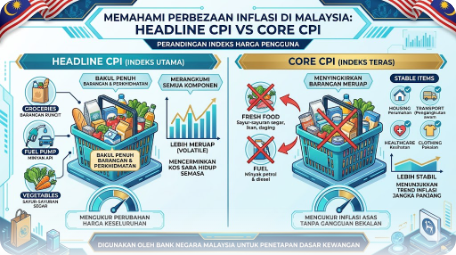
Headline Inflation (Headline CPI) = all 12 consumer price categories, including fresh food and government-administered prices.
Core Inflation (Core CPI) = CPI with volatile items stripped out - fresh food and government-controlled prices (RON95, diesel, electricity) are excluded.
For investors: follow Core Inflation for long-term trends (it reflects real price pressure and drives BNM's OPR decisions), but follow Headline Inflation for short-term impact on consumer purchasing power (consumer and retail stocks).
What Is Headline Inflation (Headline CPI)?
Headline inflation measures the price increase of the entire consumer basket in Malaysia as captured by the Consumer Price Index (CPI).
According to OpenDOSM, Malaysia's CPI covers 12 main divisions:
- Food & non-alcoholic beverages
- Alcoholic beverages & tobacco
- Clothing & footwear
- Housing, water, electricity, gas & other fuels
- Furnishings & household maintenance
- Health
- Transport
- Communication
- Recreation, sport & culture
- Education
- Restaurants & accommodation services
- Insurance & financial services
Each division is assigned a weight based on how much Malaysian households spend on that category. Food and transport usually get the highest weights.
Headline inflation is the figure most cited by the media because it reflects what people actually feel - when petrol prices rise, chicken prices rise, or LRT fares go up, it all feeds in.
What Is Core Inflation (Core CPI)?
Core inflation is CPI minus volatile items. According to DOSM's methodology, the excluded items are:
1. Fresh food (volatile food)
- Fresh fish (shark, mackerel, pomfret, etc.)
- Fresh vegetables (mustard greens, spinach, chilli, onions, etc.)
- Fresh fruits
- Fresh chicken and certain fresh meats
Why? The prices of these items fluctuate due to weather, seasonality, and short-term supply - not because of structural economic pressure.
2. Government-administered prices
- RON95 petrol (pegged at RM2.05/litre)
- Subsidised diesel
- Domestic electricity tariffs
- Subsidised cooking gas
- Certain tolls
- Some essential medicines
These prices do not move with the market - they are set by the government. When the government raises electricity tariffs by 2%, that is not "inflation" in the supply-demand sense; it is a policy decision.
By removing these two categories, core inflation gives a clearer picture of persistent, structural price pressure - not just daily noise.
Why Are the Two Numbers Often Different?
In March 2026, DOSM data showed:
| Metric | February 2026 | March 2026 |
|---|---|---|
| Headline Inflation | 1.4% | 1.7% |
| Core Inflation | 2.0% | 2.1% |
Notice: Core inflation is HIGHER than headline. This is a common pattern in Malaysia during 2024-2026 because:
- RON95 petrol prices remain stable at RM2.05 (pegged by the government). This "drags down" headline CPI in the transport category.
- Electricity subsidies keep tariffs low for regular consumers - dragging down housing CPI.
- Fresh food prices fluctuate - sometimes they spike, sometimes they fall. When they fall in a particular month, they pull headline lower.
But real structural costs (rent, education, healthcare, services) continue to rise - this is what core inflation captures.
In certain months, core can be LOWER than headline - for example when global oil prices spike dramatically (even with subsidies, freight and other transport costs feel the pinch). But on long-term averages in Malaysia, core tends to be higher or more stable relative to headline.
Why BNM Follows Core Inflation
Bank Negara Malaysia (BNM) uses core inflation as its main reference when setting the Overnight Policy Rate (OPR). Several reasons:
1. It reflects real demand-supply pressure
If core inflation rises, it means there is broad price pressure across the economy. Price increases in teh tarik, haircuts, rent, or kindergarten fees are not about the weather - they are demand versus supply. BNM can respond with monetary policy (raise OPR to cool demand).
2. Monetary policy cannot change government-set prices
If the government decides to raise electricity tariffs, BNM raising the OPR will not bring those prices down. So it is pointless to react to components the government controls.
3. Stable core is more suitable for medium-term decisions
OPR decisions are made every two months. If BNM chased a wildly swinging headline number, it would be forced to change the OPR frequently, creating instability. Core inflation is steadier, allowing decisions to be made with more confidence.
According to BNM statements in the quarterly Monetary Policy Statement, core inflation is often the focus of discussion - not headline. BNM itself projects headline inflation to average between 1.5% and 2.5% in 2026.
Which Should Retail Investors Follow?
The answer is not "one or the other" - it depends on the investment decision you are making.
Follow Core Inflation for:
1. OPR forecasting and its impact on stocks
Rising core inflation = higher risk of OPR hike = positive for banks (NIM expansion), negative for property/REITs (discount rate rises).
2. Growth vs value stock selection
Rising core inflation sustains a "tight" environment - defensive/value stocks typically outperform growth.
3. Long-term fundamental valuation
When calculating DCF (Discounted Cash Flow) or estimating a stock's fair value, use expected inflation over 5-10 years. Core inflation is a more reliable baseline.
Follow Headline Inflation for:
1. Consumer & retail stocks
When fresh food surges (fish, vegetables), household purchasing power takes a hit - consumer discretionary (Padini, MyNews, AEON) are the most sensitive.
2. Subsidy-linked stocks
When petrol prices appear stable in headline, but subsidies are scheduled to be reduced - it affects retail oil stocks (Petronas Dagangan, Shell).
3. Consumer staples
Nestle, Dutch Lady, Fraser & Neave - their input costs (imported milk, wheat) track headline, not core.
Bottom line: If you are a long-term investor focused on macro portfolio strategy (asset allocation, sector rotation, duration), follow core. If you trade thematics or pick stocks based on the impact on households, headline matters too.
Where to Find Malaysian Inflation Data
Two free official sources:
1. OpenDOSM
The Department of Statistics' open data portal. Interactive dashboards show headline CPI, core CPI, and each of the 12 divisions. You can download CSV data for your own analysis.
2. BNM Financial Markets
Bank Negara also publishes inflation data with alternative breakdowns. Useful for tracking how BNM itself interprets the numbers.
Data is typically released mid-month (15-20th) for the previous month's figures. Example: March 2026 inflation data was released around 18-20 April 2026.
Common Investor Mistakes About Inflation
1. Thinking low inflation is good for all stocks
No. Inflation that is too low (below 1%) or deflation is actually a serious risk - it signals weak demand, slow economic growth, and companies struggling to raise prices. Stocks can underperform.
2. Assuming BNM reacts to every headline rise
No. BNM focuses more on core. If core is stable even as headline rises due to world oil prices, BNM typically stays patient and does not hike OPR.
3. Ignoring categories relevant to specific stocks
Example: if you have exposure to F&B stocks, you should specifically track the "Food & beverages" CPI category - not just headline.
4. Comparing directly with the US
Core PCE and Core CPI in the US use different methodologies (PCE excludes "food & energy", US CPI is different). Do not translate the Fed dot plot directly to BNM.
5. Forgetting the impact on debt servicing
High inflation = high interest rates = rising financing costs. Leveraged companies (heavy debt load) will suffer especially in construction, property, and aviation. Check the gearing ratios of stocks you hold.
For more on the OPR mechanism and its effect on stocks, read What Is OPR and the Effects of OPR Hikes.
Malaysia vs US Inflation: Quick Comparison
| Aspect | Malaysia | United States |
|---|---|---|
| Statistics body | DOSM | Bureau of Labor Statistics (BLS) |
| Headline CPI Mar 2026 | 1.7% | ~3.2% (estimate) |
| Core CPI Mar 2026 | 2.1% | ~3.8% (estimate) |
| Central bank target | No precise target (1.5-2.5% in 2026) | 2% (Fed target) |
| Subsidy share | High (petrol, electricity) | Low |
| Volatility | Low-moderate | Moderate |
Malaysia's inflation has been lower than the US throughout 2024-2026 due to heavy subsidies on fuel and energy. This is why the OPR in Malaysia (2.75%) is lower than the Fed Funds Rate (~4.5%+).
How Inflation Hits Stock Sectors on Bursa
High inflation affects each sector differently:
Sectors that usually WIN when inflation rises:
- Banks (Maybank, CIMB, Public Bank): NIM expands when OPR rises
- Commodities (Petronas Chemicals, IOI Corp): Selling prices rise with global inflation
- REITs with rental escalation (IGB REIT, Sunway REIT): Lease contracts with CPI-linked escalation
Sectors that usually LOSE when inflation rises:
- Consumer discretionary (Padini, MyNews): Households cut back on spending
- Property (SP Setia, Mah Sing): Mortgages get expensive, sales volume falls
- High-growth tech: High discount rates compress the present value of future earnings
- Capped-tariff utilities (TNB): Cannot fully pass costs to consumers
Understanding this breakdown helps you adapt your portfolio when CPI data drops - not panic sell everything.
FAQs
What is the difference between core and headline inflation?
Headline inflation covers all items in the CPI. Core inflation excludes fresh food and government-controlled prices (RON95, electricity). Core is more stable and reflects structural price pressure.
Why does BNM prefer to follow core inflation?
Because monetary policy (OPR) cannot influence government-controlled prices or fresh food fluctuations. Core gives a signal of demand-supply pressure that BNM can respond to.
When is Malaysian inflation data released?
Usually on the 18-20th of each month for the previous month. Example: March 2026 data was released around 20 April 2026.
Where can I check Malaysian inflation data?
OpenDOSM is the best official source. You can view the interactive dashboard or download free CSV data.
What is Malaysian core inflation in 2026?
March 2026: 2.1%. BNM projects headline inflation to average 1.5-2.5% throughout 2026.
Is high inflation always bad for investors?
No. Moderate inflation (2-3%) is usually healthy for stock markets because it indicates active demand. Inflation that is too high (>5%) or too low (<1%) is what causes problems.
How does inflation affect stock dividends?
Companies with pricing power (Nestle, strong brands) can maintain or raise dividends even when inflation is high. Companies with thin margins (retail, generic food manufacturing) may cut dividends.
What is the effect of inflation on EPF and fixed deposits?
If inflation is 2.5% but fixed deposit rates are only 2.5%, your real return is ZERO. EPF dividend in 2024 was around 5.5% - still delivering a real return of 3%+ against 2.5% inflation. This means EPF still outperforms deposits when core inflation is high.
Conclusion
Both core and headline inflation matter - but they serve different purposes. BNM uses core for OPR decisions, and long-term investors should track core for portfolio strategy. Headline inflation, on the other hand, paints the picture of household purchasing power pressure - important for consumer-facing stocks. Do not pick just one; use both for the full picture.
A deep understanding of macroeconomic data like this is the foundation for building a portfolio that adapts to market cycles. Investors who understand why the OPR rises or falls will always be one step ahead of those who only react to news headlines.
While you build your macroeconomic understanding, start building your actual investment portfolio that can benefit from these cycles.
Open a CDS trading account today to start investing in Bursa Malaysia as well as overseas markets including US and Hong Kong stocks through one platform.
Download our free stock market basics ebook to understand investment fundamentals before taking the next step.