Corporate Exercise on Bursa Malaysia: What Investors Need to Know

Have you ever woken up in the morning, opened your stock trading app, and suddenly seen your portfolio turn bright red? Or perhaps your share units suddenly doubled but the price dropped by half?
Don't panic! You haven't been scammed and your account hasn't been hacked. Most likely, the company you invested in is carrying out what is known as a Corporate Exercise (Corporate Action).
For new investors, this term may seem technical and dull. But the truth is, understanding corporate exercise is "essential knowledge" if you don't want to miss out on profit opportunities or incur losses unintentionally. Let's break it down one by one in a relaxed manner!
1. What Is a Corporate Exercise, Really?
In short, a corporate exercise is any action taken by a listed company on the stock exchange that can directly affect its shareholders (you!) and the company's financial structure.
Why do companies do this? Usually for three main reasons:
- To raise capital: To expand the business or pay off debts.
- To reward shareholders: To appreciate loyal investors by distributing profits.
- To manage share price: To make shares appear more "affordable" or more prestigious.
2. Know the Types of Corporate Exercise on Bursa Malaysia
We can categorise corporate exercises into several groups so they're easier to digest.
A. "Rewards" & Profit Distribution Category
This is every investor's favourite category. Who doesn't love getting something for free, right?
- Cash Dividend: The company distributes a portion of its profits in cash directly to your bank account.
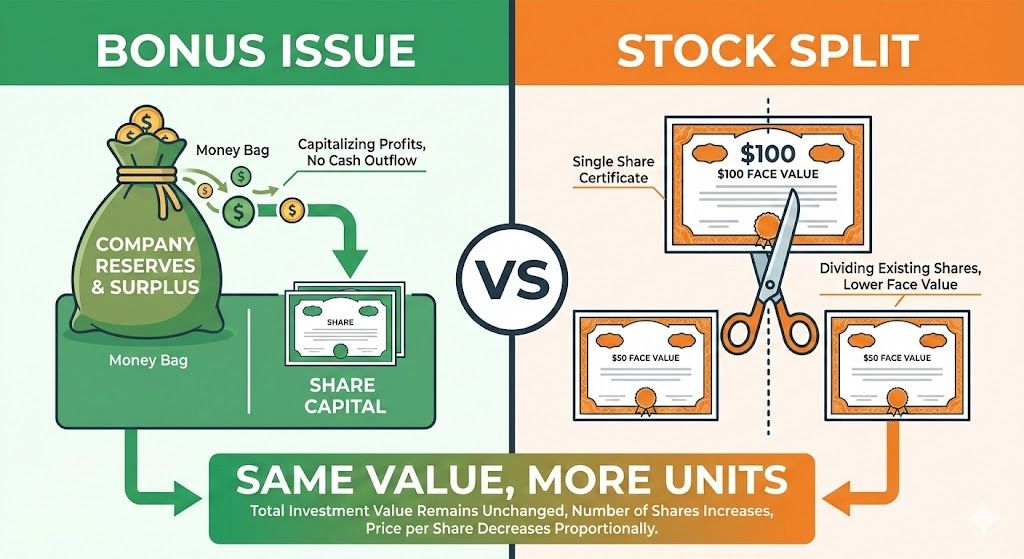
- Bonus Issue: The company gives additional share units for free. For example, 1 bonus share for every 2 shares you hold. Although the share price will be adjusted (drops slightly), your total units increase.
- Share Buyback: The company uses its own funds to buy back its shares on the open market. This is usually a sign that management believes the share price is too cheap (undervalued).
B. Fund Raising Category
Sometimes companies need extra funds for new projects. This is where they seek help from investors.
- Rights Issue: The company offers you the opportunity to buy additional shares at a discounted price. You have the right to buy, but it's not mandatory. If you don't take it up, your shareholding may experience dilution.
- Private Placement: The company offers new shares to selected investors (usually institutional investors or big players) to obtain quick capital.
C. Restructuring (Adjustment) Category
- Stock Split (Share Split): One old share is split into several smaller new shares. The purpose is to make the price appear cheaper so more retail investors can afford to buy.
- Share Consolidation: The opposite of a stock split. Several shares are combined into one. This is usually done so the share price doesn't look like a "penny stock".
3. Common Confusion: Bonus Issue vs Stock Split
Many people ask, "Aren't these two basically the same? Units increase, price drops?"
True, in terms of the impact on your pocket on the day itself, they do look the same. But from the company's accounting perspective, they are different:
- Bonus Issue: The company transfers money from its savings account (retained earnings) to its capital account. This shows the company is healthy and has substantial cash reserves.
- Stock Split: It merely splits the units. There is no transfer of money within the company's accounts. It is more of a price psychology strategy.
4. Critical Dates Every Investor Must Know
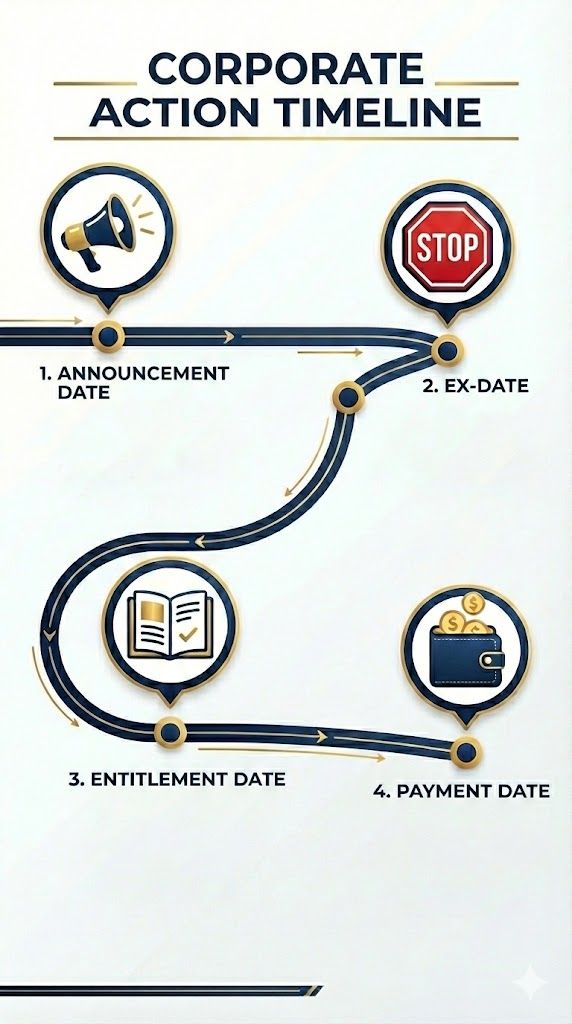
In a corporate exercise, "Timing is everything". If you miss one day, you might lose out entirely.
- Announcement Date: The day the company makes an official announcement on Bursa Malaysia.
- Ex-Date (Most Important!): If you buy shares on or after this date, you are NOT ENTITLED to receive the dividend or bonus. Want to qualify? You must buy at least one day before the Ex-Date.
- Entitlement/Record Date: The day the company checks the shareholder register.
- Payment/Crediting Date: The much-awaited day! Cash or shares are credited to your account.
5. Why Does the Share Price Drop After Ex-Date? (Price Adjustment)
Don't be surprised if you see the share price turn "red" on the morning of Ex-Date. This is called price adjustment.
Logically, if a company gives a 1-for-1 bonus, the total units in the market have doubled. Therefore, the value must be divided by two so the company's market cap remains the same.
Simple Example: You have a piece of gold weighing 1kg worth RM300,000. You cut it in two (500g each). You still have gold of the same value, just now it's in the form of two smaller pieces. That's the concept of a stock split or bonus issue.
6. What Should You Do When a Company Announces a Rights Issue?
This is the question that fills our inbox the most. When you receive news of a Rights Issue, you have three options:
- Subscribe: Pay the discounted price and increase your shareholding.
- Sell the Rights: Sometimes the "rights" themselves can be sold on the market (OR - Odd Lot/OR counter).
- Ignore (Do Nothing): This is the worst option. You don't get cheap shares, and the value of your existing holdings will be diluted. Never just ignore it!
7. FAQ – Corporate Exercise in Malaysia
Q: Is a Bonus Issue always good?
A: Psychologically, yes. It shows the company is confident about its future. However, make sure the business continues to be profitable afterwards.
Q: How do I find out if a company is carrying out a Corporate Exercise?
A: Always check the "Company Announcements" section on the Bursa Malaysia website or your trading application.
Q: Why do companies do Private Placements? Isn't that unfair to small investors?
A: Not necessarily. A private placement is the fastest and cheapest way for a company to raise capital without going through the complex documentation process required for a Rights Issue.
Conclusion: Don't Be a Clueless Investor
The world of investing isn't just about watching charts go up and down. Understanding corporate exercise enables you to plan your strategy more wisely. Do you want to hold the shares until the Ex-Date, or sell before the price is adjusted? It all depends on your financial goals.
A wise investor is one who constantly reads and learns. So, the next time you see the words "Bonus", "Rights", or "Consolidation" in stock news, you'll know exactly what to do!
Why not start learning and investing in stocks on Bursa Malaysia yourself? If you're still a complete beginner and don't know how to start, you can begin by opening a CDS account under Mahersaham. Tuan Maher is a registered dealer's representative under Mplus Broker.
If you're interested in opening a CDS account, click here: OPEN CDS ACCOUNT