Crossing Trade vs Married Deal: How Big Shareholders Move Stock Without Moving the Market

Imagine a major shareholder of a listed company wants to sell 50 million shares. If he dumps the entire lot straight into the open market during trading hours, what happens? The share price collapses. The existing buy orders are not deep enough to absorb that volume, so every slice of selling eats into a lower price, and the seller ends up getting far less than he wanted. Retail investors, meanwhile, panic as they watch a red candlestick plunge for no obvious reason.
This is where two terms that often confuse new investors come in: crossing trade and married deal. Both are official mechanisms on Bursa Malaysia that let large parties exchange big blocks of shares at an agreed price, without shaking up the open market. This article explains what these two mechanisms actually are, why the "big boss" prefers them, and what they mean for you as a retail investor.
What Is a Direct Business Transaction (DBT)?
Before understanding crossing and married deals, you need to understand the umbrella that covers both: the Direct Business Transaction (DBT).
A DBT is any share transaction negotiated and agreed outside Bursa Malaysia's Automated Trading System (ATS), but still reported into the system for settlement and record-keeping. In other words, the buyer and seller have already discussed and agreed on the price and quantity privately. They do not place orders into the regular order book you see on your trading platform. Instead, the broker simply "reports" the already-agreed transaction to the exchange. According to Bursa Malaysia's official trading procedures, this type of transaction occurs outside the regular order book but is still recorded within the same system.
Think of it this way: the open market (order book) is like a noisy wholesale market where the price is set by second-by-second bargaining. A DBT, on the other hand, is like two parties who have already shaken hands outside the market, agreed on a single price, then come to the counter to register their deal officially. The transaction is still valid, still incurs fees, and still has to settle - the price is just not set by open auction.
Crossing Trade vs Married Deal: What's the Difference?
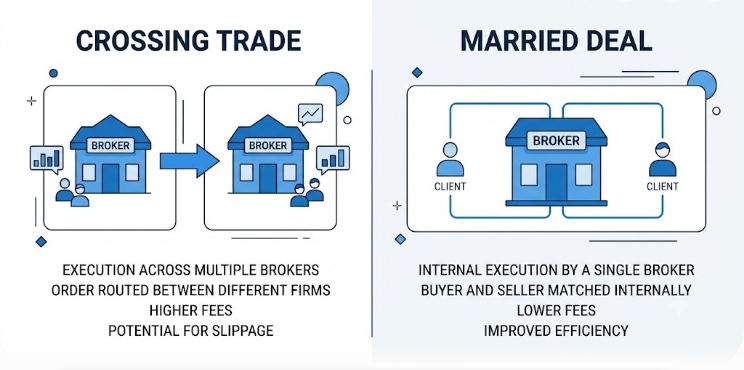
Many people use these two terms interchangeably, but there is one important technical difference. It comes down to how many brokers (Participating Organisations, or POs) are involved.
Crossing Trade
A crossing trade happens when the buyer and seller are clients of two different brokers. For example, the seller is a client of Broker A, while the buyer is a client of Broker B. The two brokers "cross" the already-agreed orders between their respective clients. That is why it is called a crossing - the orders cross across two different broker firms.
Married Deal
A married deal happens when the buyer and seller are clients of the same broker. One PO acts for both sides - it handles the seller and the buyer simultaneously. Because the transaction is "married" within the same firm, it is called a married deal. The broker matches the buy and sell internally, then reports it to the exchange.
So the simple formula to remember:
- Crossing trade = two different brokers (cross between POs)
- Married deal = one broker only (within the same PO)
In terms of market impact, both are the same: a large block of shares changes hands at an agreed price, without pushing the market price sharply up or down. The difference between a crossing and a married deal is about the broker structure, not about what you see as a retail investor.
The Four Types of DBT on Bursa Malaysia
In the Bursa Malaysia system, DBTs are actually broken down into four categories, depending on the transaction type and lot size:
- Crossing - Normal (CN) - a cross between two brokers, in standard lots (board lots)
- Crossing - Odd Lot (CO) - a cross between two brokers, in odd lots
- Married - Normal (MN) - a married deal within one broker, standard lots
- Married - Odd Lot (MO) - a married deal within one broker, odd lots
Most large block transactions involving the "big boss" fall under the CN and MN categories because they involve large quantities in board lots. If you are new to this and still unclear on the concept of lots, first read our guide on how to buy and sell odd lot shares so you understand the difference between a board lot and an odd lot.
Why Does the "Big Boss" Use This Method?
The most important question: why do large shareholders, directors, or institutional funds choose to exchange shares through a crossing or married deal, rather than directly in the open market? There are several strong reasons.
1. Avoiding Market Impact
This is the main reason. When the quantity to be sold or bought is too large relative to the stock's daily volume, doing it in the open market causes slippage - the price moves against you with each order filled. With a married deal, a large block can be exchanged at a single, stable price, without triggering an alarming price crash or spike. This concept is closely tied to the relationship between bid-ask, volume and supply-demand that determines price movement second by second.
2. Certainty of Price and Quantity
In the open market, you are never certain at what price your entire order will be filled. For a large block, this uncertainty is high risk. A DBT lets both parties lock in the exact price and quantity in advance. The seller knows precisely how much he will get; the buyer knows precisely how much he will pay.
3. Strategic Block Transfers
Many corporate situations require the orderly transfer of large blocks of shares, including:
- Restructuring of holdings - for example, moving shares from the founder's personal name into his own holding company.
- Entry of a strategic investor - a new fund or partner buying a large block directly from an existing shareholder.
- Family or estate transfers - transferring shares between family members or for estate planning.
- Placements - selling a block to selected investors to increase the public float.
In all these cases, the intention is not short-term "trading", but to transfer an interest cleanly at a fair price. The large players who move blocks like this are often called market "sharks". Read more about the 5 sharks that move share prices to understand who the big players behind the scenes are.
Transparency: A DBT Is Not a "Dark" Transaction
A big misconception is to assume that these off-market transactions are something "secret" or unlawful. In fact, they are not. DBTs are a tightly regulated mechanism under Chapter 10 of the Rules of Bursa Malaysia Securities. Here are the important transparency features:
- Reported to the exchange - every DBT must be reported into the Bursa system on the same trading day, so it appears in the stock's trade summary.
- Normal settlement - a DBT still goes through the same T+2 settlement cycle as a regular trade, and still incurs the official Bursa transaction costs such as brokerage, clearing fee, and stamp duty.
- Price limits - a DBT price cannot deviate excessively from the prevailing market price. Bursa imposes price parameters to prevent manipulation or improper transfer of value.
Mandatory Disclosure by Substantial Shareholders and Directors
This is the most important layer of transparency for retail investors. When a large block changes hands through a crossing or married deal, it usually triggers official disclosure obligations:
- Substantial shareholders - anyone holding 5% or more of a listed company's voting shares must notify the company and the authorities. Any change in interest, or ceasing to be a substantial shareholder, must also be disclosed.
- Company directors - directors must announce any dealing in their own company's shares to Bursa, including those done via a married deal.
This means that when a "big boss" transfers a large block, you can usually read the purpose behind it through the official announcements on the Bursa Malaysia Company Announcements page. To understand how director and shareholding information is disclosed in annual reports, refer to our guide on how to read director information in an annual report.
How Do Retail Investors See a DBT?
As a retail investor, you cannot participate in a crossing or married deal (it is for large, privately negotiated blocks). But you can see its effect in the trading data. On the M+ Global platform, for example, DBTs are often displayed as "Neutral" - neither Buy nor Sell - because they occur outside the order book. We have explained this in depth in our article on what Neutral means in M+ Global.
Signs of a DBT you can watch for:
- A single large-volume transaction appearing at one price, with no corresponding price movement on the chart.
- A "Neutral", "Direct", or "DBT" label in the transaction flow (time and sales).
- An announcement of a change in a substantial shareholder's holding on the Bursa site a few days later.
Is a Large Married Deal a Buy or Sell Signal?
This is a question many investors ask. The answer is: not necessarily, and you need to be careful about jumping to conclusions.
A married deal is simply a change of hands. It does not automatically mean the stock will go up or down. Context is everything:
- It can be positive - if a strong strategic investor enters by buying a large block, this may signal confidence in the company's prospects.
- It can be neutral - if it is merely an internal restructuring (for example, moving from a personal name to a holding company), there is no real change in control or prospects.
- It can be negative - if a substantial shareholder is continuously reducing his holding, it may be a sign of fading confidence.
The key is to read who is buying, who is selling, and why - not just the size of the transaction. Combine this with broader fund flow analysis. Our guide on how to read foreign fund flow on Bursa can help you see the bigger picture of institutional movements.
Frequently Asked Questions (FAQ)
Are crossing trades and married deals legal?
Yes, both are fully legal and regulated under Chapter 10 of the Rules of Bursa Malaysia Securities. They are not "dark" transactions - each one must be reported to the exchange on the same day and goes through official T+2 settlement.
What is the main difference between a crossing trade and a married deal?
A crossing trade involves two different brokers (POs) for the buyer and seller, while a married deal involves a single broker acting for both sides. In terms of market impact, the two are the same.
Can a retail investor do a married deal themselves?
Technically, a DBT is open to any client, but in practice it is used for large, privately negotiated blocks. An ordinary retail investor trading through the order book will not be involved in a married deal for small daily transactions.
Can a married deal price differ greatly from the market price?
No. Bursa imposes price band parameters so that a DBT does not deviate too far from the prevailing market price. This is to prevent price manipulation or improper transfer of value between parties.
Why do I see large volume but no price movement?
That is most likely a DBT (a crossing or married deal). Because the transaction happens outside the order book at an already-agreed price, it does not push the market price even though the volume is large. On the M+ Global platform, it shows up as "Neutral".
How do I know the purpose of a married deal?
Check the company's official announcements on the Bursa Malaysia site. Substantial shareholders (5% and above) and directors must declare their share dealings, so you can usually find out who bought, who sold, and the purpose a few days after the transaction.
Does a married deal affect the share price the next day?
Not directly, because it does not move the order book. However, if the market interprets the transaction as a signal (for example, a strategic investor entering or a major shareholder exiting), sentiment can influence the price in the following days.
Conclusion
Crossing trades and married deals are orderly, legal ways for large parties to transfer big blocks of shares without rattling the market. Both are Direct Business Transactions - negotiated outside the order book, but reported transparently to Bursa Malaysia. The only difference is the number of brokers involved: a crossing runs across two brokers, a married deal stays within a single broker.
For you as a retail investor, understanding this mechanism is not just trivia - it helps you interpret trading data more intelligently, recognise the moves of big players, and avoid panicking when you see unusual large volume. But remember: transaction size alone is not a signal. The context - who, why, and under what circumstances - is what matters.
Understanding the inner workings of the market like this is an important step towards becoming a more confident investor. The next step is making sure you have an account that lets you invest properly.
To start investing on Bursa Malaysia as well as overseas markets such as the US and Hong Kong, you can open a CDS and trading account with us.
And if you are just starting out, get our free stock market basics ebook to build a solid foundation of knowledge before you invest.