Exchanging Duit Raya: When It Becomes Riba & How to Avoid It

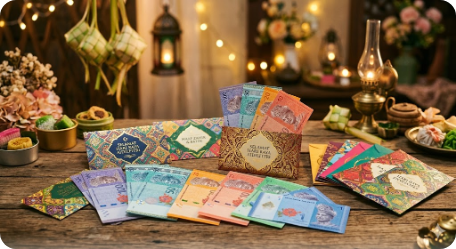
As Hari Raya Aidilfitri approaches, a phenomenon increasingly viral on social media is what netizens call the "duit raya cartel". Many people offer services to exchange old notes for crisp new ones - RM1, RM5, RM10 - charging a fee. Some charge RM3 per RM100, others RM10 for RM500.
But the question is: is this riba (usury)? Is it the same as paying someone to go exchange money at the bank? And where is the line between halal and haram in this duit raya exchange?
This article answers all these questions based on scholars' views and official fatwas in Malaysia.
Quick Answer
Exchanging duit raya at equal value (e.g., RM100 old = RM100 new) in cash is permissible (harus). It becomes haram and riba when the values are unequal - for example, giving RM100 but only receiving RM95 in small notes because RM5 is deducted as a "fee". If you want to pay someone to exchange money at the bank, the fee must be paid separately from the exchanged amount - not deducted from the exchange value.
What Is the 'Duit Raya Cartel'?
The term "duit raya cartel" refers to individuals or groups who monopolise the supply of new notes before Raya. They queue early at banks, exchange large amounts of money, then resell to the public at a markup.
Common examples:
- Someone queues at the bank and exchanges RM5,000 into new RM1 notes
- Then sells them: RM100 in new RM1 notes = RM103 (RM3 fee)
- Or worse: RM100 in new notes = RM110
This practice differs from a situation where someone is asked to help exchange money at the bank. This distinction is crucial from an Islamic law perspective.
Paper Money Is a Ribawi Item
In fiqh muamalat (Islamic commercial law), paper money is categorised as a ribawi item because it functions as a medium of exchange. This is based on the decision of Majma' al-Fiqh al-Islami (OIC) which stipulates that fiat money is subject to the rules of al-Sarf (currency exchange).
When exchanging money of the same type (e.g., Ringgit for Ringgit), two mandatory conditions must be met. Otherwise, the transaction falls into the category of riba.
The Federal Territory Mufti Office also confirms that fiat money is ribawi property and any same-type exchange must comply with Shariah-prescribed conditions.
Two Mandatory Conditions for Same-Currency Exchange
Based on the hadith of Prophet Muhammad SAW narrated by Muslim, exchanging ribawi items of the same type must fulfil two conditions:
1. Tamathul (Equal Value)
The amount exchanged must equal the amount received. RM100 must be exchanged for RM100 - no more, no less. Any excess or shortage constitutes riba.
2. Taqabud (Immediate Exchange)
The exchange must be done in cash and immediately (yadan bi yadin). There can be no delay - for example, giving money today but receiving new notes next week.
If either condition is not met, the exchange becomes haram.
Riba Fadhl vs Riba Nasiah: Duit Raya Scenarios
Let us understand two types of riba that can occur in the context of exchanging duit raya:
Riba Fadhl (Excess)
Occurs when the exchange values are unequal.
Example: Ali wants to exchange duit raya. He gives RM100 to a small-note seller but only receives RM95 because the seller deducts RM5 as a "service charge".
This is riba fadhl because there is excess in the exchange of same-type ribawi items. According to Ustaz Azhar Idrus (Kosmo): "Exchange RM100, RM3 fee, so you get RM97 - haram and accursed."
Riba Nasiah (Deferment)
Occurs when the exchange is not done immediately.
Example: Sarah asks her friend to exchange RM500 at the bank. She transfers money via online banking today, but her friend only gives the new notes next week after payday.
This delay makes the transaction riba nasiah, even though the values are equal.
Permissible Scenario
Example: Ahmad wants to exchange duit raya. He gives RM500 cash to the seller and receives RM500 in new RM1 notes immediately. Then, he pays RM20 separately as a service fee.
This is permissible because both conditions are met - equal value and immediate exchange. The RM20 paid is not part of the money exchange but payment for services (ujrah).
Duit Raya Cartel vs Service Fee: The Key Difference
Many people cannot distinguish between these two situations. The difference is actually very clear:
Scenario 1: Duit Raya Cartel (Potentially Haram)
- Seller exchanges RM100 old = RM95 new (deducts RM5 fee)
- Fee is taken from the exchange value
- Exchange values NOT equal = Riba Fadhl
- Ruling: HARAM
Scenario 2: Paying Someone to Help Exchange (Permissible)
- You ask a friend to go to the bank and exchange RM500
- Friend exchanges and gives you RM500 in new notes (equal value)
- You pay friend RM20 for petrol/time separately
- Exchange values EQUAL, fee paid SEPARATELY = Wakalah (agency) + Ujrah (fee)
- Ruling: PERMISSIBLE
According to the Penang Mufti via Sinar Harian, taking a fee for exchanging money is permissible as long as the payment is made separately and not taken from the exchanged amount.
Key Differences
| Aspect | Cartel (Haram) | Service Fee (Permissible) |
|---|---|---|
| Exchange value | Unequal (RM100 = RM95) | Equal (RM100 = RM100) |
| Fee/charge | Deducted from exchange | Paid separately |
| Contract type | Pure money exchange | Wakalah + ujrah |
| Handover | May be deferred | Immediate/cash |
Scholars' Views & Official Fatwas
Ustaz Azhar Idrus (UAI)
UAI emphasises that taking fees from the money exchange itself is haram. He gives this example: if someone exchanges RM100 and only receives RM97 because RM3 is deducted as a fee, that is accursed riba. The correct way: exchange RM100 = RM100, then pay the fee separately.
Federal Territory Mufti Office
Through Irsyad Hukum Series No. 766, the Federal Territory Mufti Office explains that same-type currency exchange must be equal in value and done immediately (lani). Any charge that causes unequal values constitutes riba.
Penang Mufti
The Penang Mufti emphasises that exchanging money for new notes for duit raya purposes is permissible, but the exchange must be at equal value. He also reminds the public to avoid elements of riba in duit raya exchanges.
The Correct Way to Exchange Duit Raya Without Riba
Here is a practical guide to ensure you do not fall into riba:
Option 1: Exchange at the Bank (Safest)
- Go to the bank counter or special new-note ATM
- Banks do not charge for same-denomination exchanges
- Maybank, CIMB, and Bank Islam usually provide this service before Raya
Option 2: Ask Someone to Help (Permissible With Conditions)
- Hand over the amount you want exchanged - e.g., RM500
- Ensure you receive EXACTLY RM500 in small/new notes
- Pay the fee separately - e.g., "Here's RM500 duit raya, and here's RM30 for your petrol"
- Do not mix the fee with the exchange
Option 3: Buy From a New-Note Seller (Be Careful)
- Ensure the exchange is 1:1 (RM100 = RM100 new notes)
- Any additional payment must be contracted as a service fee, NOT as part of the exchange
- If the seller says "RM100 new notes = RM105" without a separate contract = HARAM
What to Avoid
- Never exchange money at unequal values, even by one ringgit
- Never delay the handover of money
- Never let the seller "deduct" fees from the exchanged amount
- Never ignore intention - even if the fee is small, if the contract is wrong, it is still riba
Frequently Asked Questions (FAQ)
Can I charge RM5 to exchange someone's duit raya?
Yes, IF the fee is paid separately and NOT deducted from the exchanged money. You must ensure that RM100 requested for exchange is returned as exactly RM100. The RM5 fee is paid separately.
If I transfer online and my friend gives new notes tomorrow, is it haram?
Yes, this could fall under riba nasiah because there is a delay in the exchange. The safe way: make the exchange face-to-face and in cash.
What is the difference between a money changer and a duit raya cartel?
A licensed money changer exchanges DIFFERENT types of currency (e.g., RM to USD). The ruling differs because it involves two types of currency. A duit raya cartel exchanges the SAME type of currency (RM to RM) with a markup - this is problematic from a Shariah perspective.
If I sell a Raya envelope with RM1 inside, is it haram?
If the envelope costs RM5 and contains RM1, this is not considered riba because you are buying an envelope (a product), not exchanging money. However, if the envelope costs RM3 and contains RM10, and the buyer actually wants the RM10 - be careful, as the intent is a money exchange with a markup.
The bank is closed and I have to buy small notes from someone, what do I do?
Necessity does not make what is haram halal in the context of riba. Riba is a major sin prohibited absolutely (qat'i). Alternatives: use whatever money you have without exchanging, or give duit raya via online transfer.
If spouses help each other exchange money, must the fee be paid separately too?
If a husband asks his wife (or vice versa) to exchange money at the bank and there is no charge, this is permissible as it constitutes mutual assistance (ta'awun). The issue of riba only arises when there is a charge that makes the exchange values unequal.
Does this ruling apply to coin exchanges too?
Yes, the same ruling applies to all forms of fiat money - whether paper or coins. RM1 coin exchanged for RM1 paper - as long as it is the same currency, the conditions of tamathul and taqabud must be fulfilled.
What is the minimum amount considered riba?
There is no minimum amount. Even RM1 difference is still riba. As UAI emphasises: "Even RM1, it is haram to take fees (from the exchange value) for exchanging duit raya."
Conclusion
Exchanging duit raya is a beautiful tradition in Malaysian society. However, as Muslims, we must ensure this money exchange complies with Shariah. The key is simple: exchange at equal value, do it immediately, and pay any fees separately.
Do not let the excitement of celebrating Raya cause us to fall into riba - a sin against which Allah and His Messenger have declared war.
If you want to start investing in a Shariah-compliant manner after Raya, the first step is opening a CDS account.
Open a CDS trading account today to start investing on Bursa Malaysia as well as international stocks including US and Hong Kong markets.
Get your free Stock Market Basics Ebook to understand the fundamentals of investing before you begin.
Further Reading
- Kenapa Forex Haram? 5 Sebab Utama & Apa Kata Fatwa Malaysia
- Urusniaga Tawarruk: Apa Yang Boleh & Tidak Boleh Dalam Kewangan Islam
- Bila Trading Jadi Judi? Sempadan Pelaburan & Spekulasi Dalam Islam
- Panduan BNPL Malaysia 2026: Risiko, Hukum Syariah & Cara Guna Dengan Bijak
- Kenapa Umat Islam Patut Paling Bijak Buat Keputusan Kewangan?