ESG Investing on Bursa Malaysia: Facts, Benefits & How to Start

What Is ESG Investing?
ESG stands for Environmental, Social, and Governance. ESG investing means selecting stocks and assets based not only on financial performance, but also on how a company impacts the environment, treats its stakeholders, and governs itself.
The premise is straightforward: companies that manage environmental risks, look after their employees and communities, and practise transparent governance tend to be more resilient over the long run. The data backs this up - according to MSCI, companies with higher ESG ratings outperformed lower-rated peers across 11-17 year periods, driven by stronger earnings fundamentals.
In Malaysia, ESG investing is gaining significant traction. As of December 2023, there are 69 sustainable investment funds worth RM7.7 billion. The Securities Commission Malaysia has also introduced the SRI Sukuk framework, blending Islamic finance with sustainable investing.
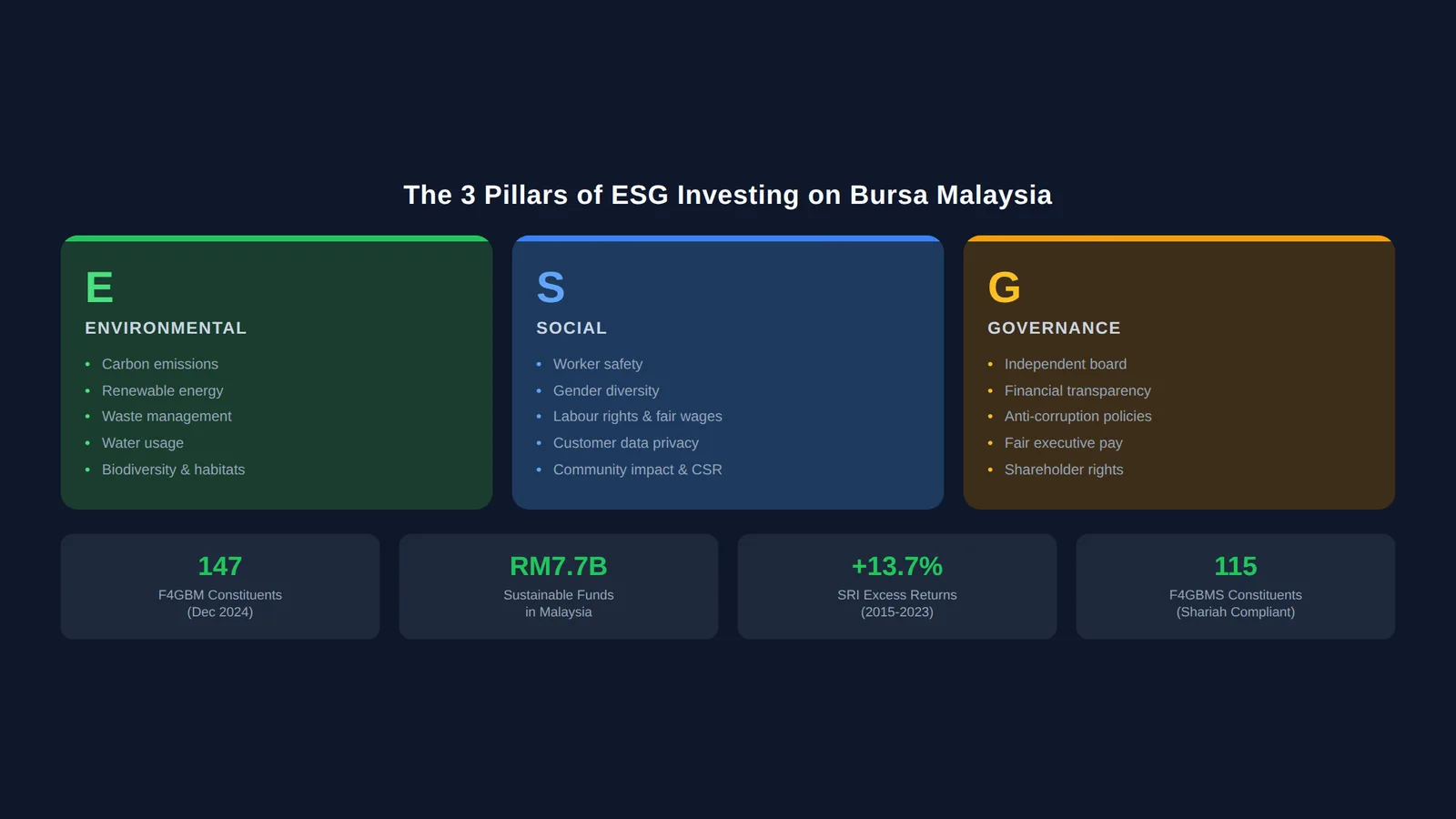
The 3 Pillars of ESG: What Exactly Gets Evaluated?
Each letter in ESG represents a distinct dimension of assessment:
E - Environmental
Measures how a company manages its impact on the natural environment. This includes:
- Carbon emissions - how much greenhouse gas the company produces
- Energy usage - energy efficiency and renewable energy adoption
- Waste management - how industrial waste and packaging are handled
- Water usage - efficiency in water resource consumption
- Biodiversity - the impact of operations on ecosystems and habitats
On Bursa Malaysia, plantation companies like IOI Corporation and utilities like YTL Power (through solar and hydro projects) typically score well on this component.
S - Social
Measures how a company relates to its employees, suppliers, customers, and communities. This includes:
- Worker health and safety - OHS policies, accident rates
- Diversity and inclusion - gender ratios at management level
- Labour rights - fair wages, working hours, no forced labour
- Data privacy - customer information protection
- Community impact - CSR programmes, local community development
Companies like Nestle Malaysia and Sunway Berhad are often recognised for their social programmes and workforce diversity.
G - Governance
Measures the quality of a company's management and leadership. This includes:
- Board composition - independence, diversity, qualifications
- Transparency - disclosure of financial and non-financial information
- Anti-corruption - policies and practices to prevent bribery
- Executive compensation - whether CEO pay aligns with performance
- Shareholder rights - protection of minority investors
Malaysia's major banks such as Maybank, CIMB, and Public Bank generally receive high governance scores due to stringent Bank Negara Malaysia oversight.
Why ESG Matters for Malaysian Investors
ESG is not just "green investing" or a moral obligation. It has real financial implications:
1. Better Long-Term Performance
Data from the Journal of Asset Management shows that SRI (Sustainable & Responsible Investment) indices generated cumulative excess returns of 13.7% over conventional benchmarks between 2015-2023. This is no coincidence - ESG companies tend to manage risks better, attract quality talent, and avoid controversies that can tank share prices.
2. Risk Reduction
Companies with low ESG scores are more exposed to risks such as environmental lawsuits, labour scandals, or governance failures. A Malaysian example - plantation companies that fail to meet sustainability standards risk losing access to European markets due to the EUDR (EU Deforestation Regulation).
3. Institutional Fund Flows
EPF, PNB, and major global funds are increasingly allocating capital to ESG assets. According to PwC Malaysia, global ESG investment flows were projected to exceed US$50 trillion by 2025. Companies included in ESG indices gain access to a larger pool of capital.
4. Growing Regulatory Requirements
Bursa Malaysia requires all listed companies to provide sustainability reports in their annual reports. The F4GBM Index now has 147 constituents - the highest since its 2014 launch. This regulatory trend will only intensify, making ESG not optional but essential.
FTSE4Good Bursa Malaysia Index: The ESG Stock List
The FTSE4Good Bursa Malaysia (F4GBM) Index is the primary benchmark for ESG stocks in Malaysia. Established in December 2014, it is reviewed semi-annually (June and December).
How F4GBM Works
F4GBM constituents are selected from the top 200 stocks in the FTSE Bursa Malaysia EMAS Index, then screened against transparent ESG criteria. Companies need to achieve a minimum ESG score to qualify for inclusion.
Key F4GBM Facts (December 2024)
- 147 constituents - the highest in the index's history
- 28 new inclusions in the December 2024 review
- F4GBMS (Shariah-compliant version): 115 constituents
- Companies are assessed across 14 ESG themes spanning 300+ indicators
Example F4GBM Constituents
Among the blue chips consistently in the F4GBM are Tenaga Nasional, Petronas Chemicals, Gamuda, Press Metal, and Inari Amertron. These companies demonstrate that strong ESG performance does not mean sacrificing financial returns.
How to Start ESG Investing on Bursa Malaysia
Here are practical steps for Malaysian investors looking to begin ESG investing:
Step 1: Understand Your Investment Objective
Before you start, determine whether you want to:
- Exclusion - avoid sectors you consider irresponsible (e.g. gambling, tobacco, weapons)
- Best-in-class - select companies with the highest ESG scores within each sector
- Impact investing - target companies that create direct positive impact (e.g. renewable energy)
- ESG integration - use ESG data as an additional factor in your existing investment analysis
Step 2: Use the F4GBM List as a Starting Point
The F4GBM constituent list is the easiest initial screen. Visit the Bursa Malaysia website to view the latest list. From there, conduct further analysis using standard financial criteria - PE, ROE, FCF, dividends.
Step 3: Review Sustainability Reports
Every Bursa-listed company is required to provide a sustainability report in its annual report. Read this section to understand a company's ESG strategy, targets set, and actual achievements. Watch out for "greenwashing" - companies that talk big but act small.
Step 4: Consider ESG ETFs and Unit Trusts
If you prefer not to pick individual stocks, consider:
- F4GBM ETF - passively tracks the FTSE4Good Bursa Malaysia Index
- SRI Funds - unit trusts following the Sustainable & Responsible Investment framework
- Shariah ESG Funds - combining Shariah and ESG screening (F4GBMS)
Step 5: Combine ESG With Traditional Analysis
ESG is NOT a replacement for financial analysis. It is a complement. A high ESG score does not mean a stock is cheap or will rise. Combine ESG data with fundamental analysis - free cash flow yield, PE ratio, earnings growth - to make well-rounded investment decisions. The growth vs value approach can also be applied within an ESG context.
ESG vs Shariah Investing: What's the Difference?
Many Muslim investors in Malaysia confuse ESG with Shariah investing. While there is overlap, they are fundamentally different:
| Aspect | ESG | Shariah Investing |
|---|---|---|
| Basis | Environmental sustainability, social impact, governance | Islamic legal principles |
| Exclusion | High carbon, weapons, tobacco | Gambling, alcohol, interest (riba), pork |
| Rating | ESG scores (MSCI, FTSE) | Shariah compliance (SC Malaysia) |
| Financial focus | Debt ratios, ESG metrics | Interest-based debt ratios, haram income |
| Overlap | Both avoid unethical companies. F4GBMS combines both screens. | |
For a deeper understanding, read our article on Shariah vs conventional investing. Muslim investors can opt for the F4GBMS Index which combines both Shariah and ESG screening - getting the best of both worlds.
Risks and Criticisms of ESG Investing
ESG investing is not without controversy. Here are the key criticisms investors should understand:
1. Greenwashing
Some companies "sell" a green image without real change. They publish attractive sustainability reports while continuing to pollute. According to Britannica, greenwashing has become an increasingly concerning global issue - investors need to look at ACTIONS, not just promises.
2. Rating Inconsistency
ESG ratings from different agencies (MSCI, FTSE, Sustainalytics) can give vastly different scores for the same company. This is due to different assessment methodologies, criteria weightings, and data sources. Investors should not rely on a single source.
3. Limited Investment Universe
Screening stocks based on ESG reduces the number of options available. On Bursa Malaysia, the F4GBM only has 147 out of 900+ listed companies. A smaller universe can limit portfolio diversification - especially for investors who also apply Shariah screening.
4. Short-Term Performance Not Guaranteed
While long-term data supports ESG, short-term performance can vary significantly. In certain years, "dirty" stocks (e.g. oil, mining) can substantially outperform ESG stocks. ESG is a long-term strategy, not a formula for quick profits.
5. Higher Costs
ESG funds often charge higher management fees compared to conventional funds due to additional research and monitoring costs. Investors need to ensure these extra fees are offset by better performance.
Frequently Asked Questions (FAQ)
What is ESG investing in simple terms?
ESG investing means selecting stocks based on 3 additional factors beyond financials: how a company protects the environment (E), treats workers and society (S), and the quality of its management (G). The goal: profit while being responsible.
Is ESG investing the same as Shariah investing?
No, but they overlap. ESG screens based on environmental sustainability and governance, while Shariah screens based on Islamic law (gambling, alcohol, interest). The F4GBMS Index combines both screens - suitable for Muslim investors who want ESG and Shariah compliance simultaneously.
Does data show ESG investing is profitable?
Yes, over the long term. MSCI research found that companies with high ESG ratings outperformed low-rated peers across 11-17 year periods. The SRI index also generated 13.7% cumulative excess returns over conventional benchmarks (2015-2023). However, short-term performance can fluctuate.
How do I check a company's ESG score on Bursa Malaysia?
The easiest way: check whether the company is listed in the FTSE4Good Bursa Malaysia Index (F4GBM). The constituent list is updated every June and December on the Bursa Malaysia website. Detailed ESG ratings can be obtained through MSCI ESG Ratings or Sustainalytics.
What is greenwashing and how do I avoid it?
Greenwashing is when a company claims to be environmentally friendly but its actual actions don't align. To avoid it, review sustainability reports - compare targets vs actual achievements, look for quantitative data (carbon emissions, water usage), and don't trust slogans without evidence.
How many ESG stocks should be in my portfolio?
There is no fixed answer. An "ESG integration" approach (combining ESG as one additional factor) is more practical than going 100% ESG. Start with 20-30% of your portfolio in high-quality ESG stocks, then gradually increase as you gain confidence.
Can small retail investors practise ESG investing?
Yes. The easiest way: buy an ETF that tracks the F4GBM Index, or choose an SRI unit trust. If you want to pick stocks yourself, use the F4GBM list as an initial screen, then conduct standard financial analysis. You don't need large capital to start.
Which sectors have the most ESG constituents on Bursa Malaysia?
The financial, utilities, and consumer staples sectors typically have the most F4GBM constituents because they are under strict regulatory oversight. The semiconductor and technology sectors are also increasingly represented due to good governance practices and low carbon emissions.
Conclusion
ESG investing is not just a trend - it reflects a fundamental shift in how global investors evaluate companies. On Bursa Malaysia, the FTSE4Good Index with 147 constituents and SRI fund growth to RM7.7 billion demonstrate strong momentum. Data spanning 11-17 years shows that ESG companies tend to outperform the market due to stronger earnings fundamentals and better risk management.
To start building an ESG portfolio on Bursa Malaysia, you need a trading account that supports stocks across multiple sectors.
Open a CDS trading account with M+ to invest on Bursa Malaysia as well as international stocks such as US and Hong Kong markets through our CDS account registration page.
Download our free Stock Market Basics Ebook to understand the fundamentals of stock investing before applying ESG strategies to your portfolio.
Further Reading
- Shariah vs Conventional Investing: What's the Real Difference for Stocks, Unit Trust, EPF & Takaful
- Defensive vs Growth Stocks: Why Smart Portfolios Need Both
- Free Cash Flow Yield: The Real KPI Expert Investors Track Before PE
- Stock Portfolio by Age: How to Structure Investments in Your 20s, 30s & 40s
- Sector Rotation: 4 Economic Cycle Phases & Winning Sectors