Sector Rotation: Which Sectors Win in Each Phase of the Economic Cycle

What Is Sector Rotation?
Sector rotation is an investment strategy that shifts money from one sector to another based on the current phase of the economic cycle. The principle is simple: every sector has its own "season" - there are times it shines, and times it lags behind.
Think of the economy as a wheel that constantly rotates through 4 phases - recovery, expansion, peak, and recession. Investors who understand this cycle can "switch seats" to sectors that are currently or about to outperform the market, while avoiding sectors that will lag.
According to Fidelity Investments, sector rotation has proven effective because different sectors respond differently to macroeconomic factors such as interest rates, inflation, and GDP growth. Data from State Street Global Advisors shows that the financial sector outperformed the market in 11 out of 13 expansion phases studied.
Unlike momentum investing which follows individual stock price trends, sector rotation operates at a higher level - it looks at entire industry sectors and determines which will benefit from upcoming macroeconomic changes.
The 4 Phases of the Economic Cycle
Before understanding which sectors win, you need to recognize the 4 phases of the economic cycle (business cycle) that repeat periodically:
Phase 1: Recovery (Early Expansion)
The economy has just emerged from recession. GDP begins growing again, unemployment is still high but starting to decline, and the central bank typically maintains low interest rates to stimulate growth. Consumer confidence gradually recovers.
Phase 2: Expansion (Mid-Expansion)
Economic growth strengthens. Unemployment declines, income rises, and consumer spending expands. Companies begin increasing capital expenditure (capex). This is typically the longest and most profitable phase for stock investors overall.
Phase 3: Peak (Late Expansion)
The economy reaches its highest level of activity. Inflation starts rising, the central bank raises interest rates to cool the economy, and growth begins slowing. Commodity prices often reach their highest levels. This is the phase where savvy investors start preparing for the next rotation.
Phase 4: Recession (Contraction)
GDP contracts, corporate profits decline, unemployment rises, and the stock market generally falls. The central bank begins cutting interest rates to stimulate the economy. Investors shift to defensive assets and stable sectors.
Which Sectors Win in Each Phase?
Here is the mapping of sectors to economic cycle phases - with specific stock examples on Bursa Malaysia:
Phase 1 - Recovery: Financials, Real Estate & Technology
The financial sector benefits greatly during recovery as low interest rates stimulate lending. Banks like Maybank, CIMB, and Public Bank see increases in new loans and declining non-performing loan (NPL) rates.
The real estate and construction sectors also begin recovering - low borrowing costs drive home purchases and development projects. Stocks like Sunway and Gamuda are typically among the first to move up.
Technology stocks also benefit as companies increase IT spending after tightening budgets during the recession. On Bursa, semiconductor stocks like Inari Amertron and Frontken often move early in this phase.
Phase 2 - Expansion: Consumer, Construction & Industrials
As the economy expands, people's income rises and consumer spending grows. The consumer discretionary sector becomes the star. In Malaysia, this includes retail stocks like MR D.I.Y., and the casino/tourism sector like Genting Malaysia.
The construction sector continues to strengthen during this phase as the government implements mega infrastructure projects. Read our detailed analysis of the construction cycle in construction stocks and MRT3. Stocks like IJM Corporation and Gamuda benefit directly.
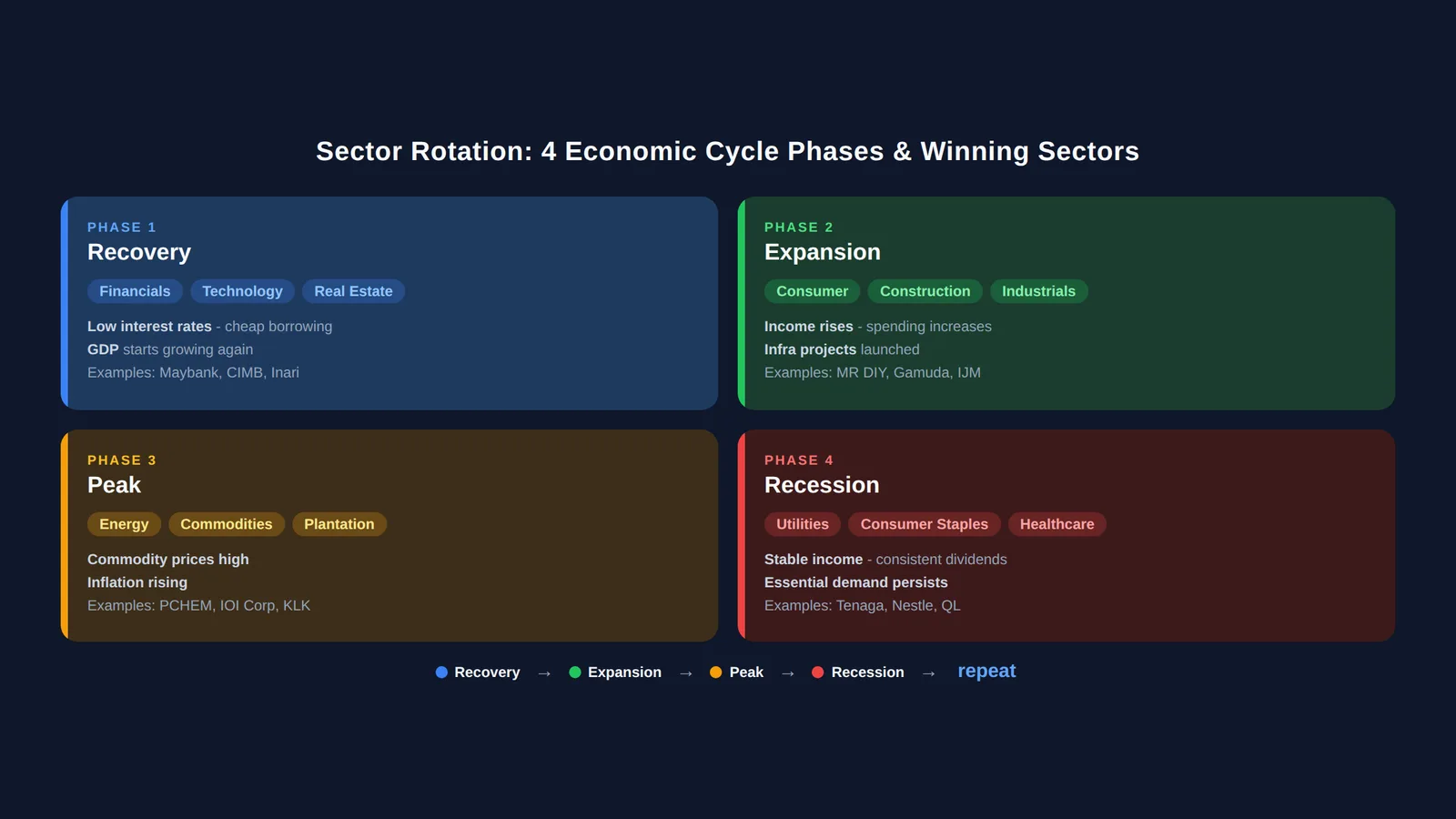
Phase 3 - Peak: Energy, Commodities & Materials
At the cycle's peak, high demand drives commodity prices up. The energy and materials sectors become winners. Stocks like Petronas Chemicals and Dialog Group move in tandem with global oil prices.
The plantation sector also often shines during the peak phase - CPO prices tend to increase when global demand is high. Stocks like IOI Corporation and Kuala Lumpur Kepong show stronger performance. For deeper understanding, read about the CPO price cycle and when to enter plantation stocks.
Aluminium and industrial metals also rise, benefiting Press Metal.
Phase 4 - Recession: Utilities, Healthcare & Consumer Staples
During recessions, investors shift to defensive sectors that provide stable income regardless of economic conditions. People still need electricity, water, food, and medicine.
Utility stocks like Tenaga Nasional and YTL Power become favorites due to stable cash flows and consistent dividends. Consumer staples stocks like Nestle and QL Resources also hold up better as their products remain in demand.
Interestingly, recessions also open opportunities for contrarian investors who buy quality stocks at cheap prices before the next recovery phase begins.
Sector Rotation in Malaysia: Real Examples 2020-2026
Malaysia provides very clear sector rotation examples throughout the 2020-2026 period:
2020: Recession Phase (COVID-19)
The pandemic triggered a sudden recession. The FBMKLCI fell from 1,602 to 1,219 in March 2020. The aviation, tourism, and property sectors were severely impacted. But the healthcare sector - especially glove stocks like Top Glove and Hartalega - surged hundreds of percent due to global PPE demand.
2020-2021: Recovery Phase
Bank Negara Malaysia cut the OPR to 1.75% - the lowest in history. Technology and semiconductor stocks began dominating. Inari rose over 300%, Frontken over 200%. The financial sector stabilized and slowly recovered. Investors who understood sector rotation had already started moving from gloves to tech in mid-2020.
2022-2023: Peak & Normalization Phase
BNM raised the OPR gradually to 3.00%. Technology stocks began weakening after their massive run-up. The commodity sector shone instead - palm oil prices exceeded RM6,000/metric ton, greatly benefiting plantation stocks. Petronas Chemicals and the energy sector also gained momentum from high oil prices.
2024-2026: New Expansion
According to The Star, the plantation (+9.06%), REIT (+16.86%), and financial (+3.11%) sectors emerged as outperformers in 2025. The construction sector attracted foreign investor interest with net buying of RM541 million, driven by data centre projects and MRT3. The technology sector (-13.56% in 2025) underwent correction after the AI surge - but long-term, global AI capex is expected to exceed US$400 billion.
How to Apply Sector Rotation on Bursa Malaysia
Here are practical steps for applying sector rotation:
Step 1: Determine the Current Economic Phase
Monitor key macroeconomic indicators to determine which phase we're in:
- GDP growth - Bank Negara and the Department of Statistics Malaysia publish quarterly data
- OPR rate - BNM's decision every 6 weeks; rising OPR = peak phase, falling OPR = recession/recovery
- Inflation (CPI) - Rising inflation = approaching peak, declining inflation = approaching recovery
- Manufacturing PMI - PMI >50 indicates expansion, <50 indicates contraction
- Foreign fund flows - Net foreign buying signals confidence in the expansion cycle
Step 2: Map Sectors to Phases
After determining the phase, select sectors that have historically outperformed in that phase. Refer to the mapping table below as a basic guide.
| Economic Phase | Key Sectors | Example Stocks | Reason |
|---|---|---|---|
| Recovery | Financials, Technology, Real Estate | Maybank, CIMB, Inari, Sunway | Low interest rates, capex recovery |
| Expansion | Consumer, Construction, Industrials | MR DIY, Genting, Gamuda, IJM | Income growth, infra projects |
| Peak | Energy, Commodities, Plantation | PCHEM, Dialog, IOI Corp, KLK | High commodity demand & prices |
| Recession | Utilities, Consumer Staples, Healthcare | Tenaga, Nestle, QL Resources | Stable income, consistent dividends |
Step 3: Use a Phased Approach
Don't go "all-in" on one sector. Sector rotation doesn't mean 100% in one sector. A wiser approach:
- Overweight sectors suited to the current phase (30-40% of portfolio)
- Neutral sectors in transition (20-30%)
- Underweight sectors expected to lag (10-20%)
- Maintain core holdings that remain stable across all phases
Step 4: Monitor Transition Signals
Sectors don't switch suddenly. They move gradually. Transition signals to watch:
- OPR decisions - Every interest rate change is a sector rotation signal
- Earnings season - Which sectors show accelerating vs decelerating profit growth
- Commodity prices - Changes in CPO, oil, and aluminium prices signal related sectors
- Foreign fund flows - Which sectors foreign investors are actively buying or selling
Step 5: Review Portfolio Every Quarter
Sector rotation is not a daily strategy. A portfolio review every 3 months is sufficient. At each review, ask yourself: "Is the economic phase still the same? Do I need to adjust my sector weighting?" This is essentially a growth vs value approach at the sector level.
5 Common Mistakes and Risks of Sector Rotation
This strategy is not without pitfalls. Here are the most common mistakes:
1. Rotating Too Early or Too Late
This is the most critical mistake. Economic phases don't switch on calendar dates - they change gradually. Investors who enter a sector too early may "sit" in a non-performing stock for months. Those who enter too late buy at prices that already reflect the improvement. According to Ryan O'Connell CFA, the risk of timing too early or late can erode overall strategy returns.
2. Overtrading
Sector rotation is NOT day trading. It requires a 3-12 month forward view, not daily changes. Investors who rotate too frequently incur high transaction costs - broker commissions, spreads, and potential taxes. According to MarketGauge analysis, rotating too often can produce lower returns than simple buy-and-hold.
3. Ignoring Bursa Malaysia's Unique Characteristics
The global sector rotation model (based on the US economy) cannot be applied 100% in Malaysia because:
- Plantation sector - unique to Malaysia/Indonesia, highly dependent on global CPO prices
- Government influence - GLCs and government projects (MRT, data centres) create their own cycles that don't exist in Western markets
- Low liquidity - small sectors on Bursa may be difficult to enter/exit without moving prices
- Ringgit sensitivity - some sectors (export vs import) depend on ringgit strength
4. Relying on a Single Indicator
Don't determine the economic phase based on one data point alone. GDP may be growing but PMI is already contracting, or the OPR is still low but inflation is already rising. Combine multiple indicators for a more accurate picture.
5. Not Maintaining Core Holdings
Investors who rotate 100% of their portfolio into one sector take extremely high risk. Always keep 30-40% of your portfolio in high-quality core holdings that remain stable across all phases - as discussed in our guide on portfolio allocation by age.
Frequently Asked Questions (FAQ)
What is sector rotation in simple terms?
Sector rotation means shifting stock investments from one sector to another based on the current economic phase. For example, buying banking stocks during economic recovery and switching to utility stocks during recession.
How often should you rotate sectors in your portfolio?
Sector rotation is not a daily strategy. A review every quarter (3 months) is sufficient. Economic phases change slowly - typically 6-24 months for a full phase. Rotating too frequently only adds transaction costs.
Is sector rotation suitable for beginner investors?
Beginners can practice simplified sector rotation - overweighting sectors suited to the current phase and underweighting those that aren't. No need to rotate 100% of the portfolio. Start by understanding the 4 economic phases and monitor OPR decisions as a basic guide.
What are the key indicators to determine the economic phase?
A combination of GDP (growth/contraction), OPR rate (rising/falling), CPI inflation (increasing/decreasing), and PMI (>50 expansion, <50 contraction). No single indicator is perfect - you need a combination for an accurate picture.
Which sector is safest on Bursa Malaysia?
The utilities sector (like Tenaga Nasional) and consumer staples (like Nestle) are historically the most stable across all phases. They may not deliver the highest returns, but they provide the best protection during recessions and market uncertainty.
Can sector rotation be combined with other strategies?
Yes, it pairs very well with momentum investing (buying the rising sector in the right phase) or value investing (buying undervalued stocks in a sector about to enter its strong phase). This combination gives investors a sharper edge.
What is the difference between sector rotation and stock picking?
Sector rotation operates at the macro level - it determines WHICH sector should be prioritized. Stock picking operates at the micro level - it selects WHICH stock is best within that sector. Smart investors combine both: choose the right sector first, then pick the best stocks within it.
Does data show sector rotation works?
Yes. Data from State Street Global Advisors shows the financial sector outperformed the market in 11 out of 13 expansion phases. On Bursa Malaysia, the plantation sector (+9.06%) and REITs (+16.86%) in 2025 demonstrate clear sector rotation following economic conditions.
Conclusion
Sector rotation is a strategy that allows investors to navigate economic cycles wisely - not just buying and holding, but actively shifting portfolio weights to sectors best suited to the current economic phase. On Bursa Malaysia, this strategy is highly relevant because major sectors - financials, construction, plantation, technology, and utilities - each have clear and predictable cycles.
To start applying sector rotation on Bursa Malaysia, you need a trading account that supports multiple sectors.
Open a CDS M+ account to start investing on Bursa Malaysia and also international stocks such as US and Hong Kong markets through our CDS account registration page.
Download our free Stock Market Basics Ebook to understand the fundamentals of stock investing before applying sector rotation strategy.
Further Reading
- Plantation Stocks: The CPO Price Cycle & When Investors Should Enter
- Construction Stocks: MRT3, Mega Projects & When the Construction Cycle Recovers
- Defensive vs Growth Stocks: Why a Smart Portfolio Needs Both
- Contrarian Investing: The Art of Buying When Everyone Runs
- Momentum Investing: Why Stocks That Rise Tend to Keep Rising