Hibah and Faraid in Islamic Inheritance: What Muslims in Malaysia Should Know

Did you know that an estimated RM70 billion in Muslim estates in Malaysia remain frozen and unclaimed? This figure continues to grow every year — and the main cause is the lack of estate planning during one’s lifetime. The two primary instruments in Islamic estate planning are hibah (gift during lifetime) and faraid (distribution after death), but many are confused about when and how to use each one.
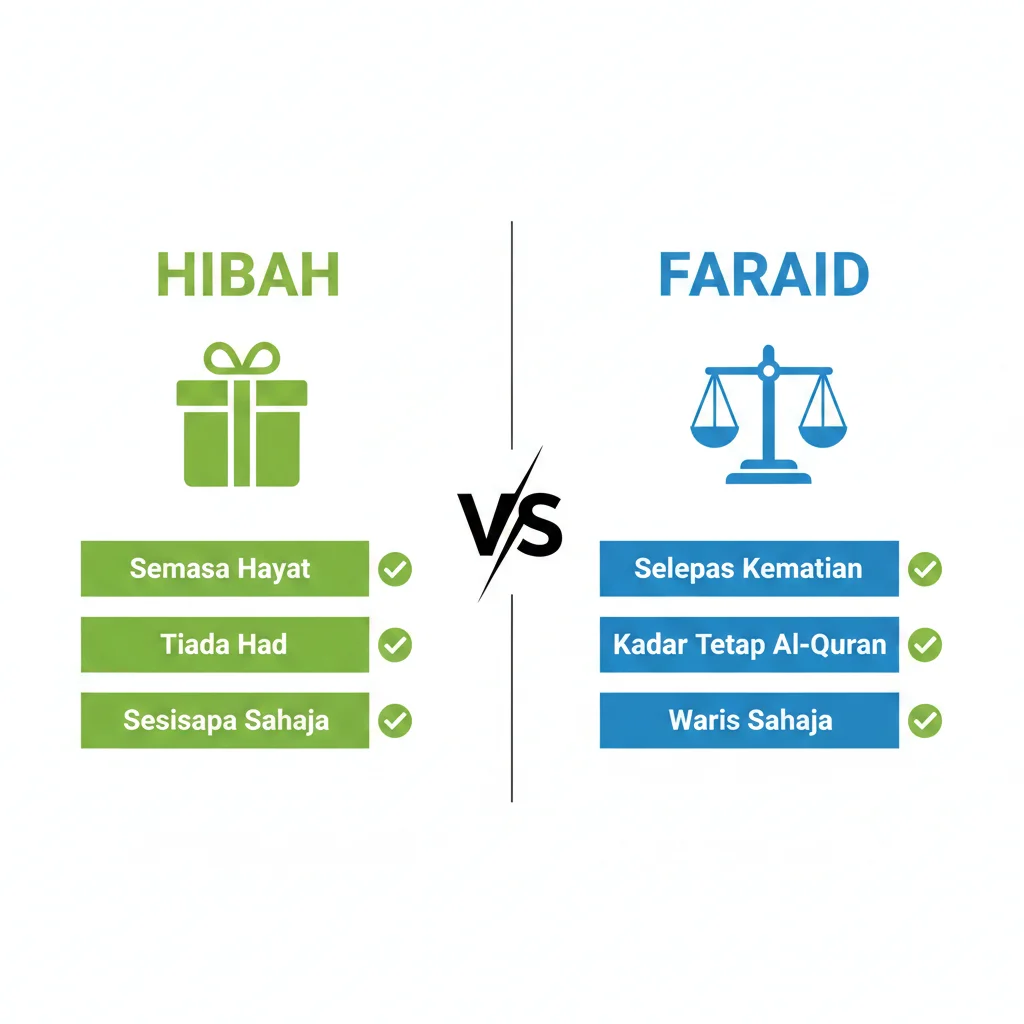
Quick answer: Faraid is the MANDATORY system of estate distribution after death according to fixed rates in the Quran. Hibah is a voluntary gift of property during one’s lifetime — with no limit on the amount and can be given to anyone. Both are complementary, not contradictory.
What Is Faraid?
Faraid comes from the Arabic word “al-faridhah” meaning a predetermined share. It refers to the Islamic estate distribution system based on Surah An-Nisa, verses 11, 12, and 176. Faraid is only carried out after someone’s death.
Before faraid is executed, the deceased’s estate is deducted in the following order:
- Funeral expenses (burial, shroud)
- Debts of the deceased (bank loans, credit cards, personal loans)
- Execution of wasiyyah/will (maximum 1/3 of estate, for non-heirs only)
- Remainder distributed according to faraid
The Quran establishes 6 fixed shares for heirs: 1/2, 1/4, 1/8, 2/3, 1/3, and 1/6. Each heir receives a different share depending on their relationship to the deceased and the presence of other heirs.
Main Heir Shares in Faraid
Here is a summary of the main heir shares established by the Quran — you can also use the MAIS E-Faraid Calculator for precise calculations:
Husband & Wife
| Heir | If Children Exist | If No Children |
|---|---|---|
| Husband | 1/4 | 1/2 |
| Wife | 1/8 | 1/4 |
Note: If there is more than one wife, the 1/8 or 1/4 share is divided equally among them.
Children
- Son: Asabah (residuary heir) — takes the remainder after fixed-share heirs.
- Daughter (one, no sons): 1/2
- Daughters (two or more, no sons): 2/3 shared equally
- Daughters with sons: Ratio 1:2 (sons receive double)
Parents
| Heir | If Children Exist | If No Children |
|---|---|---|
| Father | 1/6 | Asabah (takes remainder) |
| Mother | 1/6 | 1/3 |
What Is Hibah?
Hibah is the voluntary giving of property by a person (giver/wahib) to another individual (recipient/mawhub lahu) during their lifetime, without expecting anything in return. Unlike faraid which follows fixed rates, hibah gives the giver complete freedom to determine who receives what and how much.
According to the MAIS E-Faraid Portal, a valid hibah requires four pillars:
- Giver (Wahib) — legal owner, of age, sound mind, not coerced
- Recipient (Mawhub Lahu) — can be anyone (heir or non-heir)
- Property (Mawhub) — halal, valuable, existing, fully owned
- Offer & Acceptance (Sighah) — clear expression of giving and receiving
Types of Hibah
1. Hibah Mutlak (Absolute Gift)
Transfer of ownership without any conditions. Once delivery (qabd) occurs, ownership transfers immediately and cannot be revoked.
2. Hibah Bersyarat (Conditional Gift)
- Hibah Umra — ownership based on lifetime. Example: “This house is yours as long as you live.” After the recipient dies, the property returns to the giver.
- Hibah Ruqba — “survivor takes all” concept. If either party dies, the property belongs to the survivor.
3. Hibah Takaful
Takaful benefits are given directly to the hibah recipient without going through the estate process — speeding up payment to beneficiaries.
4. Hibah of Encumbered Property
For property still under bank financing — requires MRTT/MRTA coverage and consent from the financial institution.
Can Hibah Be Revoked?
Generally, a completed hibah cannot be revoked. However, according to the Selangor Mufti Department, there is one exception: hibah from parents, grandparents to children/grandchildren can be revoked provided:
- The property is still in the child’s possession (not sold or given to others)
- Revocation is not due to the giver’s death
- No damage to the property
- Revocation MUST go through the Syariah Court
Hibah vs Faraid — Key Differences
| Aspect | Hibah | Faraid |
|---|---|---|
| Timing | During giver’s lifetime | After death |
| Limit | No limit (up to 100%) | Fixed Quranic rates |
| Recipients | Anyone | Eligible heirs only |
| Flexibility | Giver decides freely | Rates cannot be changed |
| Ownership | Transfers immediately | After administration process |
When to Use Hibah vs Faraid
Use HIBAH when:
- Wife needs protection — under faraid, a wife only gets 1/8 if there are children. Gifting the house during lifetime ensures she won’t lose her home.
- Adopted children — adopted children are NOT eligible to inherit through faraid. Hibah is the only way.
- Special needs children — conditional hibah secures their future.
- Childless couples — without hibah, assets go to parents/siblings via faraid.
- Avoid frozen estates — hibah transfers ownership during lifetime, no probate needed.
- Family business — ensures continuity without assets being divided.
Let FARAID handle it when:
- All heirs agree and there are no special circumstances
- Assets are sufficient for all heirs
- You want distribution fully aligned with Islamic law
COMBINED approach (best):
Gift some assets during lifetime (house to wife, takaful to children), will for non-heirs (maximum 1/3), and remaining assets distributed via faraid.
Frozen Estate Statistics in Malaysia — RM70 Billion and Growing
According to Harian Metro, an estimated RM70 billion in estates remained unclaimed as of 2020. Some sources claim this figure has reached RM90 billion by 2024.
Key causes of frozen estates include:
- Disputes among heirs — fighting over assets without knowledge of faraid
- Complacency — delaying estate claims
- Lack of awareness about estate planning importance
- Bureaucratic processes — lengthy and complex
- Low hibah adoption rate — according to Utusan Malaysia, hibah awareness remains low
Good news: Effective 15 July 2024, the small estate threshold was raised from RM2 million to RM5 million under amendments to the Small Estates (Distribution) Act 1955. This makes it easier for more heirs to claim estates through JKPTG without going to the High Court.
Key Institutions for Estate Matters
| Institution | Role |
|---|---|
| Amanah Raya Berhad (ARB) | Movable estate administration up to RM600,000 |
| JKPTG | Small estates up to RM5 million |
| JAWHAR | Waqf, zakat management, Islamic will manual |
| JKSM | Syariah Court coordination, Faraid Certificates |
| Legal Aid Department | Free legal advice on estate matters |
7 Common Misconceptions About Hibah and Faraid
1. “Hibah is a way to escape faraid”
No — hibah is a Shariah-approved instrument. Faraid only applies to assets remaining after death.
2. “EPF/Tabung Haji nominees are absolute owners”
Wrong — nominees are merely administrators. EPF and Tabung Haji funds are part of the estate and MUST be distributed according to faraid.
3. “Joint property automatically belongs to the surviving spouse”
No — the deceased’s share in joint ownership still enters the estate and requires faraid distribution.
4. “Takaful hibah cannot be challenged”
It can — especially if documentation is incomplete or the pillars of hibah are not fulfilled.
5. “A will can be given to any heir”
A will (wasiyyah) to a faraid heir is INVALID unless agreed by all other heirs. Wills are limited to 1/3 of the estate.
6. “Equal distribution is sufficient”
Equal distribution without following faraid is invalid from a Shariah perspective — UNLESS all heirs agree via consensus (takharuj).
7. “All assets can be gifted away at once”
While there’s no legal limit on hibah, giving away all assets can cause problems for the giver. Wise planning is essential.
FAQ: Frequently Asked Questions About Hibah and Faraid
1. How much does it cost to make a hibah?
Costs vary by trust company. On average, hibah documentation in Malaysia starts from RM500 to several thousand ringgit, depending on the type of asset and case complexity.
2. Does hibah need to be registered in court?
Registration is not mandatory, but highly recommended to get Syariah Court verification to prevent future disputes.
3. Can I gift a house that’s still under a bank loan?
Yes, through hibah of encumbered property — provided there is MRTT/MRTA coverage and consent from the financial institution (mortgagee).
4. What’s the difference between a will and hibah?
A will is executed after death (limited to 1/3 of estate, for non-heirs). Hibah is executed during lifetime (no limit, for anyone).
5. How do I claim faraid in Malaysia?
Heirs need to apply for a Faraid Certificate from the Syariah Court, then submit an estate distribution application to JKPTG (estates up to RM5 million) or the High Court (exceeding RM5 million).
6. Can a daughter receive more than her faraid share?
Yes — through hibah during the owner’s lifetime. In faraid, the shares are fixed by the Quran and cannot be changed.
7. What happens if all heirs disagree with the faraid distribution?
Heirs can make a consensus agreement (takharuj) where, after knowing their respective faraid shares, they agree to distribute the estate differently.
8. Where can I get free advice on estate matters?
The Legal Aid Department (JBG) provides free legal advice. You can also consult Amanah Raya Berhad or Islamic trust companies like as-Salihin Trustee Berhad.
Conclusion
Hibah and faraid are not contradictory instruments — they complement each other in holistic Islamic estate planning. Understand each heir’s rights through faraid, and use hibah strategically to protect those who need additional protection. Don’t let your assets become part of the RM70 billion frozen estate statistic — start your estate planning today.
Protect Your Estate, Start Shariah-Compliant Investing
Good estate planning starts with building wealth in a Shariah-compliant manner — and the first step is investing in stocks listed on Bursa Malaysia. Open a CDS Trading Account to start investing in Shariah-compliant stocks and build a portfolio that can be passed on to the next generation. Also download the Free Stock Market Basics Ebook to understand investing fundamentals from a Malaysian Muslim investor’s perspective.