How to Calculate Averaging Price for Stocks — With Examples

What Is Averaging Price
Averaging Price is the average purchase price of your shares, which is used in calculations when you want to sell a stock.
Normally, if you buy shares once and sell once with the same quantity, there is no issue. However, it becomes a question for some investors when there are multiple transactions with different quantities of share units.
So in this article, we will show you the correct way to calculate Averaging Price based on 3 different scenarios.
Example: How to Calculate Averaging Price 1: Buy Once, Sell Once
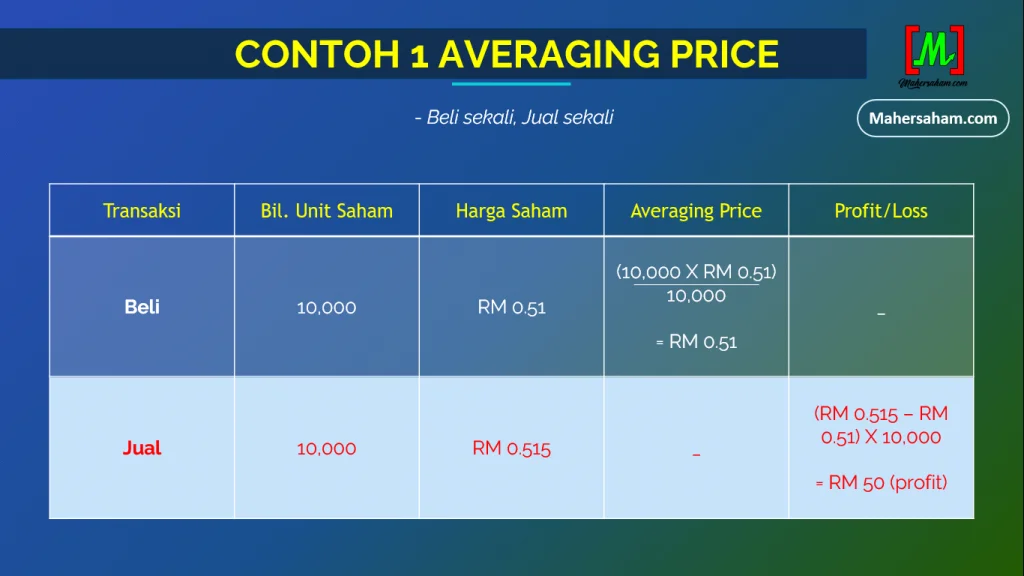
For example, Ali buys Stock ABC at RM0.51 for 10,000 share units.
Therefore, the Averaging Price of Stock ABC is:
(10,000 x RM0.51) / 10,000 = RM 0.51
If Ali sells all 10,000 share units at RM0.515, then Ali's profit is (0.515-0.51) X 10,000 = RM50
Example: How to Calculate Averaging Price 2: Buy Twice, Sell Once
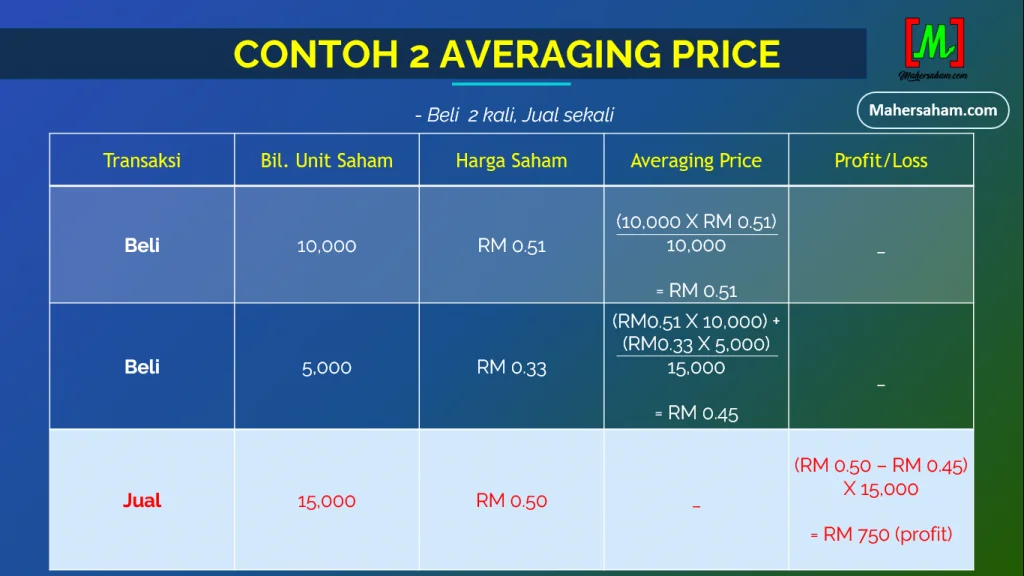
Abu buys Stock ABC at RM0.51 for 10,000 share units.
Then Abu buys another 5,000 share units of Stock ABC at RM0.33.
Therefore, Abu's portfolio Averaging Price for Stock ABC is:
(10,000 x RM0.51) + (5,000 x RM0.33) / 15,000 = RM 0.45
If Abu sells Stock ABC at RM0.50, then Abu's profit is (0.50-0.45) X 15,000 = RM750
Example: How to Calculate Averaging Price 3: Buy Once, Sell Twice
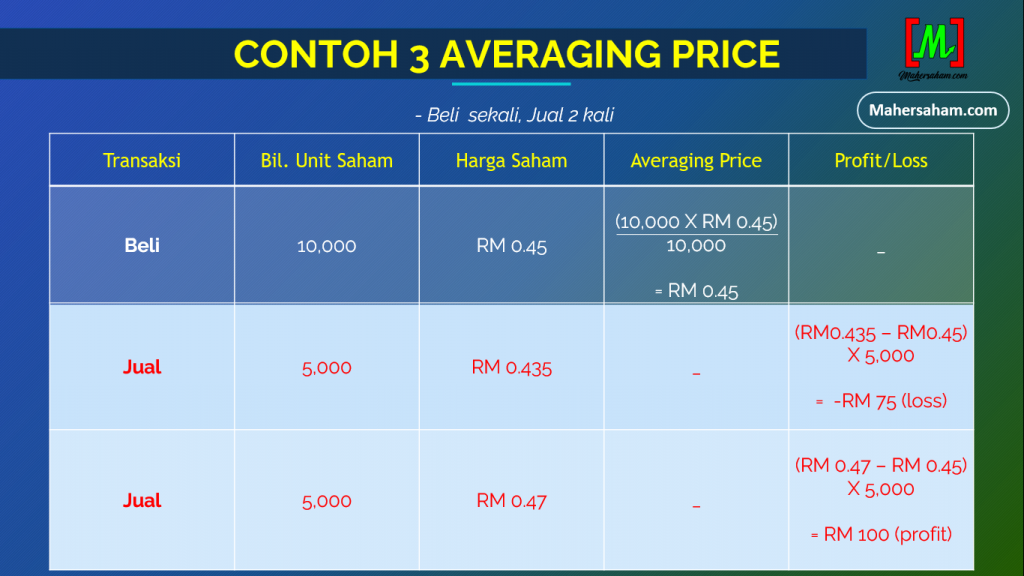
Lim buys Stock ABC at RM0.45 for 10,000 share units.
Therefore, the Averaging Price of Stock ABC is:
(10,000 x RM0.45) / 10,000 = RM 0.45
Then Lim sells a portion of 5,000 share units at RM0.435. So now Lim incurs a loss of (0.435-0.45) X 5,000 = RM75
Now there are 5,000 share units of Stock ABC remaining in Lim's portfolio.
After a few days, Lim sells all remaining 5,000 share units of Stock ABC at RM0.47.
So Lim's profit now is (0.47-0.45) X 5,000 = RM100
Frequently Asked Questions (FAQ)
1. What is Averaging Price in stocks?
Averaging Price is the average purchase price of your shares. It is important to know the average price of your stock purchases so you can set a profit target (TP) and avoid losses.
2. How do you calculate Averaging Price if you buy shares multiple times?
Add up the total purchase cost (price x units for each purchase) and divide by the total number of share units owned. Example: (1000 x RM0.50 + 2000 x RM0.45) / 3000 = RM0.467.
3. Does Averaging Price change if I sell some of my shares?
No, your Averaging Price remains the same even if you sell a portion of your shares. What changes is only the number of share units remaining in your portfolio.
4. When is the averaging down strategy suitable to use?
Averaging down is suitable when you are confident in the company's fundamentals and the share price drops temporarily. However, make sure you do your research first and do not simply add to your position without proper analysis.
Conclusion
It is important to know your Averaging Price so that you can determine the average purchase price of your shares and set the right TP target to avoid losses.
If you do not have a CDS account yet, open a CDS account now to start investing. To learn the basics of stock investing, get a free ebook from Mahersaham.