How to Get Stock Dividends: 5 Things You Must Know

How to Get Dividends — Profiting From Stocks
Did you know that there are actually 2 ways to profit from stocks?
- First, through stock price appreciation (Capital Gain)
- Second, through Company Dividends.
Many people know about Capital Gains, but not many know how to get Company Dividends.
So in this article, I'll show you how to get company dividends.
5 Things You Must Know About Dividends
-
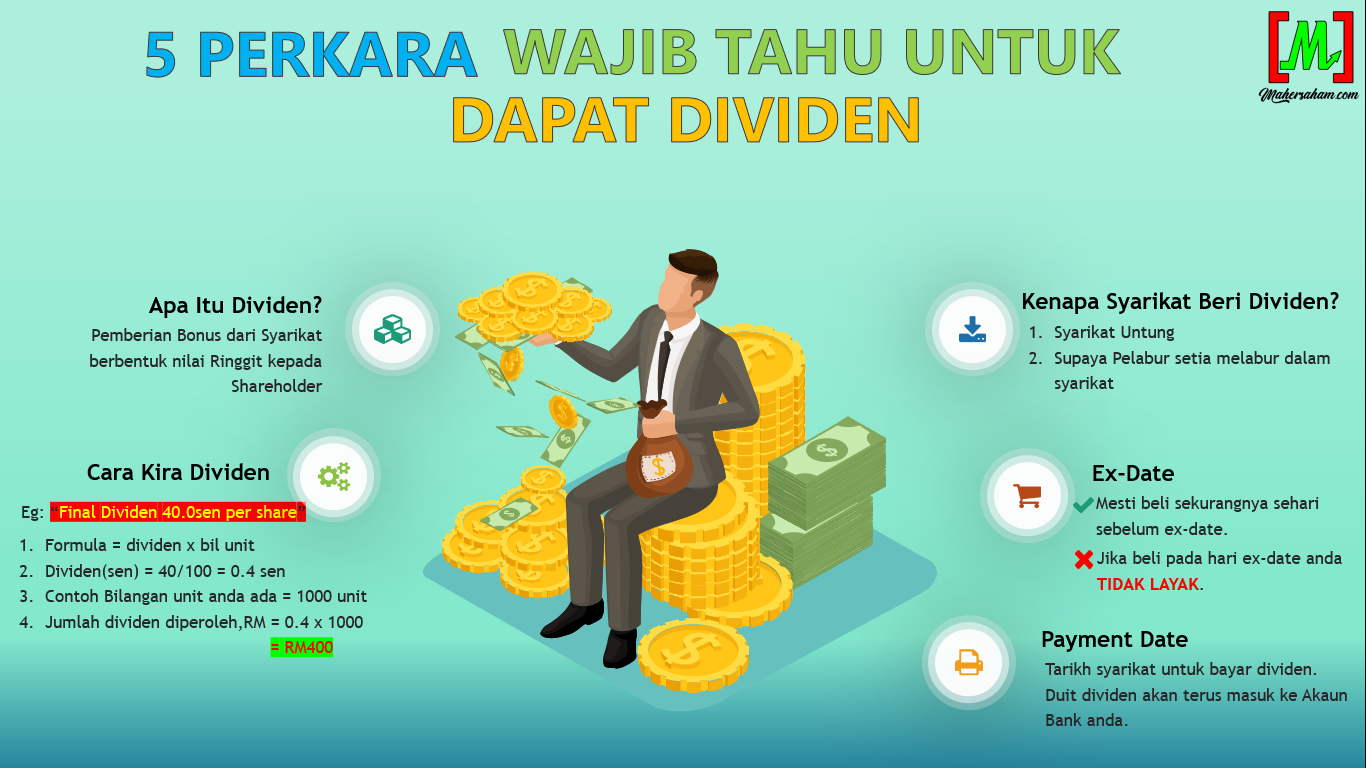
What Are Dividends?
A dividend is a bonus from a company in the form of monetary value (Ringgit) given to shareholders due to good financial performance and other factors.
-
Why Do Companies Pay Dividends?
Firstly, the company is obviously making a profit and wants to share the excess with its shareholders.
Secondly, paying dividends is one way to keep investors loyal to the company.
Remember — the dividend money you receive is tax-free! Why?
Because dividends paid by the company come from the company's profits. After the company pays its taxes and there is still excess profit remaining,
That excess profit is what gets distributed as dividends to shareholders. So you are not taxed on dividends you receive.
-
Ex-Date
What is the Ex-Date? I'll explain below.
To be eligible for dividends, you must buy at least one day before the Ex-Date and hold until the Ex-Date. You can sell on the Ex-Date itself.
If you buy on the Ex-Date, you are NOT eligible for the dividend!
-
Payment Date
The date when the company will pay the dividend directly into your bank account.
This bank account is updated when you open your CDS account. If you don't have a CDS account yet, you can register at Open a CDS Trading Account.
-
How to Calculate Dividends
Example: Company Announces Dividend: 40.0 sen per share
Dividend Calculation Formula = dividend × number of shares held
NOTE: The dividend value needs to be converted from sen to RM first. For example, 40.0 sen per share = 40/100 = RM0.40
Then, if you hold 1,000 units of Stock X:
Your dividend = RM0.40 × 1,000 = RM400 in Dividends!
Another example: dividend of 0.03 sen. In RM that would be:
Convert from sen to RM = 0.03/100 = RM0.0003
That is the dividend value given for each unit of stock you own.
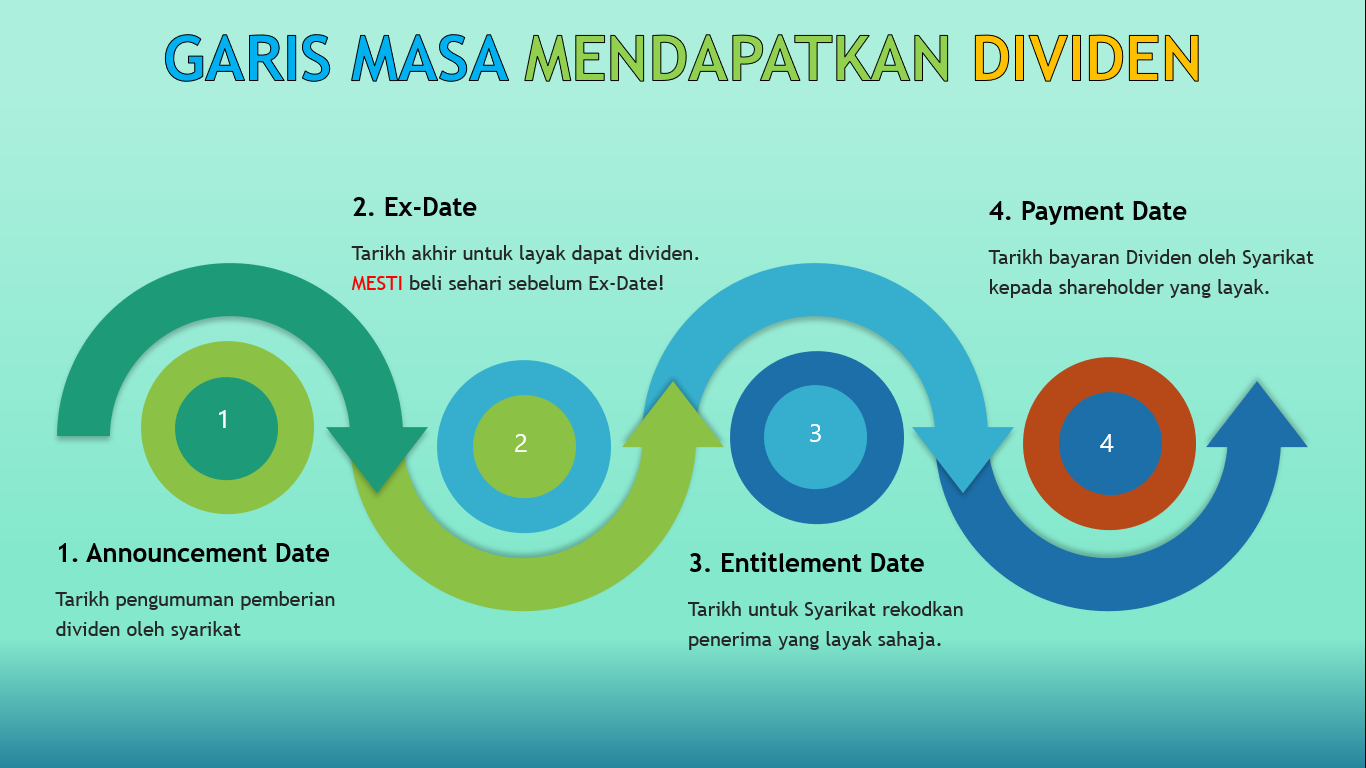
4 Important Dates for Dividends
-
Announcement Date
The date the company announces the dividend.
Here the company will announce how much dividend will be paid, the Ex-Date, and the Payment Date.
Where can you find the list of companies paying dividends?
Easy. Now you can check using just your phone.
Open the Dividend Calendar on mahersaham.com. It lists the companies about to pay dividends, with the ex-date, entitlement date, payment date, dividend amount and yield. It is free to use and there is nothing to download.
-
Ex-Date
The last date to qualify for the dividend. You must buy at least one day before the Ex-Date to be eligible!
-
Entitlement Date
The date for the company to record eligible dividend recipients.
-
Payment Date
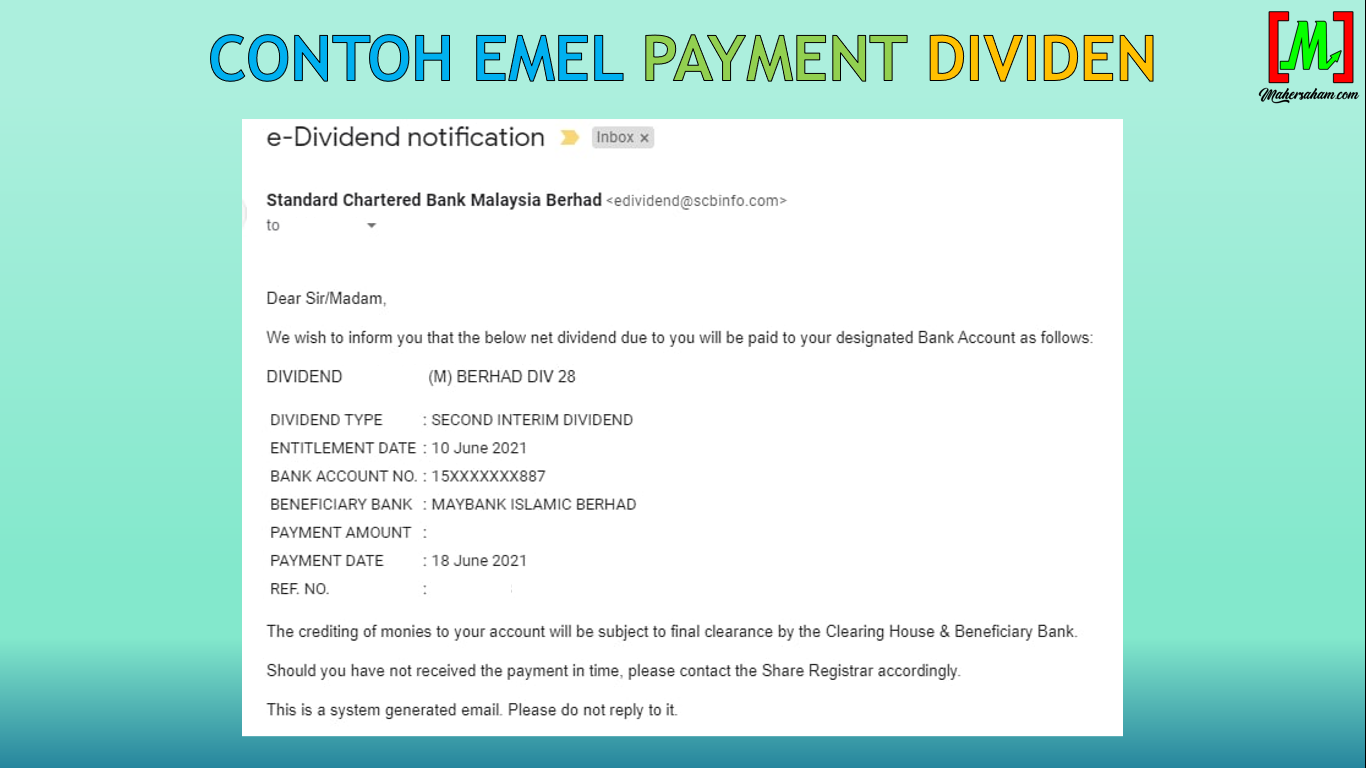
The date the dividend is paid to all eligible shareholders. Here's an example of a dividend payment notification.
You will receive an email like this:
Dividend Eligibility Scenarios
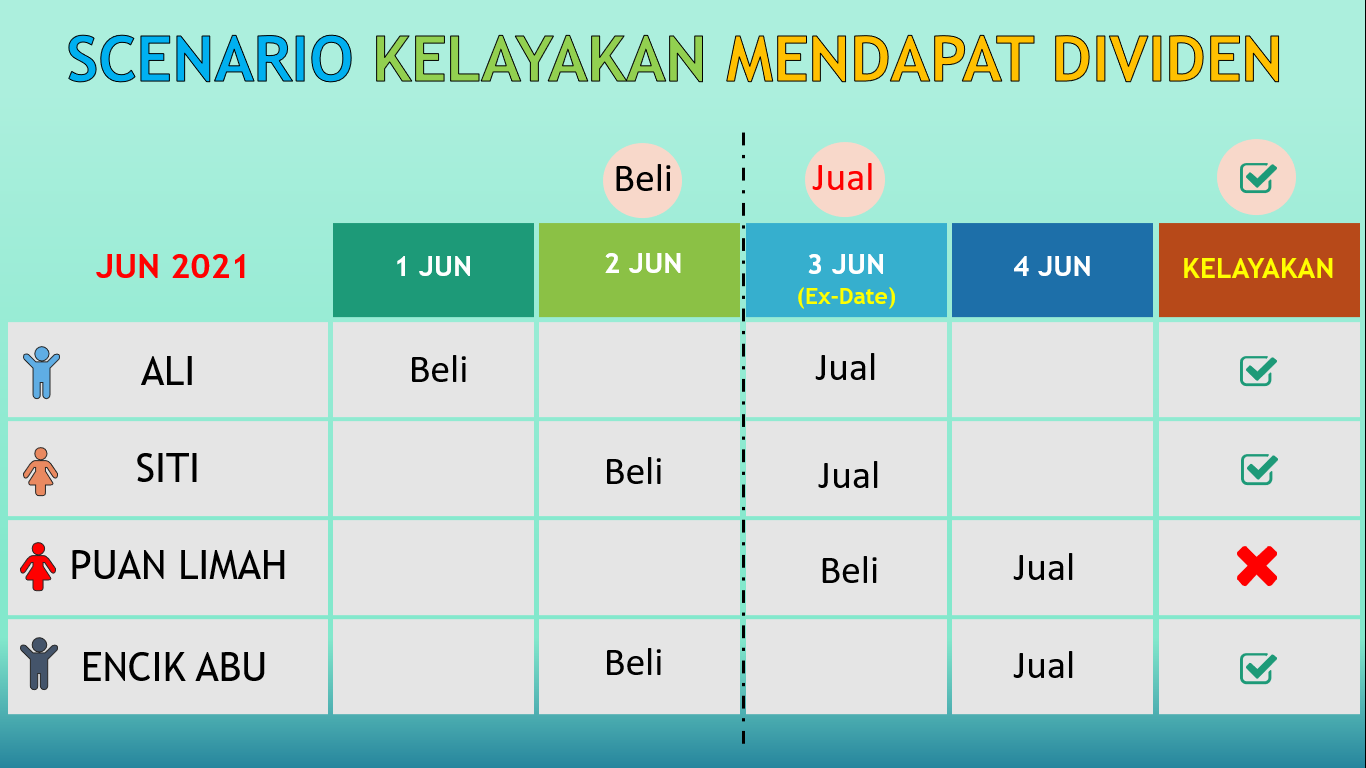
Here are 4 scenarios showing which shareholders are eligible and which are not eligible for dividends.
For example, company ABC BERHAD has an Ex-Date on 3 June 2021.
-
Scenario 1
Ali buys on 1 June and sells on 3 June (the Ex-Date). Ali IS eligible for the dividend because he bought before the Ex-Date and sold on the Ex-Date — no problem.
-
Scenario 2
Siti buys on 2 June and sells on 3 June (the Ex-Date). Siti IS eligible for the dividend because she bought one day before the Ex-Date and sold on the Ex-Date.
-
Scenario 3
Puan Limah buys on 3 June (the Ex-Date) and sells on 4 June (one day after the Ex-Date).
Puan Limah is NOT eligible for the dividend.
Why? Because the requirement to receive dividends is that you must buy at least one day before the Ex-Date.
Puan Limah bought on the Ex-Date itself, which does not qualify her for that dividend.
-
Scenario 4
Encik Abu buys on 2 June and sells on 4 June (one day after the Ex-Date).
Encik Abu IS eligible for the dividend because he bought before the Ex-Date. It doesn't matter when he sells after the Ex-Date.
FAQ (Frequently Asked Questions)
1. What are stock dividends?
Dividends are a distribution of company profits to shareholders. It is one way investors earn returns besides stock price appreciation (capital gain). Not all companies pay dividends.
2. When must I buy shares to be eligible for dividends?
You must buy shares at least one day before the Ex-Date. If you buy on the Ex-Date or after, you are not eligible for that dividend period.
3. Can I sell shares after the Ex-Date and still receive dividends?
Yes, you can. After the Ex-Date, you are free to sell your shares and will still receive the dividend. The key is that you held the shares at least one day before the Ex-Date.
4. How are dividends paid to shareholders?
Dividends are usually paid directly to the bank account registered in your CDS account. Payment is made on the date set by the company after the Ex-Date.
Conclusion
To be eligible for dividends, you must buy shares at least one day before the Ex-Date. Understand the 5 key things explained in this article so you don't miss out on dividends.
Start your investment journey today. Open a CDS Trading Account with Mahersaham and start collecting dividends from the best companies on Bursa Malaysia. Also download the Free Stock Market Basics Ebook to learn the fundamentals of stock investing.