Howard Marks & Oaktree Memos: How to Read Market Cycles Like a Distressed Investor

Every time an envelope from Howard Marks lands on his desk, Warren Buffett says it is the first thing he opens and reads. "I always learn something," Buffett has said about this man's memos. Imagine that, one of the most successful investors in history pauses to read the writing of another investor. So who exactly is Howard Marks, and why has his way of reading market cycles become a reference point for investors managing billions?
For retail investors on Bursa Malaysia who keep asking "should I get in now or wait?", Howard Marks' philosophy may be one of the most valuable things you can learn. He is not the type who tries to predict whether the market will go up or down tomorrow. Instead, he teaches you how to read where we are in the cycle, and let that understanding guide your decisions. This is how distressed investors think, and it is exactly what we will unpack in this article.
Who Is Howard Marks?
Howard Marks is the co-founder and co-chairman of Oaktree Capital Management, a fund manager that is the world's largest investor in distressed securities. In simple terms: when companies or assets fall so hard in price that other investors are afraid to touch them, Oaktree is the one stepping in to buy. As of 2026, the firm manages hundreds of billions of dollars in assets.
Marks founded Oaktree in 1995 with Bruce Karsh after leaving TCW. Under his leadership, Oaktree earned extraordinary returns by buying cheap assets during the financial crises of 1998, 2001 and 2008, when most other investors were panic selling. This strategy was not luck, it came from a highly disciplined approach to reading cycles. According to his profile, Marks' philosophy centres on the importance of understanding economic cycles and the limits of our knowledge about the macro future.
What Are the Oaktree "Memos" and Why Buffett Never Misses One
Since the early 1990s, Marks has written long essays called "memos" and published them for free on the Oaktree website. These memos are not sales reports or promotions. They are honest reflections on market conditions, risk, investor psychology, and where we stand in the cycle. That is why they are respected throughout the global investment community.
Among his most famous memos are "The Most Important Thing" (later turned into a book), "You Can't Predict. You Can Prepare." and the series of memos during the 2008 crisis that kept many investors sane when the world looked like it was collapsing. His more recent memo in late 2025 warned about "carelessness" in private credit markets, although he stressed the issue was not yet systemic, as reported by CNBC.
The lesson for us: you do not need to subscribe to anything or pay expensive fees to learn from one of the greatest investment thinkers alive. All of Oaktree's memos can be read for free. All you need is the patience to read and the humility to accept that you cannot predict the future.
The Core Philosophy: "You Can't Predict, But You Can Prepare"
This is the single most important line from Howard Marks. It means: you cannot precisely predict when the market will rise or fall, but you can prepare for a range of possibilities. Many retail investors get this wrong, spending their time guessing "will the KLCI go up or down tomorrow?", when short-term forecasting is almost impossible to do consistently.
Marks distinguishes between two types of knowledge. First, "what will happen" (the future), which we cannot know. Second, "where we are right now" (the present), which we actually can assess fairly well. When valuations are stretched, debt is cheap, and everyone is convinced there is no risk, that is a sign we are in dangerous territory, even though we cannot know exactly when the market will fall. This is the difference between predicting and preparing.
This concept ties closely to the idea of "margin of safety" from The Intelligent Investor by Benjamin Graham. You do not have to be right about timing, you just need to buy at a price low enough to leave room for error.
The Market Pendulum: Between Greed and Fear
One of Marks' most powerful metaphors is the market "pendulum". He says the market rarely sits at a "fair" point. Instead, it swings like a clock's pendulum, from too optimistic (greed) to too pessimistic (fear), and rarely pauses long in the middle. When the pendulum is at the greed extreme, prices soar and risk is actually at its highest. When the pendulum is at the fear extreme, prices fall and that is where the real opportunity appears.
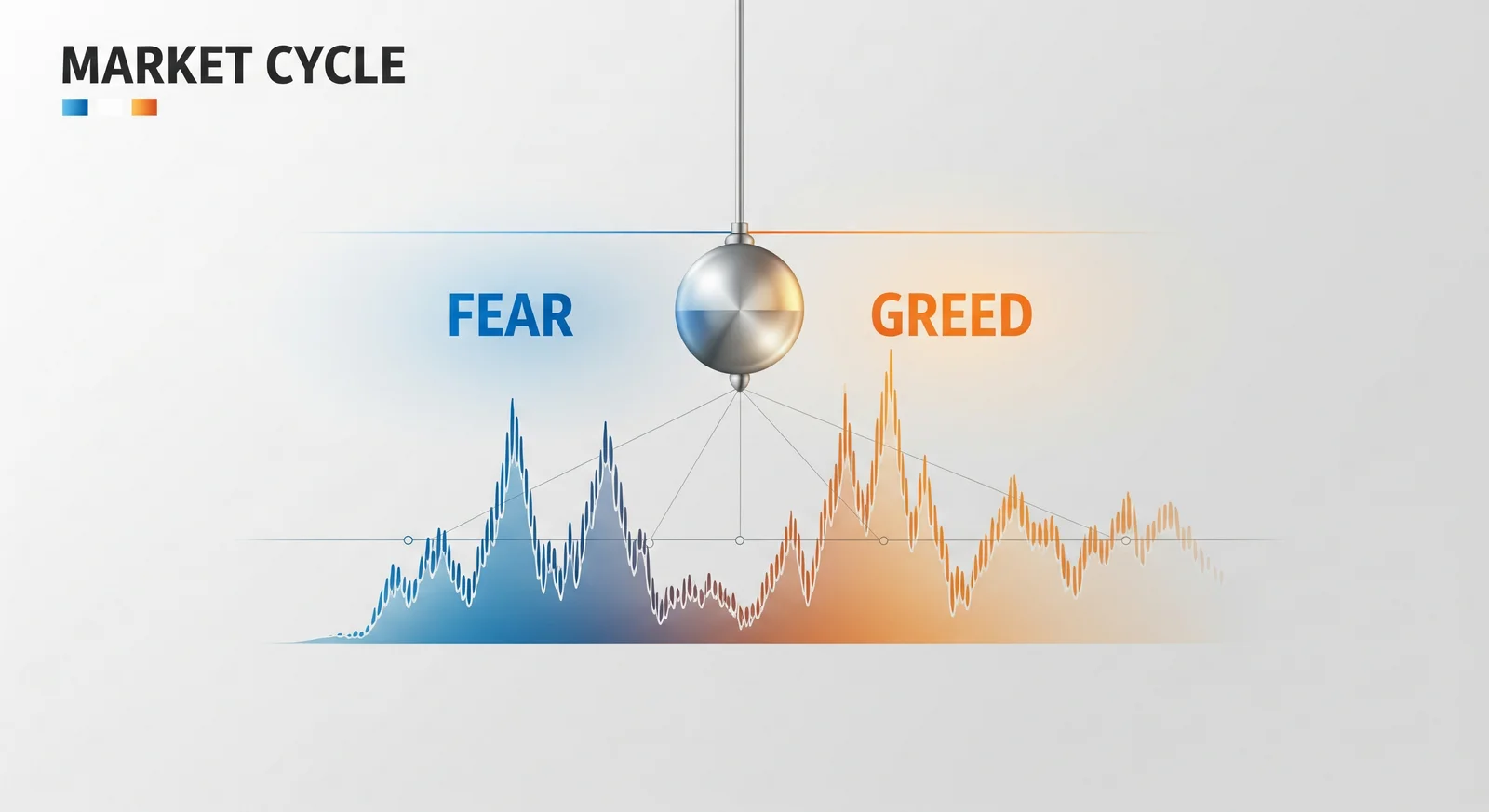
Interestingly, most retail investors do the opposite of what logic dictates. They are most excited to buy when prices have already soared (the greed extreme) and most afraid to sell when prices have already crashed (the fear extreme). Marks teaches us to be aware of where the pendulum is, and to fight the herd instinct. This is the heart of contrarian psychology. If you want to understand the instincts that sabotage investment decisions, read about the 7 mental biases that make investors lose money on Bursa Malaysia.
Mastering the Market Cycle: How to Know Where We Stand
In his book "Mastering the Market Cycle", Marks gives a practical framework for assessing the market's temperature. The core idea: we may not know where the market is going, but we can "take the market's temperature" right now by looking at certain signs. Once you know the temperature, you can adjust your portfolio to be more aggressive or more defensive.
Signs We Are at the Top (Greed Pendulum)
- Financial news is full of optimism, nobody talks about risk
- New listings (IPOs) sell out fast even when the companies are not yet profitable
- People who have never invested are suddenly all talking about stocks
- Valuations (such as the PE ratio) are far above historical averages
- Debt is easy to get and cheap, lenders are not fussy
Signs We Are at the Bottom (Fear Pendulum)
- News is full of gloom, many forecast "the market will fall even further"
- Investors sell good assets along with bad ones, indiscriminately
- Nobody dares to say the word "buy"
- Valuations fall far below historical averages, many stocks trade below book value
- Debt is hard to get, everyone wants to hold cash
Marks stresses that this is not a precise forecasting tool. You will never know the exact day or week the market turns. But by recognising the temperature, you avoid being most aggressive when risk is highest, and avoid being most fearful when the opportunity is greatest. This cycle concept also applies to specific sectors, for example the CPO price cycle for plantation stocks.
Second-Level Thinking: How to Think Like a Distressed Investor
Another concept Marks popularised is "second-level thinking". First-level thinking is easy and the same as the crowd: "This is a good company, let's buy." Second-level thinking goes deeper: "This is a good company, but everyone already knows it is good, so the price is already high and expectations are too high. Therefore it may be a poor investment."
Distressed investors must constantly think on the second level because they buy what others throw away. They ask: "Why is this asset cheap? Is it genuinely bad, or are people simply too afraid? What is the market missing?" This way of thinking is not only for distressed investors. Every Bursa Malaysia investor who wants to beat the market average needs to think differently from the crowd, not just follow it. This idea aligns with Charlie Munger's mental models, which emphasise thinking in reverse and from multiple angles.
How Distressed Investors Profit When Everyone Else Panics
Oaktree's history shows the same pattern repeating again and again. During the 2008 global financial crisis, when large institutions collapsed and many investors fled, Oaktree deployed around USD 6 billion into distressed debt over a few months. When the market recovered, those investments delivered extraordinary returns. Marks did not predict when the crisis would end, he simply saw that prices had fallen far below true value, so he prepared and acted.
The same pattern played out during the 2020 pandemic crash. Within weeks, many quality stocks fell 30-50% out of panic, not because their businesses were broken. Investors brave enough to step in when there was "blood in the streets" eventually reaped large gains when the market recovered. But here is the hard part: buying when everyone is afraid requires extraordinary courage and emotional preparation.
Marks constantly reminds us that the biggest opportunities appear when three things come together: quality assets, prices that have already crashed, and extreme fear among the crowd. Investors who keep cash and patience while others are greedy will have the ammunition to fire when others are fearful. You can see the same psychological pattern in the history of bull markets on Bursa Malaysia.
A recent example is unfolding right before our eyes. Throughout 2024 and 2025, capital flowed indiscriminately into the technology sector on the back of artificial intelligence (AI) hype, pushing the valuations of giants like Nvidia to extreme levels. Then in early 2026, when geopolitical tensions and a reassessment of Fed policy triggered panic, the pendulum swung hard back toward fear. In his recent memo, Marks insists AI is a genuine structural development, not a passing trend, yet he still reminds investors to be aware of where the pendulum stands, as discussed in the Oaktree memos. This euphoria-to-fear pattern has also been noted by other investors, as we covered in our article on Michael Burry's bubble warning.
How Bursa Malaysia Investors Can Apply Howard Marks' Philosophy
Marks' philosophy is not just theory for Wall Street investors. Here is how Malaysian retail investors can use it practically:
- Take the market's temperature, do not predict. Instead of asking "will the KLCI go up tomorrow?", ask "are valuations expensive or cheap relative to history?" Look at the market's average PE ratio and news sentiment.
- Hold cash when the pendulum is at the greed extreme. When everyone is excited and IPOs sell out fast, that is the time to be cautious and build up cash, not the time to go all-in.
- Prepare a watchlist. Identify quality companies you want to own, but wait for prices to fall to attractive levels. When the market panics, you already have your list and avoid emotional decisions.
- Fight the herd instinct. When the news is full of gloom and friends are selling at a loss, that is when disciplined investors start examining opportunities.
- Focus on value, not price. Learn to estimate a company's true worth through methods like DCF valuation, so you know when a stock is genuinely cheap.
Most importantly, Marks' philosophy requires emotional control. Without psychological discipline, all these frameworks are useless because you will still be greedy at the top and fearful at the bottom. That is why reading and understanding yourself is just as important as reading the market.
Frequently Asked Questions (FAQ)
Who is Howard Marks and what is his connection to Oaktree?
Howard Marks is the co-founder and co-chairman of Oaktree Capital Management, the world's largest investor in distressed assets. He is famous for his market memos, read by investors worldwide, including Warren Buffett.
Where can I read Howard Marks' memos?
All Oaktree memos are published for free on the official Oaktree Capital website (oaktreecapital.com) under the Insights section. You do not need to be a client to read them.
What does "you can't predict, you can prepare" mean?
It means you cannot precisely predict short-term market moves, but you can assess where we are in the cycle and prepare for a range of possibilities. Focus on preparation, not prediction.
What is a distressed investor?
A distressed investor buys the assets or debt of companies that are in trouble or have crashed in price, hoping their value recovers. They buy when others panic sell, which requires deep analysis and emotional control.
Is Howard Marks' philosophy suitable for small Bursa Malaysia investors?
Yes. Although Marks manages large funds, his principles such as reading the market's temperature, second-level thinking, and buying when there is fear can all be applied by retail investors with small capital on Bursa Malaysia.
What is the difference between predicting the market and reading the cycle?
Predicting the market tries to guess direction and exact timing (e.g. "the KLCI will rise next month"), which is nearly impossible to do consistently. Reading the cycle assesses current conditions (expensive or cheap valuations, greed or fear sentiment) to adjust portfolio risk.
Which Howard Marks book should I read first?
Start with "The Most Important Thing" for the core philosophy, then "Mastering the Market Cycle" to understand how to read market cycles in greater depth.
Conclusion
Howard Marks teaches us a truth many investors refuse to accept: we cannot predict the future, but we can read where we are now and prepare. The market pendulum always swings between greed and fear, and the biggest gains go to those who dare to fight the herd instinct with discipline and preparation.
You do not need to manage billions to use this wisdom. Start by reading the market's temperature, thinking on the second level, and always focusing on value over price. To truly apply this philosophy, you need an account to invest and a solid foundation of knowledge.
Open your CDS account today to start investing in Bursa Malaysia as well as foreign stocks such as US and Hong Kong markets, so you are ready to act when opportunity appears.
Also download our free stock market basics ebook to understand key concepts before you invest real money.
Further Reading
- The Intelligent Investor Summary: Mr. Market, Margin of Safety & Bursa Malaysia Application
- Charlie Munger: The Mental Models That Made Him Wiser Than Buffett
- Investor Psychology: 7 Mental Biases That Make You Lose Money on Bursa Malaysia
- Warren Buffett's Investment Philosophy in Times of War: Lessons for Malaysian Investors
- Michael Burry: Today's Stock Market Looks Like the "Final Months of the 1999-2000 Bubble"