Malaysia's Fiscal Deficit: 25 Years of Overspending & Its Impact on You

Malaysia has been running a budget deficit for over 25 years. Every year, the government spends more than it collects - and this gap is covered through borrowing. For the average citizen, this may sound like an issue only discussed by economists at seminars. But in reality, fiscal deficit directly impacts your wallet - from the price of goods at the supermarket to the performance of your stock investments on Bursa Malaysia.
In this article, we will break down in a simple and easy-to-understand manner what fiscal deficit is, why Malaysia keeps overspending, and how it affects your life and investment decisions.
What Is Fiscal Deficit?
Fiscal deficit occurs when the government spends more than the revenue it collects within a year. Government revenue comes from taxes (income tax, SST, corporate tax), dividends from government-linked companies like Petronas, and non-tax revenue. When total spending exceeds this revenue, the difference is called a deficit.
To understand this concept simply, imagine your monthly salary is RM5,000 but you spend RM6,500 every month. The extra RM1,500 is covered by credit cards or personal loans. That is your personal "deficit." The government does the same thing, just on a scale of billions of ringgit.
According to the Ministry of Finance Malaysia, fiscal deficit is measured as a percentage of Gross Domestic Product (GDP). For example, a 3.5% deficit means the government overspent by 3.5% of the nation's total economic output.
It is important to distinguish fiscal deficit from national debt. Deficit is the annual gap (how much more you spend this year), while national debt is the cumulative total of all deficits that have ever occurred. Think of deficit as a "new wound" and debt as "the total of all wounds that have ever existed."
History of Malaysia's Fiscal Deficit: From 1998 to 2026
Malaysia has not recorded a budget surplus since 1997 - before the Asian Financial Crisis struck. Since then, the country has been operating in deficit mode for over two consecutive decades.
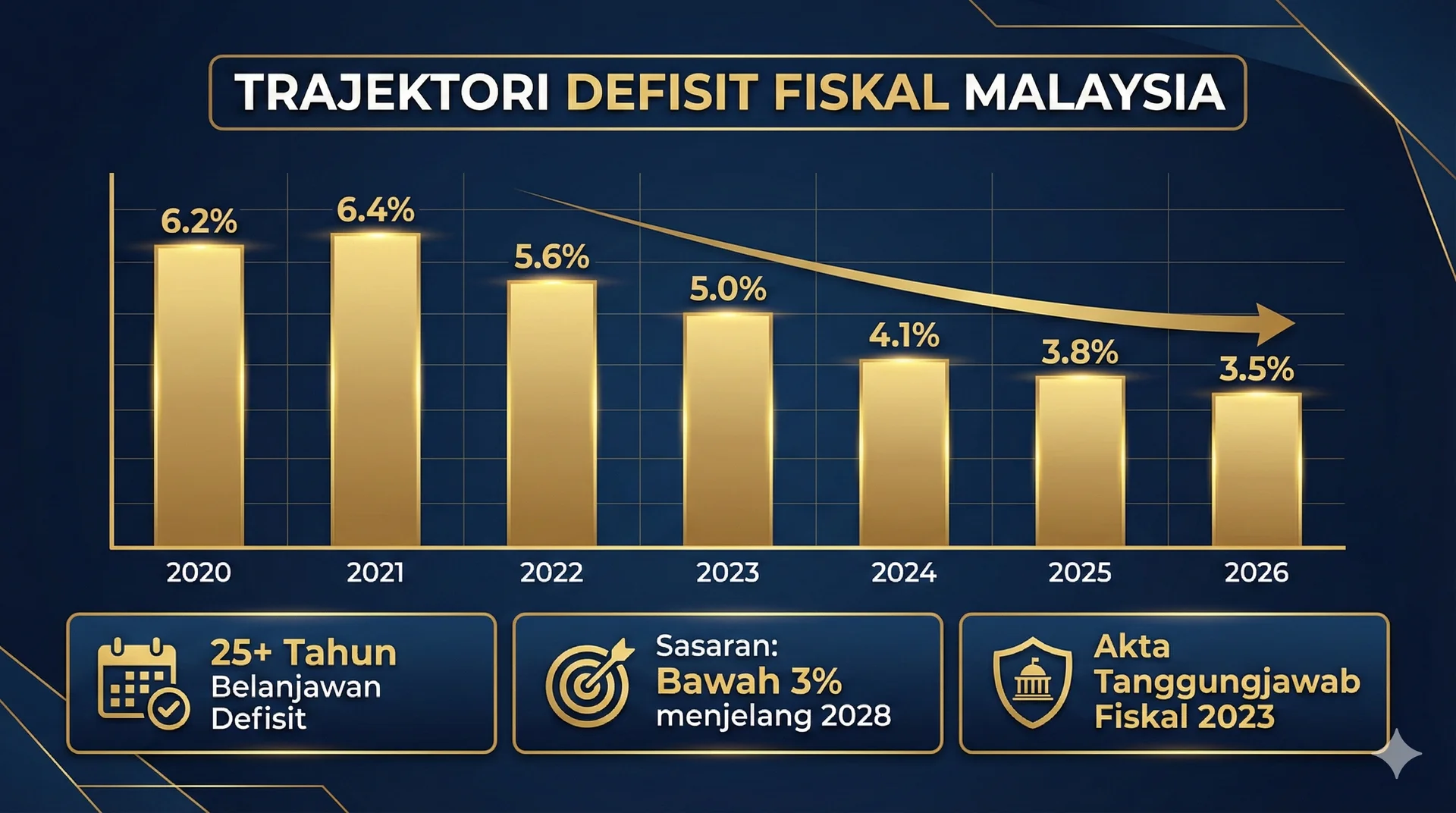
Here is the trajectory of Malaysia's fiscal deficit in recent years:
| Year | Deficit (% of GDP) | Notes |
|---|---|---|
| 2019 | 3.4% | Pre-pandemic |
| 2020 | 6.2% | COVID-19 pandemic, massive stimulus spending |
| 2021 | 6.4% | Continued pandemic impact |
| 2022 | 5.6% | Post-pandemic reduction begins |
| 2023 | 5.0% | MADANI government begins fiscal consolidation |
| 2024 | 4.1% | Significant reduction, subsidies begin to be targeted |
| 2025 | 3.8% (target) | Diesel subsidy restructuring continues |
| 2026 | 3.5% (target) | Budget 2026, goal of below 3% by 2028 |
Data from CEIC Data shows that Malaysia's average fiscal deficit since 1970 has been around 4.6% of GDP. The worst point occurred during the COVID-19 pandemic in 2020-2021, when the government was forced to spend hundreds of billions of ringgit on economic stimulus packages.
What is clear is the downward trend in deficit since 2022. This is not happening by coincidence - it is the result of fiscal consolidation policies implemented gradually by the government.
Why Is Malaysia Always in Deficit?
This question is frequently asked: if the government knows deficit spending is unhealthy, why has it continued for 25 years?
1. Large subsidies and social assistance
Malaysia is among the countries that provide the most subsidies in Southeast Asia. Fuel subsidies, electricity, basic food items, and various cash aid programs (STR, formerly BRIM) consume a large portion of spending. According to Kosmo Digital, subsidies remain one of the largest components of government expenditure.
2. High operating expenditure
Over 80% of government spending goes to operations (civil servant salaries, maintenance, debt payments) rather than development. Malaysia has over 1.7 million civil servants - among the highest ratios in the world relative to population.
3. Revenue dependent on commodities
Government revenue has traditionally relied on petroleum revenue through Petronas. When crude oil prices fall, government revenue also shrinks. Although this dependence has been decreasing, it still plays an important role.
4. Narrow tax base
After the GST was abolished in 2018 and replaced with SST, Malaysia's tax base narrowed. Only a small proportion of citizens pay income tax, and this limits the government's ability to generate revenue.
Fiscal Responsibility Act (FRA) 2023: A Turning Point
An important development that many citizens may not be aware of is the enactment of the Fiscal Responsibility Act in 2023. This is a historic law that legally binds the government to:
- Reduce the fiscal deficit gradually to below 3% of GDP
- Limit government debt to not exceed 60% of GDP
- Increase transparency in public financial management
- Mandate periodic fiscal reporting to Parliament
The FRA is important because it is not merely a political promise - it is a legal obligation. Any subsequent government is bound to comply with the established limits, providing long-term assurance to investors and international credit rating agencies.
Impact of Fiscal Deficit on Ordinary Citizens
You may wonder - what does fiscal deficit have to do with daily life? The answer: a lot.
Subsidies are being reduced gradually
To reduce the deficit, the government needs to either increase revenue or reduce spending - or both. One of the most notable measures is the targeted subsidy restructuring. Diesel subsidies have already been retargeted, and other subsidies may follow.
Potential new taxes
When spending is difficult to cut, the government may look to increase revenue through new taxes. Discussions on capital gains tax, carbon tax, and expanding the scope of SST are constantly taking place at the policy level.
Government borrowing costs rise
A high deficit means the government needs to borrow more. When borrowing demand is high, interest rates tend to rise. This can have a spillover effect on housing and personal loan rates for citizens.
Long-term inflation
When the government borrows excessively to cover the deficit, it can contribute to inflationary pressure. Too much money in the economy without a corresponding increase in productivity will push up the prices of goods and services.
Impact on Investors and the Stock Market
For investors on Bursa Malaysia, fiscal deficit is not just a macroeconomic number - it directly influences investment decisions.
National credit rating
International rating agencies such as Moody's, S&P, and Fitch closely monitor fiscal deficit. An excessively high deficit can lead to a credit downgrade, which in turn raises the country's borrowing costs and undermines foreign investor confidence. According to BERNAMA, the 3% deficit target by 2028 is viewed as a positive step by rating agencies.
Foreign investor confidence
Fiscal reforms help strengthen investor confidence in the country. Foreign holdings in Malaysian Government Securities have risen to 35.6% - a sign that international investors still believe in Malaysia's economic prospects.
Impact on the ringgit
A high fiscal deficit can weaken the national currency. A weak ringgit means imports become more expensive, raw material costs rise, and companies dependent on imports will be affected. Conversely, deficit reduction supports the strengthening of the ringgit.
Opportunities in specific sectors
Deficit reduction through increased revenue means the government may expand tax collection. The financial services, accounting, and fintech technology sectors could benefit from increased tax compliance and the digitalization of tax administration.
2026 Deficit Target and the 13th Malaysia Plan
Budget 2026 targets a fiscal deficit of 3.5% of GDP - a reduction from 3.8% in 2025. Economists consider this target realistic based on the consistent downward trajectory since 2022.
In the long term, the 13th Malaysia Plan (2026-2030) announced by the Prime Minister targets:
- Fiscal deficit below 3% of GDP in the medium term
- Government debt not exceeding 60% of GDP
- Economic growth of 5-6% per year through strategic investment
- Expanding the tax base without burdening low-income earners
These targets are important because they provide confidence that Malaysia is moving in the right direction in terms of fiscal discipline, while supporting long-term economic growth.
How Does the Government Fund the Deficit?
When spending more than revenue, the government needs to find funding sources. Here are the main ways the deficit is funded:
1. Government bond issuance (MGS & GII)
The government issues Malaysian Government Securities (MGS) and Government Investment Issues (GII) - both are bonds purchased by banks, pension funds (including EPF), insurance companies, and foreign investors. This is the largest source of funding.
2. Domestic borrowing
The majority of Malaysia's government debt is denominated in ringgit and held by local institutions. This reduces the risk of a debt crisis caused by foreign investors suddenly withdrawing funds.
3. Foreign borrowing
A small portion of funding comes from international markets through bond issuance in foreign currencies (Samurai bonds, global Sukuk). This provides access to potentially lower interest rates but carries foreign exchange risk.
Frequently Asked Questions (FAQ)
What is the difference between fiscal deficit and national debt?
Fiscal deficit is the annual gap between government spending and revenue. National debt is the cumulative total of all deficits that have ever occurred. Deficit adds to debt every year - if the deficit is reduced, the rate of debt growth slows, even though the total debt amount still increases.
Does fiscal deficit mean the country will go bankrupt?
Not necessarily. As long as the government can pay its debt interest and the economy continues to grow, the deficit can be managed. What matters is the deficit-to-GDP ratio - as long as the economy grows faster than debt, the situation remains under control. Most developed countries also operate with deficits.
Can Malaysia achieve a budget surplus?
In theory, yes - Malaysia recorded a surplus in 1997. But in the current context, the realistic goal is to reduce the deficit to a sustainable level (below 3%), not to eliminate it entirely. This is because development spending is still needed for economic growth.
How does fiscal deficit affect the OPR?
A high deficit can add inflationary pressure, which may force Bank Negara Malaysia to raise the OPR to control price increases. A higher OPR means housing and car loan rates also rise, affecting citizens' monthly repayments.
Why doesn't the government eliminate subsidies entirely to reduce the deficit?
Sudden elimination of subsidies could cause price shocks that severely impact low-income groups. A gradual and targeted approach - reducing subsidies for those who can afford it while maintaining them for those in need - is more responsible from an economic and social perspective.
What role does EPF play in funding the government's deficit?
EPF is among the largest buyers of Malaysian government bonds. When the government issues MGS or GII to cover the deficit, EPF invests in these instruments because they provide stable fixed returns. This means a portion of citizens' retirement savings indirectly funds the government's deficit.
Will new taxes be introduced to reduce the deficit?
The government is constantly evaluating options to broaden the revenue base. Discussions on capital gains tax, carbon tax, and SST review are ongoing. However, any new taxes are typically introduced gradually and accompanied by protective measures for low-income groups.
How can I protect my investments from the effects of fiscal deficit?
Diversification is key. Investors can consider a mix of assets including stocks, bonds, gold, and international investments. Stocks of companies that benefit from government spending (infrastructure, technology) can be a good choice, while investments in foreign-denominated assets can protect against ringgit weakness.
Conclusion
Fiscal deficit is not something to be feared, but it needs to be understood. As Malaysian citizens and investors, understanding how the government manages the nation's finances helps you make smarter financial decisions - from evaluating the impact of subsidy policies to choosing the right stocks for your portfolio.
Understanding macroeconomics like fiscal deficit is the first step to becoming a more knowledgeable investor. If you haven't started investing yet, now is a good time to take the first step.
Open a CDS Trading Account to start investing on Bursa Malaysia through our CDS account opening guide.
Download our Free Stock Market Basics Ebook to understand the fundamentals of investing before you begin.