Malaysia Glove Stocks Are Back: The 120% US Tariff Turning Point

After nearly four years in the wilderness, Malaysia's rubber glove sector is finally seeing light at the end of the tunnel. In April 2026, Hartalega Holdings surged +27.55% and Top Glove jumped +26.56% in a rally that caught many investors off guard. The catalyst? A sharp escalation in US import tariffs on Chinese medical gloves to 120% effective January 2026 - and markets finally woke up to the fact that Bursa Malaysia's big four are back on the front foot.
The real question: is this the start of a structural comeback, or just a momentum spike? This article unpacks the hard data behind the rally, traces the boom-bust-recovery arc of Malaysia's glove sector since COVID, explains why US tariffs this time round are genuinely different, profiles all four major counters (Hartalega, Top Glove, Kossan, Supermax), walks through Kenanga's sector call, flags the risks most investors overlook, and lays out a practical strategy for anyone considering a position today.
What Actually Happened in the April 2026 Rally
As of 10 April 2026, Hartalega led the charge with a blistering +27.55% gain, closely followed by Top Glove at +26.56%. This wasn't just surprising - it's the strongest sector momentum Malaysian glovemakers have seen since the COVID boom of 2020.
The rally played out against an already bullish market backdrop. The FBM KLCI hit 1,757 points - its highest level since October 2018 - but glove stocks outpaced the benchmark by a wide margin. Three simultaneous drivers were behind the move:
- Section 301 US tariffs on China stepped up in phases - from 50% in early 2025 to 70% in the second half, and now 120% effective January 2026 (higher than the originally flagged 100%).
- Kenanga Investment Bank upgraded the sector to
OVERWEIGHTwith Kossan asTop Pick, triggering an institutional re-rating after years of neglect. - Average selling prices (ASP) in Malaysia (US$18-21 per 1,000 pieces) are now sharply competitive against China (which has to price at US$25+ after tariffs).
Trading volumes in the big four spiked 3-5x their daily averages in the first week of April. This signals more than retail FOMO - institutions are repositioning.
The Boom-Bust-Recovery Arc of Malaysian Gloves
To understand why this rally matters, you need to know just how badly the sector crashed first.
The Boom (2020-2021)
During the COVID-19 pandemic, demand for rubber gloves exploded to record levels. Top Glove, Hartalega, Kossan and Supermax all posted record profits - Top Glove alone booked RM7.8 billion in FY2021 net profit. Glove stocks rallied 300-500% in under a year.
The Crash (2022-2024)
Once the pandemic subsided, demand collapsed. Worse still, Chinese manufacturers - with lower labour costs and state subsidies - began undercutting Malaysian producers with aggressive pricing. The result:
- Malaysia's global market share fell from 63% (2019) to around 35% (2025), according to MIDA.
- China grew its share from 11% (2019) to ~34% (2025) - nearly matching Malaysia, the long-time global leader.
- Top Glove, Hartalega and Kossan posted operating losses across multiple quarters. Supermax faced labour-related issues that blocked US market access.
The Recovery (2025-2026)
The turning point came when the US administration announced stepped-up Section 301 tariffs on Chinese medical goods. From 50% in early 2025, the rate was lifted to 70% in H2 2025, and now 120% from January 2026. This completely rewrites the price dynamics between Malaysian and Chinese producers.
Why the 120% Tariff Is a Game Changer
Previously, Chinese glove manufacturers sold into the US at ASPs well below Malaysian peers - sometimes 30-40% cheaper. That allowed US buyers (distributors, hospital chains, group purchasing organisations) to shift away from Malaysia to save on cost.
With 120% tariffs applied:
- Effective China glove price to US now exceeds US$25 per 1,000 pieces
- Malaysia is still at US$18-21 per 1,000 pieces
- The pricing advantage now sits firmly with Malaysia at US$4-7 per 1,000 pieces
The consequence: rational US buyers are switching back to Malaysia. According to Margma, this isn't hypothetical - long-term supply contracts are already being moved. Kenanga projects Malaysian market share rebounding from 35% to 50% by end-2026.
On top of that, global demand is forecast to hit ~398 billion pieces in 2026, driven by healthcare spending recovery in developed markets. Malaysia's production capacity of 201-206 billion pieces is well-positioned to absorb that volume.
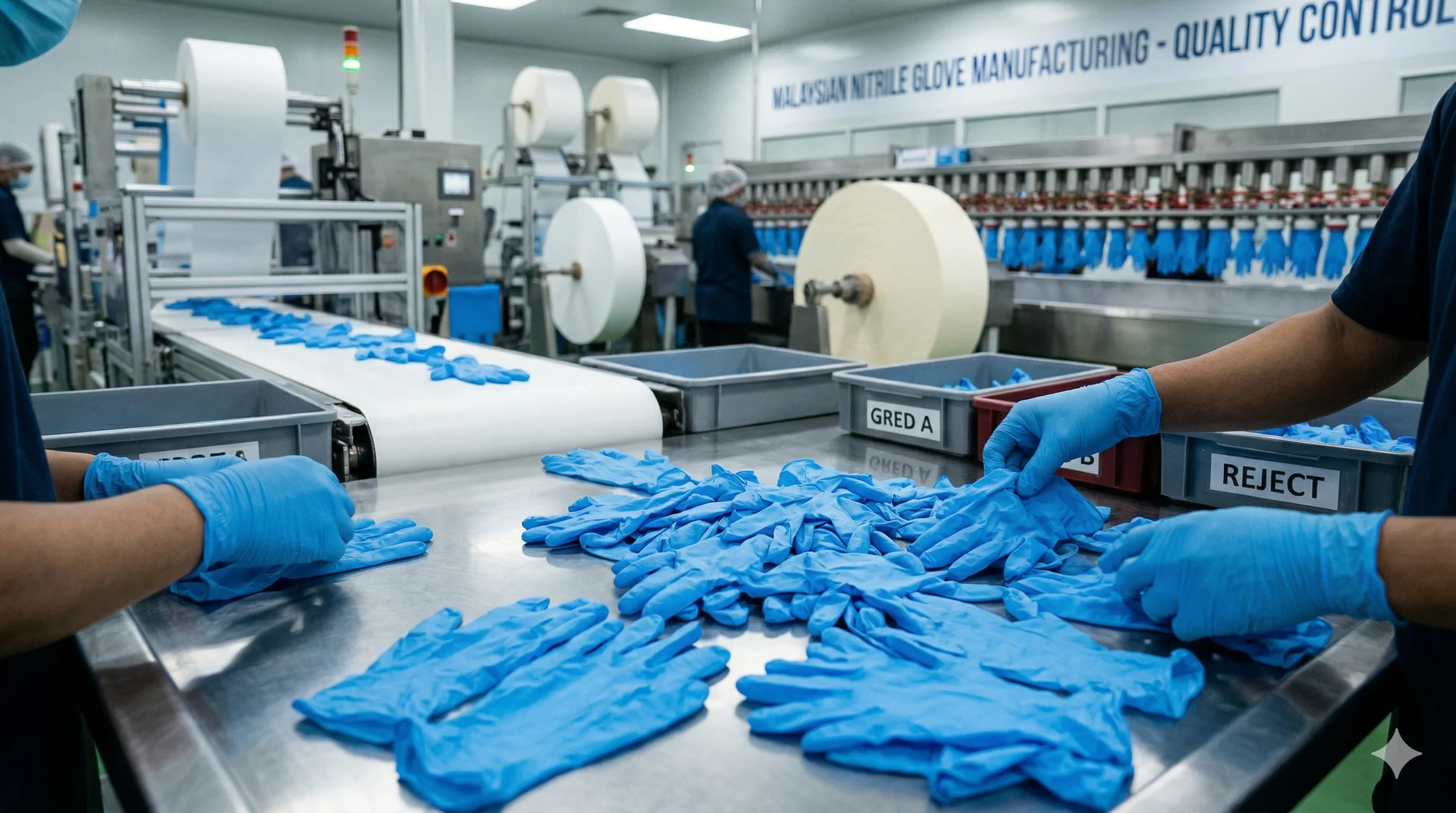
The Big Four Glove Stocks on Bursa Malaysia
Bursa Malaysia hosts four globally significant glove producers. Each offers a distinct investment thesis.
1. Hartalega Holdings (HARTA, 5168)
- Technology leader in the nitrile glove segment
- Invested over RM14 million to upgrade its ERP system to Industry 4.0
- Production capacity of 42,000 pieces per hour per line - among the highest globally
- Focus on premium nitrile gloves for US and European medical markets
- ~60% US exposure - the highest of the big four
- April 2026 rally: +27.55%
2. Top Glove Corporation (TOPGLOV, 7113)
- World's largest glovemaker with ~26% global market share
- Widest product spectrum - medical, industrial, food service
- EBITDA margins recovered from 10% to 14% between 4QFY2024 and 3QFY2025
- Highest operating leverage of the big four - biggest upside if recovery sustains
- FY2026 net profit forecast to grow 24% YoY to RM135m
- April 2026 rally: +26.56%
3. Kossan Rubber Industries (KOSSAN, 7153)
- Speciality glove focus for higher-margin products
- Tightest cost discipline of the big four
- EBITDA margins 11-14% between 4QFY2024 and 3QFY2025
- Strong balance sheet with RM1.6 billion in cash and investments
- PAT margin 8.6% in 3Q25 vs 10.1% in 2019 - closest to pre-COVID profitability
- Kenanga Top Pick with price target of RM2.70
4. Supermax Corporation (SUPERMX, 7106)
- Vertically integrated player - owns downstream US/UK distribution
- Previously faced labour-related issues affecting US access - since resolved
- Highest leverage to owned-distribution margin upside
- Cheapest valuation - high-risk, high-reward recovery play
Why Kenanga Picked Kossan as Top Pick
In its October 2025 sector note, Kenanga Investment Bank reiterated an OVERWEIGHT call on the glove sector and named Kossan as its Top Pick with an OUTPERFORM rating and price target of RM2.70.
Kenanga's reasoning:
- Kossan's speciality glove mix delivers better margins than peers focused on commodity gloves
- Tightest cost discipline - lowest cost structure among the big four
- Robust balance sheet - sufficient cash reserves to weather any order slowdown
- Less volume-sensitive - with higher per-unit margins, Kossan is less reliant on utilisation for profit
Kossan's 11-14% EBITDA margin has held up even through the sector downturn. That contrasts with peers whose margins swing wildly with utilisation rates.
One more important point: Kenanga also flags that global overcapacity is expected to shrink 35% to 72 billion pieces by 2026. This means the supply-demand balance will tilt in favour of producers with the highest operational efficiency - exactly where Kossan sits.
Global Demand vs Malaysian Capacity - The Numbers
| Metric | 2025 | 2026 (Forecast) |
|---|---|---|
| Global demand | ~370 billion pieces | ~398 billion pieces |
| Malaysia capacity | ~180 billion pieces | 201-206 billion pieces |
| Malaysia market share | ~35% | 45-50% |
| China market share | ~34% | Down to ~25% |
| Malaysia ASP (US$/1,000) | 18-20 | 19-21 |
| China ASP (effective with tariff) | 22 | 25+ |
| Global overcapacity | 111 billion | 72 billion (-35%) |
The maths is straightforward: demand is rising, Malaysian capacity can absorb it, overcapacity is shrinking, and the main competitor (China) has been forced to raise prices. Rarely do these conditions line up simultaneously in manufacturing history.
Risks Investors Often Overlook
Positive momentum doesn't mean the sector is risk-free. Several risks deserve consideration:
1. Tariffs can change. Section 301 is a US administration decision. Presidential elections, trade policy shifts, or bilateral agreements could weaken or eliminate tariffs. Investors betting 100% on tariff sustainability are taking on meaningful political risk.
2. Chinese overcapacity hasn't gone away. Even if Chinese exports to the US are pressured, Chinese producers aren't shutting factories - they'll try to dump into other markets (Europe, Middle East, Asia). This could pressure global prices in the short term.
3. Raw material costs. Natural rubber latex and nitrile butadiene rubber (NBR) prices can spike. If input costs rise faster than ASPs, margins can get squeezed again even as volumes recover.
4. Margin sustainability. A recovery to 10-14% EBITDA margins is encouraging but far from the COVID peak (30%+). Investors need to be realistic - this is about market share recovery, not a replay of the pandemic boom.
5. Momentum risk. Hartalega's +27.55% in a single month shows FOMO momentum is kicking in. When momentum trading dominates price action, volatility spikes. Stop-loss discipline and position sizing matter.
Strategy: Is It Too Late to Get In?
The question most investors ask: "I missed the first leg of the rally - should I buy now?"
Honest answer: it depends on your horizon and risk tolerance.
Short-term momentum traders (< 3 months): A +27% gain in one month is firmly in overbought territory. Wait for a 10-15% pullback before accumulating. Don't chase.
Medium-term investors (3-12 months): The market share recovery thesis is still intact. Dollar-cost averaging over 3-6 months is a reasonable approach. Focus on names with margin quality - Kossan and Hartalega top the list.
Long-term investors (> 12 months): This is a structural re-rating if tariffs hold and Malaysia recaptures 50% market share. Size positions so you can stomach short-term volatility. Top Glove offers the highest leverage to this thesis.
Watchlist & Entry Zones (based on consensus analyst views):
- Kossan: Entry zone RM2.00-2.20, Kenanga TP RM2.70 (22-35% upside)
- Hartalega: Buy on dips to RM2.80 or lower, consensus target RM3.50
- Top Glove: Leverage play - volatile, suited for those with higher risk tolerance
- Supermax: High-risk recovery play - only for investors who can stomach large drawdowns
One more thing: before opening any position, make sure you know how to read an income statement and cash flow properly for these companies. Glove makers are manufacturing-heavy - you need to spot the warning signs in cash flow statements before committing capital.
Conclusion
Malaysia's glove sector is going through its first genuine structural turning point since 2021. Section 301 tariffs at 120%, combined with recovering global demand and shrinking overcapacity, give Malaysia a real shot at clawing back lost market share. The four names - Hartalega, Top Glove, Kossan and Supermax - each offer different investment theses, with Kossan standing out on cost discipline and margin quality. But investors need to weigh the political risk of tariff reversal, residual Chinese overcapacity, and raw material cost swings.
If you're seriously considering taking a position in this sector, starting with the right investment platform is the first step.
If you don't yet have an account to invest on Bursa Malaysia and international markets like US and Hong Kong, you can open a CDS account through mahersaham.com for direct access to names like Hartalega, Top Glove, Kossan and Supermax - plus global trading opportunities.
For those still learning the basics of stock investing, download the free stock market basics ebook at mahersaham.com/ebookasas as your starting point before committing capital.
Frequently Asked Questions (FAQ)
1. Why did Malaysian glove stocks rally in April 2026? The rally is driven by the US Section 301 tariff hike on Chinese gloves to 120% effective January 2026. This closes the price gap between Malaysia and China, letting Malaysian producers win back US export contracts.
2. Will US tariffs on China stay in place? Section 301 tariffs are a US administration decision and could change. However, both major US political parties broadly support protectionist policies toward China, making the tariffs likely to stay in place for at least the next 12-24 months.
3. Among Hartalega, Top Glove, Kossan and Supermax, which is the best pick?
Kenanga Investment Bank lists Kossan as its Top Pick with a price target of RM2.70. The rationale is Kossan's focus on higher-margin speciality gloves, tightest cost discipline, and strongest balance sheet.
4. What is Malaysia's current global market share in the glove industry? Malaysia's market share fell from 63% (2019) to around 35% (2025). Kenanga projects it can recover to 45-50% by end-2026 if US tariffs remain in place.
5. Is it too late to enter glove stocks now? Not necessarily - it depends on your horizon. Short-term traders may want to wait for a 10-15% pullback. Medium- and long-term investors can dollar-cost average over 3-6 months. What matters is position sizing and disciplined risk management.
6. What are the main risks of investing in glove stocks? Five main risks: (1) tariffs could be reversed, (2) Chinese overcapacity is still high, (3) raw material costs could spike, (4) margins won't return to COVID peaks, and (5) momentum trading volatility.
7. How do I buy Hartalega or Top Glove shares? You need to open a stock trading account (CDS account) with a licensed broker. Once active, you can trade these stocks directly through your broker's platform.
8. What percentage of a portfolio should glove stocks take? For diversified investors, a single sector generally shouldn't exceed 5-10% of a portfolio. If you're bullish on the recovery thesis, 7-10% is within reasonable range. Don't go beyond that unless you're a sector specialist prepared to accept concentration risk.
Further Reading
- FBM KLCI Hits Highest Level Since 2018 - Opportunities for Investors in 2026
- US Supreme Court Strikes Down Trump Tariffs - Implications for Malaysian Investors
- China's Strategy to Dominate Global Trade After Trump Tariffs
- How to Read an Income Statement: Revenue, Net Profit & Cash Flow Reality
- 2026 Strategy: Why Small-Cap Stocks Are Set to Lead the Market