Malaysia National Budget: How It Is Made, Approved & Monitored

Every year, the Malaysian government tables a national budget worth hundreds of billions of ringgit. Budget 2026, for example, recorded a total expenditure of RM421.6 billion - the largest amount in history. But have you ever wondered how this enormous sum is planned, who approves it, and how it is monitored to prevent misuse?
For ordinary citizens and investors, understanding the budget process is not just additional knowledge - it helps you assess the country's economic direction, anticipate tax changes, and understand why certain sectors receive more allocation than others. This article explains the entire Malaysian budget cycle from A to Z.
What Is the National Budget?
The national budget (or "bajet negara") is the government's annual financial plan that outlines two key elements: how much money is expected to be collected (revenue) and how much will be spent (expenditure) within one fiscal year.
According to the Ministry of Finance Malaysia, the national budget is not merely a financial document - it reflects the government's priorities and direction. Every ringgit allocated represents a choice: does the government want to focus on education, healthcare, defence, or infrastructure development?
The budget is divided into two main components:
- Revenue Estimates - projected government income from taxes (income tax, SST, corporate tax), dividends (Petronas, Khazanah), and non-tax revenue (permits, licences, fines)
- Expenditure Estimates - divided into Operating Expenditure (day-to-day government operations) and Development Expenditure (infrastructure, education, and healthcare projects)
Who Is Responsible for Preparing the Budget?
The budget preparation process involves many parties, but the key players are:
1. Ministry of Finance (MOF)
The Ministry of Finance is the central pillar of the budget process. The Budget Division under MOF coordinates the entire process - from collecting allocation requests from every ministry to finalising the document for tabling in Parliament. The Finance Minister (currently also the Prime Minister, Datuk Seri Anwar Ibrahim) is the official presenter of the budget.
2. Treasury Department
The Treasury Department under MOF is responsible for analysing budget requests from every ministry and agency, ensuring they align with government priorities and expenditure ceiling limits.
3. Economic Planning Unit (EPU)
The EPU under the Prime Minister's Department is responsible for planning long-term development expenditure, ensuring development projects align with the Malaysia Plan (currently the 13th Malaysia Plan, 2026-2030).
4. Government ministries and agencies
Each ministry and agency prepares its own allocation request, complete with justification and expected outcomes.
5. Jemaah Menteri (Cabinet)
The Cabinet evaluates and approves the final budget draft before it is tabled in Parliament. This is the stage where political decisions are made - which ministry gets more, which projects are approved or deferred.
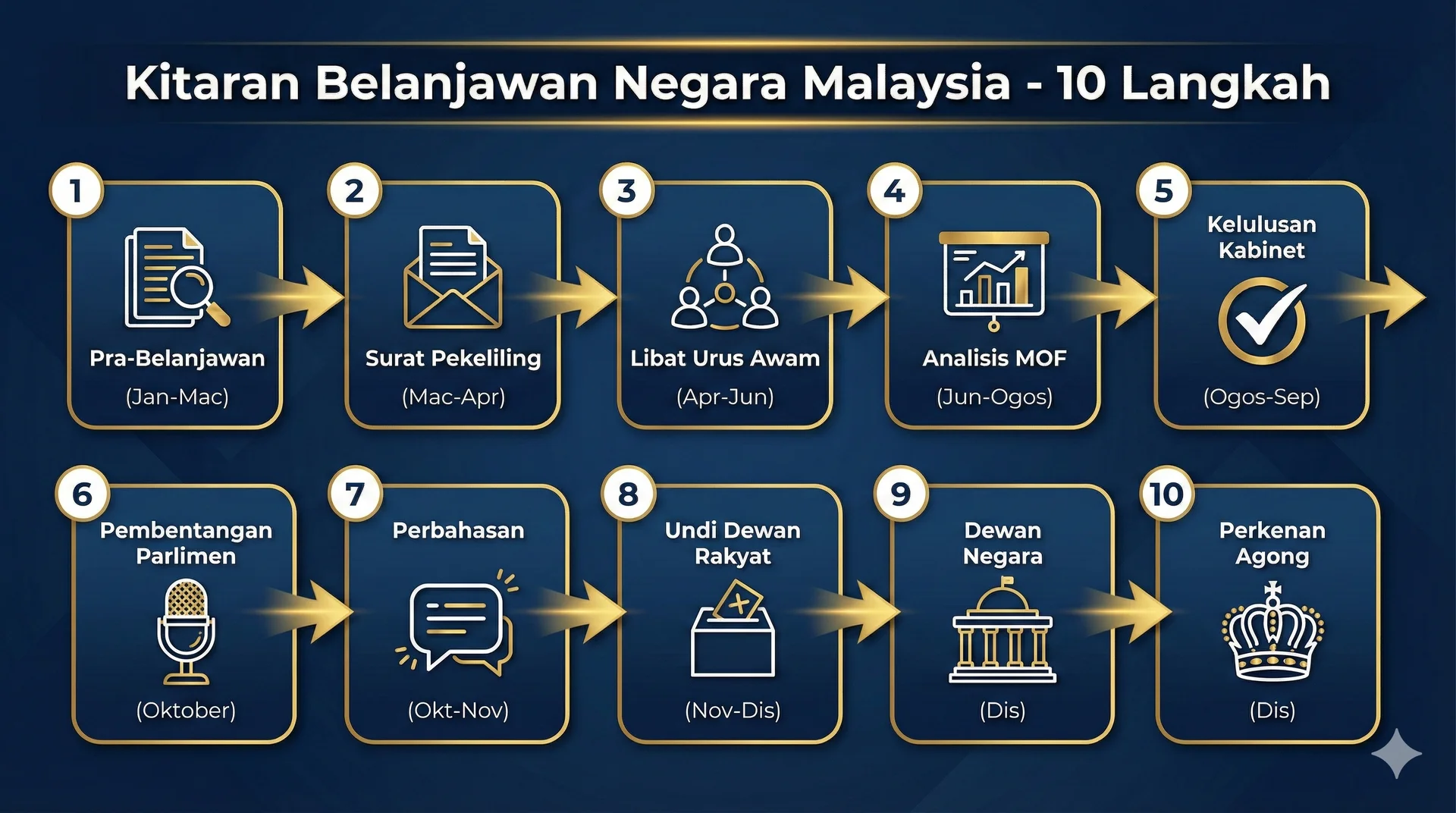
How Is the Budget Made? A Step-by-Step Process
The Malaysian budget preparation process takes approximately 8-10 months before it is tabled in Parliament. Here is the complete cycle:
Step 1: Pre-Budget Statement (January-March)
The Ministry of Finance publishes the Pre-Budget Statement outlining the current economic situation, fiscal challenges, and government priorities for the coming year. This provides early signals to the public and stakeholders about the budget's direction.
Step 2: Treasury Circular Letter (March-April)
MOF issues a circular letter to all ministries and agencies with guidelines and allocation ceiling limits. Each ministry begins preparing its allocation request based on these guidelines.
Step 3: Engagement Sessions & Dialogues (April-June)
The Budget Engagement Sessions are held where various stakeholders - the private sector, academia, NGOs, and civil society - provide input and suggestions. A Budget Proposal Portal is also opened for the public to submit suggestions online.
Step 4: Analysis & Compilation (June-August)
The MOF Budget Division analyses all requests and proposals, aligning them with economic projections and fiscal limits. The draft budget is compiled and refined.
Step 5: Cabinet Approval (August-September)
The final budget draft is presented to the Jemaah Menteri (Cabinet) for approval. The Cabinet may request changes before approving the final version.
Step 6: Tabling in Parliament (October)
The Finance Minister tables the Supply Bill in the Dewan Rakyat. The tabling usually takes place in October, accompanied by a budget speech covering the economic review, fiscal policy, and detailed allocations.
Step 7: Debate in Dewan Rakyat (October-November)
Members of Parliament debate the budget at two levels - the policy stage (general direction) and the committee stage (allocation for each ministry). Every ministry is scrutinised in detail.
Step 8: Voting & Approval in Dewan Rakyat (November-December)
The budget is voted on in the Dewan Rakyat. Budget 2026, for example, received 120 votes in favour versus 67 votes against. Budget approval is also considered a vote of confidence in the government - if the budget is rejected, the government may fall.
Step 9: Approval by Dewan Negara
After the Dewan Rakyat, the budget is brought to the Dewan Negara (Senate) for approval. The Dewan Negara can delay but cannot reject outright.
Step 10: Royal Assent by the Yang di-Pertuan Agong
After being approved by both Houses, the Supply Bill is presented to the Yang di-Pertuan Agong for royal assent. Once assented, it becomes law and the government can begin spending the allocations from 1 January of the following year.
Who Monitors Budget Spending?
Approving the budget is only half the story. Equally important is ensuring money is spent according to its allocation. Here are the key bodies that play a monitoring role:
1. Auditor General
This is the most important monitoring body. The National Audit Department conducts independent audits of all government accounts. The Auditor General's annual report often reveals wastage, leakages, and irregularities - and this report is tabled in Parliament for scrutiny.
2. Public Accounts Committee (PAC)
The PAC is a special parliamentary committee with the power to examine government accounts and the Auditor General's reports. The PAC has been chaired by an opposition Member of Parliament (since 2024) - this is important to ensure effective checks and balances.
3. Accountant General's Department
The Accountant General's Department prepares the Federal Government Financial Statement annually. This statement is then audited by the Auditor General before being tabled in Parliament.
4. Ministry of Finance (MOF)
MOF also acts as an internal monitor, ensuring each ministry spends its allocation according to the original purpose. The eSPKB system (Computerised Accounting System) is used to monitor expenditure flow in real-time.
5. Malaysian Anti-Corruption Commission (MACC)
MACC investigates corruption and misappropriation cases involving government funds. MACC's role is increasingly important in ensuring public expenditure integrity.
Why Is the Budget Important for Investors?
As an investor on Bursa Malaysia, the national budget provides important clues about which sectors will receive government support and which may be affected.
Sector allocations = investment signals
When the government announces large allocations for a particular sector, companies within that sector often benefit. For example, the large infrastructure allocation in Budget 2026 benefits construction and building materials companies listed on Bursa.
Tax changes affect company profits
Announcements of new taxes or changes in tax rates in the budget directly impact companies' net profits. Investors need to evaluate the tax impact on stocks in their portfolio.
Fiscal deficit and market sentiment
The deficit size announced in the budget affects the country's credit rating and foreign investor confidence. A controlled deficit sends a positive signal to the market.
Public assistance and the consumer sector
Cash assistance such as STR and subsidies affect the people's purchasing power, which in turn impacts companies in the consumer and retail sectors.
Frequently Asked Questions (FAQ)
What is the difference between "belanjawan" and "bajet"?
There is no difference - both refer to the same thing. "Belanjawan" is the official term in Malay, while "bajet" is borrowed from the English word "budget" and is more commonly used in everyday conversation.
When is the budget tabled each year?
The budget is usually tabled in Parliament in October each year, although the exact date may vary. The tabling is typically done on a Friday.
Can Parliament reject the budget?
Yes, theoretically. Rejection of the budget is considered a vote of no confidence in the government, which could cause the government to fall and Parliament to be dissolved. This makes the budget vote one of the most critical votes in Parliament.
What happens if the budget is not approved before year-end?
The government can request Parliament to approve an "interim budget" that allows basic expenditure to continue until the full budget is approved. This is provided for under Article 102 of the Federal Constitution.
Can the government spend beyond the budget allocation?
Yes, through supplementary allocations that must be approved by Parliament. This commonly occurs during emergencies such as the COVID-19 pandemic, when the government requires additional unforeseen funds.
Who can provide suggestions for the budget?
Anyone. The Ministry of Finance opens a Budget Proposal Portal every year where citizens, businesses, and organisations can submit their suggestions online. This is part of the increasingly transparent public engagement process.
How does the state budget differ from the federal budget?
The federal budget covers nationwide expenditure and is tabled in Parliament. State budgets are prepared by their respective state governments and tabled in the State Legislative Assembly (DUN). Both are separate processes.
What is the role of the Fiscal Responsibility Act (FRA) in the budget process?
The FRA 2023 sets legal limits on the fiscal deficit and government debt. This means the budget process must now comply with stricter guidelines, including maintaining the deficit below certain levels and improving fiscal reporting transparency.
Conclusion
The national budget is not just numbers on paper - it is the country's economic action plan that affects the life of every Malaysian. From daily goods prices to stock market performance, the budget's impact is felt widely. By understanding how it is made, approved, and monitored, you become a more informed citizen and investor.
Understanding macroeconomics like the national budget process is an essential foundation for making wise investment decisions. If you are interested in starting to invest, the first step is to open a trading account.
Open a CDS trading account to start investing on Bursa Malaysia through our CDS account opening guide.
Download our free Stock Market Basics Ebook to understand investment fundamentals before getting started.