Malaysia's Oil Industry: From the First Well in Miri to PETRONAS Upstream and Downstream Operations

Malaysia is not just an oil-importing nation - it is a significant oil and gas producer in the Southeast Asian region. The country's petroleum industry has a history spanning over 100 years, from a small well in Sarawak to becoming a global LNG powerhouse. This article traces the full journey of Malaysia's oil industry - how oil forms geologically, its discovery history, and PETRONAS operations from upstream to downstream.
History of Oil Discovery in Malaysia
Malaysia's oil story began in 1910, when Shell (Royal Dutch Shell) discovered crude oil in Miri, Sarawak. In 1914, the first commercial oil well known as the "Grand Old Lady" at Bukit Tengah began operations. This well is now a protected historical landmark.
Throughout the colonial era, foreign companies - primarily Shell - completely dominated oil exploration and production in Malaya, Sabah, and Sarawak. Malaysia at that time only received small royalties without any control over its own natural resources.
The Birth of PETRONAS (1974)
The biggest turning point came in 1974. Under the leadership of Malaysia's 2nd Prime Minister, Tun Abdul Razak, the government passed the Petroleum Development Act 1974 and established Petroliam Nasional Berhad (PETRONAS).
This act gave PETRONAS exclusive rights over all petroleum resources in Malaysia. Foreign companies could still operate, but only through Production Sharing Contracts (PSC) with PETRONAS. This move transformed the national oil industry landscape - from foreign-controlled to self-governed.
How Oil Forms in Malaysia
To understand the oil industry, we need to know how oil forms underground. This process takes tens to hundreds of millions of years.
Raw Materials - Ancient Organisms
Millions of years ago, the shallow seas around Sundaland (the ancient landmass of Southeast Asia) were filled with plankton, algae, and microscopic marine organisms. When these organisms died, their remains sank to the seabed and were buried by layers of mud and sand (sediments).
The Catagenesis Process
Layer upon layer of sediment buried this organic material over millions of years. The deeper it was buried, the more pressure and temperature increased. The organic material transformed into kerogen - a carbon-rich solid material.
At depths of approximately 2-4 kilometres and temperatures of 60-120 degrees Celsius, kerogen "cooks" and transforms into crude oil. At temperatures exceeding 120 degrees Celsius, it transforms into natural gas. This process is known as catagenesis.
Petroleum System - Three Essential Requirements
Oil that forms does not stay in one place. It migrates upward through rock fractures until trapped in specific geological structures. Three essential requirements for oil accumulation:
- Source rock - organic-rich rock where oil originally forms
- Reservoir rock - porous rock like sandstone that stores oil like a sponge
- Cap rock (seal) - impermeable layer such as mudstone or shale that traps oil from reaching the surface
Why Is Malaysia Rich in Oil?
Malaysia sits atop several major sedimentary basins formed by tectonic movements millions of years ago. According to the Malaysian Investment Development Authority (MIDA), the oil and gas sector remains one of the country's major economic contributors.
Major Sedimentary Basins
Peninsular Malaysia:
- Malay Basin - the largest and most productive basin
- Penyu Basin
Sabah and Sarawak:
- Sarawak Basin
- Sabah Basin
- Baram Delta Basin
Unique Geological Factors
Three key factors make Malaysia rich in oil:
- Sundaland - Malaysia sits on a shallow and stable continental shelf, ideal for thick sediment accumulation
- Ancient shallow seas - this area was once a shallow sea rich with marine life, producing abundant organic material
- Tectonic activity - earth crust movements created traps that prevented oil from reaching the surface
PETRONAS Operations: Upstream Sector
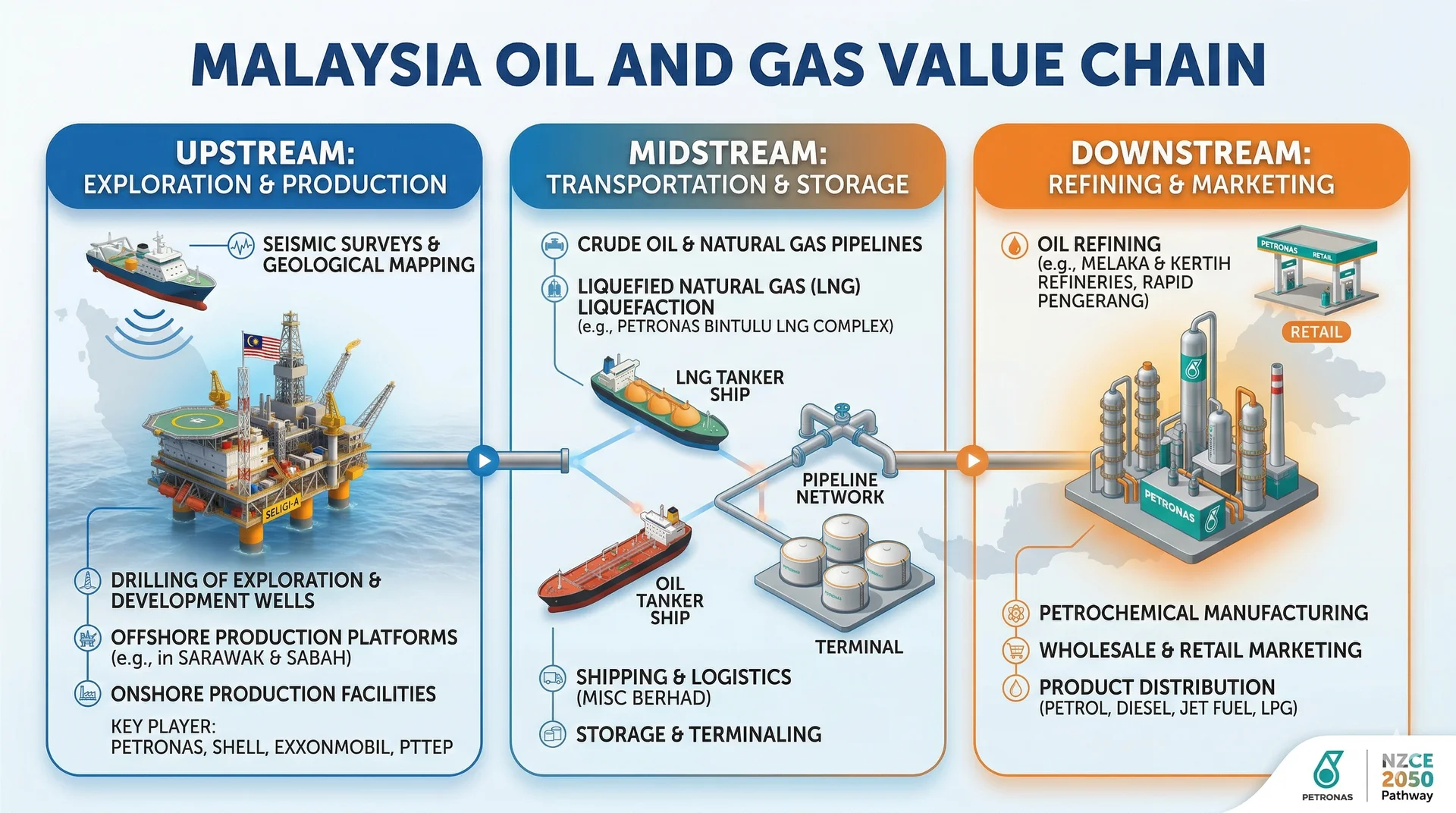
The upstream sector encompasses all activities related to finding and extracting crude oil and gas from underground. This is the riskiest phase requiring the largest investment.
Exploration Phase
PETRONAS uses advanced technology to detect the presence of oil underground:
- Seismic surveys - specialised ships fire sound waves at the seabed. The reflected waves are analysed to identify subsurface rock structures
- 3D data processing - seismic data is processed using powerful computers to build three-dimensional subsurface maps
- Exploration drilling - if potential is detected, exploration wells are drilled to confirm the presence of oil
The success rate in oil exploration is typically only 1 in 5 to 10 wells. This means PETRONAS needs to invest billions of ringgit before finding a single commercially viable oil field.
Development Phase
After confirming profitable reserves, PETRONAS builds production infrastructure:
- Oil platforms - steel structures installed on the seabed
- FPSO (Floating Production Storage & Offloading) - large vessels that float, process, and store oil in the open sea
- Subsea pipelines - transporting oil and gas from platforms to shore
Production Phase
In this phase, oil and gas are pumped up from depths of 1 to 5 kilometres. At the platform, crude oil is separated from gas, water, and sand before being transported to shore via pipelines or tankers.
According to The Energy Year, Malaysia produces approximately 550,000 to 600,000 barrels of crude oil daily, making it one of the largest producers in Southeast Asia.
PETRONAS Operations: Midstream Sector
The midstream sector connects production to processing. It involves the transportation and storage of oil and gas.
Pipelines and Transportation
- Peninsular Gas Utilisation (PGU) - the main gas pipeline system across Peninsular Malaysia
- Oil tankers - large ships transporting crude oil from platforms to refineries
- Storage terminals - Kertih (Terengganu) and Bintulu (Sarawak) are among the main terminals
LNG - Malaysia's Key Strength
Natural gas is cooled to minus 162 degrees Celsius to become liquid (Liquefied Natural Gas or LNG) at PETRONAS LNG Complex, Bintulu. This complex is among the largest LNG facilities in the world.
Malaysia is currently one of the world's top five LNG exporters, with production capacity exceeding 30 million tonnes per year.
PETRONAS Operations: Downstream Sector
The downstream sector is where crude oil and gas are processed into end products we use every day.
Refineries
PETRONAS operates several major refineries:
- PETRONAS Refinery Melaka 1 and 2 - combined capacity of approximately 270,000 barrels per day
- Pengerang Integrated Complex (PIC/RAPID) in Johor - capacity of approximately 300,000 barrels per day, one of the largest refineries in Southeast Asia
At the refinery, crude oil is heated to 350-400 degrees Celsius in a distillation column. This process separates crude oil into different products based on boiling points:
- Gas (LPG, butane) - lightest, rises to the top of the column
- Naphtha - raw material for the petrochemical industry
- Petrol (RON95, RON97) - vehicle fuel
- Jet fuel (avtur) - aircraft fuel
- Diesel - heavy vehicle fuel
- Fuel oil - heaviest, at the bottom of the column
Petrochemicals
Naphtha and gas are further processed into basic chemicals such as ethylene, propylene, and polymers. These chemicals become raw materials for producing plastics, synthetic rubber, fertiliser, paint, and textiles.
PETRONAS Chemicals Group (PCG) is among the largest petrochemical producers in Southeast Asia, with operations in several countries.
Retail and Marketing
The closest part to consumers is PETRONAS petrol stations. With over 1,000 stations across Malaysia, PETRONAS Dagangan Berhad manages the retail sale of products including RON95, RON97, diesel, Petronas Primax, and Petronas Syntium lubricants.
Key Facts and Figures of Malaysia's Oil Industry
Here are some important data points about the national oil and gas industry:
- Daily production: approximately 550,000-600,000 barrels of crude oil
- LNG: Malaysia among the world's top 5 LNG exporters
- Proven reserves: approximately 2.7 billion barrels (oil) and approximately 80 trillion cubic feet (gas)
- Government revenue contribution: oil and gas sector contributes approximately 20% of federal government revenue
- Workforce: over 300,000 workers in the oil and gas industry
- International operations: PETRONAS operates in over 40 countries
The Future of Malaysia's Oil Industry
Malaysia's oil and gas industry is undergoing a major transformation. Key challenges and opportunities include:
Challenges
- Declining reserves - existing oil fields are maturing, production costs increasing
- Global energy transition - international pressure to reduce fossil fuel dependency
- Price volatility - fluctuating global oil prices affect national revenue
Opportunities and Initiatives
- GENTARI - PETRONAS subsidiary established specifically for clean energy, including solar, hydrogen, and carbon capture and storage (CCS)
- Enhanced Oil Recovery (EOR) - technology to extract remaining oil from mature fields
- Digitalisation - use of AI, IoT, and data analytics in upstream operations to improve efficiency
- PETRONAS Activity Outlook (PAO) - annual guide serving as a benchmark for vendors and contractors in the industry
Oil Royalty Issues
Oil royalties remain an important political topic in Malaysia. Oil-producing states such as Sabah, Sarawak, Terengganu, and Kelantan continue to demand a larger share of petroleum revenue. Discussions on the distribution of oil revenue between the federal and state governments are expected to continue.
Frequently Asked Questions (FAQ)
What is PETRONAS and who owns it?
PETRONAS (Petroliam Nasional Berhad) is Malaysia's national oil and gas company established in 1974. It is wholly owned by the Malaysian Government and has exclusive rights over all petroleum resources in the country.
How long can Malaysia's oil last?
Based on current proven reserves and production rates, Malaysia's oil reserves are estimated to last approximately 15-20 more years. However, new field discoveries and EOR technology could extend this period.
Where are Malaysia's main oil production locations?
Main production is concentrated in offshore waters - the Malay Basin off Peninsular Malaysia (Terengganu), the Sarawak and Baram Delta Basins off Sarawak, and the Sabah Basin off Sabah.
What is the difference between crude oil and natural gas?
Both originate from the same organic material but form at different temperatures. Crude oil forms at 60-120 degrees Celsius while natural gas forms above 120 degrees Celsius. Crude oil is a liquid processed into petrol and diesel, while natural gas is used for electricity generation and exported as LNG.
What is an FPSO and how does it work?
FPSO (Floating Production Storage and Offloading) is a large vessel that functions as a floating refinery at sea. It receives crude oil from subsea wells, processes it onboard, stores the processed oil, and transfers it to tankers for delivery to onshore refineries.
Why are petrol prices in Malaysia government-controlled?
The Malaysian government controls petrol prices through subsidies and the Automatic Pricing Mechanism (APM) to protect the people's purchasing power. RON95 is subsidised, while RON97 follows market prices. Petrol subsidies are among the government's largest expenditures.
What is GENTARI's role in Malaysia's energy future?
GENTARI is a PETRONAS subsidiary established to lead the transition to clean energy. Its main focus is solar energy, clean hydrogen, and carbon capture and storage (CCS) technology. GENTARI represents PETRONAS' commitment to balancing current energy needs with environmental sustainability.
Can Malaysia become a major world oil producer?
Malaysia is not a major world oil producer in terms of volume (compared to Saudi Arabia or Russia), but it is important regionally. Malaysia's real strength lies in the natural gas and LNG sector, where it is one of the largest global players.
Conclusion
Malaysia's oil and gas industry has a rich history - from the first well in Miri in 1910 to becoming a global LNG powerhouse today. Although oil reserves are declining, transformation through GENTARI and new technologies provides hope for the nation's energy future.
For investors interested in Malaysia's oil and gas sector, understanding the value chain from upstream to downstream is essential for evaluating related companies on Bursa Malaysia.
Open a CDS trading account to invest in oil and gas stocks on Bursa Malaysia as well as international stocks in the US and Hong Kong markets through this link.
Download the free Stock Market Basics ebook to understand how to evaluate companies before investing through this link.