Overvalued Stocks and How to Identify Them

An overvalued stock is a share that has a price higher and more expensive compared to its actual value. Purchasing overvalued stocks at a high price is either unprofitable or yields only small returns.
However, an overvalued stock does not necessarily mean it is a stock without potential.
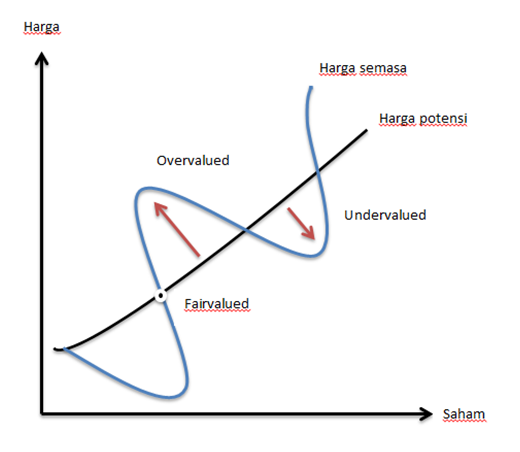
Based on the diagram above, we can conclude that if the current price is higher than the potential price, then the stock is overvalued and expensive.
If the current price is lower than the potential price, then the stock is undervalued and cheap.
If the current price equals the potential price, then the stock is fair valued.
How to Identify

To identify whether a stock is overvalued, undervalued or fair valued, you can perform a valuation.
Namely:
- Absolute valuation
- Discounted cash flow
- Relative valuation
PE Multiples / PE Ratio
The PE ratio value represents the expected future stock price.
Formula PE ratio = market price per share / earnings per share
Earnings Per Share (EPS)
To calculate the expected PE ratio value, the Earnings Per Share (EPS) is taken into account. For example, over the past 5 years, the EPS has increased by 2%. This EPS value is the average EPS calculation and can be seen on the CAGR.
Therefore, stock price comparison can be done by looking at the expected future stock price based on the PE ratio calculation.
If the current price is more expensive compared to the future price, then the stock is overvalued.
Using Ratio Analysis
- PB ratio
- The ratio of price to Net Tangible Asset per share
- If the PB ratio value > 1, then the stock is overvalued
- PE ratio
- Formula PE ratio = (price of 1 unit share / earnings of 1 unit share)
- If the PE ratio value > 15, the stock can be considered overvalued, though this depends on the sector
- Weakness: lagging occurs
- Advantage: The lower the stock price, the better the PE ratio reading
Frequently Asked Questions (FAQ)
1. What is an overvalued stock?
An overvalued stock is a share whose market price is higher than the company's actual or intrinsic value. This means investors are paying more than what they should based on the company's financial performance.
2. How do you identify an overvalued stock?
You can use the PE ratio (if it exceeds 15 depending on the sector) and PB ratio (if it exceeds 1) to identify overvalued stocks. Comparing the current price with the future price also helps.
3. Does an overvalued stock mean the company is not good?
Not necessarily. An overvalued stock may reflect high growth expectations from investors. However, buying at an overvalued price increases the risk of losses if the price drops to its actual value.
4. What are the risks of buying overvalued stocks?
The main risk is the potential for losses when the stock price drops to its actual intrinsic value. Returns are also smaller because the purchase price is already high compared to the company's actual value.
Want to start investing more wisely? Open a CDS account with Mahersaham today for access to a comprehensive investment platform. Also download our free stock ebook to learn the basics of stock investing.