Qurban (Sacrifice): Procedure, Required Quantity for One Family & Virtues According to Sunnah

Every year, when 10-13 Dzulhijjah arrives, Muslims worldwide perform the qurban (sacrifice) ritual, following the Sunnah of Prophet Ibrahim AS and Prophet Muhammad SAW. But many Muslim Malaysian investors and families remain confused about basic matters: Is qurban obligatory or recommended? How many qurban portions are sufficient for one family? What is the ruling on sharing a cow among 7 people? How should the meat be distributed according to Shariah?
This article is written from a Muslim economist perspective - we unpack not just the evidence from Al-Quran and authentic hadith for qurban, but also the economic dimensions of this worship: how qurban functions as a wealth redistribution mechanism, the actual costs in Malaysia, and financial planning strategies to prepare for this ritual without straining family finances.
In this article, we cover: - Al-Quran & authentic hadith evidence encouraging qurban - Ruling on qurban according to the Shafi'i school (official Malaysian position) - Conditions of sacrificial animals - age, types, soundness - Quantity of qurban sufficient for one family (explanation of often-misunderstood hadith) - Slaughter procedures and meat distribution according to Sunnah - Virtues and rewards of qurban in the sight of Allah SWT - Economic aspects of qurban - costs in Malaysia, financial planning, institutional qurban
Al-Quran Evidence: Encouragement to Sacrifice
Allah SWT directly commands us to sacrifice in Surah Al-Kauthar (108:2):
"So pray to your Lord and sacrifice (your sacrificial animal)."
This is a clear and direct command to Prophet Muhammad SAW and his Ummah. Scholars cite this verse as the primary evidence for the legislation of qurban.
Allah also says in Surah Al-Hajj (22:36-37):
"And the sacrificial camels - We have made them for you as among the symbols of Allah, in which there is much good... Neither their flesh nor their blood will ever reach Allah, but what reaches Him is your piety."
This verse teaches that the purpose of qurban is not the meat or blood - but piety and sincerity to Allah SWT. The meat and blood are mere symbols; the true value is intention and obedience.
Authentic Hadith: Strong Encouragement to Sacrifice
Several authentic hadiths strongly encourage this worship.
First Hadith: Warning for Those Who Are Able But Don't Sacrifice
"Whoever can afford to sacrifice but does not, let him not come near our prayer place."
(Reported by Ibn Majah and Ahmad - with some disagreement on the hadith's grading)
This hadith shows the importance of qurban for those who are able. While there is scholarly disagreement on its grading, it forms the basis of the Hanafi school's opinion that qurban is obligatory for those who can afford it.
Second Hadith: Virtues of Qurban on Eid al-Adha
"There is no deed performed by the son of Adam on the day of Nahr (Eid al-Adha) more beloved to Allah than shedding the blood (of a sacrificial animal). Indeed, it will come on the Day of Judgment with its horns, hair, and hooves, and indeed the blood will reach Allah's pleasure before it falls to the ground."
(Reported by At-Tirmidhi, Ibn Majah - see Irsyad Al-Hadith Mufti Wilayah Series 211)
This hadith provides strong evidence that qurban is the deed most beloved to Allah on the day of Eid al-Adha - surpassing other forms of charity on that day.
Third Hadith: Quantity of Qurban for the Family
It is narrated from Ata' ibn Yasar that he asked Abu Ayyub al-Ansari RA about qurban during the time of the Prophet SAW. Abu Ayyub answered:
"During the time of Allah's Messenger SAW, a man would sacrifice a single sheep for himself and his family members. They would eat and feed others."
(Reported by At-Tirmidhi and Ibn Majah - hasan sahih hadith)
This is the primary evidence that allows one sheep for an entire family - we will elaborate in the "Quantity of Qurban for One Family" section.
Ruling on Qurban According to the Shafi'i School
The Shafi'i school - the official school in Malaysia - rules qurban as Sunnah Mu'akkadah (strongly recommended sunnah). This means:
- Not obligatory - no sin for not performing
- Strongly recommended - whoever is able but doesn't sacrifice is considered makruh (disliked)
- Great reward - those who sacrifice receive significant rewards
According to the Federal Territories Mufti Department, the ruling on qurban is:
"Sunnah mu'akkadah. If one has excess wealth above the needs of oneself and dependents during the day and night of Eid al-Adha and Tashreeq days, but does not perform qurban, then it is makruh."
Difference with the Hanafi School
The Hanafi school (following Imam Abu Hanifa) rules qurban as obligatory for Muslims who: 1. Are resident (not traveling) 2. Are able (own the nisab like zakat) 3. Are sane and have reached puberty
For Malaysian Muslim investors, following the Shafi'i school (Sunnah Mu'akkadah) is the official position - but don't miss the great reward opportunity if you are able.
Conditions of Sacrificial Animals
According to official guidelines from State Mufti Departments, several animal conditions must be met:
Valid Animal Types
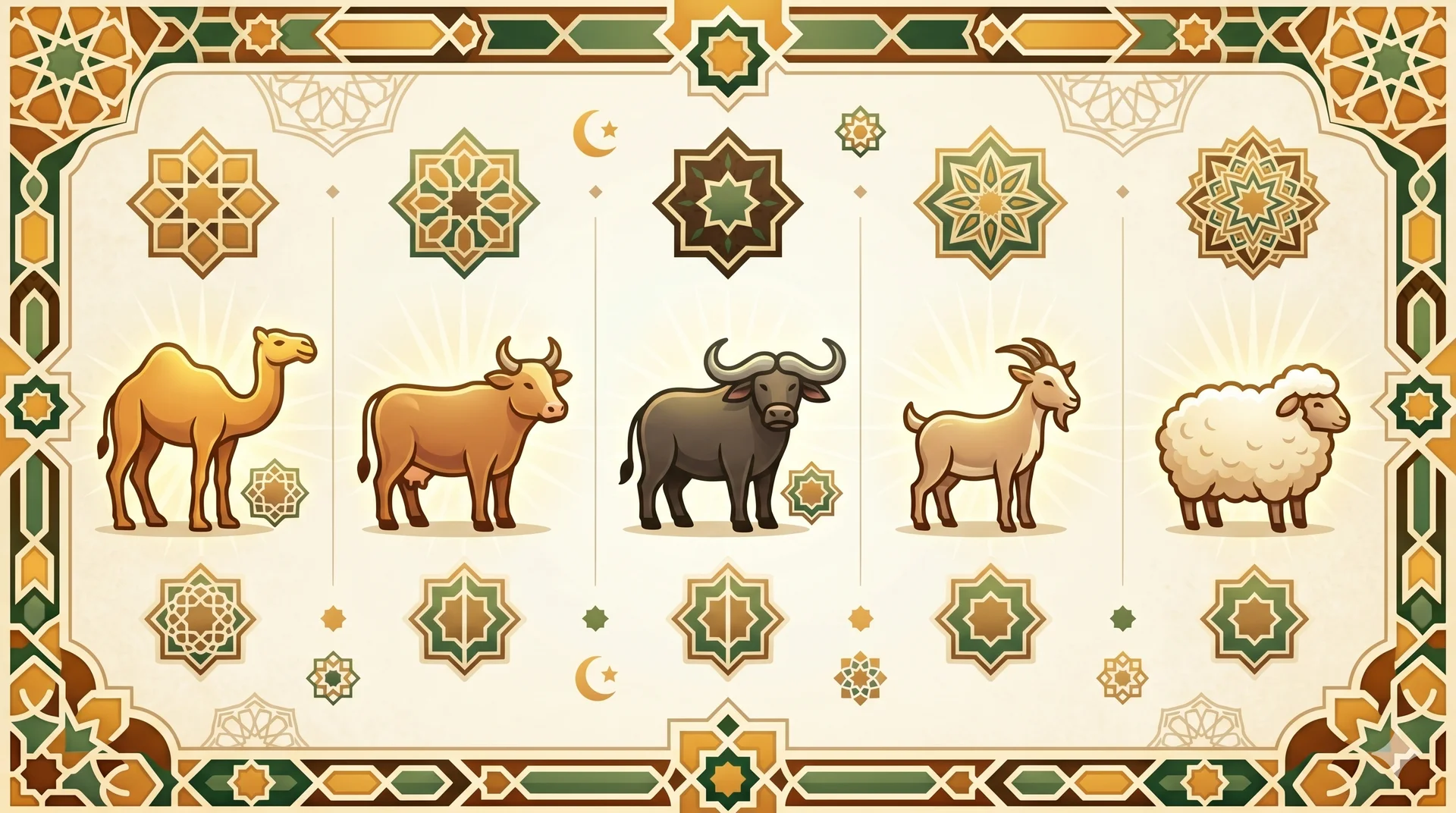
Only 5 types of livestock are valid for qurban: 1. Camel (al-ibil) 2. Cow (al-baqar) 3. Water buffalo (al-jamus) 4. Goat (al-ma'iz) 5. Sheep (al-dha'n)
Other animals such as chickens, ducks, fish, horses, or rabbits are NOT VALID for qurban even if slaughtered on Eid al-Adha. They can only be considered ordinary charity.
Minimum Age for Sacrificial Animals
| Animal Type | Minimum Age |
|---|---|
| Camel | 5 years and above |
| Cow | 2 years and above |
| Water buffalo | 2 years and above |
| Goat | 2 years and above (or 1 year for certain goat breeds) |
| Sheep | 1 year and above |
Physical Soundness
The animal must be physically sound - free from obvious defects: - Not blind in one or both eyes - Not obviously lame - Not so thin that bone marrow is gone - Not having ears or tails severely cut - Not obviously sick
Minor defects such as slight hair loss or broken hooves do not invalidate the qurban.
Quantity of Qurban for One Family
This is the most frequently asked question - and the most often misunderstood. Let us clarify:
Basic Rules:
| Animal Type | Number of Portions | For How Many People/Families |
|---|---|---|
| Goat / Sheep | 1 portion (1 animal) | 1 person + dependent family members |
| Cow / Buffalo | 7 portions (1 animal) | Can be shared among 7 people (1 portion each) |
| Camel | 7 portions (1 animal) | Can be shared among 7 people (1 portion each) |
Sheep for One Family - Hadith Explanation
Based on the hadith of Abu Ayyub al-Ansari RA, a man during the Prophet's SAW time sacrificed one sheep for himself and all his family members. The reward of qurban is shared by all family members under his financial dependency - wife, children, dependent parents, and others under his financial care.
Important: According to Mufti Wilayah Persekutuan, one sheep CANNOT be divided among several separate families. But it can be for one family regardless of how many members it has.
Cow Divided into 7 - Hadith Explanation
Sayyidina Jabir RA narrated:
"We performed qurban with the Prophet SAW in the year of Hudaybiyyah, a camel for seven (people) and a cow for seven (people)."
(Reported by Muslim)
Meaning: one cow can be shared among 7 different people - each takes 1 portion (1/7), and each portion can be intended for self + dependent family members.
Practical example: - Family A buys 1 portion of cow (cost RM2,800) → intention for Mr. Ahmad + wife + 3 children (5 people) - Family B buys 1 portion of the same cow → intention for Mr. Halim + wife + 2 children (4 people) - Up to 7 different families can share 1 cow
Common Misconceptions
❌ Wrong: "I need to do 5 portions of qurban because my family has 5 people" ✅ Right: 1 sheep or 1 portion of cow is sufficient for the entire dependent family
❌ Wrong: "1 sheep can be shared between 2-3 families" ✅ Right: 1 sheep is only for 1 family
❌ Wrong: "Adult children working still count under father's qurban" ✅ Right: Children who are independent and have own family should perform their own qurban
Slaughter Procedure & Meat Distribution
Timing of Qurban
Qurban is only valid within the 10-13 Dzulhijjah period in this order: - 10 Dzulhijjah (Eid al-Adha): after the Eid prayer until before maghrib - 11, 12, 13 Dzulhijjah (Tashreeq days): before maghrib on 13 Dzulhijjah
Qurban outside this period = INVALID as qurban (counted only as ordinary charity).
Slaughter Etiquette
- Intention before slaughter - verbalize in heart or with tongue
- Face the animal toward the qibla
- Recite Bismillah and Allahu Akbar during slaughter
- Slaughter quickly and skillfully - avoid animal suffering
- Sharp knife - ensure throat artery, esophagus, and blood vessels are severed
- No torture - other animals should not see the animal being slaughtered
Meat Distribution
According to official meat distribution guidelines, the general formula:
Recommended Distribution (1/3 - 1/3 - 1/3): - 1/3 for self & family (the one sacrificing and household members) - 1/3 as charity to the poor and needy - 1/3 as gift to relatives, neighbors, friends
Obligatory Distribution (Nazar Qurban): If the qurban is a vow, then all the meat MUST be given as charity to the poor - the household CANNOT eat even a little.
Distribution for Ordinary Sunnah Qurban: - May take 1/3 or more for self - Recommended to give at least a little as charity to the poor - May gift to relatives and neighbors even if they are wealthy
Virtues & Excellence of Qurban Worship
Several qurban virtues mentioned in hadiths and sayings of companions:
1. The Deed Most Beloved to Allah on Eid al-Adha
As in the hadith above - no other deed on Eid al-Adha is more beloved to Allah than shedding the blood of the sacrificial animal.
2. Reward for Every Hair of the Animal
It is narrated from Aishah RA, the Prophet SAW said:
"No human performs a deed on the day of Nahr (Eid al-Adha) more beloved to Allah than spilling the blood of a sacrificial animal. Indeed, the animal's blood will come on the Day of Judgment with its horns, hair, and hooves. Indeed, the blood will fall in a place beside Allah Ta'ala before falling to the ground."
(Reported by At-Tirmidhi)
Scholars interpret: each hair, horn, and hoof of the sacrificial animal will become witnesses of goodness on the Day of Judgment for the one who sacrificed.
3. Following the Sunnah of Prophet Ibrahim AS
Qurban is a continuation of the Sunnah of Prophet Ibrahim AS who was willing to sacrifice his son Prophet Ismail AS upon Allah's command. Allah replaced with a sheep (Surah As-Saffat 37:107).
Each time we sacrifice, we remember this great sacrifice and renew our taqwa to Allah.
4. Provisions for the Hereafter
Some scholars say the sacrificial animal will become a mount on the Day of Judgment - helping its owner cross the sirat. While the hadith on this is disputed in grading, the spiritual meaning remains strong - sincere deeds will be blessed by Allah.
5. Social Concern
Qurban is a natural wealth redistribution mechanism - meat is distributed to the poor who may not be able to eat meat throughout the year. This is one of the social economic dimensions of this worship.
Economic Aspects of Qurban in Malaysia
As a Muslim economist, let us view this worship through an economic lens.
Qurban Costs in Malaysia (2026 Estimates)
| Portion Type | Estimated Cost |
|---|---|
| 1 goat / sheep | RM800 - RM1,800 |
| 1 portion (1/7) of cow | RM800 - RM1,500 |
| 1 whole cow | RM5,000 - RM10,500 |
| 1 portion (1/7) of camel | RM2,500 - RM4,000 (if imported) |
Costs vary by: - Location (Selangor/KL usually more expensive than Kelantan/Pahang) - Type of slaughter (in Malaysia vs abroad) - Size and quality of animal - Financial year (food inflation)
Qurban Abroad (Wakalah)
Many organizations such as Muslim Aid Malaysia, MyCare, Yayasan Mendaki, Aman Palestin, and mosques offer qurban wakalah abroad - usually in Palestine, Yemen, Bangladesh, Indonesia, or Cambodia. Costs are lower (RM400-700 per goat) and meat is distributed to communities that need it more.
Shariah aspect: qurban abroad is valid according to the majority of scholars, but you cannot consume your own qurban meat.
Financial Planning for Qurban
As a Muslim investor, consider:
-
Set aside annual qurban funds: save RM100-150 monthly to collect RM1,200-1,800 by Eid al-Adha. Same approach as setting aside for zakat.
-
Institutional vs individual qurban: compare costs - sometimes sharing a cow with 6 others is more economical than buying your own goat.
-
Ruling on debt for qurban: According to Mufti Wilayah Series 77, debt for qurban is permissible with conditions:
- Able to repay within a reasonable period
- Debt does not burden the family
-
Not encouraged to take large debt for qurban - better to wait until able
-
Qurban is not zakat: don't confuse them. Zakat is obligatory for those reaching nisab. Qurban is sunnah mu'akkadah. Both are separate and both should be fulfilled if able.
Qurban as Wealth Redistribution Tool
Qurban has a significant redistributive function in the Muslim economy:
- Those who are able spend RM1,000-3,000 on qurban
- Meat is distributed to the poor and community
- Local livestock industry receives high demand during the Eid al-Adha season
- Economic multiplier effect: farmers, workers, transport, butchers, distribution sources
This is the model of circular economy based on worship - different from typical stock investment models, but equally productive in circulating wealth in society.
FAQ: Common Questions About Qurban
1. Am I obligated to sacrifice?
According to the Shafi'i school (official Malaysian position), qurban is Sunnah Mu'akkadah - not obligatory but strongly recommended. If you are able but don't sacrifice, it is makruh. The Hanafi school makes it obligatory for those who are able and resident.
2. When is the valid time for qurban?
The valid time is after the Eid al-Adha prayer on 10 Dzulhijjah until before maghrib on 13 Dzulhijjah. Qurban before the Eid prayer or after maghrib on 13 Dzulhijjah is NOT VALID.
3. Can working children still be included in father's qurban?
Yes, but it is more recommended that children who are independent and able sacrifice on their own. Father's qurban technically covers family members under his financial dependency.
4. Can I eat my own qurban meat?
Yes for sunnah qurban. The household is recommended to take some meat (at least a little). For nazar qurban, all meat MUST be given fully to the poor.
5. What is the difference between qurban and aqiqah?
- Qurban: on Eid al-Adha (10-13 Dzulhijjah), sunnah mu'akkadah, following the sunnah of Ibrahim AS
- Aqiqah: for a newborn child (sunnah on the 7th day), tahnik for baby, as gratitude for birth
Both are separate and different in purpose. A goat used for aqiqah cannot be shared for qurban.
6. I can't afford it. Am I sinful if I don't sacrifice?
No. Sunnah mu'akkadah means no sin for not doing it. What is sinful or makruh is for those who ARE ABLE but don't sacrifice. If you struggle, better to: - Help the community in other ways (charity, food, time) - Intend to sacrifice next year when finances stabilize - Don't take large debt for qurban that burdens the family
7. Can I sacrifice for someone who has passed away?
Yes and it is a good practice. It is considered sadaqah jariyah for the deceased. But ensure your intention is clear and follow the valid conditions of qurban.
8. What's the difference between qurban in Malaysia vs abroad (wakalah)?
In Malaysia: you can take meat for self and family, witness the slaughter, support the local livestock industry. Abroad: lower costs, meat distributed to communities in extreme need (Palestine, Yemen, Bangladesh), you cannot take meat yourself.
Both are valid from a Shariah perspective. The choice depends on your goal - physical involvement or maximum social impact.
Conclusion
Qurban is a highly esteemed Sunnah Mu'akkadah in Islam, following the footsteps of Prophet Ibrahim AS and praised by Prophet Muhammad SAW. The quantity of qurban sufficient for one family is one goat/sheep or one portion (1/7) of cow/camel - with reward shared among the entire family under the dependency of the family head. For Muslim Malaysian investors, financial planning for annual qurban (RM800-RM3,000) is a discipline of faith and finance worth practicing.
Before making any financial decisions for qurban worship or broader Islamic financial planning, understand the basics of Shariah-compliant investing to build halal wealth.
To start investing in Bursa Malaysia with Shariah-compliant stocks and overseas markets like the US and Hong Kong, you need a CDS account - register your CDS account with Mahersaham here.
For stock investing fundamentals on Shariah-compliant investing and strategies to build halal wealth for ibadah preparation like qurban and hajj, get our free stock investing fundamentals ebook.
Further Reading
- Defensive vs Growth Stocks: Why a Smart Portfolio Needs Both - Long-term investment strategy for worship financial preparation
- ROE vs ROA vs ROIC: 3 Real KPIs Expert Investors Track - Select quality Shariah-compliant companies
- EV/EBITDA: The Valuation Metric for High-Debt Companies - Valuation with Shariah threshold awareness
- How to Read a Bursa Malaysia Annual Report Without Getting a Headache - Essential Muslim investor skill