Stock Investor Tax in Malaysia: LHDN, Dividend Tax & Capital Gains Explained

"I bought stocks on Bursa and made a profit. Do I need to pay tax?" This is one of the most common questions asked by Malaysian retail investors, and the answer depends entirely on the type of profit you earned and your investment activity profile.
Malaysia's tax system for stock investors is quite unique compared to countries like the United States (where everything is taxed) or Singapore (which has no capital gains tax). Malaysia has a single-tier dividend system since 2008, no Capital Gains Tax (CGT) on listed shares, and recently introduced a 2% dividend tax on dividend income exceeding RM100,000 annually, effective from Year of Assessment 2025.
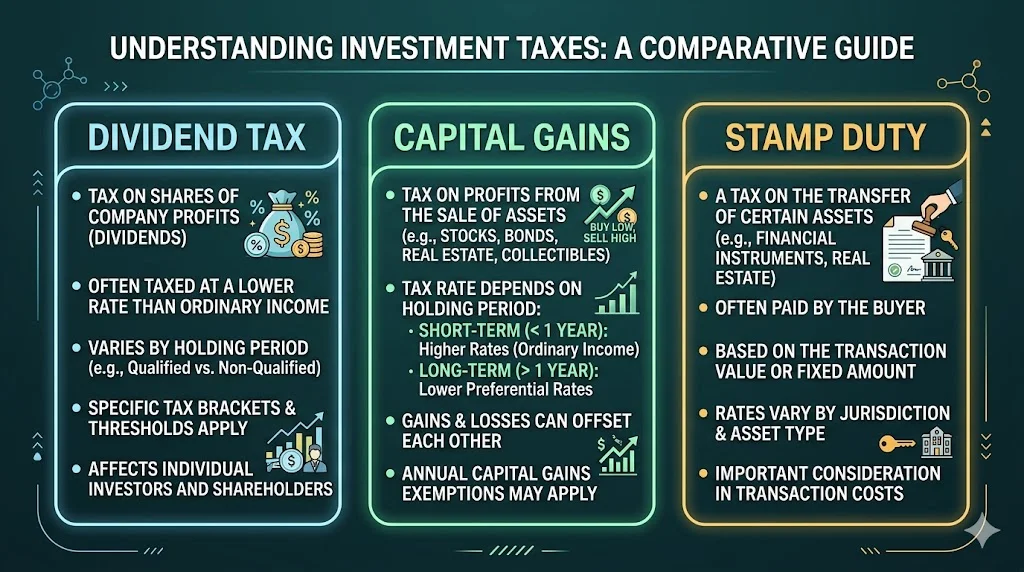
In this article, we unpack:
- Dividend tax - when it's exempt, when the 2% applies, and how ASB is treated
- Capital Gains Tax (CGT) - why Bursa stocks are exempt but unlisted shares are taxed
- Stamp duty - the official transaction cost on every buy/sell
- Badges of trade - when LHDN classifies you as a trader (not an investor)
- Tax on foreign stocks - US, Hong Kong, and overseas dividends
- Practical scenarios - how to declare in LHDN e-Filing
- Tax strategies for Bursa Malaysia retail investors
Single-Tier System: The Foundation of Malaysian Dividend Tax
Before 2008, Malaysia used an imputation tax system where dividends were taxed at the individual level, with tax credits from the paying company. This system was abolished and replaced with the single-tier system effective 1 January 2008.
Under the single-tier system:
- The company pays corporate tax (24% standard rate) on its profits
- Shareholders receive dividends already net of tax - no additional income tax required
- Dividends from Malaysian resident companies are exempted from income tax for individuals
This means if you receive RM5,000 in dividends from Maybank shares, you don't need to declare it in LHDN e-Filing and don't need to pay additional tax. The tax has already been paid by the company.
What's Changing in Year of Assessment 2025: The 2% Dividend Tax
Starting Year of Assessment 2025 (for calendar year 2025 income), LHDN introduces a 2% dividend tax for individual investors, according to Malaysia Tribune reports.
The rules:
- The first RM100,000 of annual dividend income remains exempt from tax
- Any excess above RM100,000 is taxed at 2%
- Only for Malaysian resident individuals
- Only for dividends from Malaysian resident companies (single-tier)
Calculation example:
- You receive RM150,000 in dividends per year
- Excess above RM100,000 = RM50,000
- 2% dividend tax = RM50,000 x 2% = RM1,000
For the majority of retail investors who receive dividends below RM100,000 per year, nothing changes - dividends remain fully exempt.
ASB & Unit Trust Funds: Tax Treatment
Distributions from Amanah Saham Bumiputera (ASB) and funds under Permodalan Nasional Berhad (PNB) are fully exempted from income tax for individual investors. Tax has already been levied at the fund level.
To understand how ASB dividends are calculated and their portfolio implications, read ASB Dividend Calculation: Formula, Examples & Latest Rates.
For other unit trust funds (Public Mutual, Permodalan Nasional, RHB Asset Management, etc.), distributions are usually also exempt if they meet single-tier system conditions. Refer to your fund prospectus or Annual Income Distribution Statement (AIDS) issued by the fund manager.
Capital Gains Tax: Bursa Stocks Still Exempt
One of the major advantages of investing in stocks in Malaysia compared to many other countries is NO Capital Gains Tax (CGT) on shares listed on Bursa Malaysia.
This means if you buy a stock at RM2.00 and sell at RM3.00, the RM1.00 per share gain is 100% yours - no tax deduction. This differs from the United States where long-term capital gains are taxed 15-20%.
CGT on Unlisted Shares
While Bursa stocks remain exempt, Malaysia introduced CGT on the disposal of unlisted shares starting 1 March 2024, according to LHDN guidelines.
Scope of 2024 CGT:
- Only for companies (Sdn Bhd, Bhd), LLPs, trust bodies, and cooperatives disposing of unlisted shares - NOT individuals
- Rate: 10% on net gain, or option of 2% on gross disposal price (if shares acquired before 1 January 2024)
- Disposal of shares in Malaysian-incorporated companies
- Disposal of foreign shares holding Malaysian real property (>75% of value)
For individual retail investors on Bursa Malaysia, this CGT is not relevant. You remain exempt from CGT.
Stamp Duty: The Unavoidable Transaction Cost
Every time you buy or sell shares on Bursa Malaysia, you'll incur stamp duty on the contract note issued by your broker.
Current rate (until 31 December 2026):
- 0.15% of contract note value (or RM1.50 per RM1,000)
- Capped at RM1,000 maximum per contract note
- Charged on BOTH buyer and seller
According to the Bursa Malaysia announcement, the RM1,000 cap was introduced to reduce the cost burden on high-frequency traders.
Calculation example:
- Buying RM50,000 worth of stock: stamp duty = RM50,000 x 0.15% = RM75
- Selling RM50,000 worth of stock: stamp duty = RM75 (also)
- Total transaction cost: RM150
This stamp duty CANNOT be claimed back or deducted from income tax, unless you're classified as a trader (see next section).
Other Additional Charges
In addition to stamp duty, you'll also incur:
- Brokerage fee: 0.05% - 0.42% (depends on broker, lower for online trading)
- Clearing fee: 0.03% (max RM200)
- SST (Service Tax): 8% on brokerage fee
- Trading fee: 0.0025% (small but accumulative)
For beginners looking to pick a suitable broker and CDS platform, read the guide Stocks for Beginners: 7 Criteria to Pick Your First Stock at Bursa Malaysia.
Investor vs Trader: When Does LHDN Classify You as a Trader?
This is the part many investors don't realise. Although Bursa stocks are exempt from CGT, if LHDN determines you to be a trader (not an investor), your stock trading gains can be classified as business income and taxed at regular income tax rates (up to 30% for high earners).
LHDN uses a framework known as "Badges of Trade" to distinguish between these two categories.
The 6 Badges of Trade LHDN Applies
Based on Crowe Malaysia analysis, LHDN looks at six main factors:
- Subject matter - what type of asset? Shares can be investment or trading, depending on context
- Length of ownership - holding for a few days = trader, several years = investor
- Frequency of transactions - 100+ trades a year = clearly a trader, 10 trades = more investor-like
- Supplementary work - using daily technical analysis, following live charts = trader behaviour
- Circumstances of realisation - selling for quick profit = trader, selling due to cash needs = investor
- Motive - was the original intent to buy for short-term profit or long-term hold?
Scenarios: When Are You at Risk of Being Classified as a Trader?
High risk (trader):
- Day trading with 10+ trades per day
- Switching stocks every week/month
- Main income from buying/selling stocks (not salary)
- Registered as a professional trader, with office setup
Low risk (investor):
- Buy stocks, hold for 2-5 years
- 5-20 trades per year
- Stocks held for long-term dividends
- Main occupation is not trading
Tax Implications If Classified as a Trader
If LHDN classifies you as a trader:
- Profits are subject to income tax at your marginal rate (0-30%)
- You need to file Form B (for business income), not Form BE
- You can claim expenses as deductions: stamp duty, brokerage, internet subscription, trading courses, equipment
- Losses can be carried forward to offset future profits
- Subject to more intensive LHDN audits
For ordinary retail investors following a buy and hold or dollar cost averaging strategy, trader classification is highly unlikely.
Tax on Foreign Stocks (US, Hong Kong, Singapore)
If you invest in foreign stocks through a CDS account that supports overseas markets, the tax treatment differs slightly.
Capital Gains on Foreign Stocks
Similar to Bursa Malaysia stocks, capital gains from selling foreign stocks held as investments are exempt from Malaysian income tax for individuals. This aligns with the no-CGT-for-individuals policy.
HOWEVER: If you're classified as a trader (badges of trade applies), gains can be taxed as business income.
Dividends from Foreign Stocks
Dividends from foreign stocks like Apple, Microsoft, Tencent will incur withholding tax at the source country before reaching your account:
- US stocks: 30% withholding tax for non-US citizens. However: even with a W-8BEN filed with your broker, the rate stays at 30% (Malaysia-US has no tax treaty that reduces the dividend rate)
- Hong Kong stocks: 0% withholding tax (HK doesn't tax dividends)
- Singapore stocks: 0% withholding tax (Singapore has a one-tier system like Malaysia)
The foreign-sourced income exemption for individuals has been extended until 2036 per Malaysia's Budget, where foreign dividends remitted back to Malaysia are exempt if certain conditions are met.
For those wanting to invest in US and Hong Kong markets alongside Bursa Malaysia, open a multi-market CDS account that allows access to local and overseas stocks on one platform.
Practical Scenarios: LHDN e-Filing for Stock Investors
Let's walk through realistic scenarios of how stock investors complete their LHDN e-Filing.
Scenario A: Passive Investor (Buy & Hold)
Profile:
- Permanent job, RM6,000/month salary
- Buys Maybank, Tenaga, IHH stocks to hold 3-5 years
- Receives RM4,000 in dividends per year (under RM100k)
- Buys/sells 5-10 trades per year
e-Filing:
- Uses Form BE (regular for salaried employees)
- RM4,000 dividends DO NOT need to be declared (exempt single-tier)
- Capital gains from selling stocks DO NOT need to be declared (no CGT)
- Stamp duty CANNOT be claimed
Action: Simply follow regular e-Filing for salary; no additional steps required.
Scenario B: Active Investor With High Dividends
Profile:
- Large portfolio, receives RM180,000 in dividends per year from Malaysian stocks
- Trades 20-30 times per year, still considered investor (badges of trade don't apply)
e-Filing (YA 2025 onwards):
- First RM100,000 of dividends remains exempt
- Excess RM80,000 subject to 2% tax = RM1,600
- Must declare in the dividend section of e-Filing
- LHDN will integrate with CDS records for verification
Scenario C: Active Trader
Profile:
- Full-time day trading, 50+ trades per month
- Main income from the stock market
- Net trading income RM150,000 per year
e-Filing:
- Use Form B (business income)
- Declare trading profits as business income
- Claim expenses: stamp duty, brokerage, internet, equipment, courses
- Tax at marginal rate (can reach 30% for high income)
Tax Strategies for Retail Investors
While most stock investors don't have heavy tax burdens, there are several smart strategies you can use.
1. Leverage the Exempt Status of Bursa Stocks
Rather than investing in instruments that are taxed (e.g., certain ASN paying <3.5% or fixed deposits which are taxed), quality Bursa stocks paying 4-6% dividends are after-tax - no further deductions.
2. Diversify Dividend Sources
If you're approaching RM100,000 in annual dividends from a single Malaysian source, consider diversifying into:
- Foreign stocks with low withholding tax (HK, SG)
- REITs (dividends fairly regular, manageable)
- Unit trust funds with reinvestment option
3. Keep Complete Records
Although Bursa stocks are exempt from CGT, keep all contract notes and transaction records for at least 7 years. This is critical if LHDN audits your activity and wants to verify investor (not trader) status.
4. Distinguish Trading vs Investing Strategy
If you want to avoid being classified as a trader:
- Hold stocks for at least 6-12 months minimum
- Don't trade high frequency on a single stock
- Maintain a different primary occupation
- Document investment thesis (not trading) for each purchase
5. Consider Zakat on Stocks
For Muslim investors, zakat on stocks is a religious obligation separate from LHDN taxes. Read Zakat on Stocks: An Instrument of Wealth Purification to understand rates and calculation methods.
Frequently Asked Questions (FAQ)
Do I need to declare Bursa Malaysia dividends in LHDN e-Filing?
No, if your total dividends are under RM100,000 per year. Single-tier dividends from Malaysian resident companies are exempt from income tax and don't need to be declared in the standard Form BE. Starting YA 2025, only the excess above RM100,000 needs to be declared and is subject to 2% tax.
How much tax on capital gains from selling Bursa Malaysia stocks?
None. Malaysia doesn't impose Capital Gains Tax on shares listed on Bursa Malaysia for individuals. The 10% CGT introduced in 2024 only applies to unlisted shares and only to companies/LLPs/trusts/cooperatives, NOT individuals.
How much is stamp duty for buying stocks on Bursa Malaysia?
Stamp duty is 0.15% of contract note value (RM1.50 per RM1,000), with a maximum cap of RM1,000 per contract note. Effective from 1 January 2022 until 31 December 2026.
Are US stock dividends taxed?
Yes, by the US government as 30% withholding tax (standard rate for non-US citizens). After withholding, the net dividend you receive is exempt from Malaysian tax (if you're a Malaysian resident individual, under the foreign-sourced income exemption until 2036).
How does LHDN know if I'm a trader or investor?
LHDN uses the "Badges of Trade" framework - evaluating 6 factors: type of asset, holding period, transaction frequency, supplementary work, disposal circumstances, and motive. If you make 50+ trades per month, hold short-term, and trading is your main income, classification as a trader is likely.
If I'm a trader, how much tax do I pay?
If classified as a trader, stock trading gains are considered business income and taxed at standard income tax rates - marginal rates of 0% to 30% depending on annual income. You can claim expenses (brokerage, internet, equipment, courses) as deductions.
Does the 2% dividend tax YA 2025 apply to ASB?
No. ASB and funds under PNB/ASNB use the single-tier system and distributions remain fully exempt from income tax for Malaysian individual investors, even above RM100,000.
If I sell stocks at a loss, can I claim it?
Not for regular investors. Capital losses from individual stock investments CANNOT be deducted from income tax because capital gains aren't taxed either. But if you're classified as a trader (business income), losses can be deducted from other trading profits or carried forward.
Conclusion
Good news for Malaysian retail investors: our tax system is relatively the most investor-friendly in the region. No CGT on listed shares, single-tier dividends exempt up to RM100,000, and stamp duty capped at RM1,000 per contract note. The key is to stay in the long-term investor profile and avoid becoming a high-frequency trader that draws LHDN attention.
For investors just starting out or wanting to diversify into foreign markets, the first step is opening a suitable trading account.
A CDS account allows you to invest in Bursa Malaysia stocks and overseas markets like US and Hong Kong, with a transparent tax structure and access to many investment instruments - open your CDS account here.
For stock investing fundamentals from scratch, including cash flow dividend concepts and after-tax return calculations, download the free Stock Market Basics Ebook that will help you build an investment strategy that optimises tax efficiency.
Further Reading
- ASB Dividend Calculation: Formula, Examples & Latest Rates
- Dividend Yield & Payout Ratio: A Guide for Malaysian Dividend Investors
- Zakat on Stocks: An Instrument of Wealth Purification for Muslim Investors
- Stocks for Beginners 2026: 7 Criteria to Pick Your First Stock at Bursa Malaysia
- Cryptocurrency and LHDN Tax: Malaysian Guide
- MM2H Malaysia: Tax Benefits & Investment Strategy for the Diaspora