When Trading Becomes Gambling: The Line Between Halal Investing & Speculation

Quick Answer
Stock trading becomes gambling when it is done without knowledge, based purely on speculation, using money you cannot afford to lose, and driven by emotions rather than analysis. Islam distinguishes between investment (which involves real ownership and profit-loss sharing) and speculation (which involves excessive gharar and elements of maysir).
Investment vs Speculation: What's the Difference?
Before we go further, it is important to understand the fundamental difference between investment and speculation:
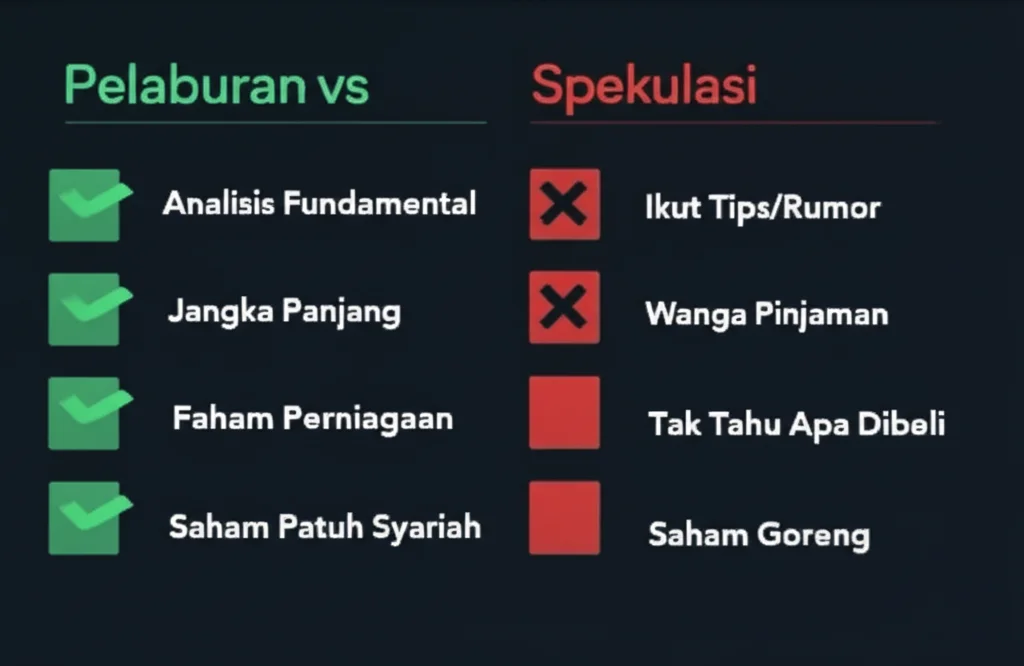
| Aspect | Investment (Halal) | Speculation (Problematic) |
|---|---|---|
| Intention | Long-term ownership in a business | Quick profit from price movements |
| Basis of decision | Company fundamental analysis | Guesswork, tips, price momentum |
| Time horizon | Weeks, months, years | Minutes, hours, days |
| Risk | Calculated and understood | Don't care - "as long as I profit" |
| Knowledge | Understands the business being bought | Doesn't know what is being bought |
| Money used | Surplus money you can afford to lose | Borrowed money, emergency savings |
In fiqh muamalat, stock investment is fundamentally halal because it involves real ownership (milk) in a productive business. You are buying a portion of a company, sharing profits through dividends, and bearing the risk of loss together.
But when the focus shifts from "owning a business" to "guessing prices" - that is where it starts to become problematic.
Gharar and Maysir: Two Main Reasons Trading Can Become Haram
Gharar - Excessive Uncertainty
Gharar refers to any transaction involving excessive uncertainty, ambiguity, or deception. According to Sheikh Taqi Usmani, one of the leading authorities on Islamic finance, the prohibition of gharar aims to eliminate ambiguity that could lead to conflict, injustice, or unwarranted enrichment.
In the context of stock trading, gharar occurs when:
- You sell shares you do not fully own (short selling)
- You trade derivatives such as futures and options
- You use excessive leverage through margin trading
- You buy shares without any knowledge of the company
Maysir - Elements of Gambling
Maysir means obtaining profit purely through luck, speculation, or guessing without productive effort. Ibn Taymiyyah emphasized that the harm of gambling is greater than that of riba because gambling is the result of combining two evils - profit without effort and unlawful play.
In trading, maysir occurs when buy and sell decisions are not based on analysis but depend on "luck" - just like a gambler who depends on dice or cards.
Malaysia's Fatwa: What Does the National Fatwa Council Say?
At the 98th Muzakarah of the National Fatwa Committee held on 13-15 February 2012, the Council ruled that individual electronic spot forex trading is haram. This decision was made because such transactions contain elements of riba (rollover interest), resemble debt-based sales contracts through leverage, have ambiguity in ownership transfer, involve selling currencies not owned, and speculation akin to gambling.
Although this fatwa specifically addresses forex, the same principles can be applied to any form of trading that contains these elements - including speculative stock trading.
The Shariah Advisory Council (SAC) of the Securities Commission Malaysia maintains a list of Shariah-compliant securities that is updated twice a year. This screening involves a two-tier quantitative test - the ratio of interest-based debt and cash in conventional accounts must each not exceed 33%.
But remember: Shariah-compliant stocks do not mean your trading method is Shariah-compliant. You can trade Shariah-compliant stocks in a haram way if your approach is speculative and resembles gambling.
5 Signs Your Trading Has Become Gambling
1. Following Tips Without Doing Your Own Analysis
"Bro, buy XYZ stock tomorrow. Confirm it'll go up!" - If this is the basis of your investment decisions, you are not an investor. You are a gambler.
The culture of WhatsApp and Telegram stock tip groups in Malaysia is extremely dangerous. Many do not realize they are actually victims of pump-and-dump schemes - where organizers buy shares early, spread "tips" to push up prices, then sell at the peak. Those who enter late are guaranteed to lose.
2. Revenge Trading and FOMO
When you lose and keep re-entering to "get revenge" (revenge trading), or buy something because you are afraid of missing out (FOMO - Fear of Missing Out), you have already lost rational control. A study published in the Journal of Banking and Finance found that investors with compulsive gambling symptoms tend to adopt "a more active and speculative trading style, demonstrated by higher frequency of stock trades, day trading, and investment in derivatives and leveraged products."
3. Using Money You Can't Afford to Lose
If you are using emergency savings, your children's education funds, or worse - borrowing money to trade, this is not investing. This is gambling. Islam forbids us from exposing ourselves and our families to unnecessary financial harm.
4. Not Knowing What You Are Buying
You buy a stock but don't know what the company does? Never read the annual report? Don't know the profit margins, debts, or prospects of the company? This means you are not investing in a business - you are guessing numbers, just like at a casino.
5. Trading Only for the Thrill
If the excitement when prices go up and the panic when prices drop become the main reason you keep trading - not long-term returns - you are already trapped in the same dopamine cycle as gambling addiction. As discussed in this article on gambling psychology, the human brain does not differentiate between the thrill of a slot machine and the thrill of watching a stock chart move.
The "Goreng Stock" Phenomenon in Malaysia
Malaysia has a unique problem known as "saham goreng" (fried stocks) - penny stocks that are manipulated by syndicates for quick profits.
During the COVID-19 pandemic, 75% of the 20 most actively traded stocks on Bursa Malaysia were generally loss-making companies. Retail investors recorded net purchases of RM6.4 billion in the first half of 2020 alone, with retail participation rising from 20.8% (2019) to 32.4% of total trading value.
The clearest example is the case of Saudee Bhd - a stock that surged to RM1.19 on news of a supply contract with China, then crashed to just 5.5 sen within a few months. Many investors who mistimed their entry were badly burned.
Goreng stocks are not investments. They are gambling wrapped in a "stock market" package - and from an Islamic perspective, they clearly contain elements of gharar and maysir.
What Science Says: 97% of Day Traders Lose
For those who still want to argue that day trading is a "legitimate investment strategy," here are some startling facts:
A major study by Barber et al. analyzing 3.7 billion transactions on the Taiwan Stock Exchange from 1992 to 2006 found that:
- Only 3% of day traders were consistently profitable
- Even the most experienced day traders still lost money
- Nearly three-quarters of all day trading could be traced to traders with a history of losses
The researchers' conclusion: "Trading to learn is no more rational or profitable than playing roulette to learn."
Another study in Brazil (2013-2015) found that 97% of day traders lost money and only 1.1% earned more than Brazil's minimum wage.
In general, 80% of day traders quit within the first two years because they run out of money. This is not investing - it is a transfer of wealth from uninformed retail investors to far more sophisticated institutions and algorithms.
Trading Apps and Gamification: A Casino in Your Pocket
Recent studies reveal that modern trading apps use the same gamification techniques as gambling apps to create addiction.
According to a study published in the journal Management Science, hedonic gamification in trading apps increases trading volume by an average of 5.17%. These techniques include:
- Flashing prices and confetti animations that provide an instant dopamine hit
- Push notifications that encourage repeated portfolio checking
- Variable reward schedules similar to slot machines
- Leaderboards and achievements that create social competition
Brain imaging studies show that heavy users of gamified trading apps exhibit neural patterns similar to gambling addicts. The human brain does not differentiate between pulling a slot machine lever and swiping to refresh a portfolio.
A recent study published in PMC (2025) confirmed the overlap between trading behavior and gambling disorder, with traders treated in gambling problem units showing "high event frequency and short event duration in financial trading - characteristics frequently found in gambling disorders."
The Day Trading Question: Halal or Haram?
The day trading issue remains a complex and debated matter among Islamic scholars. Here are the key considerations:
Ownership Issue (T+2)
On Bursa Malaysia, transaction settlement takes T+2 - that is, two business days after the transaction. In day trading, shares are sold before settlement is completed. Selling something you do not fully own raises serious Shariah concerns.
Margin and Riba Issues
Margin accounts involve interest-bearing loans (riba) to finance trades. Although Islamic margin financing exists in Malaysia through licensed brokers, using it for short-term speculative trading defeats the original hedging purpose.
Intention and Approach Issues
If day trading is done with:
- Thorough technical and fundamental analysis
- Your own money (not interest-bearing margin)
- Only Shariah-compliant stocks
- Without excessive speculation
...then it may be permissible according to some scholars. But if it is done without knowledge, based on guesswork, and using borrowed money - it clearly contains elements of gambling.
How to Ensure Your Investments Remain Halal
1. Buy Only Shariah-Compliant Stocks
Refer to the SAC list from the Securities Commission, which is updated every May and November. Open an Islamic CDS account that automatically rejects purchases of non-Shariah-compliant stocks.
2. Understand What You Are Buying
Before buying any stock, read the annual report, understand the business model, check the financial ratios, and make sure you can explain why you are buying it to someone else. If you can't - don't buy it.
3. Use Only Surplus Money
Only invest money you can afford to lose without affecting your daily life. Never use emergency savings, children's education funds, or borrow money to invest.
4. Avoid Interest-Bearing Margin Trading
If you want to use margin, make sure it is Islamic financing free from riba. Better yet - use your own cash.
5. Think Long Term
Real investors think in terms of years, not days. Warren Buffett once said: "The stock market is a device for transferring money from the impatient to the patient." In the Islamic context, patience (sabr) is a praiseworthy virtue.
6. Avoid Stock Tip Groups
Leave WhatsApp and Telegram groups that promise "stocks that are guaranteed to go up." If something sounds too good to be true - it is. Do your own analysis or seek advice from a licensed remisier.
FAQ - Frequently Asked Questions About Trading and Gambling
Is all stock trading haram in Islam?
No. Stock trading is fundamentally halal as long as the stocks are Shariah-compliant, you understand what you are buying, and the transactions do not contain elements of riba, excessive gharar, or maysir. What is haram is a speculative approach that resembles gambling.
What's the difference between trading and gambling in Islam?
Halal trading involves real ownership in a productive business, knowledge-based analysis, and profit-loss sharing. Gambling depends solely on luck and guesswork without real ownership or productive effort. The main dividing line is knowledge versus luck.
Is day trading haram?
It is debated. Some scholars allow it with strict conditions (Shariah-compliant stocks, cash account, thorough analysis). Other scholars consider it problematic due to the T+2 ownership issue and speculative tendencies. What is clearly haram is day trading using interest-bearing margin without any analysis.
Why do most day traders lose money?
Academic studies consistently show that 97% of day traders lose money because they compete against institutions and algorithms that have far greater advantages in information, speed, and capital. Transaction costs (brokerage, spread) also eat into small profits.
How do I know if I am addicted to trading?
Signs include: constantly checking stock prices, inability to sleep thinking about positions, using money you cannot afford to lose, lying to family about losses, and continuing to trade despite significant losses. If you show these symptoms, refer to this article on gambling psychology and seek professional help.
Are goreng stocks haram?
Yes, from an Islamic perspective, goreng stocks contain elements of gharar (excessive uncertainty) and maysir (speculation resembling gambling). They also often involve market manipulation, which is forbidden in Islam. Companies that are "goreng-ed" are usually loss-making with no fundamental basis.
What are halal alternatives to day trading?
Long-term investment in Shariah-compliant stocks based on fundamental analysis, Islamic unit trusts, Shariah-compliant ETFs, sukuk (Islamic bonds), and property investment. All of these provide more stable returns and are in line with Islamic principles.
Is using technical analysis haram?
Technical analysis itself is not haram - it is a tool for understanding price patterns. The problem arises when it is used as the sole basis for decisions without understanding the company's fundamentals, and when it drives short-term speculative trading.
Conclusion
The line between halal investing and gambling does not lie in what you buy, but how you buy it. Shariah-compliant stocks traded speculatively can still fall into the category of maysir. Conversely, long-term knowledge-based and analytical investment in good companies is one of the best ways to grow wealth in a halal manner. Be an investor, not a gambler.
If you want to start your investment journey the right way, open a CDS Trading Account through Mahersaham to invest on Bursa Malaysia as well as international stocks such as US and Hong Kong with guidance from a licensed remisier.
Download the Free Stock Market Basics Ebook to build a solid halal investing foundation before you start trading.
Further Reading
- Apa Itu Judi Dalam Islam? Dalil, Hukum & Contoh Moden yang Ramai Tak Sedar
- Psikologi Judi: Kenapa Otak Manusia Mudah Terperangkap?
- Kenapa Forex Haram? 5 Sebab Utama & Apa Kata Fatwa Malaysia
- Kajian Kewangan Patuh Syariah: Cara Betul Guna Tanda Aras 33%
- Kenapa Umat Islam Patut Paling Bijak Buat Keputusan Kewangan?