Why Did Jensen Huang Resign? The Nvidia Case Explained for Investors

On 12 November 2026, Nvidia announced that its co-founder, Jensen Huang, had resigned as President, Chief Executive Officer and a member of the Board, effective immediately. It came just four days after the same board said it had "confidence" in him.
Many Malaysian investors who hold Nvidia (NVDA), or AI and data centre stocks on Bursa, are asking the same thing: what exactly is the Nvidia case, and what does it mean for my portfolio?
This article sets out the facts by date and separates clearly what has been officially confirmed by Nvidia, what has been reported by the media, and what remains unproven allegation.
Disclaimer: This article is for information and education only and is not a recommendation to buy, sell or hold any security. Facts are as of 13 November 2026. Investigations are ongoing and new information may change the overall picture.
The Short Answer: What Is the Nvidia Case?
Jensen Huang admitted to an extramarital affair. According to the New York Times, the woman involved is Alice Huang, an executive at data centre company Megaspeed whom US intelligence assessed as likely passing information to Chinese intelligence. Nvidia's board opened an independent investigation. After media reports of a second relationship with an Nvidia vice president, Huang resigned. CFO Colette Kress is now interim CEO.
The most important point for investors: there is no public evidence so far that Nvidia's secrets or US national security were compromised. That is the board's own statement, and no criminal charges against Huang have been reported.
Who Is Jensen Huang and Why Does This Matter?
Jensen Huang, 63, co-founded Nvidia with two partners in 1993 and led it for 33 years. Under him, Nvidia grew from a maker of video game graphics cards into the world's leading supplier of AI chips. It is now among the most valuable companies on the US stock market, with a market value of around US$4 trillion even after this week's fall.
In investment terms, Huang is a textbook case of key person risk: the risk that a company's value depends heavily on one individual. If you have read our analysis of the parallels between Nvidia today and Cisco in 2000, this is one of the risks rarely discussed while a stock is rising.
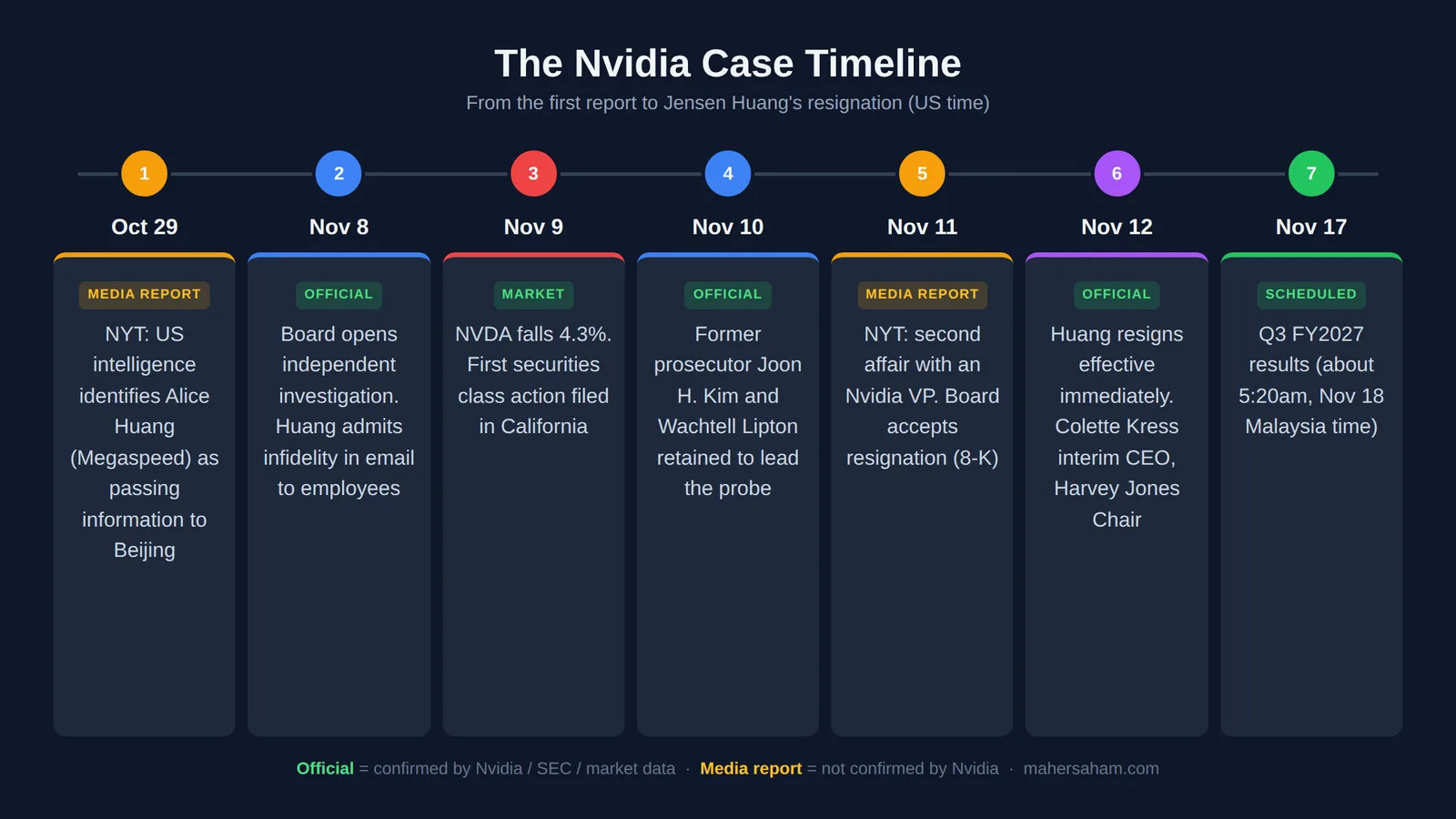
Timeline of the Nvidia Case
All dates below are US time.
2023 to 2025: The Megaspeed Background
According to corporate records cited by the Wall Street Journal, Alice Huang (also known as Huang Le) became managing director of Megaspeed International, a Singapore-based data centre company, in March 2023. She is a Chinese citizen and a former television reporter for Chinese state media. Despite the shared surname, she is not related to Jensen Huang.
There is a Malaysian angle. According to the New York Times as cited by Newsweek, a Megaspeed sister company in Malaysia bought at least US$4.8 billion of equipment containing Nvidia chips between June 2024 and February 2026. The US Commerce Department began investigating Megaspeed in late 2024 on suspicion of helping China obtain export-controlled Nvidia technology. The case was later taken over by the US Justice Department. Megaspeed maintains that it is a legitimate and compliant business. According to an Nvidia spokesman speaking to the WSJ, Nvidia has banned all sales and shipments to Megaspeed since June 2025.
29 to 30 October 2026: The First Reports
The New York Times reported that US intelligence had identified Alice Huang as someone passing information to Beijing, and that Jensen Huang may have been a target. On 30 October, Huang told Bloomberg that his dealings with Megaspeed were "normal and not unusual".
8 November 2026 (Sunday): Admission and Independent Investigation
Two official statements came out on the same day.
First, a statement from Nvidia's Board of Directors announced an independent investigation following reports that Huang had been "the target of a foreign intelligence effort". It is overseen by a committee of independent directors assisted by outside counsel. The board said it "has no reason to believe that either national security or NVIDIA secrets were compromised" and that it still had confidence in Huang and his leadership team.
Second, in an email to all employees, Huang wrote: "I was unfaithful to my wife. My actions hurt her and our children. There is no excuse for what I did. I am deeply sorry." He said he would cooperate fully with the investigation. Note that Huang did not name the woman in that email. Alice Huang's name comes from media reports.
9 November 2026 (Monday): Shares Fall, First Lawsuit Filed
On the first trading day after the investigation was announced, Nvidia shares fell US$7.97, or 4.3%, wiping out about US$190 billion in market value, according to the Associated Press via PBS.
The same day, Rosen Law Firm filed a proposed securities class action in the US District Court for the Northern District of California on behalf of a retail investor. The suit alleges that Nvidia and Huang misled investors by describing the Megaspeed relationship as normal while the personal relationship allegedly existed at the same time. These are allegations that have not been decided by any court. Several other law firms announced their own investigations.
President Donald Trump said the FBI was looking into the matter. According to Trump, Huang told him he did not know the woman was a spy. China's Foreign Ministry denied the espionage allegation and called it "smears against China".
10 November 2026 (Tuesday): Former Prosecutor Retained
The independent members of the board retained Joon H. Kim, former acting US Attorney for the Southern District of New York, and his firm Wachtell, Lipton, Rosen & Katz to conduct the investigation.
11 November 2026 (Wednesday): Report of a Second Relationship
Late that evening, the New York Times reported that Huang had also had an affair with Kimberly Powell, Nvidia's vice president of health care, who reported directly to him. This is a different issue from the espionage question. It is an internal governance matter: a personal relationship between a CEO and a direct report. According to the Form 8-K Nvidia filed with the SEC, the board accepted Huang's resignation on 11 November.
12 November 2026 (Thursday): Resignation Announced
In its official announcement, the board said Huang had resigned "effective immediately". The release gave no reason for the resignation and included no quote from Huang. According to CNBC, Reuters reported the same day that Huang had also had an intimate relationship with another, unnamed Nvidia employee.
Who Is Running Nvidia Now?
Based on the official release and the Form 8-K, three changes took place:
- Colette Kress (59) was appointed interim CEO while remaining Executive Vice President and Chief Financial Officer. She joined Nvidia in September 2013, after nearly 25 years in finance roles including at Cisco and Microsoft.
- Harvey C. Jones (73) was appointed Chair of the Board, the first such position in Nvidia's history. He has been an Nvidia director since 1993 and is a former CEO and Executive Chairman of Synopsys.
- The board began a search for a permanent CEO and will consider internal and external candidates.
Harvey Jones said the board expects the company's operations, customer commitments and product roadmap to "continue without interruption". That is the board's expectation, not a guarantee. Investors will judge for themselves based on upcoming financial results and guidance.
Impact on Nvidia's Share Price
Key figures based on market closing data:
- 6 November 2026: NVDA closed at US$186.64, before the investigation was announced.
- 9 November 2026: down 4.3% on the first trading day after the investigation was announced.
- 12 November 2026: according to StockTitan, the stock hit a low of US$148.80 (down 14.35%) shortly after the open before closing at US$166.19, down 4.34% from US$173.73 the day before.
- That 12 November close was about 11% below the 6 November close, and about 30% below the US$239.24 close on 6 October 2026.
One detail stands out. The stock fell more than 14% early in the session but closed down only about 4%. That suggests the market on the day did not treat the case as a threat to Nvidia's core business, at least for now. But one day's move is not a guide to the long-term direction.
Analysts are divided too. According to CNBC, Cantor Fitzgerald's CJ Muse cut his price target from US$350 to US$250 while keeping an Overweight rating, and called Huang's departure "a major loss" for Nvidia. Analyst opinions are not guarantees, and price targets change often.
Three Kinds of Risk Now in Play
To think about this case calmly, separate it into three distinct risks:
1. Leadership Risk
Nvidia is now led by an interim CEO who is also the CFO. The key questions are who the permanent CEO will be, how long the search will take, and whether other senior executives stay.
2. Legal and Regulatory Risk
Still under way: the board's independent investigation, the investor class action, US authorities' investigations related to Megaspeed, and interest from the US Congress in calling Huang to testify. Under US securities law, investors have 60 days after notice of the first lawsuit to apply to become lead plaintiff. Cases like this usually take years.
3. Geopolitical Risk
The case touches a sensitive US-China issue: export controls on AI chips. Any tighter new policy could affect Nvidia's sales to certain regions, and also data centre supply chains in Southeast Asia, including Malaysia.
What to Watch Next
- Third-quarter fiscal 2027 results on Tuesday, 17 November 2026, at approximately 1:20 p.m. Pacific time (around 5:20 a.m. on Wednesday, 18 November, Malaysia time). Watch whether guidance for the next quarter changes and what management says about customer demand.
- Findings of the independent investigation led by Joon H. Kim and Wachtell Lipton.
- The appointment of a permanent CEO.
- Developments in the class action and US authorities' investigations.
- US AI chip export control policy, especially regarding China and Southeast Asia.
Lessons for Malaysian Investors
Whatever your view on Nvidia, this case carries some basic lessons:
First, don't depend on a single stock. However strong the company, news about one individual can move the price by double digits within minutes. Diversification across companies and sectors still matters. See also other companies benefiting from the AI boom.
Second, position size matters more than predictions. An investor holding a reasonable share of their portfolio in one stock can assess the situation calmly. An investor who went "all in" has to decide in a panic. Learn the concept in our article on stop loss and position sizing.
Third, separate facts, reports and allegations. In this case, many headlines describe a "Chinese spy" as if it were proven fact. In reality, it is a US intelligence assessment reported by the media, denied by China, and not yet tested in court. Good investment decisions start with accurate information.
Fourth, governance is not a minor issue. Nvidia appointed its first-ever board chair only after this crisis. When evaluating any company, on Bursa or Wall Street, check the board structure, director independence and CEO succession plans.
FAQ: Common Questions About the Nvidia Case
Why did Jensen Huang resign?
Nvidia's official statement did not give a reason. The resignation followed Huang's admission of infidelity, the board's independent investigation into reports that he was the target of a foreign intelligence effort, and a New York Times report of a second relationship with an Nvidia vice president.
Who is Nvidia's new CEO?
Colette Kress, Nvidia's CFO since 2013, was appointed interim CEO while remaining CFO. The board is searching for a permanent CEO among internal and external candidates.
Is Alice Huang really a Chinese spy?
That is the assessment of US intelligence agencies as reported by the New York Times and the Wall Street Journal. China denies it. As of 13 November 2026, no charges or court findings have been publicly reported.
Were Nvidia's secrets leaked?
Nvidia's board said it has no reason to believe that national security or Nvidia secrets were compromised. The investigation is ongoing, so that statement may be updated.
How much did Nvidia stock fall?
On 12 November 2026, NVDA closed at US$166.19, about 11% below its 6 November close (US$186.64) before the investigation was announced.
What is the Malaysian connection to the Nvidia case?
According to the New York Times, a Megaspeed sister company in Malaysia bought at least US$4.8 billion of equipment containing Nvidia chips between June 2024 and February 2026, and a US Commerce Department official reportedly saw Nvidia equipment still in boxes at a Megaspeed data centre in Malaysia. Investigations related to Megaspeed are ongoing.
When does Nvidia report its next results?
Tuesday, 17 November 2026, at approximately 1:20 p.m. Pacific time, which is around 5:20 a.m. on Wednesday, 18 November, Malaysia time.
Should I sell or buy Nvidia shares now?
This article does not make buy or sell recommendations. The decision depends on your objectives, time horizon and risk tolerance. If needed, consult a licensed dealer's representative or financial planner, and avoid making decisions based on headlines alone.
Conclusion
The Nvidia case began as a CEO's personal matter but quickly became a governance, legal and geopolitical issue for a company worth around US$4 trillion. The confirmed facts so far are Huang's admission, the board's independent investigation and his resignation. The espionage allegation remains unproven. For investors, the lesson is clear: manage position size, diversify, and decide based on facts.
If you want to invest in global or local companies with discipline and proper risk management, the first step is having your own trading account.
Open a CDS trading account to invest on Bursa Malaysia as well as in foreign stocks such as the US and Hong Kong.
Download the free Stock Market Basics Ebook to understand the fundamentals before you make any decision.
Further Reading
- US Stocks Guide: How to Start Investing in Global Stocks Step by Step
- NVIDIA Today = Cisco 2000? Historical Lessons & Other AI Stocks Worth Watching
- Beyond NVIDIA: 8 Companies Winning From the AI Boom
- Stop Loss & Position Sizing: How to Protect Your Capital Before Buying Stocks
- IPO Investment Risk Analysis: Stock Risk Management Strategy Guide Malaysia