Stop Loss & Position Sizing: How to Protect Your Capital Before Buying Stocks

Most Bursa Malaysia retail investors only ask one question before pressing the Buy button: "Will this stock go up?" They don't ask the two questions that actually matter more:
- Where will I exit if I'm wrong? (Stop loss)
- How many shares should I buy? (Position sizing)
These are the two risk management tools that will determine whether you're still in the market five years from now, or bankrupt in six months. Research by Van Tharp shows that position sizing accounts for 91% of trading performance variability - not the stock selection that most investors obsess over. Source: Van Tharp Institute.
In this article, you'll learn:
- Why stop loss must be set BEFORE buying, not after the stock drops
- 4 types of stop loss and when to use which (fixed %, ATR-based, support-based, time stop)
- The position sizing formula to calculate how many shares to buy
- Worked examples with real Bursa Malaysia stock scenarios
- How stop loss & position sizing connect mathematically
- Common mistakes that bankrupt retail investors
- A trading checklist before buying any stock
Why Risk Management Matters More Than Stock Picking
Imagine two investors, A and B. They buy the same stock at the same price. After 10 trades:
- Investor A wins 6 times, loses 4 times. But each loss is 5x bigger than each win.
- Investor B wins 4 times, loses 6 times. But each win is 3x bigger than each loss.
Who's profitable? Investor B, despite a worse hit rate. This is the concept Van Tharp calls R-multiple - R = Risk per trade. If you risk RM100 and gain RM300, that's a 3R win. If you lose, that's a -1R loss.
Stop loss + position sizing allow you to control R precisely on every trade. Without both, one mistake can destroy a portfolio built over years.
Last year, we already explained why position sizing is 80% of trading strategy using the story of George Soros breaking the Bank of England. This article is the practical follow-up: how you apply both tools BEFORE pressing the Buy button.
Part 1: Stop Loss - Where Will You Exit If You're Wrong?
A stop loss is a pre-determined price at which you'll sell your stock if the market moves against you. It's not "I'll wait until I'm stressed, then sell" - that's not a stop loss, that's emotion.
The key: set the stop loss BEFORE you buy, not after the stock starts dropping. This is because when your stock crashes, your emotional brain will invent 1001 reasons to "wait a bit longer" - and a 5% loss becomes 30%.
4 Types of Stop Loss You Need to Know
1. Fixed Percentage Stop Loss
You set the stop loss at a fixed percentage below entry. Example: buy stock at RM2.00, set stop loss at RM1.86 (7% below).
Pros: Easy to calculate, consistent across all trades. Cons: Doesn't account for the specific volatility of the stock. A defensive stock like utilities may never drop 7%, while a tech stock might swing 10% in a single day.
When to use: Long-term investors protecting downside. Typically 7-10% for defensive stocks, 15-20% for growth stocks.
2. ATR-Based Stop Loss (Volatility-Adjusted)
ATR (Average True Range) is an indicator measuring average daily price movement of your stock - created by J. Welles Wilder. The idea: stop loss should match the actual volatility of the stock, not generic percentages.
Popular formula: Stop Loss = Entry Price - (2 x ATR)
Example: Stock X priced at RM5.00 with 14-day ATR of RM0.12. Stop loss at 2x ATR = RM5.00 - RM0.24 = RM4.76 (4.8% below entry).
For more volatile stocks, use higher multipliers (3x ATR). For more stable stocks, 1.5x is enough. According to LuxAlgo analysis, 2-3x ATR is the typical range used by professional traders.
When to use: Traders comfortable with technical analysis who have access to charting platforms (TradingView, ThinkOrSwim, Bursa Anywhere).
3. Support-Based Stop Loss (Structural)
You set the stop loss just below the nearest support level - a price area where selling typically stops. Example: a stock held at RM3.20 multiple times in the past two months. You buy at RM3.35 and set stop loss at RM3.15 (slightly below support).
Pros: Logical - if price breaks support, your technical thesis is invalidated. Cons: Stop loss distance can be too tight (entry 2% above support) or too far (entry 15% above support).
When to use: Technical traders, swing traders, and momentum traders.
4. Time Stop
You set a deadline - if the thesis doesn't materialise within a certain period, you exit regardless of price. Example: "If the stock doesn't break above RM4.00 within 6 weeks, I'll exit."
When to use: Trades based on specific catalysts (earnings, product launch, major contract). If the catalyst doesn't materialise, your capital is locked up without upside.
Trailing Stop: Lock In Profit As Stock Rises
A trailing stop is a stop loss that moves up with price but doesn't move down. Example: buy at RM3.00, initial stop loss RM2.80. Price rises to RM3.50, trailing stop "drags up" to RM3.30. Now you're guaranteed at least 10% profit, or breakeven if price drops back.
Chandelier Exit (by Charles Le Beau) is a very popular ATR-based trailing stop - using 22-period high minus 3x ATR.
There are five different ways to calculate a trailing stop level, and the right distance depends on the counter's volatility. We cover all of them in our trailing stop guide, including how to run one on Bursa Malaysia where platforms offer no automatic trailing stop order.
Part 2: Position Sizing - How Many Shares Should You Buy?
You now know where the stop loss is. Next question: how many units should you buy?
Most retail investors at Bursa Malaysia answer with one of two wrong approaches:
- "I buy whatever I can afford" - if I have RM5,000, buy RM5,000 of stock. (WRONG)
- "I buy round lots based on sentiment" - very confident? 5 lots. Less confident? 1 lot. (WRONG)
The right answer: position sizing is determined by risk per trade and stop loss distance - not by your emotional confidence.
The Position Sizing Formula
Position Size (number of units) = Risk Capital / Risk per Unit
Where:
- Risk Capital = Maximum loss you're willing to accept for this trade (typically 1-2% of total portfolio)
- Risk per Unit = Entry Price - Stop Loss Price (per share)
The 1% Rule
Rule of thumb used by professional traders: never risk more than 1-2% of portfolio on any single trade. This means even if you lose 10 trades in a row (rare if your strategy has an edge), your portfolio drops only 10-20% maximum - recoverable.
For retail investors starting with small capital (under RM20,000), 1.5-2% may be more suitable. Professional traders with large portfolios typically use 0.5-1%.
Worked Example: Buying a Bursa Malaysia Stock
Let's run a complete example with realistic numbers:
Setup:
- Your portfolio: RM50,000
- Risk per trade: 1% = RM500 max loss
- Target stock: hypothetical Bursa-listed stock at RM4.20
- Stop loss (support-based): RM3.95 (below RM4.00 support)
- Risk per unit: RM4.20 - RM3.95 = RM0.25 per share
Position size calculation:
Position Size = RM500 / RM0.25
              = 2,000 units
So you buy 2,000 units (4 lots @ 500 each at Bursa Malaysia).
Capital deployed: 2,000 x RM4.20 = RM8,400 (16.8% of portfolio)
Worst case: If stop loss is triggered, you lose: 2,000 x RM0.25 = RM500 (exactly 1% of portfolio).
This is the beauty of position sizing: even though this trade uses 16.8% of your capital, actual risk is only 1%. You won't get hit hard even if this trade fails.
What Happens If Stop Loss Is Further?
Let's change the scenario slightly. Same stock, but support level is further away - stop loss at RM3.60 instead.
- Risk per unit: RM4.20 - RM3.60 = RM0.60 per share
- Position size: RM500 / RM0.60 = ~833 units (1-2 lots)
A further stop loss = a smaller position size. You automatically buy fewer shares to maintain the same risk. This is the discipline that saves portfolios.
What About Cheap Stocks?
Penny stocks (under RM1.00) often look "attractive" because "you can buy many units". But run the math properly:
- Stock at RM0.30, stop loss at RM0.27 (10% below)
- Risk per unit: RM0.03
- Position size: RM500 / RM0.03 = 16,666 units (33 lots)
- Capital: 16,666 x RM0.30 = RM5,000 (10% portfolio)
Penny stocks aren't automatically "safer" - position sizing must always be based on risk per unit, not unit price.
Part 3: The Mathematical Link Between Stop Loss & Position Sizing
Here's the insight most retail investors miss - stop loss and position sizing are two halves of the same equation:
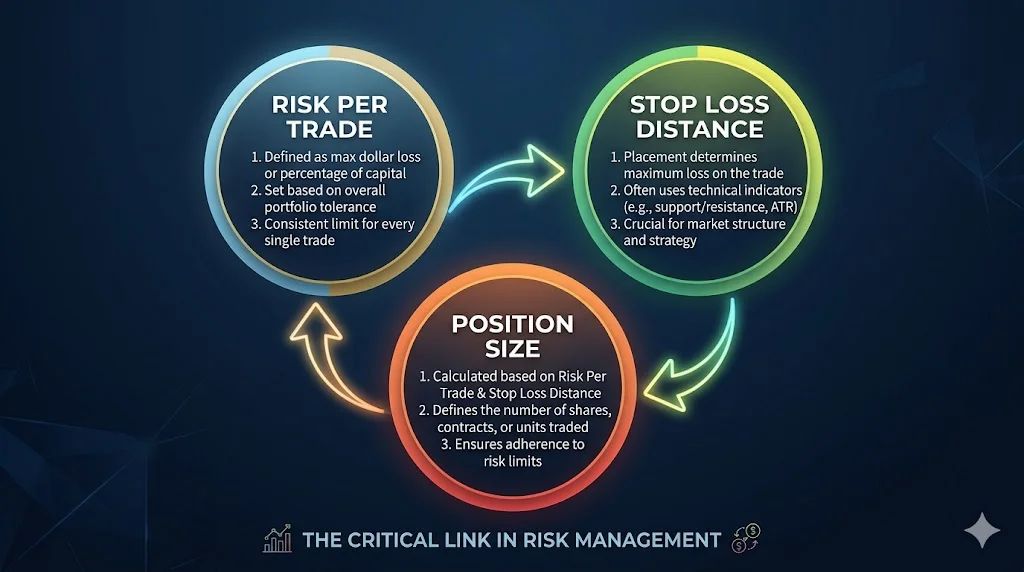
When you fix risk per trade at 1% (= RM500 on a RM50K portfolio), two numbers can vary:
- Large stop loss distance -> Small position size -> Small capital deployed
- Small stop loss distance -> Large position size -> Large capital deployed
You CANNOT change position size without changing stop loss, and vice versa, as long as you want to maintain fixed risk.
What Happens When Retail Investors Break This Rule?
Common scenario: Investor sees a "hot" stock. So confident, puts in 50% of portfolio. Stop loss? "I didn't set one, I'm holding long term."
When the stock drops 30%, they lose 15% of portfolio in a SINGLE trade. To recover from -15%, they need a positive return of 17.6%. That's months or a year of good trading wiped out by one mistake.
Compare with 1% rule discipline: Worst case single trade hits -1%. You need 1.01% return to recover - that's potentially one good market day.
Part 4: Pre-Trade Checklist
Before pressing Buy on any stock, answer these 8 questions:
- What's my total trading capital? (Total portfolio value)
- What % am I willing to risk on this trade? (Default 1%, max 2%)
- What's my entry price? (Limit order, not market at any price)
- Where's my stop loss? (Fixed %, ATR, or support-based)
- What's the risk per unit? (Entry - Stop Loss per share)
- What's the position size per formula? (Risk Capital / Risk per Unit)
- Round to nearest lot (Bursa Malaysia: 100 units/lot for most stocks)
- What's my profit target (take profit)? (Risk-reward minimum 1:2)
If you can't answer all eight, you shouldn't buy. Period.
For order execution, mahersaham has a stop limit guide for the M+ Online platform that walks you through setting stop loss orders mechanically after you buy.
Part 5: Common Mistakes Retail Investors Make
Mistake 1: "Mental Stop Loss"
"I know where my stop loss is, no need to set the order." WRONG. Your emotional brain will invent reasons not to sell. Set a real stop limit order on the platform - automatic, no compromise.
Mistake 2: Moving Stop Loss Down
Stock approaches your stop loss, you "adjust" it lower. Not a new analysis - just because you don't want to admit you're wrong. This breaks the most basic discipline. If the stop loss is wrong, fix your rule, not the individual trade's stop loss.
Mistake 3: Increasing Position After Loss (Martingale)
"I lost RM500. Next trade I'll double, get it back." This is a fast track to bankruptcy. If your strategy is losing, change the strategy - don't add leverage.
Mistake 4: Position Sizing Based on "Feel"
"I'm confident on this trade, putting 30% in." Confidence isn't strategy - data is strategy. Stick with the 1% rule even when you feel 99% sure. The market doesn't care about your confidence.
Mistake 5: Forgetting Take Profit
Stop loss protects downside, but you also need a take profit target. Risk-reward minimum 1:2 - if risking RM500, target at least RM1,000 profit. If a setup can't provide 1:2 or better, skip the trade.
For more context on psychology affecting investors, read 13 Emotional Traps That Can Destroy Your Portfolio - many of the above mistakes originate from there.
Part 6: Practical Tips for Bursa Malaysia Investors
1. Calibrate Risk % to Your Experience
| Level | Risk per Trade | Notes |
|---|---|---|
| Beginner (0-1 year) | 0.5-1% | Many small trades, collect data |
| Intermediate (1-3 years) | 1-1.5% | Once edge is proven |
| Experienced (3+ years) | 1-2% | After strategy validated with 100+ trades |
2. Calculate Pre-Trade in Excel or Calculator
Don't mental math - use a spreadsheet formula or free position sizing calculator from Van Tharp Institute. Consistent calculation builds natural discipline.
3. Track Every Trade in R-Multiples
Don't record "profit RM200, profit RM150" - record in R. Trade 1: +2R, Trade 2: -1R, Trade 3: +3R. This shows you the true expectancy of your strategy, undistorted by capital size.
4. Don't Risk More Than 6% on Correlated Stocks
If you have 3 active trades in the banking sector (all positively correlated), your total risk isn't 1% x 3 = 3%. If banking crashes, all three will hit stop loss simultaneously. Treat sector as a single unit - max 2-3% total exposure.
Frequently Asked Questions (FAQ)
What's the difference between stop loss and cut loss?
Same thing. "Cut loss" is the common term among retail investors at Bursa, "stop loss" is the international technical term. Both refer to selling stock at a predetermined price to limit losses.
Do I have to set a stop loss order on the platform, or can I just remember it?
You must set a real order. "Mental" stop losses don't work because when price drops, emotion invents reasons not to sell. Set an automatic stop limit order on your broker's platform.
What's the difference between stop loss and stop limit?
A stop loss order sells at market price after trigger - can suffer large slippage in illiquid stocks. A stop limit order sets both trigger and limit prices - more control but may not trigger if price gaps significantly. For Bursa Malaysia, stop limit is more popular due to relative control over gap volatility.
What stop loss percentage is suitable for retail investors?
No single answer. Depends on:
- Stock volatility (defensive: 5-10%, growth: 10-20%)
- Time horizon (intraday: 1-3%, swing: 5-15%, position: 15-25%)
- Trading style (technical: support-based, fundamental: % based) What matters: consistency with your rule, not changing it every trade.
Is the 1% position sizing rule too small for small capital like RM5,000?
No. 1% of RM5,000 = RM50 risk per trade. This seems small, but it's how you stay in the market. A beginner risking 20% per trade on RM5,000 capital will be wiped out in 5 losing trades. Start with discipline from day one.
Can I use the same stop loss for all stocks?
You can, if using percentage-based fixed stops. But optimally: each stock has a different volatility profile, so ATR-based or support-based stops are more suitable. Don't force a 5% stop loss on a stock with 10% ATR - you'll get stopped out incorrectly repeatedly.
What if a stock gaps down past my stop loss?
This is a real risk - especially after earnings announcements or major news. Mitigation:
- Don't hold stocks through earnings if risk-averse
- Smaller position size for stocks with catalyst risk
- Use stop limit (not stop loss market) to avoid wild slippage - but accept the risk of stop not triggering
Is position sizing relevant for long-term investors (buy & hold)?
Yes, although more from a portfolio allocation angle than per-trade risk. Long-term investors shouldn't put more than 5-10% of portfolio in a single individual stock, regardless of how strong the thesis. Diversification is position sizing for long-term investors.
Conclusion
Stop loss answers the question "where do I exit if I'm wrong?" and position sizing answers "how much can I risk on one trade?". Combined with the 1-2% risk-per-trade rule, these tools guarantee you stay in the market even through brutal losing streaks.
Successful retail investors aren't the ones who pick the right stocks most often - they're the ones who survive long enough to pick the right stocks. Risk management is your survival passport.
Before opening your next trade, calculate stop loss and position size using the formulas above. Make it a habit - within a few months, it will become automatic.
To start using this strategy in your investing, you'll need a trading account that allows you to set stop limit orders automatically.
A CDS account lets you invest in Bursa Malaysia stocks as well as overseas markets like US and Hong Kong, with access to stop limit orders that execute your discipline automatically - open your CDS account here.
For stock investing fundamentals including deeper risk management concepts, download the free Stock Market Basics Ebook that will help you build a solid foundation before investing real money.
Further Reading
- Introduction to Risk Management in Stocks
- Learning From The Man Who Broke the Bank of England: Why Position Sizing Is 80% of Your Trading Strategy
- How to Use Stop Limit on M+ Online Platform
- Trading Plan: 3 Things You Must Understand Before Trading
- Stock Investment Psychology: 13 Emotional Traps That Can Destroy Your Portfolio
- Stocks for Beginners 2026: 7 Criteria to Pick Your First Bursa Stock