How Many More Lives? Malaysia Needs Tougher Drunk Driving Laws

I extend my deepest condolences to the family of the late Amirul Hafiz bin Omar, who returned to the mercy of Allah following a tragic accident yesterday. His passing is not merely a loss to his family, but yet another painful reminder to all of us about the real threat posed by drunk drivers on our roads.
The truth is, this is not an isolated incident. On 29 March 2026, a motorcyclist was killed on Jalan Raya Barat, Klang after being struck by a Honda City driven recklessly from the opposite direction. The victim was thrown onto the roof of a Perodua Myvi and pronounced dead at the scene. The driver tested positive for both alcohol and drugs.
Tragedy After Tragedy Throughout 2026
Unfortunately, the Klang incident is merely the latest in a series of horrific accidents involving drunk drivers throughout 2026:
- 5 January 2026 (Penang) - A 67-year-old woman was killed after being hit by an SUV driven by a foreign national suspected of drunk driving in Tanjung Tokong.
- 14 February 2026 (Temerloh) - A married couple burned to death in their Proton Preve after being struck by a Porsche Cayenne driven by a durian farmer suspected of being drunk.
- 29 March 2026 (Klang) - A motorcyclist was killed after being thrown onto a car roof by a driver who tested positive for alcohol and drugs.
Three incidents. Four lives. All within just three months. Too often we hear of innocent lives being snatched away by the negligence of those who choose to drive while intoxicated.
Current Laws: Are They Tough Enough?
The current law under Section 44(1) of the Road Transport Act 1987 (Amendment 2020) provides the following penalties for drunk driving causing death:
First conviction:
- 10 to 15 years imprisonment
- Fine of RM50,000 to RM100,000
- Minimum 10-year driving disqualification
Second and subsequent convictions:
- 15 to 20 years imprisonment
- Fine of RM100,000 to RM150,000
- Minimum 20-year driving disqualification
In 2024, the government also amended Act 333 to cover drivers under the influence of drugs, who previously could only be prosecuted if they caused an accident. While this is a step forward, the question remains - are these penalties heavy enough to curb this crime?
How Do Other Countries Handle This?
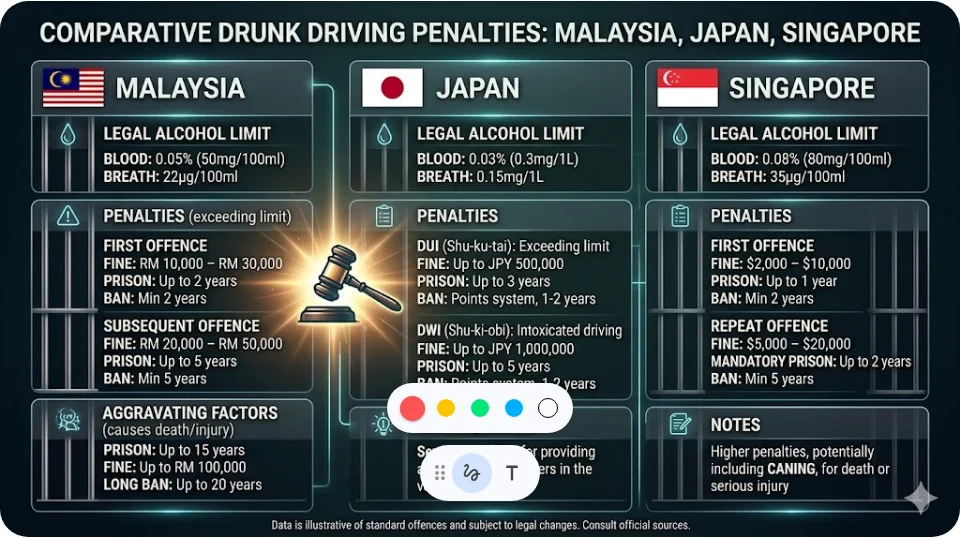
To understand where Malaysia stands, let us compare with other countries:
- Malaysia - 10-15 years imprisonment + RM50,000-RM100,000 fine (first conviction)
- Japan - Up to 30 years imprisonment, among the heaviest in Asia
- Singapore - 2-8 years (first), 4-15 years (repeat), minimum SGD10,000 fine
- South Korea - Up to 12 years imprisonment, but 95% of cases receive suspended sentences
Japan stands out with penalties of up to 30 years imprisonment, making it among the strictest in the world.
Statistics: Small Numbers, But Every Life Matters
According to official data, in 2024 only 12 fatal accidents caused by drunk drivers were recorded, or 0.19% of 6,464 total fatal accidents.
However, these statistics should not be grounds for complacency. According to the Malaysian Institute of Road Safety Research (MIROS), drivers under the influence of alcohol are 13 times more likely to cause accidents compared to sober drivers. Every single death is one too many, and every single death is preventable.
Three Reform Proposals
It is time for the government to take bolder and firmer action. Human lives cannot continue to be gambled with penalties that fail to deliver a real deterrent effect.
1. Prosecution Under the Penal Code
Cases involving death caused by drunk drivers should be prosecuted under the Penal Code, not merely under the Road Transport Act. This would enable heavier penalties including life imprisonment or sentences commensurate with the offence.
If drug-related offences carry severe penalties because they destroy society, then the act of driving while intoxicated to the point of taking lives deserves the same seriousness - if not more, as it directly involves the loss of life.
2. Mandatory Compensation (Diat) for Victims' Families
The concept of diat, or mandatory compensation for victims' families, is not foreign to Islamic jurisprudence. The Federal Territory Mufti Department has already discussed proposals for implementing diat within Malaysia's justice system.
According to IKIM (Institute of Islamic Understanding Malaysia), diat for road accident fatalities can be integrated with the existing insurance system. A proposed minimum diat of RM100,000 has been put forward as a reasonable baseline compensation.
This compensation must be borne by the perpetrator. If the perpetrator lacks the means, alternative mechanisms including the involvement of the perpetrator's family should be considered fairly and within legal frameworks. This is not merely punishment - it is moral responsibility and justice for families who have lost their breadwinner.
3. Centralised Death Benefit Scheme
Mandatory for all driving licence holders, this scheme ensures immediate assistance can be channelled to victims' families without bureaucratic delays. Imagine a small contribution - say RM5 per year from each of Malaysia's 16 million licence holders - would generate RM80 million annually specifically to help accident victims' families.
Diat in Islam: Foundation of Justice for Victims
It must be understood that diat in Islam is not merely monetary compensation. It is a mechanism of justice recognised by Shariah to ensure victims' families are not left with nothing after losing a loved one.
In cases of unintentional killing (qatl al-khata'), Islam does not impose qisas (retaliatory punishment), but still requires diat as a form of responsibility. According to research published in the Journal of Shariah, University of Malaya, integrating the concept of diat with modern insurance systems is the most realistic approach for Malaysia.
Importantly, diat is not only for Muslims - the principle of mandatory compensation for victims is universal and can be applied to all citizens regardless of religion.
Call to Parliament: Do Not Wait Any Longer
I urge the Transport Minister and all Members of Parliament, regardless of political bloc, to immediately table motions and take comprehensive legislative action on this matter.
The Dewan Rakyat has already passed amendments for heavier penalties in 2020, proving that bipartisan consensus can be achieved when it involves public safety. Now is the time to go further.
How many more innocent lives must be sacrificed before we truly act? The value of a life is immeasurable. Do not let us only realise this when it involves someone we love.
Frequently Asked Questions (FAQ)
What is the penalty for drunk driving causing death in Malaysia?
Under Section 44(1) of the Road Transport Act 1987 (Amendment 2020), first-time offenders face 10 to 15 years imprisonment, a fine of RM50,000 to RM100,000, and a minimum 10-year driving disqualification.
What is diat in the context of road accidents?
Diat is a compensation concept in Islamic jurisprudence that requires the perpetrator to pay damages to the victim's family in cases of death. In road accidents, diat can be integrated with modern insurance systems as mandatory compensation.
How many fatal accidents are caused by drunk drivers in Malaysia?
In 2024, 12 fatal drunk driving accidents were recorded, representing 0.19% of the total 6,464 fatal road accidents. While statistically small, each death is a preventable tragedy.
Can drivers under the influence of drugs also be prosecuted?
Yes. The 2024 amendment to Act 333 enables stricter action against drug-impaired drivers, even if they do not cause an accident.
What is the legal alcohol limit for driving in Malaysia?
The legal blood alcohol concentration (BAC) limit in Malaysia is 0.08% (80mg of alcohol per 100ml of blood). Exceeding this limit while driving is a criminal offence.
How do other countries punish drunk driving that causes death?
Japan imposes up to 30 years imprisonment, among the heaviest in Asia. Singapore imposes 2-8 years for first offenders. South Korea allows life imprisonment but rarely implements it fully.
What is the proposed centralised death benefit scheme?
This scheme proposes a small contribution (e.g., RM5 per year) from all driving licence holders to create an immediate assistance fund for accident victims' families, without lengthy bureaucratic processes.
Who bears the cost of diat if the perpetrator cannot afford it?
In Islamic jurisprudence, diat liability can be borne by the perpetrator's family (aqilah). In a modern context, alternative mechanisms such as government special funds, mandatory insurance, or centralised contribution schemes can be considered.
Conclusion
The issue of drunk driving is not merely a traffic problem - it is a public safety and social justice issue requiring immediate legislative action. Penalties need to be strengthened, mandatory compensation must be established, and victim protection schemes need to be implemented.
As concerned Malaysians, we need to take proactive steps in planning our finances and protecting ourselves and our families.
A wise first step is to open a CDS investment account that enables you to invest in Bursa Malaysia as well as international markets including US and Hong Kong stocks - a way to build long-term wealth for your family. Open your CDS account here.
To better understand the basics of investing and financial management, download our free Stock Market Basics ebook here.