Inverted Yield Curve: The Recession Signal Wall Street Watches & How Bursa Investors Use It

Every time the global economy starts to wobble, one term suddenly floods Bloomberg screens, investment bank memos, and the mouths of Wall Street analysts: the inverted yield curve. To some investors it sounds like complicated economic jargon. In reality, it is one of the most reliable early-warning signals in modern financial market history.
The question is: what exactly is an inverted yield curve, why does Wall Street watch it so closely, and most importantly, how should a Bursa Malaysia investor respond when it appears? This article breaks the concept down from the ground up to practical application in the local market.
What Is an Inverted Yield Curve?
Short answer: An inverted yield curve occurs when the yield on short-term government bonds becomes higher than on long-term bonds. Normally you are paid more to lend money for longer. When this relationship flips, it signals that the market expects economic trouble ahead, and historically this has often preceded a recession within 6 to 24 months.
To understand it fully, we need to start with the "yield curve" itself. A yield curve is a graph plotting the yields of government bonds across their maturities, from the 3-month bill to the 2-year note, all the way to the 10-year and 30-year bonds. It acts like a "vital sign" for a country's economic health.
Normal vs Inverted Yield Curve: What's the Difference
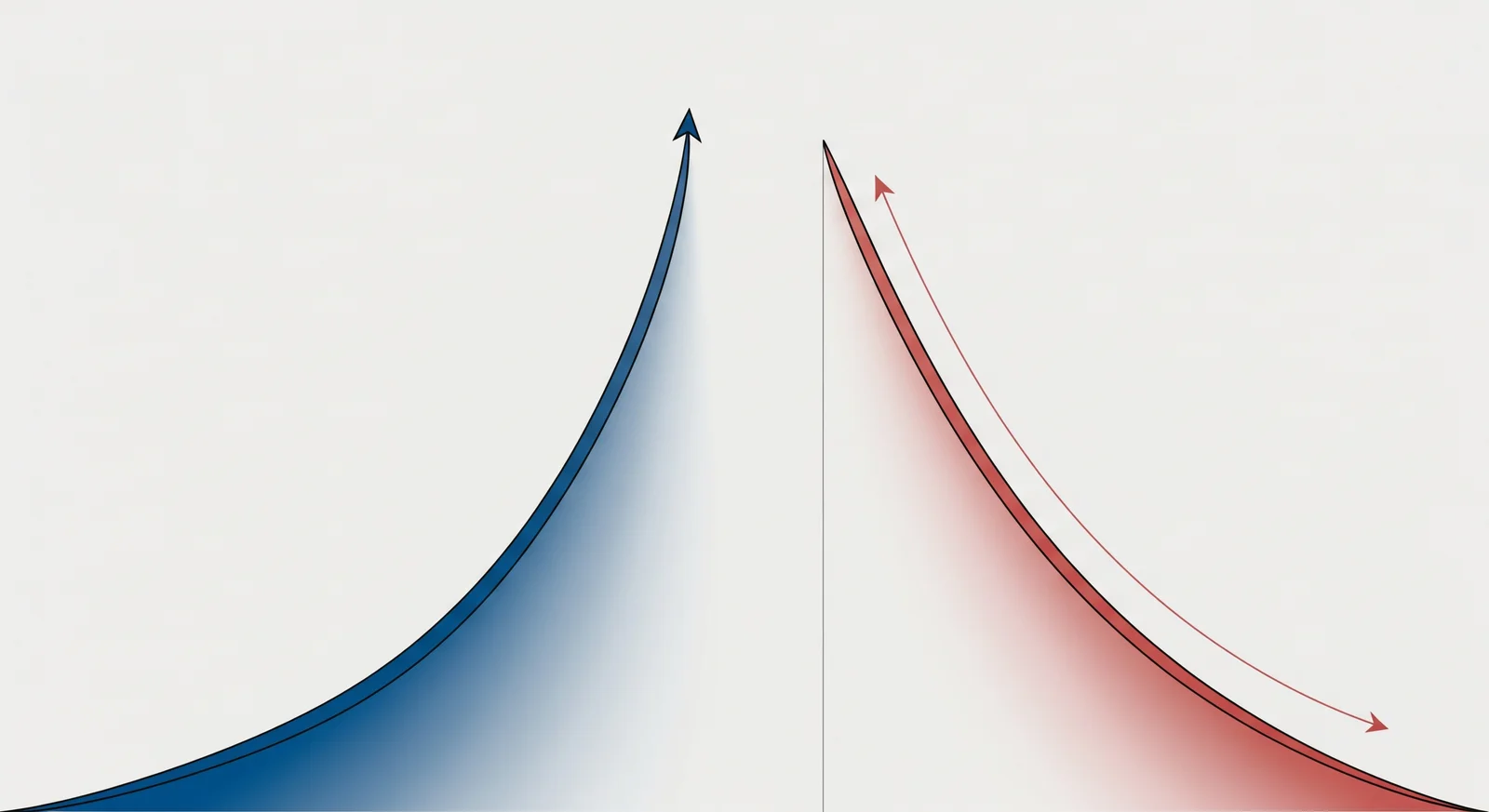
In a healthy economy, the yield curve slopes upward. The logic is simple: if you lend money to the government for 10 years, you take on more risk (inflation, interest rate changes, uncertainty) than lending for just 3 months. So you want higher compensation, meaning higher yields for longer maturities.
An inverted curve happens when this flips: short-term yields exceed long-term yields. It means investors accept a lower return to hold a 10-year bond than a 3-month bill. Why would anyone do that? Because they believe the economic future is gloomy and want to "lock in" today's long-term yields before the central bank is forced to cut rates sharply later.
The two most closely watched "spreads" are:
- 10-year vs 2-year (2s10s) - the most popular among traders and financial media.
- 10-year vs 3-month (10y3m) - considered by Federal Reserve researchers to be the most accurate recession predictor.
When either spread falls below zero (negative), we say the yield curve has "inverted".
Why an Inverted Curve Becomes a Recession Signal
Yield curve inversion is not just a statistical coincidence. It reflects two market forces acting at once:
1. The central bank raises short-term rates
When inflation peaks, central banks like the Federal Reserve raise interest rates to cool the economy. These hikes push short-term yields (which are highly sensitive to central bank policy) up quickly. This is exactly what happened during the Fed's aggressive rate-hike cycle of 2022 to 2023.
2. Investors pile into long-term bonds
At the same time, investors worried that the economy will slow start buying long-term bonds as a hedge. High demand pushes bond prices up, and when bond prices rise, their yields fall. The result: long-term yields drop below short-term yields, and the curve inverts.
In short, the inversion is the bond market's way of "voting" that the central bank has hiked rates too high and will trigger a slowdown, forcing it to cut rates again before long. Understanding cycles like this is the core of mature investing. Legendary investors like Howard Marks constantly stress the importance of reading market cycles, a skill we explore in our article on Howard Marks & the Oaktree Memos.
Track Record: Almost Never Wrong Since 1955
The main reason Wall Street is so obsessed with this signal is its remarkable track record. According to research from the Federal Reserve Bank of San Francisco, before every one of the 10 US recessions since 1955, the yield curve inverted first.
Even more striking, a simple rule that predicts a recession within two years when the term spread turns negative has correctly flagged all nine recessions since 1955, with only one "false positive" in the mid-1960s, when an inversion was followed by an economic slowdown but not an official recession.
Fed researchers found the 10-year vs 3-month spread to be the best summary measure. The lag between the term spread turning negative and the start of a recession is usually between 6 and 24 months. This is why an inversion is not a "sell everything now" signal, but rather an early warning to start being cautious.
It is important to understand: the yield curve does not cause recessions. It merely reflects the collective expectations of thousands of bond investors managing trillions of dollars. The strength of the signal comes from the fact that the bond market is usually "smarter" and more forward-looking than the stock market.
The 2022-2024 Episode: When the Signal 'Failed' for the First Time
This is where the story gets complicated, and why investors cannot follow this signal blindly. The inversion that began in July 2022 and ended around August 2024 was the longest sustained inversion in modern US history, lasting roughly 784 days, breaking the previous record from 1978-1979. At its trough, the 2s10s spread fell to about negative 108 basis points, making it the second-deepest inversion in post-war data.
By "the textbook", a recession should have followed. But it did not. Instead, US real GDP grew about 2.9% in 2023 and above 3% on an annualised basis in the second and third quarters of 2024. The 10-year vs 3-month spread finally turned positive again around December 2024. Many analysts now consider this episode potentially the first "false signal" in the series.
What is the lesson? An inverted yield curve is a probability indicator, not a guarantee. After the pandemic, unusual factors such as high household savings, a tight labour market, and massive fiscal intervention may have "delayed" or cancelled the usual effect. Smart investors use it alongside other indicators, not as a single crystal ball.
The Yield Curve in Malaysia: MGS, OPR & BNM
Although the term is more often associated with US Treasury bonds, Malaysia has its own yield curve through Malaysian Government Securities (MGS). Bank Negara Malaysia (BNM) regularly issues MGS with maturities of 3, 5, 7, 10, 15 and 20 years as benchmark securities, forming the local yield curve.
As of early 2026, Malaysia's interest rate environment is far more stable than the US. The 10-year MGS yield sits around 3.5% to 3.6%, while BNM has kept the Overnight Policy Rate (OPR) at a relatively low and stable level. The latest government yield data can be checked directly at the BNM Government Securities Yield page and portals like World Government Bonds.
A few things Malaysian investors need to understand:
- Malaysia's yield curve rarely inverts as severely as the US. The economic structure, BNM's more conservative policy, and local inflation dynamics make a full inversion relatively rare.
- Bursa Malaysia is still affected indirectly. When the US yield curve inverts and global recession fears rise, foreign capital often flows out of emerging markets including Malaysia, pressuring the Ringgit and the FBM KLCI.
- MGS yield movements are influenced by global trends. When global bond yields rise or fall, MGS usually moves in tandem, as reported by Business Today when geopolitical tensions hit the bond market.
For retail investors who want to dive deeper into the world of government bonds, we have a dedicated guide on Retail Sukuk Malaysia explaining how to buy government bonds without big capital.
How Bursa Malaysia Investors Can Use This Signal
This is the most important part: not just knowing what an inverted yield curve is, but knowing how to use it. Here is a practical approach for Bursa Malaysia investors.
1. Treat it as an alarm clock, not a panic button
When the US yield curve inverts, do not immediately sell all your stocks. Remember the 6 to 24 month lag. Instead, use it as a cue to start reviewing your portfolio: are you over-exposed to high-risk cyclical stocks that suffer most in an economic slowdown?
2. Tilt towards defensive stocks
When the recession signal flashes, defensive sectors like healthcare, utilities, telecommunications, and consumer staples are usually more resilient. You can read more in our article Defensive vs Growth Stocks. This does not mean dumping all growth stocks, but adjusting the ratio according to the cycle stage.
3. Build cash and keep dry powder
A prolonged inversion is a good time to build "dry powder" (cash for opportunities). History shows market drawdowns after recessions often create the best buying opportunities. Investors with cash while others panic tend to profit most.
4. Monitor, don't predict dates
Instead of trying to predict "exactly when" a recession arrives (impossible), monitor several indicators together consistently: the yield curve, employment data, inflation, and credit growth. Tracking core vs headline inflation gives a clearer picture of the price pressures that may force a central bank to act.
5. For advanced traders: hedging instruments
Experienced investors may consider hedging instruments during periods of heightened downside risk. We have discussed this phenomenon in our article on Inverse vs Leverage ETFs. However, such instruments are high-risk and not for everyone.
Common Mistakes When Investors Hear 'Inverted Yield Curve'
Many retail investors overreact when they read a headline about the yield curve. Among the most frequent mistakes:
- Selling all stocks immediately. The stock market often keeps rising for months after the first inversion. Exiting too early can cause you to miss big returns.
- Assuming it is 100% accurate. The 2022-2024 episode proved this signal can "fail". No single indicator is perfect.
- Ignoring the local context. A US yield curve inversion does not mean Malaysia's economy will fall at the same time. Domestic factors like commodities, government investment, and regional demand play a big role.
- Neglecting other asset classes. During recession fears, gold, bonds, and cash often serve as useful hedges for portfolio diversification.
FAQ (Frequently Asked Questions)
What does an inverted yield curve mean in simple terms?
It is a situation where lending to the government for a short term (e.g. 3 months) pays a higher yield than for a long term (e.g. 10 years). This flipped condition signals that the market expects the economy to slow.
Does an inverted yield curve guarantee a recession?
No. It is a highly reliable probability indicator historically, but not a guarantee. The 2022-2024 episode in the US is an example of a long inversion that was not followed by an official recession.
How long after an inversion does a recession usually occur?
According to Federal Reserve research, the lag between yield curve inversion and the start of a recession is usually between 6 and 24 months. This is why it is considered an early signal, not an immediate one.
Which spread is most important to watch?
The 10-year vs 3-month spread is considered by Fed researchers to be the most accurate recession predictor, while the 10-year vs 2-year (2s10s) spread is most popular in financial media and among traders.
Has Malaysia's yield curve ever inverted?
Malaysia's MGS yield curve rarely inverts as severely as the US due to its economic structure and BNM's more conservative policy. However, Bursa Malaysia is still affected indirectly when a US inversion triggers foreign capital outflows from emerging markets.
What should I do as a Bursa investor when the yield curve inverts?
Do not panic sell. Instead, review your portfolio's risk exposure, tilt towards defensive stocks, build cash for opportunities, and monitor several economic indicators together, not just the yield curve.
Why can long-term yields fall below short-term yields?
When investors worry the economy will slow, they pile into long-term bonds as a hedge. High demand raises bond prices and lowers their yields, until they fall below short-term yields, which are pushed up by central bank rate hikes.
Conclusion
The inverted yield curve is one of the most powerful economic warning signals ever, with a record of predicting almost every US recession since 1955. Yet the 2022-2024 episode reminds us that no indicator is perfect, and it should be used as part of the bigger picture, not as a single panic signal.
For Bursa Malaysia investors, the key is understanding context: the US yield curve hints at global sentiment and capital flows, while domestic factors determine the real impact on your portfolio. What matters most is preparing yourself with knowledge and strategy before the signal appears.
To start investing and apply this macroeconomic knowledge practically in the real market, you need the right trading account.
Open your CDS account today to start investing in Bursa Malaysia as well as foreign stocks such as the US and Hong Kong markets, so you can act quickly when opportunities arise.
And if you are just starting out, download our free Stock Market Basics Ebook to understand the fundamentals of stock investing before going further.
Further Reading
- Howard Marks & the Oaktree Memos: Reading Market Cycles Like a Distressed Investor
- Defensive vs Growth Stocks: Why a Smart Portfolio Needs Both
- Retail Sukuk Malaysia: How to Buy Government Bonds Without Big Capital
- Core vs Headline Inflation: Which Should Investors Follow?
- FBM KLCI Nearing 1,800: Why Inverse ETFs Outsell Leverage