Is Crypto Halal or Haram? SharLife CEO Answers Every Popular Question

"Is crypto halal or haram?" is perhaps the most frequently asked question among Muslim investors in Malaysia. It's not a simple question - the answer involves differences of scholarly opinion, blockchain technology developments, and regulations still under construction.
In an exclusive Bicara Kripto podcast with Tuan Zul Haikal, CEO and founder of SharLife - Malaysia's first Shariah-compliant crypto screener platform - many popular questions about crypto and Shariah were answered in detail. SharLife isn't just any platform - it's registered as a Shariah Advisory under the Securities Commission (SC) Malaysia, with a Shariah committee comprising leading experts including the Mufti of the Federal Territory.
This article summarises the key points from that conversation - from the fatwa status of Bitcoin, rulings on futures and meme coins, all the way to crypto zakat.
Bitcoin Already Has a Fatwa, But What About Altcoins?
One thing many crypto investors don't know - Bitcoin actually has a gazetted fatwa. According to Tuan Zul, the Perlis State Fatwa has gazetted Bitcoin as permissible (harus), including the obligation to pay zakat on it.
The Mufti of Selangor and the Mufti of the Federal Territory have also issued similar views. However, for cryptocurrencies other than Bitcoin (altcoins), no official fatwa has been issued by any fatwa body in Malaysia.
What exists now are scholarly opinions and screening platforms like SharLife that make assessments based on specific methodologies. Tuan Zul himself emphasised that the Shariah status issued by SharLife is not a fatwa - it's an opinion based on methods that have been presented to the SC Malaysia.
What Is SharLife and Who's Behind It?
SharLife has been operating for nearly 5-6 years (starting as Tuan Zul's personal project) and has been incorporated for 3 years. The platform provides a Shariah-compliant crypto screener - helping investors identify which tokens meet Shariah criteria.
SharLife's Shariah committee comprises three members:
- Tuan Zul Haikal - CEO and Shariah committee member
- Ustaz Ahmad Fawaz - Mufti of the Federal Territory
- Ustaz Arham - Former Head of Shariah at Bursa Malaysia
SharLife's screening methodology has been presented to the SC, and the SC has "noted" it without rejection. This gives SharLife legitimacy as a Shariah screening reference in Malaysia's crypto ecosystem.
Crypto Is Not Currency, It's an Asset
One of the most important points discussed - and often misunderstood - is how the SC Malaysia classifies crypto.
According to the Securities Commission Malaysia guidelines, crypto is recognised as "mal" (beneficial property/asset), not currency. This classification carries significant legal implications:
- As an asset, crypto can have deferred payments
- Crypto is not subject to currency exchange rules (ribawi items)
- This forms the basis for why lending platforms can be Shariah-compliant - because crypto is not a ribawi item
According to hadith, there are 7 ribawi items mentioned (gold, silver, wheat, barley, dates, salt, and rice). Crypto is not included in this list, so rulings related to currency exchange riba do not directly apply.
Crypto Futures - Can Be Shariah-Compliant, But No Platform Does It Right
This is among the most controversial topics. Many immediately assume futures are haram without understanding the mechanics.
According to Tuan Zul, futures by default can actually be Shariah-compliant - if the product is structured correctly. He gave the example of FCPO (Futures Crude Palm Oil) in Malaysia, which has long operated as Shariah-compliant on Bursa Malaysia.
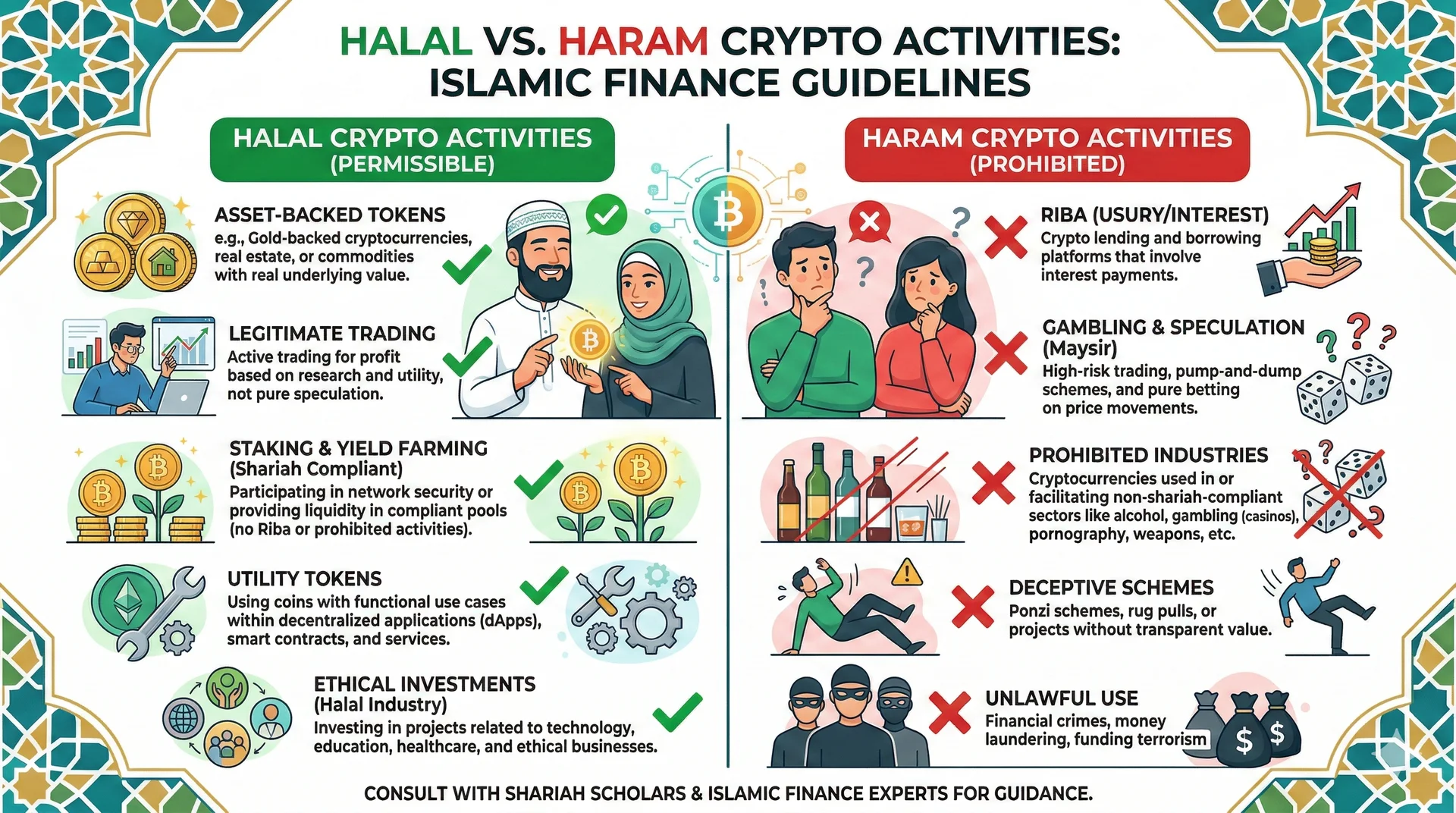
The problem? Not a single crypto platform structures futures in a Shariah-compliant manner like FCPO. All current crypto platforms use CFD (Contract for Difference), which is not Shariah-compliant because:
- No actual underlying asset
- Involves high levels of gharar (uncertainty)
- No physical settlement
Tuan Zul revealed he once met with the CEO of Bybit to discuss the possibility of structuring crypto futures in a Shariah-compliant manner. SharLife is ready to serve as an advisory should any platform seriously want to build halal crypto futures products.
Meme Coins - Not Shariah-Compliant by Default
For investors excited about meme coins, this is a fact that needs to be accepted - all new meme coins are automatically not Shariah-compliant.
Why? Because new meme coins don't meet the criteria for "mal" (beneficial property). They have no utility, no real project behind them, and their value depends entirely on speculation.
However, there are interesting exceptions. Coins like Dogecoin and Shiba Inu that already have large communities and are accepted as a medium of payment on several platforms can change status. According to Tuan Zul, such coins can shift to "gray" status after a review conducted twice a year (semi-annually).
So it doesn't mean meme coins are permanently non-Shariah-compliant - it depends on the development of their ecosystem and utility over time.
Staking and DeFi - What's the Ruling?
For staking enthusiasts, there's good news. Native staking for tokens like Solana and Ethereum has no Shariah issues.
This includes:
- Native staking - locking tokens to support the blockchain network
- LST (Liquid Staking Tokens) - tokens representing staking positions
- Liquidity pools - providing liquidity in DeFi protocols
A frequently raised question is - what if the validator processes haram transactions made by others? According to Tuan Zul, this issue is considered beyond the validator's control and does not affect the Shariah status of the staking party.
For example, staking on Luno Malaysia has received certification from SharLife as Shariah-compliant.
For lending and DeFi, the same principle applies - since crypto is categorised as an asset (not currency), lending activities are not directly subject to ribawi item rules. However, each protocol needs to be assessed individually based on its structure and mechanisms.
"Prohibiting What Is Halal Is Worse Than Permitting What Is Haram"
This is the fiqh principle that forms the core philosophy of SharLife in evaluating crypto assets. Ustaz Ahmad Fawaz (Mufti of the Federal Territory) brought this principle into SharLife's Shariah committee, and it fundamentally changed the screening approach.
Previously, many parties took a cautious approach - prohibiting everything doubtful. However, this principle reminds us that forbidding something that is actually halal also carries sin - it denies Muslims the right to benefit from legitimate assets and technology.
This doesn't mean everything is relaxed without control. Each token still goes through rigorous screening based on:
- Project utility and benefit
- Financial structure
- Absence of riba, gharar, and maisir elements
Tokenomics and VC - Is It a Shariah Issue?
Many question the allocation of tokens to VCs (Venture Capital), founders, and teams before a token launches. Isn't this unfair?
According to Tuan Zul, this is not a Shariah issue. It's a common practice similar to the IPO process on Bursa Malaysia - where founders, early investors, and institutions receive share allocations before being offered to the public.
As long as there's no evidence of riba, gharar, or maisir in the tokenomics structure, it cannot be ruled as non-Shariah-compliant. What matters is transparency in token distribution and the project roadmap.
Crypto Zakat - An Obligation Many Forget
One aspect rarely discussed - if you hold crypto that meets the haul (period) and nisab (minimum amount) requirements, you are obligated to pay zakat.
SharLife provides a platform to pay crypto zakat using native tokens like Solana, Ethereum, or Polygon. The platform once collaborated with PPZ (Pusat Pungutan Zakat) for Malaysia's first crypto zakat payment.
According to Tuan Zul, crypto zakat collection amounts are large but come from a small number of payers - mostly "whale" investors holding significant amounts. In fact, 2-3 zakat payers from the United Kingdom also use SharLife through one-to-one sessions.
Comparison With Other Platforms
Internationally, IFG (Islamic Finance Guru) is among the popular platforms. However, according to Tuan Zul, IFG only covers about 30 coins with very limited detail.
SharLife, in contrast, provides more comprehensive screening because:
- Backed by a Shariah committee registered under the SC
- Methodology that has been presented to the regulator
- Semi-annual screening for tokens other than layer-1
- Specific Malaysian local context
DYOR - Including the Shariah Aspect
Tuan Zul's main message to all Muslim crypto investors - don't argue about crypto's Shariah status. Most rulings that exist now are still at the opinion level, not fatwa. Differences of opinion between platforms and scholars are normal in Islamic jurisprudence.
Use platforms like SharLife as a guide and helper, not as a definitive fatwa. Every investor is responsible for doing their own research (DYOR) - including on the Shariah aspect.
The SC Malaysia is also in the process of building a more comprehensive crypto framework. When this framework is complete, it will become a clearer benchmark for the future.
FAQ - Crypto and Shariah
Is Bitcoin halal in Malaysia?
Yes, the Perlis State Fatwa has gazetted Bitcoin as permissible (harus). The Mufti of Selangor and the Mufti of the Federal Territory have also issued similar views. Bitcoin is also recognised by the SC Malaysia as a tradeable digital asset.
What's the difference between a fatwa and a Shariah opinion?
A fatwa is an official ruling by a fatwa body with legal authority (like the Perlis Fatwa). A Shariah opinion (like those issued by SharLife) is an assessment based on specific methodology but without legal authority.
Are crypto futures halal?
Futures can conceptually be Shariah-compliant, but currently no crypto platform structures them in a Shariah-compliant manner. All platforms use CFDs which don't meet Shariah requirements.
Can I invest in meme coins?
New meme coins are not Shariah-compliant by default because they have no real utility. However, mature meme coins with large communities (like Dogecoin) can change status after review.
Is crypto staking haram?
Native staking for tokens like Solana and Ethereum has no Shariah issues. In fact, staking on Luno has received certification from SharLife.
How do I pay crypto zakat?
You can pay crypto zakat through the SharLife platform using tokens like Solana, Ethereum, or Polygon. SharLife has collaborated with PPZ for crypto zakat collection.
Is crypto lending haram?
Not necessarily. Since crypto is categorised as an asset (not currency), it's not included in the ribawi items list. However, each lending protocol needs to be assessed individually.
What is SharLife and who runs it?
SharLife is a Shariah-compliant crypto screener platform registered under the SC Malaysia. Its Shariah committee comprises Tuan Zul Haikal (CEO), Ustaz Ahmad Fawaz (Mufti of the Federal Territory), and Ustaz Arham (former Head of Shariah at Bursa Malaysia).
Conclusion
The crypto and Shariah landscape in Malaysia is evolving rapidly. Bitcoin already has a clear fatwa, while other crypto assets still depend on opinions and screening by bodies like SharLife. What matters is that investors need to do their own research including on the Shariah aspect, and not be too quick to judge something without understanding its fundamentals.
If you're ready to start building a more structured investment portfolio, the first step is having access to the right platform.
Open a CDS trading account today to start investing on Bursa Malaysia as well as international stocks including US and Hong Kong markets through one platform.
Download our free stock market basics ebook to understand the fundamentals of investing before taking the next step.