Psychology of Gambling: Why the Human Brain Gets Trapped

Quick Answer
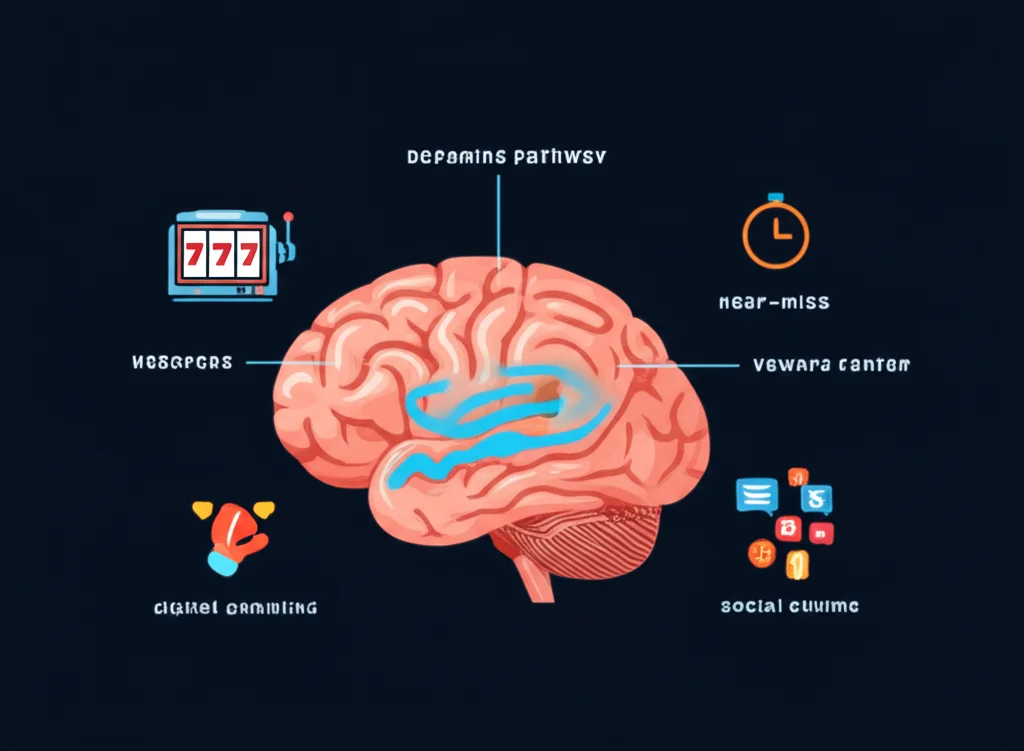
The human brain easily gets trapped by gambling because of dopamine and variable ratio reinforcement mechanisms - the same reward system involved in drug addiction. The gambling industry is specifically designed to exploit this weakness. Islam prohibits gambling not merely as a legal ruling, but as a protection against human psychological vulnerabilities that have now been proven by modern science.
Dopamine: The Chemical Behind Addiction
To understand why gambling is so captivating, we need to understand the role of dopamine - a chemical in the brain that functions as a "pleasure messenger".
Dopamine is released when the brain anticipates a pleasurable reward. Interestingly, neuroscience research shows that dopamine is released in greater amounts when the reward is uncertain compared to when it is guaranteed.
This means: uncertainty itself is addictive.
According to a study published in the journal ScienceDirect, random and unpredictable reward patterns produce stronger behavioral reinforcement than consistent rewards - even when the total reward amount is smaller. This is why someone can keep playing slot machines even though they know the odds of winning are extremely low.
Variable Ratio Reinforcement: The Most Powerful Secret of the Gambling Industry
In psychology, there is a concept called the variable ratio reinforcement schedule. It is the technique most resistant to behavioral extinction among all types of reinforcement.
How Does It Work?
Imagine you are pressing a slot machine button. Sometimes you win after 5 presses. Sometimes after 50. Sometimes after 200. You do not know when the reward will come - but you know it WILL come at some point.
This uncertainty creates an extremely powerful addiction loop:
- Press the button (behavior)
- No win (minor disappointment)
- Dopamine is still released because the brain anticipates a reward might come on the next attempt
- Press again - the loop repeats
According to HARP Private Rehab, this type of reward schedule activates the brain's reward center in a manner similar to addictive substances like cocaine and heroin. The difference? You do not need to inject anything - just playing is enough.
Why Is It So Hard to Stop?
With a fixed reward schedule (example: monthly salary), your brain knows when the reward is coming and can adjust expectations. But with variable ratio, your brain is constantly in a state of "maybe this time!" - and this state is extremely difficult to extinguish.
Psychology researcher B.F. Skinner discovered that rats given rewards on a variable ratio schedule would continue pressing a lever thousands of times even after rewards were completely stopped. Humans are not much different.
Near-Miss Effect: Why "Almost Winning" Is More Dangerous Than "Losing Badly"
One of the most important discoveries in gambling psychology is the near-miss effect. This phenomenon occurs when a gambling outcome is very close to a win but is actually still a loss.
Example: a slot machine displays two matching symbols, and the third symbol stops just one space away from a win. You win nothing - but your brain processes the experience as if you almost won.
A study by Clark et al. (2009) published in the journal Neuron found that although near-misses were rated as more unpleasant than full losses, they simultaneously increased the desire to continue playing. This is because near-misses activate the same brain reward circuits as actual wins.
More concerning, further research found that individuals who already had gambling problems showed stronger midbrain dopamine responses to near-misses - creating a vicious cycle that becomes increasingly difficult to escape.
Near-Miss Is Not a Coincidence
The gambling industry knows about the near-miss effect and deliberately programs slot machines to produce near-misses at rates higher than normal chance. This is not a conspiracy theory - it is a documented business strategy.
Gambling Disorder: When Gambling Becomes a Disease
In 2013, the American Psychiatric Association (APA) made a historic move. In the fifth edition of the Diagnostic and Statistical Manual of Mental Disorders (DSM-5), gambling addiction was moved from the "Impulse Control Disorders" category to the "Substance-Related and Addictive Disorders" category - the same category as alcohol and drug addiction.
This means modern science officially recognizes that gambling can cause addiction equivalent to drugs from a neurobiological perspective.
Diagnostic Criteria
A person is diagnosed with Gambling Disorder if they meet at least 4 of the following 9 criteria within a 12-month period:
- Needing to gamble with increasing amounts of money to achieve excitement
- Feeling restless or irritable when trying to reduce or stop gambling
- Repeated unsuccessful attempts to control or stop gambling
- Frequently thinking about gambling (recalling past experiences, planning the next session)
- Gambling when feeling distressed (sad, guilty, anxious)
- After losing, returning to gamble to "get even" (chasing losses)
- Lying to hide the extent of gambling involvement
- Losing relationships, jobs, or educational opportunities due to gambling
- Relying on others to solve financial problems caused by gambling
Statistics in Malaysia
According to a study published in the Asian Journal of Gambling Issues and Public Health, the problem gambling rate in Malaysia stands at 4.4% - higher than other Asian populations that report rates between 1.4% and 2.5%. This means nearly 1 in every 23 adults in Malaysia has a gambling-related problem.
Psychology Techniques Used by the Gambling Industry
The multi-billion dollar gambling industry did not happen by accident. It is carefully designed using psychological principles to maximize the time and money spent by players:
1. Design Without Clocks and Windows
Casinos deliberately do not install clocks or windows so that players lose their sense of time. Without external cues, the brain does not notice how much time has passed.
2. Winning Sounds and Lights
Every small win is greeted with cheerful sounds and flashing lights. This creates the illusion that wins occur more frequently than they actually do - a phenomenon called availability bias.
3. Tokens and Chips Replace Real Money
Using chips or digital credits reduces the pain of paying - the psychological pain felt when parting with real money. When you do not see cash leaving your pocket, your brain feels the loss less.
4. Free Spins and Bonuses
"Free trials" and sign-up bonuses function as the foot-in-the-door technique - a psychological technique where a small request opens the door to a larger commitment. Once you start playing for free, the likelihood of continuing with real money increases dramatically.
5. Social Proof
Displays of big winners, testimonials, and leaderboards use the principle of social proof - "if others can win, so can I." What is not shown are the thousands of people who lost for every single winner.
Gacha Games and Loot Boxes: Digital Casinos for the Young Generation
The gacha game and loot box phenomenon in video games uses the same psychological mechanisms as casino slot machines - but targets young people, including children.
A study published in the journal Addictive Behaviors found that:
- Loot box purchases have a significant correlation with gambling problems
- Players who spend heavily on loot boxes show psychological profiles more similar to gamblers than regular gamers
- The "pity system" mechanism (guaranteed item after x attempts) actually strengthens addiction because it creates an illusion of control
This means popular apps like Genshin Impact, FIFA Ultimate Team, and Mobile Legends that sell loot boxes are essentially operating using casino mechanisms - just in a more attractive package accessible to anyone with a smartphone.
Islam Already Knew: The Prohibition of Gambling as Psychological Protection
This is the most fascinating part. More than 1,400 years before neuroscience research and DSM-5, Islam had firmly prohibited gambling. And when we compare the reasons for prohibition with modern scientific findings, the alignment is remarkable:
| What Islam Says | What Modern Science Says |
|---|---|
| "Creates enmity and hatred" (Al-Ma'idah: 91) | Studies show gambling destroys social and family relationships |
| "Diverts from the remembrance of Allah and prayer" (Al-Ma'idah: 91) | Gambling addiction monopolizes attention and disrupts daily functioning |
| Wealth obtained through falsehood | The gambling system is designed so that the majority will certainly lose - it is not a fair exchange |
| Greed and reliance on luck | Variable ratio reinforcement creates an addiction loop that exploits greed and false hope |
| Destroys the mind | DSM-5 recognizes gambling disorder as a mental disorder equivalent to drug addiction |
Islam's prohibition of gambling is not merely an arbitrary rule. It is a preventive measure against a form of addiction that modern science has only recently begun to fully understand.
As discussed in the previous article on the ruling of gambling in Islam, this prohibition covers all forms - from traditional casinos to modern gacha games.
How to Protect Yourself and Your Family
1. Recognize the Early Signs
If you or a family member begins showing the following signs, take immediate action:
- Spending more than you can afford on games or betting
- Lying about the amount of time or money spent
- Feeling restless when not playing
- "Chasing losses" - gambling more to recover lost money
2. Limit Access
Uninstall gacha game apps, block gambling websites, and limit access to digital payment methods that facilitate impulsive spending.
3. Educate Your Children
Explain to children why games like gachapon and loot boxes contain gambling elements. Teach them about the value of money and the dangers of impulsive spending from a young age.
4. Strengthen Your Relationship with Allah
Prayer, dhikr, and remembering the hereafter are not merely spiritual practices. From a psychological perspective, they function as emotional regulation mechanisms that help control impulses and provide a greater sense of purpose than momentary pleasure.
5. Channel the Need for Risk into Halal Activities
Humans naturally need some degree of risk and excitement. Channel this need into productive activities - such as shariah-compliant stock investing, business, sports, or challenging hobbies.
FAQ - Frequently Asked Questions About Gambling Psychology
Why do people who have already lost still want to keep gambling?
This is caused by a combination of several psychological factors: variable ratio reinforcement that creates the expectation of "maybe this time", the near-miss effect that tricks the brain into feeling like it almost won, and chasing losses - the desire to "get even" by winning back lost money.
Is gambling addiction the same as drug addiction?
From a neurobiological perspective, yes. DSM-5 categorizes gambling disorder together with substance addiction because both involve similar dopamine reward system activation. The difference is that gambling does not involve external chemicals - the brain itself produces the "high".
Why are children easily influenced by gacha games?
Children's brains are not yet fully developed, especially the prefrontal cortex that controls impulse regulation and decision-making. This makes them more susceptible to the variable ratio reinforcement mechanisms in gacha games and loot boxes.
Can gambling addiction be treated?
Yes. Treatment includes cognitive-behavioral therapy (CBT), counseling, and in certain cases, medication. Recovery rates depend on the severity of addiction and environmental support. In Malaysia, Talian KASIH (15999) provides free counseling assistance.
What is the connection between social media and gambling mechanisms?
Recent studies show that social media uses the same variable ratio reinforcement as gambling - likes, comments, and notifications arrive unpredictably, creating a similar dopamine loop. This explains why many people find it difficult to put their phones down.
Are some people more prone to addiction than others?
Yes. Genetic factors, family history, mental health issues (depression, anxiety), and impulsive personality increase the risk of gambling addiction. However, no one is immune - the gambling system is designed to exploit weaknesses that exist in all human brains.
Why does Islam prohibit gambling completely instead of just restricting it?
Modern science shows that gambling addiction mechanisms are extremely powerful and progressive - they tend to get worse, not better. Total prohibition is the most effective preventive approach because, like drugs, "a little" gambling can easily turn into addiction.
What should I do if I suspect a family member is addicted to gambling?
Start a conversation gently and without judgment. Offer emotional support. Suggest seeking professional help through Talian KASIH (15999) or a certified counselor. Most importantly, do not lend money to pay gambling debts because it enables the addiction to continue.
Conclusion
Gambling addiction is not merely a matter of moral weakness or lack of faith. It is a complex neurobiological condition where the human brain is exploited by systems specifically designed to create addiction. Islam, with divine wisdom, prohibited gambling more than a thousand years before modern science fully understood these mechanisms - yet another proof that Islamic prohibitions are not arbitrary, but a form of protection ahead of its time.
If you want to channel the desire for risk and reward into a halal and productive path, shariah-compliant stock investing is a far better alternative.
Open a CDS Trading Account through Mahersaham to start investing on Bursa Malaysia with guidance from a licensed remisier.
Download the Free Stock Market Basics Ebook to understand the fundamentals of halal investing.
Further Reading
- What Is Gambling in Islam? Evidence, Rulings & Modern Examples
- From Sports to AI: Americans Are Now Haunted by Gambling Addiction
- Why Should Muslims Be the Smartest Financial Decision Makers?
- Why Is Forex Haram? 5 Key Reasons & What Malaysian Fatwa Says
- BNPL Guide Malaysia: Risks, Shariah Ruling & How to Use It Wisely