What Is Targeted Subsidy? Malaysia's BUDI95, SARA & More Explained

What Is a Targeted Subsidy?
A targeted subsidy is the government's approach to channelling financial assistance and subsidies only to those who truly need it, based on income level, household composition, and disposable income.
Unlike blanket subsidies enjoyed by everyone regardless of economic status, targeted subsidies ensure government aid reaches the right groups - primarily the B40 and a portion of the M40.
Blanket Subsidy vs Targeted Subsidy
| Aspect | Blanket Subsidy | Targeted Subsidy |
|---|---|---|
| Recipients | All citizens (rich & poor) | Only eligible groups |
| Foreign nationals | Also benefit | Malaysian citizens only |
| Leakage | ~50% goes to the wealthy | Leakage significantly reduced |
| Fiscal burden | Unsustainable (RM26 billion/year) | More sustainable |
| Savings | None | ~RM15.5 billion per year |
According to the Ministry of Finance Malaysia, the shift to a targeted subsidy model allows the government to save billions of ringgit that previously leaked to those who did not need it.
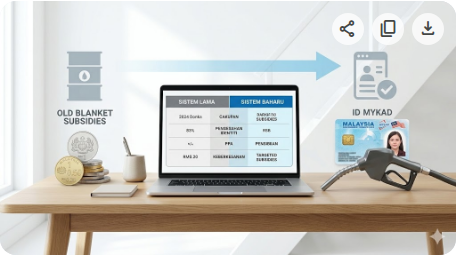
History of Malaysia's Targeted Subsidy Transition
The shift to targeted subsidies did not happen overnight. It went through several key phases:
2022: Planning Phase
The government announced its intention to move toward a targeted subsidy model. At that time, Malaysia was spending RM45.184 billion on fuel subsidies alone. However, implementation was delayed due to uncertain global economic conditions.
June 2024: Diesel Subsidy Rationalisation
This was the first concrete step. The government removed the blanket diesel subsidy in Peninsular Malaysia, setting the retail price at RM3.35 per litre based on market rates. As a replacement, the Subsidised Diesel Card System 2.0 (SKDS 2.0) was introduced for 33 eligible commercial vehicle types.
September 2025: BUDI95 Launch
The biggest milestone in the targeted subsidy agenda - the launch of BUDI MADANI RON95 (BUDI95). This programme replaced the blanket RON95 petrol subsidy with a more targeted system. About 90% of Malaysians continue to enjoy subsidised petrol at RM1.99 per litre through the BUDI95 portal.
2026: STR & SARA Expansion
Budget 2026 allocated RM15 billion for STR and SARA - a 30% increase from the previous year. All Malaysians aged 18 and above received a one-off RM100 SARA credit.
Full List of Current Targeted Subsidy Programmes
Here are all the targeted subsidy programmes currently running in Malaysia:
1. BUDI95 - RON95 Petrol Subsidy
The largest programme, covering approximately 16 million Malaysian drivers.
- Subsidised price: RM1.99 per litre (capped at 300 litres per month)
- Market price: RM2.60 per litre (above the quota)
- Eligibility: All Malaysian citizens aged 16 and above with a valid driving licence
- Portal: budi95.gov.my
Notably, BUDI95 does not use an income threshold - all citizens with a driving licence are automatically eligible. Only the T15 group (the wealthiest 15%) are excluded.
2. SKDS 2.0 - Diesel Subsidy
Replaces the blanket diesel subsidy with a fleet card system.
- Subsidised price: RM2.15 per litre (via fleet card)
- Market price: RM3.35 per litre
- Eligibility: 33 types of commercial vehicles (public transport & logistics)
- Government savings: RM4 billion per year
- Portal: mysubsidi.kpdn.gov.my
In addition to the fleet card, the BUDI Individu programme provides RM200 per month to individuals who own diesel vehicles, while BUDI Agri-Komoditi targets small-scale farmers.
3. STR - Sumbangan Tunai Rahmah (Cash Aid)
Monthly cash assistance for the B40 group.
- Amount: RM50 to RM200 per month
- Eligibility: B40 category (household income below RM5,250)
- Portal: strsara.my
4. SARA - Sumbangan Asas Rahmah (Essential Aid)
A non-cash assistance programme launched in January 2024 to help vulnerable groups purchase basic necessities.
- Amount: RM50 to RM100 per month (purchase credit)
- 2026 Bonus: One-off RM100 credit for all Malaysians aged 18 and above
- Eligibility: B40, lower M40, senior citizens, and single individuals
- Portal: sara.gov.my
SARA credits can be used at participating retail chains such as Mydin, Tesco, and Giant to purchase approved daily essentials.
5. Electricity Bill Rebate
A rebate programme of up to RM40 per month for the hardcore poor.
- Amount: Up to RM40 per month
- Eligibility: B40 group (average income of RM1,198 per month)
- 2026 Allocation: RM55 million
If the electricity bill is less than RM40, the rebate covers the entire bill. If it exceeds RM40, only RM40 is covered.
6. Subsidised Cooking Oil (eCOSS)
Starting May 2025, the eCOSS (Electronic Commodity Subsidy System) was introduced to digitally monitor the sale of subsidised packaged cooking oil.
- Eligibility: Malaysian citizens only (MyKad required)
- Restriction: From 1 March 2026, foreign nationals are banned from buying subsidised packaged cooking oil
- Next phase: MyKad QR code integration (June 2026)
7. PGRM - Program Jualan Rahmah Madani (Discounted Goods Sale)
A programme selling daily goods at 10-30% discounts, implemented across all 222 parliamentary constituencies.
- 2026 Allocation: RM300 million
- Target: 20,000 sale events per year
- Items: Chicken, fish, eggs, rice, sugar, cooking oil, vegetables, fruits, and household essentials
How Is Eligibility Determined? The Role of PADU
What Is PADU?
PADU (Pangkalan Data Utama / Central Database Hub) is a centralised government database that collects socioeconomic information on citizens to determine eligibility for targeted subsidies.
Data collected includes:
- Demographic and location information
- Socioeconomic status and employment
- Income and household composition
- Education level
- Vehicle ownership
- Poverty status and government assistance received
To date, PADU has recorded profiles for 30.4 million individuals.
Income Classification System
Malaysia is transitioning from the traditional B40/M40/T20 system to a net disposable income approach:
Old System:
| Classification | Household Income |
|---|---|
| B40 (Bottom 40%) | Below RM5,250 |
| M40 (Middle 40%) | RM5,250 - RM11,819 |
| T20 (Top 20%) | Above RM11,819 |
New System (2025 onwards):
The government now uses a disposable income approach that accounts for basic living expenses and number of dependants - not just gross income. This means a high earner with many dependants may still qualify for assistance.
How Much Does the Government Save Through Targeted Subsidies?
The shift to targeted subsidies delivers significant savings to the national finances:
| Programme | Annual Savings |
|---|---|
| Diesel rationalisation | RM4.0 billion |
| RON95 targeting (T15 excluded) | RM8.0 billion |
| Other subsidies (eggs, chicken, etc.) | RM3.5 billion |
| Total | RM15.5 billion |
Before targeted subsidies, roughly 50% of subsidies leaked to the wealthy and foreign nationals. The money saved is now redirected to aid programmes such as STR, SARA, and PGRM.
Overall subsidy allocations also show a healthy downward trend - from RM61.4 billion (2024) to RM52.6 billion (2025), reflecting the effectiveness of the targeted approach.
Challenges & Criticisms of Targeted Subsidies
Although targeted subsidies are theoretically more efficient, their implementation is not without challenges.
PADU Issues
- Low participation: Many citizens are reluctant to update their PADU profiles due to concerns about personal data collection
- Data security: PADU has experienced several data security issues since its launch
- Poor communication: Government messaging around PADU and targeted subsidies remains unclear, causing confusion among the public
Inflation Concerns
Citizens worry that removing blanket subsidies will trigger price increases. Although the government has provided assurances, consumer inflation risks remain, particularly during the transition period.
Leakage Still Occurs
Before targeted subsidies, leakage reached RM26 billion per year. Although it has been reduced, issues such as fuel smuggling to neighbouring countries and misuse of diesel fleet cards still persist.
Geographic Disparities
Implementation differences between Peninsular Malaysia and Sabah/Sarawak (which still maintain blanket diesel subsidies) raise questions of fairness. Rural areas may also struggle to access programmes like PGRM consistently.
FAQ: Targeted Subsidies Malaysia
Do I need to register with PADU to receive targeted subsidies?
PADU registration is not mandatory but is strongly encouraged. Outdated data may cause you to lose eligibility for certain subsidies. Register or update your profile at padu.gov.my.
What is the RON95 petrol purchase limit under BUDI95?
The maximum is 300 litres per month at RM1.99 per litre. Purchases beyond the quota are charged at the market price of RM2.60 per litre.
Who is not eligible for RON95 subsidies?
The T15 group (the wealthiest 15%) is excluded. However, approximately 85-90% of Malaysians still enjoy subsidised prices.
Can foreign nationals benefit from targeted subsidies?
No. All targeted subsidy programmes are exclusively for Malaysian citizens holding a valid MyKad.
How do I check my subsidy eligibility?
You can check through several official portals - BUDI95 for petrol subsidies, strsara.my for STR and SARA, and mysubsidi.kpdn.gov.my for diesel subsidies.
What happens if I do not update my PADU data?
Outdated data may cause the system to incorrectly assess your eligibility. You may lose access to subsidies you are rightfully entitled to.
When will subsidised cooking oil purchases use the MyKad QR code?
MyKad QR code integration for subsidised cooking oil purchases is scheduled to begin on 1 June 2026.
Will targeted subsidies cause prices to rise?
In theory, targeted subsidies reduce the government's fiscal burden without raising prices for the majority of citizens. However, the transition period may see some price increases in certain sectors.
Conclusion
Targeted subsidies represent a strategic move by the Malaysian government to ensure financial assistance reaches those who truly need it. With annual savings of RM15.5 billion and coverage of over 85% of citizens, it marks a new era in national fiscal management - although implementation challenges still need to be addressed.
Understanding government fiscal policy and subsidies is a first step toward making informed financial decisions.
If you are ready to start investing for the future, open a CDS Trading Account to invest in Bursa Malaysia as well as international markets including US and Hong Kong stocks via mahersaham.com/akauncds.
Also download the free Stock Market Basics Ebook to understand the fundamentals of investing at mahersaham.com/ebookasas.