Waqf in Malaysia: RM1.3 Trillion in Frozen Assets & Strategies to Develop Them

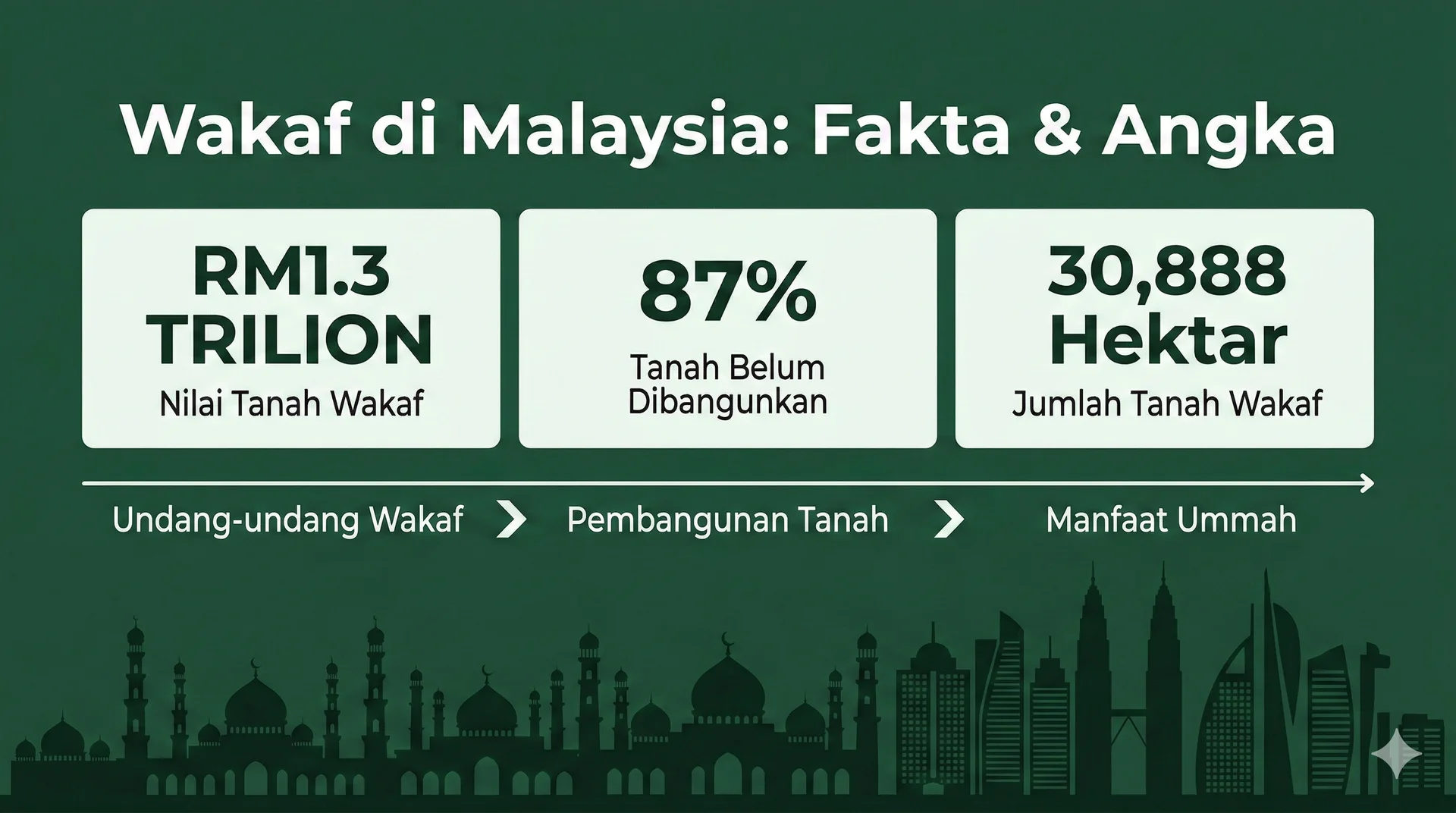
Malaysia holds waqf assets valued at over RM1.3 trillion - yet 87% of them remain undeveloped and idle. This means the Muslim community in the country is sitting on an enormous economic treasure, but has failed to capitalize on it. Why does this happen, and how can it be fixed?
This article examines the concept of waqf from its Arabic linguistic roots to modern implementation in Malaysia, including the complete procedure for endowing property, the frozen asset crisis plaguing waqf institutions, and the latest strategies from both institutional and individual perspectives.
What Is Waqf? Origins & Shariah Definition
The word waqf comes from the Arabic وقف (waqf), meaning "to stop", "to hold", or "to prevent transfer of ownership". Its root is waqafa - yaqifu - waqfan. A synonym in Arabic is al-Habs (الحبس), meaning "to restrain".
From a Shariah perspective, the Federal Territory Mufti Department defines waqf as: "Any property where the endower's rights are withheld from all transactions including sale, inheritance, gifts, and bequests, while preserving its physical source, for charitable purposes."
In simple terms - once a person endows property as waqf, that property can no longer be sold, inherited, or transferred. It remains for public benefit or a specific purpose in perpetuity.
Ibn Qudamah, a Hanbali scholar, summarized this concept: "Retaining the principal (asset) and donating its yield."
Quran & Sahih Hadith Evidence on Waqf
Quranic Evidence
Allah says in Surah Ali Imran, verse 92:
"You will never attain righteousness until you spend from that which you love."
This verse sparked the first waqf in Islamic history. The companion Abu Talhah al-Ansari, upon hearing this verse, immediately endowed his beloved garden "Bairuha'" in Madinah - one of the most fertile lands he owned.
Surah Al-Baqarah, verse 261 explains the multiplied rewards for those who spend wealth in Allah's path - including waqf as a form of ongoing charity (sadaqah jariyah).
Sahih Hadith
Hadith of Umar ibn al-Khattab's Waqf (Sahih Muslim, No. 1632):
Narrated by Ibn Umar: Umar acquired a piece of land in Khaibar and asked the Prophet SAW about it. He said: "If you wish, you may hold the property and give its produce as charity." So Umar endowed it with the condition that it could not be sold, gifted, or inherited.
This is the strongest hadith on waqf as it represents the first systematically documented waqf, with the Prophet's direct approval. Its proceeds were distributed to the poor, relatives, freeing slaves, and travelers.
Hadith of Ongoing Charity (Sahih Muslim, No. 1631):
"When a person dies, all their deeds cease except for three: ongoing charity, beneficial knowledge, or a righteous child who prays for them."
Imam An-Nawawi confirmed that "ongoing charity" in this hadith specifically refers to waqf, as it provides continuous benefit well beyond the endower's death. Read our article on charity in Islam for a deeper exploration of the sadaqah jariyah concept.
Pillars of Waqf - 4 Mandatory Requirements
According to JAWHAR (Department of Waqf, Zakat and Hajj), every waqf must fulfill 4 pillars:
| Pillar | Arabic Term | Description |
|---|---|---|
| 1. Endower | Al-Wakif | The person endowing the property. Must have full ownership, be of sound mind, of legal age, and acting voluntarily |
| 2. Waqf Property | Al-Mauquf | The endowed property - can be movable (cash, shares) or immovable (land, buildings) |
| 3. Beneficiary | Al-Mauquf 'Alaih | The party receiving the benefit (individual, group, or public purpose) |
| 4. Declaration | Sighah | The waqf declaration whether verbal, written, or by gesture |
All 4 pillars must be complete. Without any one, the waqf is invalid under Shariah.
Types of Waqf in Malaysia
1. Waqf Am (General Waqf)
Waqf for the general benefit of the Muslim community without specific beneficiary restrictions. Examples: land for community economic development, public facilities, or general welfare. Authorities are free to utilize the property for any Shariah-compliant purpose.
2. Waqf Khas (Specific Waqf)
Waqf designated for a specific purpose set by the endower. Examples: land for mosques, prayer halls, religious schools, or Islamic cemeteries. Authorities must respect the original intent and cannot change the purpose without istibdal (substitution) procedures.
3. Waqf Zurri / Waqf Ahli (Family Waqf)
Waqf whose benefits are reserved for the endower's family members and descendants. It operates like a perpetual "Islamic family trust". IKIM (Institute of Islamic Understanding Malaysia) describes family waqf as a high-potential alternative to help heirs and the community - particularly as a complement to the faraid and hibah system.
Procedure for Endowing Property in Malaysia
Want to endow land, buildings, or cash? Here are the complete steps according to procedures established by MAIN (State Islamic Religious Council) and JAWHAR.
Step 1: Make Your Decision & Determine the Type of Waqf
Decide whether you want general waqf (am), specific waqf (khas), or family waqf (zurri). Identify the property to be endowed.
Step 2: Contact MAIN or State Waqf Agency
Each state has its own waqf agency:
- Selangor: Selangor Waqf Corporation
- Federal Territory: MAIWP Waqf Centre
- Johor: Waqf An-Nur Corporation (WANCorp)
- National/Cash: Malaysian Waqf Foundation (YWM)
Step 3: Submit Application & Documents
Required documents:
- Waqf application letter (stating intention and purpose)
- Copy of endower's identity card
- Copy of property title (land grant / title deed)
- Proof of full ownership (no encumbrances or mortgages)
- Waqf declaration form (provided by MAIN)
Step 4: Investigation & Site Visit
MAIN will conduct a detailed visit to verify ownership status, ensure no third-party claims, and assess the property's suitability for endowment.
Step 5: Approval & Waqf Declaration Ceremony
After the MAIN waqf committee approves, the endower makes the formal waqf declaration before witnesses and MAIN officers. The declaration can be written or verbal.
Step 6: Transfer of Ownership
The land transfer process to MAIN as trustee is conducted through the respective state's Land and Mines Office (PTG). The land title is changed to MAIN's name. This process is final and irrevocable.
Step 7: Official Registration
The property is registered as waqf property in MAIN and JAWHAR records.
The Frozen Waqf Asset Crisis in Malaysia
This is the most critical issue in Malaysia's waqf ecosystem. With total waqf land spanning 25,047 hectares (JAWHAR 2024 data), only 13% has been developed. The remaining 87% sits idle - idle doesn't mean worthless, but rather failing to generate economic benefit.
Cause 1: Land Parcels Too Small
A MAIDAM (Terengganu Islamic Religious Council) study found that 97% of vacant general waqf land is under 1 acre. Land this small is not economically viable for individual development - construction costs exceed projected returns.
Cause 2: No Development Funding
MAIN lacks sufficient funds to finance development. Maintenance and administrative expenses sometimes exceed the annual income from waqf properties, making development unaffordable for MAIN alone.
Cause 3: Unregistered Land
Many endowers made verbal waqf declarations without formal documentation. When endowers pass away, heirs can claim the land as inheritance. IKIM reports that verbally endowed land risks being sold or transferred by heirs after the endower's death.
Cause 4: State vs Federal Legal Conflicts
Waqf falls under the State List in the Federal Constitution. This means each state has its own different waqf laws. Only 5 states have comprehensive waqf enactments. Coordination between JAWHAR (federal) and MAIN (state) is often less smooth than desired.
Cause 5: Administrative Challenges
Shortage of skilled personnel in property development, lack of entrepreneurial culture in traditional MAIN, and absence of structured development action plans are major barriers.
Connection to Frozen Muslim Assets
The frozen waqf asset issue is closely related to the broader unclaimed inheritance problem. According to DagangNews, waqf assets are estimated at over RM1.3 trillion - yet most remain unexploited. Combined with unclaimed inheritance (estimated at RM90 billion), Malaysian Muslims are sitting on a mountain of gold that remains untapped.
Ironically, many Muslims struggle with high living costs while trillions in community wealth lies idle without development. This is not a problem of insufficient assets - but of management and development.
Strategies for Developing Waqf: Institutional Perspective
1. Waqf Sukuk (Waqf-Linked Sukuk)
An Islamic financial instrument where waqf assets serve as backing for sukuk issuance. Malaysian Waqf Foundation is developing Waqf-Linked Sukuk to finance education, healthcare, and community economic sectors. This allows MAIN to fund large projects without relying entirely on cash donations.
2. Corporate Waqf - The JCorp Model
Malaysia's most successful example - Johor Corporation (JCorp) endowed shares in three listed subsidiaries: Kulim (Malaysia) Bhd, KPJ Healthcare Bhd, and Johor Land Bhd.
Results:
- Initial net asset value (2005): RM250.27 million
- Total value (June 2015): RM412.22 million (organic growth)
- Operating 11 Waqaf An-Nur Clinics charging only RM5.00 including medication
- A pioneering global corporate waqf model used as an international reference
3. Development Through Privatization
A model where MAIN partners with the private sector. Best example: Menara Imarah Wakaf (Bank Islam Tower), KL - 1.21 acres endowed by the late Ahmad Dawjee Dadhaboy, developed through collaboration between MAIWP, Lembaga Tabung Haji, and Bank Islam Malaysia. Construction cost RM151 million, MAIWP receives rental income of RM56.60 million over 25 years.
4. Waqf Fund Through Securities Commission
Securities Commission Malaysia introduced the Wakaf-Focused Fund Framework (WQ-FF) in 2014, expanded in 2023. Since then, 6 waqf-based funds have been launched with aggregate value of RM46.7 million.
Strategies for Individuals
1. Cash Waqf
The easiest way for ordinary citizens to participate in waqf. In 2022, cash waqf collection in Malaysia reached RM106 million - a 57.8% increase from RM67.19 million in 2020.
Major cash waqf platforms:
- myWakaf (AIBIM)
- MyWakafPTPTN - PTPTN and YWM collaboration for education waqf
- Wakaf Muamalat - Bank Muamalat Malaysia
- Tabung Wakaf (tabungwakaf.com)
2. Share Waqf
Endowing shares held on Bursa Malaysia. Waqf benefits (dividends) are shared with beneficiaries as long as the company operates. This is a highly practical form of "modern sadaqah jariyah" for investors.
3. Waqf Crowdfunding
Digital platforms like MyFundAction Waqaf allow the public to contribute small amounts to specific waqf projects. Malaysia is among the pioneer nations in integrating crowdfunding technology with waqf.
4. Waqf Through Islamic Banking
Islamic banks in Malaysia offer products where a portion of returns is channeled to waqf funds. Examples: Wakaf Muamalat (Bank Muamalat), Wakaf RHB (RHB Islamic).
Frequently Asked Questions (FAQ) About Waqf
What is the difference between waqf and regular charity?
Regular charity can be fully consumed, but waqf preserves the original asset (land, buildings, principal amount) and only the yield/benefit is used. Waqf is permanent - once endowed, it cannot be revoked. Read about the differences between sadaqah and infaq for clearer understanding.
Who can endow property as waqf?
Any Muslim individual who is of sound mind, of legal age, has full ownership of the property, and acts voluntarily. Corporate entities can also endow assets through the corporate waqf model.
Can endowed waqf property be taken back?
No. According to the majority of scholars, waqf is final. Endowed property cannot be sold, gifted, or inherited. However, istibdal (substituting waqf property with another more beneficial property) is permitted under certain circumstances.
What is the minimum amount for cash waqf?
There is no minimum. Most platforms like myWakaf and Tabung Wakaf accept contributions as low as RM10. This makes cash waqf highly inclusive.
Can movable property be endowed?
Yes. Besides land and buildings, movable property such as cash, shares, vehicles, and books can also be endowed. The National Fatwa Committee (April 2007) confirmed the permissibility of cash waqf.
What is the status of family waqf (waqf zurri)?
Family waqf reserves benefits for the endower's family members and descendants. It has high potential as a complement to the faraid system but remains less popular in Malaysia.
Is the government involved in waqf?
Yes. The government plays a role through JAWHAR (federal coordinator), YWM (national waqf entity), and the Wakaf Madani initiative announced in Budget 2023.
Why is so much waqf land in Malaysia idle?
Main causes: land parcels too small, no development funding, unregistered land, state legal conflicts, and shortage of skilled personnel. 87% of waqf land remains undeveloped.
Conclusion
Waqf is not merely an act of worship - it is an Islamic economic instrument with the potential to transform the community's fortunes. With RM1.3 trillion in assets still largely untapped, the real challenge is not a shortage of wealth but how to manage and develop it. Every Muslim - from ordinary individuals to large corporations - has a role in ensuring waqf continues to thrive and deliver benefits.
Beyond waqf, managing personal finances wisely is also important to ensure you can contribute more.
Open a CDS account to start investing on Bursa Malaysia as well as international stocks such as the US and Hong Kong markets through this link.
Also download the free Stock Market Basics Ebook to understand investment fundamentals before getting started.