What Is Infaq in Islam? Who Should Receive It & Dalil from Quran, Sunnah & Salaf Scholars

Many Muslims in Malaysia are familiar with zakat and sedekah, but when asked about infaq, many are confused — is it the same as sedekah? Or the same as zakat? Who should rightfully receive our infaq? And what are the dalil (evidence) supporting this practice?
This article will answer all these questions in detail by referring directly to the Al-Quran, authentic hadith, and views of scholars such as Ibn Kathir, Imam An-Nawawi, and Ibn Qayyim al-Jawziyyah.
Quick Answer
Infaq means spending wealth in the path of Allah for goodness — whether obligatory (like zakat and family maintenance) or voluntary (charitable donations). According to the Al-Quran (Surah Al-Baqarah: 215), the most prioritised recipients of infaq are parents, relatives, orphans, the poor, and travellers. The practice of infaq is promised manifold rewards up to 700 times by Allah SWT.
Definition of Infaq in Islam
The word infaq (إنفاق) comes from the Arabic anfaqa-yunfiqu which means to spend or to expend wealth. In Islamic terminology, infaq refers to the act of spending a portion of one's wealth for the purpose of goodness and obedience to Allah SWT.
According to the Centre for Waqf, Zakat and Infaq Management (WAZAN) at UPM, infaq and sedekah actually function as synonyms in Islamic terminology — both refer to giving wealth for charitable purposes. However, infaq more specifically emphasises the aspect of spending wealth itself.
Two Types of Infaq
Obligatory Infaq (Wajib) — includes zakat (wealth zakat, zakat fitrah), maintenance for wife and children, and vows that have been made.
Voluntary Infaq (Sunat) — voluntary giving beyond zakat obligations, such as daily charity, donations to mosques, aid to the poor, and contributions to welfare projects.
Difference Between Infaq, Zakat, Sedekah and Wakaf
To avoid confusion, here is a brief comparison of the four main concepts of giving in Islam:
Aspect | Infaq | Zakat | Sedekah | Wakaf |
|---|---|---|---|---|
Meaning | Spending wealth for goodness | Obligatory giving at a fixed rate | Giving goodness (wealth or non-wealth) | Retaining property, utilising its benefits |
Ruling | Obligatory & voluntary | Obligatory (4th pillar of Islam) | Voluntary | Voluntary |
Recipients | Anyone in need | 8 designated asnaf | Anyone | For public benefit |
Amount | No minimum | Fixed rate (2.5% etc.) | No minimum | No minimum |
Form | Wealth only | Wealth only | Wealth, smiles, knowledge | Permanent assets (land, buildings) |
In summary: All zakat is infaq, but not all infaq is zakat. Sedekah is broader — it includes non-monetary giving such as smiles, kind words, and helping others.
Dalil for Infaq in the Quran
The Quran contains many verses that command and encourage Muslims to practise infaq. Here are the key evidences:
1. Surah Al-Baqarah, Verse 215 — Who Should Receive Infaq
"They ask you (Muhammad) about what they should spend. Say, 'Whatever you spend of good, it is for parents, relatives, orphans, the poor, and the traveller.' And whatever good you do, indeed Allah is All-Knowing of it."
This verse is the clearest evidence regarding the priority order of infaq recipients in Islam. Allah SWT Himself established this hierarchy through revelation to the Prophet SAW.
2. Surah Al-Baqarah, Verse 261 — 700-Fold Reward
"The example of those who spend their wealth in the way of Allah is like a seed which grows seven ears; in each ear is a hundred grains. And Allah multiplies for whom He wills, and Allah is All-Encompassing, All-Knowing."
This verse illustrates the extraordinary reward for those who practise infaq — one good deed can be multiplied up to 700 times! Moreover, the phrase "Allah multiplies for whom He wills" indicates the reward can exceed 700 times.
3. Surah Al-Baqarah, Verses 262-264 — Etiquette of Infaq
"Those who spend their wealth in the way of Allah and then do not follow up what they have spent with reminders or injury, they will have their reward with their Lord." (2:262)
Three important etiquettes when giving infaq:
Do not remind — mentioning your giving nullifies the reward
Do not cause hurt — do not belittle the recipient
Be sincere for Allah — not for human praise
4. Surah Al-Baqarah, Verse 267 — Give from Good Wealth
"O you who believe, spend from the good things which you have earned..."
Allah SWT commands us to give infaq from wealth that is halal and good (tayyib) — not from unlawful wealth or things we ourselves would not want.
5. Surah Al-Baqarah, Verse 195 — Command to Spend in Allah's Path
"And spend in the way of Allah and do not throw yourselves into destruction. And do good; indeed, Allah loves the doers of good."
6. Surah Ali Imran, Verse 92 — Give from What You Love
"Never will you attain the good until you spend from that which you love."
This verse challenges us to give infaq not merely from surplus, but from wealth that we cherish — that is the highest level of infaq.
7. Surah Saba', Verse 39 — Allah's Promise to Replace
"And whatever you spend, He will replace it. And He is the Best of Providers."
This is a firm promise from Allah — every ringgit spent in infaq will be replaced with something better, whether in this world or the hereafter.
8. Surah Al-Hadid, Verse 7 — Wealth Belongs to Allah
"Believe in Allah and His Messenger and spend from that which He has made you trustees thereof."
This verse reminds us that the wealth we possess actually belongs to Allah — we are merely trustees. Therefore, giving infaq is essentially returning a portion of that trust.
Dalil from Hadith of the Prophet SAW
Besides the Quran, the Prophet SAW also greatly encouraged his ummah to practise infaq through authentic hadith:
1. Hadith Qudsi — "Spend, and I Will Spend on You"
From Abu Hurairah RA, the Prophet SAW said that Allah SWT declared: "O son of Adam! Spend (give infaq), and I will spend (provide) for you."
(Sahih Muslim)
This is a hadith qudsi — the words of Allah conveyed through the Prophet SAW. The promise is crystal clear: infaq is a cause for wealth to increase, not decrease.
2. Two Angels' Prayer Every Morning
From Abu Hurairah RA, the Prophet SAW said: "Every morning two angels descend. One prays, 'O Allah, grant replacement to those who give infaq.' The other prays, 'O Allah, grant destruction to those who withhold (their wealth).'"
(Sahih al-Bukhari)
This hadith shows the two choices we face every day — either receive the angel's prayer of blessing through infaq, or receive the prayer of destruction due to stinginess.
3. The Prophet's Advice to Bilal RA
The Prophet SAW said to Bilal RA: "Spend (give infaq) and do not fear diminishment from the Owner of the Throne."
(Narrated by al-Baihaqi)
The Prophet SAW taught his companion not to fear poverty when giving infaq — because Allah, the Owner of the Throne, guarantees its replacement.
4. Charity Does Not Decrease Wealth
From Abu Hurairah RA, the Prophet SAW said: "Charity does not decrease wealth."
(Sahih Muslim)
This hadith affirms the fundamental principle: giving infaq will not make us poor. On the contrary, it opens doors to unexpected sustenance.
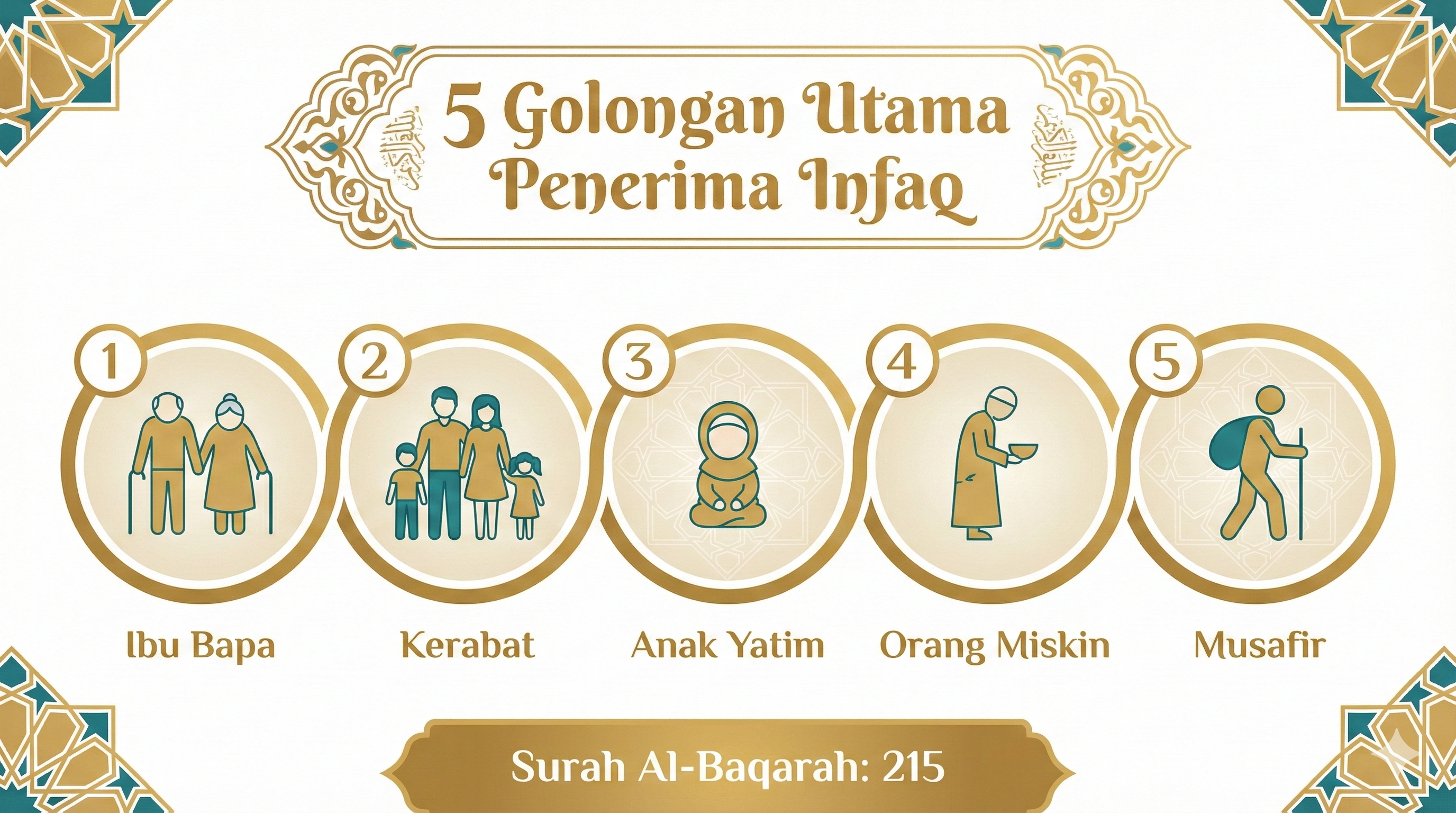
The 5 priority recipients of infaq according to Surah Al-Baqarah: 215 — parents, relatives, orphans, the poor, and travellers
Who Should Receive Infaq? Priority Order
Based on Surah Al-Baqarah verse 215 and scholarly interpretation, here is the priority hierarchy of infaq recipients:
1. Parents (الوالدين)
Parents are the most prioritised recipients. Ibn Kathir in his tafsir affirms that parents are placed first due to their immeasurable service.
2. Relatives (الأقربين)
Close family members — siblings, grandparents, uncles, and cousins who need assistance.
3. Orphans (اليتامى)
Those who have lost their father before reaching puberty and need protection and financial support.
4. The Poor and Needy (المساكين)
Those unable to meet basic life necessities — food, clothing, and shelter.
5. Travellers / Ibn Sabil (ابن السبيل)
People on a journey who have run out of supplies or money — even if they may be wealthy back home.
Additional Groups
Besides the five groups above, infaq can also be given to:
Those striving fi sabilillah — those struggling for the cause of Islam
Teachers and preachers — those spreading religious knowledge
Welfare institutions — mosques, tahfiz schools, orphanages
Those in debt — who are burdened with debts and need help
Views of Salaf Scholars on Infaq
Ibn Kathir (701-774H)
In Tafsir Ibn Kathir, he explains that verse Al-Baqarah 261 confirms Allah replaces wealth given in infaq — both in worldly and hereafter contexts. Ibn Kathir emphasises that the 700-fold reward is the starting minimum, and Allah can multiply even beyond that for those who are sincere.
Imam An-Nawawi (631-676H)
An-Nawawi in Syarah Sahih Muslim connects the hadith "Spend, and I will spend on you" with the Quranic promise of provision replacement. He affirms that Allah's promise is absolute — no exceptions for those who give infaq sincerely.
Ibn Qayyim al-Jawziyyah (691-751H)
A student of Ibn Taymiyyah, he explains that Allah multiplies wealth given in infaq beyond what was spent. In his works, Ibn Qayyim states that infaq is true proof of tawakkal — because only those who truly believe in Allah's promise are willing to part with their wealth.
Imam al-Ghazali (450-505H)
In Ihya Ulumiddin, al-Ghazali categorises infaq into several levels of sincerity:
Lowest level — giving infaq out of fear of sin (if not fulfilling zakat)
Middle level — giving infaq hoping for hereafter rewards
Highest level — giving infaq purely out of love for Allah, regardless of reward
Al-Ghazali also emphasises that stinginess (bakhil) is the most dangerous disease of the heart, and its cure is to accustom oneself to giving infaq consistently.
Imam ar-Razi (544-604H)
Ar-Razi provides an interesting analogy — he compares infaq to a guaranteed transaction. Like someone throwing goods into the ocean but having a full guarantee that they will be replaced with something better. That guarantee comes from Allah Himself, so there is no reason to doubt.
Benefits of Practising Infaq
Based on the evidences above, here are the key benefits of infaq:
Spiritual Benefits
Purification of wealth — infaq cleanses wealth from doubtful elements
Strengthening of faith — training the soul not to be overly attached to worldly matters
Angels' prayers — every morning angels pray for blessings upon those who give infaq
Expiation of sins — charity extinguishes sins like water extinguishes fire
Worldly Benefits
Increased sustenance — Allah's promise in Surah Saba' verse 39
Wealth does not decrease — hadith of the Prophet SAW in Sahih Muslim
Blessed life — peace of heart and family harmony
Protection from calamity — infaq becomes a shield from misfortune
Infaq in the Malaysian Context
In Malaysia, the practice of infaq and sedekah is facilitated through various platforms and institutions. JAWHAR (Department of Waqf, Zakat and Hajj) under the Prime Minister's Department oversees charitable collections and donations at the national level.
Additionally, digital platforms such as SedekahSini by Yayasan Ikhlas make it easy for the public to give infaq online to various verified welfare projects.
Each state also has its own Islamic Religious Council that manages the collection and distribution of infaq, zakat, and wakaf. For those who want to ensure their infaq reaches the deserving, it is recommended to channel through recognised institutions — such as MAIWP (for Federal Territory), state zakat bodies, or registered welfare organisations.
Frequently Asked Questions (FAQ) About Infaq in Islam
What is infaq in Islam?
Infaq means spending wealth in the path of Allah for goodness. It comes from the Arabic word anfaqa-yunfiqu meaning to expend or spend. Infaq encompasses both obligatory giving (zakat, maintenance) and voluntary giving (charitable donations).
What is the difference between infaq and sedekah?
Infaq and sedekah are synonyms in Islamic terminology, but infaq specifically refers to giving wealth only. Sedekah is broader — it includes non-monetary giving such as smiles, kind words, removing obstacles from the road, and helping others.
Who should receive infaq first?
According to Surah Al-Baqarah verse 215, the priority order of infaq recipients is: (1) Parents, (2) Relatives, (3) Orphans, (4) The poor, and (5) Travellers in need.
Is infaq obligatory in Islam?
Infaq is divided into two: obligatory and voluntary. Obligatory infaq includes zakat and family maintenance. Voluntary infaq is any giving beyond basic obligations, and it is highly encouraged in Islam.
How much is the reward for infaq in Allah's path?
According to Surah Al-Baqarah verse 261, the reward for infaq can reach 700 times, and even more for those whom Allah wills. The reward depends on sincerity, the quality of wealth given, and the needs of the recipient.
Can infaq be given to non-Muslims?
Yes, voluntary infaq can be given to anyone in need, including non-Muslims. This is based on the general command to do good in Islam. However, zakat (obligatory infaq) has specific recipient requirements of the 8 asnaf.
What is the proper etiquette of infaq?
Key etiquettes of infaq include: (1) Sincerity for Allah, (2) Not reminding of the giving, (3) Not hurting the recipient's feelings, (4) Giving from halal and good wealth, and (5) Giving secretly is more virtuous than publicly (unless to encourage others).
How to start giving infaq consistently?
Start with a small but consistent amount — for example RM1 per day. Set a clear intention, choose trusted channels (mosques, registered welfare bodies, digital platforms), and make it a daily routine. Imam al-Ghazali advised accustoming oneself to consistent infaq to cure the disease of stinginess in the heart.
Conclusion
Infaq is a noble practice commanded by Allah SWT through the Quran and exemplified by the Prophet SAW. It is not merely about spending wealth, but represents a manifestation of faith, trust in Allah, and compassion towards fellow human beings. The salaf scholars unanimously agree that sincere infaq will not decrease wealth — rather, it opens doors to unexpected sustenance.
Managing wealth wisely is part of every Muslim's responsibility — and the first step is having the right knowledge about finance and investment.
Open a CDS Trading Account to start investing in Shariah-compliant stocks on Bursa Malaysia and strengthen your financial management.
Download the free Stock Market Basics Ebook to understand the fundamentals of stock investment in line with Islamic principles.