Why 90% of Traders Lose Money: 5 Root Causes and One Solution

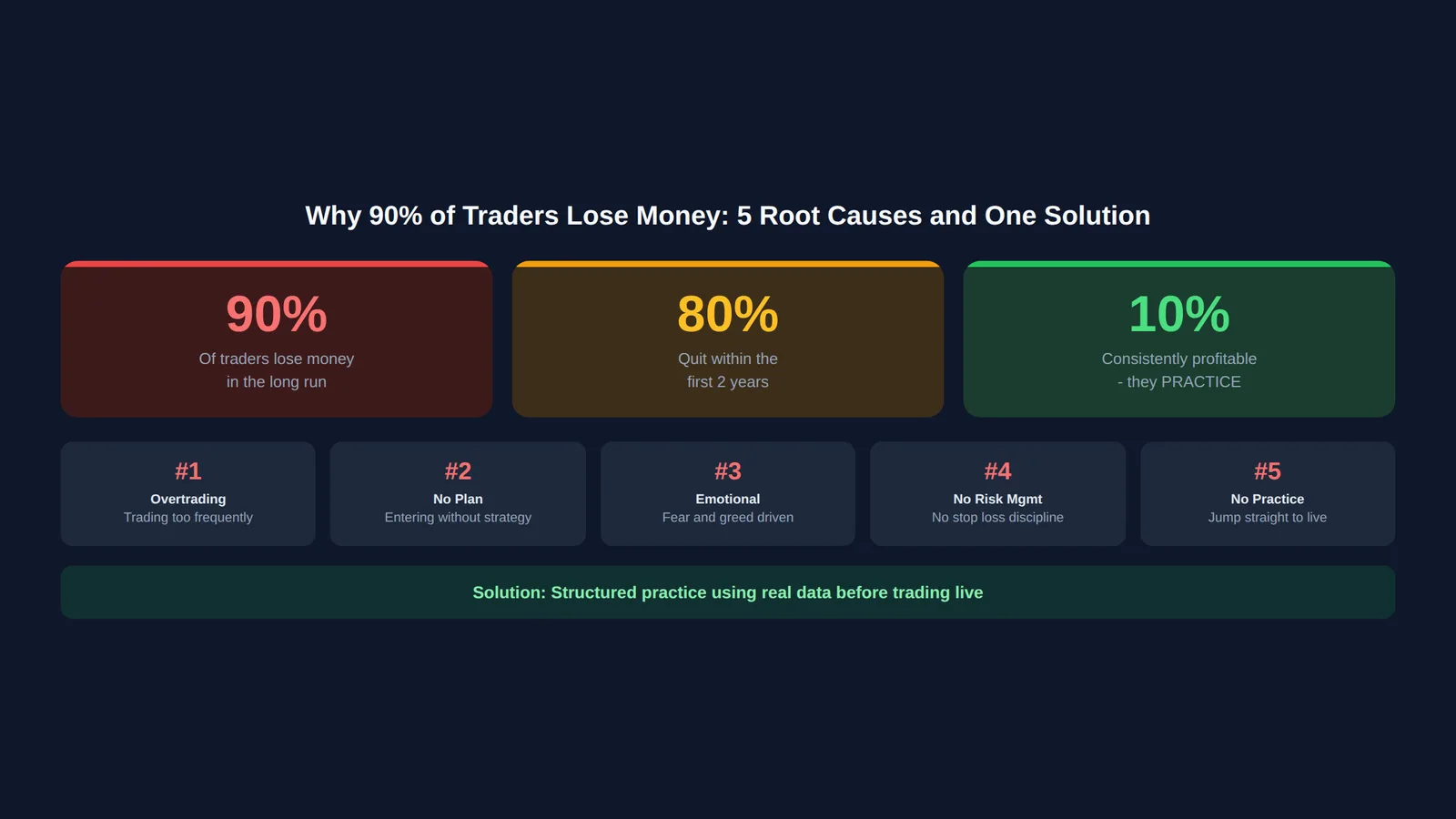
There is one statistic in the world of trading that is often repeated but rarely understood: 90% of traders lose money. This is not just a scary number meant to frighten beginners. It is a fact supported by academic research, broker data, and market regulator reports from around the world. The question is not whether this statistic is true - but why it is true, and what you can do to avoid becoming part of that 90%.
In this article, we will unpack the real data behind this number, identify the 5 root causes why traders lose money, and show how one change - disciplined practice - can move you from the losing majority to the consistently profitable minority.
The Real Statistics - How Many Traders Actually Lose?
Let us start with the data. Not opinions, not anecdotal stories - but peer-reviewed scientific research.
The landmark study by Barber and Odean (2000) from the University of California analysed 66,465 brokerage accounts between 1991 and 1996. Their findings were striking: individual investors who traded actively earned returns 6.5% lower per year compared to those who traded infrequently. The more frequently you trade, the more you lose.
Another major study in Taiwan published in the Journal of Financial Economics analysed the records of all 360,000 day traders in Taiwan over 15 years (1992-2006). The result? Over 95% of day traders lost money consistently, and less than 1% managed to generate meaningful net profits after transaction costs.
Data from European CFD brokers also confirms this pattern. Under ESMA (European Securities and Markets Authority) regulations, brokers are required to disclose the percentage of retail clients who lose money. These figures range from 74% to 89% depending on the broker.
On Bursa Malaysia itself, although detailed data is not publicly disclosed, the experience of remisiers and dealers shows a similar pattern. Many retail investors who open CDS accounts become inactive within the first 12 to 18 months - usually after experiencing discouraging losses.
So is the "90% of traders lose money" figure a myth? It is not. In fact, it may be conservative. The Taiwan study suggests the actual number may be closer to 95%.
5 Root Causes Why Traders Lose Money
If nearly all traders lose money, there must be systematic reasons - not just bad luck. After studying the data and behavioural patterns, here are the 5 root causes:
1. Overtrading - Too Many Trades
This is the number one cause. The Barber and Odean study showed a direct correlation: the higher the trading frequency, the lower the returns. Traders who made 10 trades a day generated far lower returns than those who traded 10 times a month.
Why? Every time you trade, you pay commissions, spreads, and slippage. For investors trading stocks like Gamuda or Tenaga Nasional, these costs may seem small per trade. But when accumulated over a year, they can eat up 5% to 15% of your capital.
The real cause of overtrading? Lack of practice. Traders who have not practised reading charts enough lack the patience to wait for quality setups. They trade anything that "looks like an opportunity" because they cannot distinguish a good setup from market noise.
2. No Trading Plan
Imagine a pilot flying without a checklist. Or a surgeon performing an operation without a plan. Sounds crazy, right? But this is exactly what the majority of traders do every day - they enter the market without a plan.
A complete trading plan must answer at least these four questions BEFORE you buy:
- Why are you buying this stock? (investment thesis)
- Where will you sell if you are wrong? (stop loss)
- Where will you take profit? (price target)
- How much capital are you allocating? (position sizing - read the Kelly Criterion guide for the exact formula)
Without answers to these questions, you are not trading - you are gambling. And the main reason traders do not have a plan? They have never practised creating and following such a plan in a risk-free environment.
3. Emotions Controlling Decisions
Fear and greed are the two biggest enemies of traders. According to Investopedia, loss aversion - the pain of losing money is felt twice as strongly as the joy of gaining it - is the main reason traders make irrational decisions.
What happens in practice? Your stock rises 10% and you quickly sell because you fear the profit will disappear. Your stock drops 30% and you hold because you "hope it will bounce back." This is the classic pattern described in 7 Mental Biases That Affect Stock Market Investors - and it causes traders to consistently sell winners too early and hold losers for too long.
A common example on Bursa: a trader buys Inari Amertron at RM2.80, the price rises to RM3.10 and they immediately sell. Then the price continues climbing to RM3.80. Meanwhile, another trader holds a stock that has fallen from RM1.50 to RM0.60 without cutting losses, "waiting to break even" - which may never happen.
The real cause of emotional decisions? Lack of experience under pressure. When you have never made 500 buy-sell decisions on charts, every trade feels heavy and emotional. Repeated practice builds mental resilience that reduces the impact of emotions.
4. No Risk Management
This is the silent killer. Many traders focus on "which stock to buy" but never think about "how much am I willing to lose."
Do this simple maths: if you lose 50% of your capital, you need a 100% gain just to break even. Lose 70%? You need a 233% gain. This is explained in detail in The Maths of Investment Losses Every Investor Must Know.
Risk management means:
- Never allocate more than 2-5% of capital to a single trade
- Always have a stop loss - whether mental or automatic
- Minimum risk-reward ratio of 1:2 - only take trades where potential profit is at least 2x the potential loss
Why do traders ignore risk management? Because they have never seen the consequences in practice. When you practise making decisions on hundreds of charts and see how one large loss can wipe out 10 small gains, risk management transforms from "boring theory" to "absolute necessity."
5. No Practice Before Using Real Money
This is the most fundamental cause, and it underlies all four causes above. The majority of traders jump straight into the real market with real money without any meaningful practice.
Think about other professions. Pilots train for hundreds of hours in simulators before flying real aircraft. Doctors train for years before touching their first patient. Athletes train daily for years before competing at the professional level.
But traders? Many read one or two articles about candlesticks, open a broker account, and jump straight into the market with RM10,000 in capital. When you buy stocks like Top Glove or CIMB without ever having practised reading charts and identifying setups, you are essentially "learning to drive on the highway" - the cost of mistakes is very high.
This does not mean you need years of training before starting. But you need enough practice to build the right habits - and that practice must involve real decisions on real charts, not just reading theory. If you are particularly interested in day trading, read the Day Trading Guide for Beginners to understand the basics before you start practising.
Why Practice Is the Real Solution
High-performance psychology has a concept called deliberate practice. Introduced by psychologist Anders Ericsson, this concept states that excellent performance in any field does not come from natural talent - but from thousands of hours of structured practice with immediate feedback.
According to Investopedia, deliberate practice differs from regular practice in three important ways:
- It is structured - not just "doing it many times" but focusing on specific skills
- It involves immediate feedback - you know whether your decision was right or wrong in real time
- It is progressive - the difficulty level increases as your skills improve
How does this relate to trading? A trader who practises reading charts across hundreds of scenarios before using real money builds several critical advantages:
First, pattern recognition. The human brain is extraordinary at recognising patterns - but only after sufficient exposure. After viewing 300 charts with various setups, you begin to "see" opportunities and dangers that are invisible to a trader who has only seen 20 charts.
For example, when you see a chart of Public Bank forming an ascending triangle pattern near a major resistance level, you do not need to think for long - you already know this setup from practice and know exactly where to place your entry, stop loss, and target.
Second, emotional resilience. Repeated practice builds a kind of "emotional immunity." When you have already made 500 buy-sell decisions on charts, each individual decision no longer feels heavy. It becomes a process - not an emotional event. Experienced traders do not panic when a stock drops 5% because they have already been through that scenario many times in practice.
Third, automatic discipline. Risk management and trading plans that are repeated in practice become habits. You do not need to "remember" to set a stop loss - it becomes part of your process automatically, like putting on a seatbelt before driving.
How Successful Traders Differ From Those Who Fail
If 90% of traders lose money, what does the successful 10% do differently? Studies show several consistent key differences:
They Have a Proven Edge
Successful traders do not trade randomly. They have a backtested strategy on historical data, and they know exactly what the win rate and risk-reward ratio of their strategy is. They know that if they follow their system consistently, the results will be positive in the long run.
For example, a swing trader focused on breakouts of stocks like Frontken or Dialog Group may know that their strategy produces a 45% win rate with a 1:3 risk-reward ratio. They know there will be losing trades - but overall, the system is profitable.
They Focus on Process, Not Outcomes
Failing traders judge every trade by its result: profit = good decision, loss = bad decision. This is wrong. Successful traders evaluate based on process: did I follow my plan? Did the setup meet my criteria? If yes, the trade is "good" even if it lost money - because in the long run, the right process will produce profits.
They Practise Consistently
This is the biggest difference. According to studies of professional traders at proprietary trading firms, successful traders spend 5 to 10 hours per week reviewing historical charts, testing strategies, and analysing their past trades. They do not stop practising after becoming "experts" - practice is a permanent part of their routine.
They Keep a Trading Journal
Every trade is recorded - reason for entry, reason for exit, emotions felt, mistakes made. This journal becomes a feedback tool that allows traders to identify weaknesses and improve systematically.
They Manage Position Sizes
Professional traders rarely allocate more than 2-5% of capital to a single trade. They understand that the key to success is not the occasional big winning trade, but small consistent gains that accumulate over time. Read the Kelly Criterion guide for Position Sizing for the optimal position sizing formula.
How to Start Practising Technical Analysis Today
So you know the problem: lack of practice. You know the solution: deliberate practice with immediate feedback. The next question is: how do you start?
The traditional approach - opening a demo account or paper trading - has several problems. First, it is slow. You have to wait for the market to move in real time, so gaining experience from 100 trades could take months. Second, it does not create real psychological pressure.
A more effective approach is historical chart-based practice where you make decisions on real charts - with immediate results. This is the concept behind the Chart Game on Mahersaham. For a full understanding of how it works, read the complete Chart Game guide.
The Chart Game displays real stock charts from Bursa Malaysia - without the counter name, without the date - and asks you to make a decision: Buy, Sell, or Hold? After your decision, the full chart is revealed so you can see what happened next. It is a trading simulator that provides immediate feedback - exactly what deliberate practice requires.
Why this type of practice works:
- High volume - you can make decisions on dozens of charts in a single session, compared to waiting months for one setup in the real market
- Immediate feedback - you know the result instantly, not after weeks
- No financial risk - you learn from mistakes without losing real money
- Real Bursa Malaysia charts - not fictional charts, but actual price movements that occurred in the market
- Builds pattern recognition - repeated exposure to various setups builds an intuitive ability to recognise opportunities and dangers
Traders who spend time practising on 100 to 200 charts before using real money build a far stronger skill foundation than those who dive in without practice. The difference is stark - not in theoretical knowledge, but in the ability to make fast, accurate decisions under pressure.
Frequently Asked Questions (FAQ)
Is it true that 90% of traders lose money?
Yes, and the actual figure may be even higher. A study in Taiwan showed that over 95% of day traders lost money consistently. European broker data under ESMA regulations shows 74% to 89% of retail accounts suffer losses. The "90%" figure is a conservative estimate based on multiple data sources.
How long does it take to become a consistently profitable trader?
Most professional traders take between 2 to 5 years to achieve consistency. However, this period can be shortened significantly with proper practice. Traders who practise intensively on historical charts can compress years of experience into a few months because each practice session exposes them to dozens of different scenarios.
Does technical analysis actually work?
Yes, but with an important caveat: it needs to be used as part of a complete system that includes risk management and trading psychology. Technical analysis alone does not guarantee profits - it is a tool for identifying probabilities, not certainties. Its effectiveness increases with practice and experience.
What is the difference between profitable and losing traders?
The main difference is not in the strategies or indicators used. It is in discipline, risk management, and the amount of practice. Profitable traders have a clear trading plan, manage position sizes strictly, and have built experience through hundreds or thousands of trading decisions - most of them through practice, not real money.
What is the minimum capital to start trading on Bursa Malaysia?
Technically, you can start with as little as RM100 since the minimum lot on Bursa Malaysia is 100 shares. But the more important question is not the minimum capital - but whether you have practised enough before using real money. Start with practice on the Chart Game first, then enter the market with a small amount of capital that you are willing to lose entirely.
Can I learn trading without spending money?
Yes. You can practise reading charts and making trading decisions through the Mahersaham Chart Game at no cost. You can also study charts on TradingView for free, read company annual reports on the Bursa Malaysia website, and build foundational knowledge through free resources before entering the real market.
Why is paper trading not enough as practice?
Paper trading (simulated trading with fake money) is a good starting point, but it has two major weaknesses. First, it is too slow - you have to wait for the market to move in real time. Second, it does not create the same psychological pressure as using real money. Historical chart-based practice like the Chart Game overcomes the first problem by allowing you to make dozens of decisions in a single session.
Will all traders who lose money keep losing forever?
No. Many successful traders experienced large losses at the beginning of their careers. The difference is that they stopped, reviewed their mistakes, practised systematically, and returned with a more disciplined approach. The 90% statistic describes a situation at one point in time - it is not a permanent sentence. With practice and a change in mindset, you can move from the losing majority to the profitable minority.
Conclusion
The 90% trader failure statistic is not a mystery. It is the direct result of a combination of overtrading, lack of a trading plan, emotional decision-making, neglect of risk management, and - most fundamentally - lack of practice before entering the market with real money.
The good news: all of these causes can be addressed. And the solution to all of them starts from the same place - disciplined, structured practice. When you practise making trading decisions on hundreds of real charts, you build pattern recognition, emotional resilience, and automatic discipline that separates the successful 10% from the 90% who fail.
You do not need to be a maths genius or have millions in capital to succeed in trading. You just need to practise - frequently, correctly, and with immediate feedback.
Start practising your technical analysis skills with real Bursa Malaysia charts on the Mahersaham Chart Game - free and risk-free. Every chart you practise on brings you one step closer to the consistently profitable 10%.
Open a CDS Trading Account with M+ to start investing on Bursa Malaysia, as well as US and Hong Kong stocks, when you are ready for the real market.
Download our Free Stock Market Basics Ebook to build a strong investment foundation from the ground up.