FWCMS, NIISe & Turap: Malaysia's Foreign Worker System & What It Means for Investors

Nearly 2.5 million foreign workers are currently employed in Malaysia. They are the engine behind plantation, construction, manufacturing, and F&B sectors that anchor much of the Bursa Malaysia index. Yet behind this massive labour flow, a series of digital systems - FWCMS, NIISe, and now the proposed Turap - control who can enter, in what numbers, and at what cost.
In early April 2026, parliament reignited debate over Malaysia's foreign worker management when the government was reported to be considering a new platform called Turap (Universal Recruitment Advanced Platform). The proposal is being challenged by a group of PKR MPs questioning its necessity, while the existing system vendor is defending its track record.
For Bursa Malaysia investors, this debate isn't just political theatre - it's a governance issue that can directly touch labour costs, corporate margins, and supply chain stability across some of the largest sectors of the local index.
Three Acronyms, One Labour Market
Before diving in, you need to understand the difference between these three systems. Each has a different scope, purpose, and operator:
FWCMS (Foreign Workers Centralised Management System) - The centralised foreign worker management system used by the Ministry of Human Resources (KESUMA) since 2018. It handles documentation, health screening, and work permit administration. FWCMS was developed and is operated by Bestinet Sdn Bhd, a private company.
NIISe (National Integrated Immigration System) - The integrated immigration system being developed by the Malaysian Immigration Department. NIISe's scope is broader than FWCMS - it covers all entries and exits, not just foreign workers. Phased implementation began in 2026 with full operations expected by 2028. The MyNIISe mobile app is designed for travellers.
Turap (Universal Recruitment Advanced Platform) - The proposed platform to handle foreign worker recruitment from upstream - from employer applications and worker matching through to pre-clearance. It would not replace FWCMS, NIISe, or MyIMMS, but instead operate at a different layer. Status: still under policy discussion and not yet approved.
This arrangement means - in theory - all three systems can coexist. But that's part of the debate: does Malaysia need an additional platform when NIISe itself isn't fully stable yet?
What the Audits Actually Found About FWCMS
To understand why the Turap proposal invites skepticism, you need to look at FWCMS's operational history - and these are not political claims, but official findings from oversight institutions:
First, the system ran without a written contract for six years. According to a Sinar Harian report, the Public Accounts Committee (PAC) found that FWCMS was used from January 2018 to May 2024 based only on a letter of agreement, without a formal signed contract between the government and the vendor.
Second, system access controls had serious gaps. The 2022 Auditor General's Report identified two super admin IDs held by officers outside KESUMA, plus 24 unauthorised users who approved 24 employer applications - a weak internal control for a system managing millions of workers.
Third, the new contract extension is estimated to cost the government a minimum of RM3.2 billion. After negotiations, the government renewed the FWCMS contract until 31 January 2031 - a six-year extension. The per-permit fee increased from RM100 to RM215, prompting PAC questions about value for money. Bestinet has rejected the RM3.2 billion cost interpretation, calling the PAC report's framing inaccurate.
Fourth, PAC held eight hearings between December 2023 and February 2025 - a series that reflects the complexity and importance of the issue. PAC, alongside the Auditor General, ultimately recommended that the government formalise a written contract with Bestinet for FWCMS - resolving the governance gap that had persisted since 2018.
For investors, these findings matter not because they involve a particular company, but because they reveal a pattern: critical government infrastructure operated by a single private vendor for years, without a formal contract and with weak internal controls. This is the same governance issue that credit rating agencies use to assess sovereigns.
Industry Scale: Why Investors Need to Track This
Investors who follow only political headlines may miss the actual size of this market. Some key numbers:
As of 30 September 2024, the Malaysian Immigration Department registered 2,470,781 foreign workers legally working in the country. The peak in October 2023 reached 2.7 million. The government's target is to gradually reduce this to 2.4 million - but no country has fully replaced this labour with locals in the short term.
Sector distribution (Department of Labour data, as of 2023):
- Manufacturing: 24% foreign workers as a share of sector workforce
- Construction: 17%
- Other services: 11%
- Plantation & agriculture: highest concentration at specific sites - some palm oil plantations operate with over 70% foreign labour
This means any disruption to the recruitment system - whether documentation delays, quota changes, or fee hikes - directly touches operating costs and project completion schedules.
Sector Implications: Which Stocks Are Most Exposed
For Bursa Malaysia investors, here's a map of sectors most sensitive to any change in foreign worker policy:
Plantation Sector
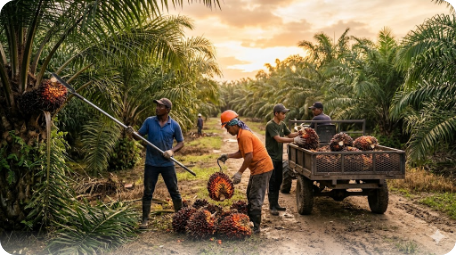
Labour cost is the largest component of palm oil production cost after fertiliser. Major companies like Sime Darby Plantation, IOI Corporation, Kuala Lumpur Kepong (KLK), Genting Plantations, FGV Holdings, and Kim Loong Resources operate with thousands of foreign workers - mostly from Indonesia. Any disruption to entry flow (whether from policy or system delays) directly impacts the average crude palm oil (CPO) yield per hectare. Investors who follow the FCPO market know that supply tightness can move prices significantly.
Construction Sector
If you hold Sunway Construction, Gamuda, IJM Corporation, WCT Holdings, Mudajaya, or Pintaras Jaya, you're exposed to foreign labour costs that cannot be avoided. Industry surveys show some construction sites operate with nearly 90% foreign labour. The proposed Sunway acquisition of IJM itself is set against a Malaysian construction landscape still heavily reliant on Bangladeshi, Nepali, and Indonesian workers.
Manufacturing & Glove Sector
Despite increasing automation, rubber glove makers like Top Glove, Hartalega, and Kossan still depend on foreign workers for large-scale production. Semiconductors and electronics are similar. Any tightening of the levy structure (see next section) directly affects their EBITDA margins.
F&B & Hospitality Sector
Companies like Heineken Malaysia, Carlsberg, Nestlé, and Fraser & Neave have indirect exposure through production and distribution networks. Hospitality and food services broadly rely on foreign workers in front-line operations.
Levy Structure: What Employers Actually Pay
Beyond system charges (FWCMS at RM215 per permit), employers carry foreign worker levies that vary by sector and zone. Based on rates from the Department of Labour Peninsular Malaysia (JTKSM):
Peninsular Malaysia (annual rates):
- Manufacturing, Construction, Services: RM1,850
- Plantation & Agriculture: RM640
- Domestic helpers: RM410
Sabah & Sarawak:
- Services: RM1,490
- Manufacturing & Construction: RM1,010
- Plantation: RM590
- Agriculture & Domestic helpers: RM410
In 2025, the government began rolling out the Multi-Tier Levy Mechanism (MTLM) - a tiered levy system that progressively scales up based on the number of foreign workers in a company. Goal: reduce dependence on foreign labour and encourage automation. Plantation and agriculture sectors are exempt for now.
For investors, MTLM means labour costs will continue to rise for companies with large foreign worker shares. This needs to feed into your margin projection models - especially for companies in construction and manufacturing.
Why the Turap Proposal Invites Skepticism
Back to the new proposal. On 16 April 2026, Bloomberg reported that the government is planning to roll out the Turap platform to handle pre-permit recruitment - with the same vendor that runs FWCMS.
A group of nine PKR MPs, led by former Economy Minister Datuk Seri Rafizi Ramli, pushed back against the proposal on several grounds: 1. NIISe under development already includes a foreign worker management module - no need for an additional system. 2. Granting a new contract to the existing vendor would extend the monopoly of critical infrastructure to a single private company. 3. PAC findings on FWCMS have not been fully resolved - expanding scope before governance issues are fixed is risky.
The system vendor and government counter: 1. Turap is being built to complement, not replace FWCMS, NIISe, or MyIMMS. 2. More than 40 years of recruitment industry experience cannot be rebuilt from scratch. 3. FWCMS has helped eliminate billions in leakage to informal intermediaries.
Both sides are now in legal proceedings, including letters of demand and defamation suits. For investor analysis purposes, you don't need to determine who's right - it's enough to understand that Malaysia's foreign worker policy is now in a phase of serious regulatory uncertainty.
What Investors Should Track
Beyond following the news drama, here are five action points relevant to your investment decisions:
1. Full PAC Outcome + Follow-Up Action
The PAC report is out; the question now is whether its recommendations will translate into concrete policy action. Any structural resolution to FWCMS will signal to the market how seriously the government is addressing governance issues.
2. Turap Status (Approved, Deferred, or Rejected)
If approved, investors need to understand that new system costs will be passed to employers - and indirectly to listed company margins. If rejected, NIISe will become the primary system for the next phase.
3. MTLM Impact on Your Sector
Check what percentage of your portfolio companies' workforce is foreign. For manufacturing and construction firms with high exposure, MTLM will progressively add structural costs. Look at the "labour costs" segment in annual reports - it should be a line item in your cash flow statement analysis.
4. Corporate Automation Plans
Companies that announce serious automation plans (not just lip service) stand to multiply their margins as labour costs rise. Track capex in quarterly reports for signs of commitment.
5. Single Vendor Risk
The biggest investor takeaway from the FWCMS saga is this - when one private company controls critical government infrastructure, policy changes can occur drastically and unpredictably. This raises regulatory risk for the entire sector dependent on that system. When reading sector PE ratios, factor regulatory exposure into your valuation.
FAQ: Frequently Asked Questions on Malaysia's Foreign Worker System
1. What's the difference between FWCMS, NIISe, and Turap?
FWCMS is the existing work permit management system (since 2018) under the Ministry of Human Resources. NIISe is the broader integrated immigration system (covering all entries/exits) being phased in through 2028. Turap is the proposed recruitment platform that would operate at the upstream stage, before permits are issued - status: not yet approved.
2. Will FWCMS be abolished?
Not in the near term. The FWCMS contract has been extended until 31 January 2031. What may change is module enhancement, integration with NIISe, or addition of supplementary platforms like Turap.
3. How much does the system cost employers?
The FWCMS system charge alone is RM215 per permit (up from RM100 before the contract extension). On top of that, employers pay annual levies that vary by sector - from RM410 (domestic helpers) to RM1,850 (manufacturing/construction/services in Peninsular Malaysia).
4. How does this issue connect to the stocks I hold?
If you hold stocks in plantation, construction, manufacturing, or services sectors (especially F&B and hospitality), labour costs depend significantly on foreign worker policy and systems. Changes to system fees, levy structure, or permit procedures can directly impact operating margins.
5. What is the Multi-Tier Levy Mechanism (MTLM)?
MTLM is a tiered levy system being phased in from 2025. Levies will progressively rise based on the number of foreign workers in a company - employers with high foreign worker ratios will pay higher rates. Goal: encourage automation and local employment.
6. What's the biggest risk in this issue for investors?
The main risk is policy uncertainty. If the system is reversed, expanded, or drastically altered, companies that rely on stable foreign worker flows may face operational delays or cost spikes before they can adapt.
7. Should investors sell stocks in affected sectors?
Not necessarily. What matters more is understanding the exposure and pricing this risk into your holding decisions. Companies with concrete automation plans, workforce diversification, or more efficient cost structures stand to outperform peers more dependent on foreign labour.
Conclusion
Malaysia's foreign worker management system is in a major transition - with three different systems (FWCMS, NIISe, and possibly Turap), significant audit findings, and unresolved policy questions. For Bursa Malaysia investors, this isn't an abstract political issue; it's a governance factor that directly touches several of the largest sectors in the local market.
What matters isn't predicting who will win the current dispute, but building a monitoring framework that allows you to adjust your portfolio as policy clarity emerges.
To start investing in companies in affected sectors and to monitor your portfolio's exposure to labour-sensitive industries, you'll need access to the stock market first.
Open a CDS account with Mahersaham to start investing in Bursa Malaysia and overseas stocks like the US and Hong Kong.
For beginners who want to understand investing fundamentals before getting started, download our free Stock Market Basics Ebook.
Further Reading
- Sunway's RM11 Billion Bid for IJM: Full Timeline & Decision Day
- Moody's Downgrades Indonesia Credit Outlook to Negative: Governance Issues at the Core
- PE Ratio: How to Tell if a Stock is Cheap or Expensive by Sector in Malaysia
- Cash Flow Statement: Tracking the Real Performance of Bursa Malaysia Companies
- FCPO: Complete Guide to Crude Palm Oil Trading in Malaysia